The Call of the Motherland: Why a Hilot Binabaylan Initiation Must Happen on Philippine Soil

There is a profound difference between learning the mechanics of a tradition and awakening its soul.

In the global diaspora, the revival of traditional Filipino medicine has sparked a beautiful wave of interest. Across the United States, Europe, and beyond, seekers are gathering in classrooms and studio spaces to reclaim their ancestral roots. They study anatomy, practice stroke sequences, and discuss indigenous cosmology.

But for those walking the path of the Hilot Binabaylan—the traditional healer, seer, and keeper of elemental balance—there comes a crossroad where book-learning and intellectual cohorts are no longer enough. To fully step into this sacred calling, one must eventually answer the call of the motherland.

An initiation integrated into a sacred pilgrimage to the Philippines transforms a practitioner in ways that a diaspora training cohort simply cannot replicate. Here is why crossing the ocean to be initiated on ancestral soil changes everything.

The Anatomy of the Craft: Technical Training vs. Spiritual Transmission

To understand the difference, we must look at how Hilot is fundamentally structured. It is not just an indigenous massage modality; it is a relational, animistic science.

  • Training in the Diaspora focuses primarily on the intellectual and technical dimensions. You learn how to touch, how to scan for energetic imbalances (salat), and the names of traditional concepts. It is safe, structured, and profoundly necessary for building a foundational framework.
  • Initiation in the Philippines is a spiritual and lineage transmission. It shifts the practice from something you do with your hands to a state of being that you embody. You are no longer just practicing a technique; you are being formally introduced to, and accepted by, the unseen world that governs the tradition.

1. Lupa (The Living Land) as the First Teacher

In the Western framework, nature is often viewed as a backdrop or a resource. In the world of the Binabaylan, the land (lupa) is a conscious, sentient entity.

[Diaspora Cohort] -------------> Simulates elements inside a climate-controlled room
[Motherland Pilgrimage] -------> Aligns your heartbeat directly with the island's pulse

When you stand barefoot on the soil of sacred mountains like Mount Banahaw or Mount Makiling, your personal energy field interacts with the literal geomagnetic and spiritual currents (bisa) of the islands. You cannot truly master how to balance the fire, water, air, and earth elements within a human body if you have never communed with those same elements in their native, raw, and untamed habitat. The motherland itself is the primary initiator.

2. Legal Tender in the Spirit Realm: Activating your Gabay

In the Binabaylan tradition, a healer’s efficacy does not come from their own ego or strength; it comes from their gabay (spiritual guides, ancestors, and nature spirits).

An initiation performed at a puwesto (a naturally occurring sacred site, such as a hidden cave or a holy waterfall) acts as a formal contract. You are presenting yourself at the doorstep of the ancestors. When you are initiated on Philippine soil:

  • The local spirits (mga elemento) recognize your face, your lineage, and your intent.
  • The ancestral portal opens wide because you are standing in the exact geography where those ancestors lived, prayed, and poured their medicine into the earth.
  • Your spiritual authority is legitimized in the unseen realm, anchoring your healing work back home with a permanent, unbreakable root system.

3. Pagpupurga: Breaking the Intellectual Ego

Training cohorts in America or Europe are culturally shielded. They fit neatly into weekends, offer comfortable accommodations, and protect the intellectual ego.

A pilgrimage-based initiation in the Philippines is intentionally raw, visceral, and volatile. It demands physical sacrifice:

  • Trekking through dense, humid jungles.
  • Enduring the disorientation of tropical climates.
  • Bathing in freezing mountain springs at dawn.
  • Sitting in the pitch-black womb of holy caves.

This physical intensity triggers pagpupurga (a deep spiritual and emotional purge). It shatters the westernized, intellectual need to “understand” everything logically, forcing the initiate entirely out of their head and into their absolute intuition. You do not just learn Hilot; you survive the very landscape that birthed it.

4. The Power of Panata: The Annual Return of the Masters

For the most powerful and revered healers, a pilgrimage to the homeland is never a “one-and-done” trip. It transforms into an lifelong panata—a sacred, non-negotiable vow and pact made with the divine and the spirits of the land.

[Amulet/Healer] -------------> Daily Practice (Drains Energy) -------------> [Home]
^ |
|__________________ Annual Panata Recharges Birtud <________________________|

The spiritual medicine of a Binabaylan is like a living battery. Every time a healer pulls pain out of a patient, absorbs spiritual density, or manipulates heavy energy, their internal store of bisa (potency) drains. To combat this, master healers return to these exact same Philippine power points year after year.

By fulfilling their annual panata, healers:

  • Renew their sacred vow of service in front of the ancestors, keeping their ego small and their channel pure.
  • Empower and amplify their healing gifts, absorbing the fresh, wild elemental currents that can only be found during highly specific spiritual seasons (like Holy Week/Lenten season).
  • Recharge their talismanic tools. A master healer’s anting-anting or birtud (healing amulets) must be bathed in the waters of the sacred springs annually to keep their protective frequencies alive.

The panata ensures that the healer does not burn out, but instead grows more potent with each passing year.

5. Harvesting the Raw Birtud (Spiritual Potency)

A Hilot Binabaylan relies heavily on the physical materials of the earth to anchor their spiritual work. During a pilgrimage initiation, you are not buying pre-made supplies; you are participating in their creation.

You learn to ask permission from the forest before harvesting fresh, endemic medicinal plants (halamang gamot). You gather coconut oil (langis) brewed over open fires at precise astrological or spiritual times, imbuing it with a high vibrational charge. If you carry amulets or talismans (anting-anting or birtud), initializing them at a high-vibrational Philippine power center permanently anchors their protective frequencies.

Dimension of GrowthThe Diaspora Cohort ExperienceThe Motherland Initiation Pilgrimage
Primary EnvironmentSafe, climate-controlled, familiarRaw, unpredictable, spiritually alive
Learning StyleCognitive, theoretical, structuralExperiential, visceral, ancestral
Lineage ConnectionConceptualized through text and teachersFelt directly through the dirt, water, and spirits
Sacred CommitmentEnds when the training module concludesBecomes an ongoing panata (annual vow)
The ResultA well-trained practitioner of HilotAn initiated vessel for the Binabaylan tradition

The Ultimate Convergence

To choose the motherland is not to diminish the beautiful work being done by diaspora teachers. Diaspora cohorts are vital—they are the welcoming gates, the community builders, and the keepers of safety. They give you the map.

But a pilgrimage to the Philippines is the journey itself.

If you feel a deeper tug in your chest when you practice Hilot, if your hands feel warm but your spirit feels restless, it is because your lineage is calling you back to the source. Go to the diaspora cohorts to learn the alphabet of your ancestors. But come home to the Philippines to write the poetry of your sacred calling—and begin the lifelong panata that will sustain your medicine forever.

Coming Home Through Hilot: Why Learning Hilot in the Philippines is More Than Just a Training Program

Since 2016, Hilot Academy of Binabaylan has welcomed students from different parts of the world, particularly Filipino-Americans, Filipino-Canadians, and Filipinos living in Europe, Australia, and other countries. Many of them travel thousands of miles back to the Philippines to participate in our Hilot Binabaylan Training Program.

When asked why they choose to study Hilot, their answers often reveal a deeper journey than simply learning traditional healing techniques.

Their response is usually the same:

“I want to reconnect with my Filipino roots.”

For many of these students, they are already second, third, or even fourth-generation Filipinos born and raised outside the Philippines. Their grandparents may have been the first generation to migrate, while they themselves grew up in countries where Filipino culture was often left behind in the pursuit of assimilation.

Many share stories of growing up without speaking Tagalog, Kapampangan, Ilocano, Cebuano, or the languages of their ancestors. Some recall being discouraged from bringing Filipino food to school because they feared being teased or bullied. Others remember feeling different because of their family traditions and eventually choosing to hide parts of their Filipino identity in order to fit into the society around them.

As adults, however, a powerful question begins to emerge:

“Who am I, and where do I come from?”

For many, the search for that answer leads them back to the Philippines—and eventually to Hilot.

Hilot as a Journey of Cultural Reconnection

At Hilot Academy of Binabaylan, we understand that our students are not simply enrolling in a training course.

They are embarking on a journey home.

While they come to learn Hilot as a traditional healing art, they also come seeking connection—with their ancestors, their heritage, their identity, and the living culture of the Filipino people.

That is why our training is intentionally designed as more than a classroom experience.

From the moment our students arrive at the airport, they are greeted not as customers, but as family.

We personally welcome them, assist them in settling into their accommodations, and ensure that they feel safe, comfortable, and cared for throughout their stay.

Every morning, students are picked up and brought to the training center where we begin the day together, often sharing breakfast before classes start.

These seemingly simple moments are among the most meaningful.

Because in Filipino culture, meals are never just about food.

They are about relationship.

The Filipino Way of Learning

Around the breakfast table, conversations naturally unfold.

Stories are shared.

Questions are asked.

Experiences are exchanged.

Laughter fills the room.

Without realizing it, students begin participating in one of the oldest educational traditions of the Philippines: oral transmission of knowledge.

Long before modern schools existed, wisdom was passed from generation to generation through storytelling, observation, demonstration, mentorship, and shared experiences.

This remains at the heart of how traditional Manghihilot learned their craft.

At Hilot Academy of Binabaylan, we continue this tradition through a blended learning approach that combines:

  • Oral teachings and storytelling
  • Physical demonstrations of healing techniques
  • Hands-on practical training
  • Field experiences
  • Reading materials and learning resources
  • Reflection and cultural immersion

Students do not merely memorize information.

They experience it.

They live it.

They become part of it.

Experiencing Filipino Hospitality

One of the most memorable aspects of the program is experiencing genuine Filipino hospitality.

Students are welcomed into an atmosphere where they feel at home.

Meals are shared together just as they would be in a Filipino household.

Breakfast may include:

  • Freshly brewed coffee
  • Pandesal
  • Sinangag
  • Eggs
  • Longganisa
  • Tocino
  • Tomatoes and cucumbers
  • Tuyo and other traditional dishes

We also make every effort to accommodate dietary requirements and food sensitivities.

Whether students are vegan, vegetarian, gluten-free, or have specific dietary needs, we prepare meals that support their health and well-being while still allowing them to enjoy the richness of Filipino cuisine.

These meals become opportunities to build friendships, cultural understanding, and lifelong connections.

Many graduates tell us that the relationships they formed during training became just as valuable as the healing techniques they learned.

Learning Hilot in the Place Where It Was Born

One question often arises:

Why travel all the way to the Philippines when Hilot training can be offered overseas?

The answer is simple.

Because authenticity matters.

Hilot is not merely a technique.

It is a living cultural tradition shaped by the environment, history, spirituality, values, and everyday life of the Filipino people.

While Hilot can certainly be taught abroad, there are dimensions of learning that can only be fully experienced in the Philippines.

For nine days, students are immersed in the living reality of Filipino life.

They observe how communities interact.

They experience local customs.

They witness the resilience, warmth, humor, and hospitality that characterize the Filipino spirit.

This cultural immersion becomes an essential part of understanding Hilot itself.

Beyond the Classroom: Discovering Everyday Filipino Life

During their stay, students experience the Philippines not as tourists, but as temporary members of the community.

They ride tricycles.

They walk through bustling public markets.

They visit neighborhood sari-sari stores.

They observe daily life unfolding around them.

Many discover simple joys they had never experienced before:

  • Eating fishballs after class
  • Trying kwek-kwek and tokneneng from a street vendor
  • Enjoying a warm bowl of lugaw or goto
  • Sharing mami and pares with friends
  • Tasting authentic bulalo, sisig, papaitan, and other regional specialties
  • Visiting local communities and interacting with ordinary Filipinos

For many overseas Filipinos, these experiences become deeply emotional.

What may seem ordinary to locals often becomes extraordinary to someone discovering their heritage for the first time.

The Value of the Filipino Siesta

Many international students are surprised when they encounter another uniquely Filipino practice: the siesta.

Rather than viewing rest as wasted time, students begin to appreciate the Filipino understanding of balance, community, and well-being.

Within the context of Hilot, this becomes an important lesson.

Healing is not simply about treating physical discomfort.

Healing is also about living in harmony with one’s body, community, and environment.

Learning to slow down becomes part of the curriculum itself.

Your Tuition Creates a Positive Community Impact

Many people ask whether traveling to the Philippines for training is worth the investment.

Our answer is an emphatic yes.

The value of the experience extends far beyond the training certificate.

The tuition and expenses associated with the program create meaningful economic opportunities for many people.

When students come to the Philippines, they support:

  • Local transportation providers
  • Hotels and guesthouses
  • Small restaurants
  • Food vendors
  • Market vendors
  • Farmers and suppliers
  • Training staff
  • Traditional healers and cultural educators
  • Community-based businesses

Each student contributes directly to the local economy.

Their investment supports Filipino families and helps preserve indigenous knowledge systems that might otherwise disappear.

In this way, studying Hilot becomes an act of cultural preservation and community empowerment.

More Than a Training Program—A Return to Identity

At the end of the nine days, graduates leave with far more than a set of healing techniques.

They leave with memories.

They leave with friendships.

They leave with stories.

Most importantly, they leave with a renewed understanding of who they are.

For many overseas Filipinos, learning Hilot in the Philippines provides something they have been searching for their entire lives:

A sense of belonging.

A connection to ancestry.

A living relationship with Filipino culture.

And a deeper appreciation for the wisdom of their forebears.

An Invitation to Come Home

If you are a Filipino living overseas and have ever felt curious about your heritage, your roots, or the healing traditions of your ancestors, we invite you to join us.

The Hilot Academy of Binabaylan is not simply offering a course.

We are offering an opportunity to come home.

Come learn the healing arts of your ancestors.

Come experience authentic Filipino hospitality.

Come share meals, stories, and laughter with new friends.

Come discover the Philippines not as a tourist, but as family.

Because sometimes, the journey toward healing begins with remembering where you came from.

Hilot Academy of Binabaylan
Preserving Filipino Healing Wisdom. Reconnecting Filipinos to Their Roots. Transforming Tradition into Living Practice.

Beyond Tuition: Understanding the True Value of Formation at Hilot Academy of Binabaylan

Why our programs are not ordinary training courses, and why we intentionally describe them as formation pathways in Indigenous Filipino Healing Arts and Sciences.

More Than a Course

One of the questions we occasionally receive at Hilot Academy of Binabaylan is:

“Why do some of your certification programs cost more than typical wellness or vocational training courses?”

It is a fair question.

To answer it honestly, we must first explain what Hilot Academy of Binabaylan is—and what it is not.

Hilot Academy of Binabaylan is not a conventional vocational school. It is not merely a massage training center. It is not a weekend workshop provider. Rather, it is an educational ministry dedicated to the preservation, transmission, and advancement of Indigenous Filipino Healing Arts and Sciences through structured formation, mentorship, cultural stewardship, and community service.

The programs offered by the Academy have been carefully developed over many years by Apu Adman (Rev. Rolando Gomez Comon), Lakay Magbaya, and Bahay SiAdtala Binabaylan through research, field experience, curriculum development, community engagement, and actual healing practice.

When students enroll, they are not simply purchasing classroom hours.

They are investing in a living tradition.

What Is a Formation Program?

In many ways, our educational model resembles that of a seminary, traditional apprenticeship, lineage school, or indigenous knowledge institution.

A formation program aims not only to teach information, but also to cultivate:

  • Knowledge
  • Competence
  • Character
  • Ethics
  • Cultural responsibility
  • Spiritual maturity
  • Community leadership

Our students are guided through a progression of learning experiences that prepare them to serve as practitioners, cultural advocates, mentors, and ministers within their communities.

This is why we often describe our programs as formation pathways rather than short courses.

The Value of Lineage-Based Education

One of the most significant aspects of our programs is direct mentorship.

Students receive instruction from teachers who have spent decades studying, preserving, teaching, and practicing Indigenous Filipino Healing Arts.

The Academy’s educational framework is rooted in:

  • Indigenous Filipino healing knowledge
  • Traditional diagnostic systems
  • Hilot practices
  • Herbal traditions
  • Spiritually informed healing methodologies
  • Contemporary educational standards
  • Ministry formation

This form of education cannot be measured solely by the number of hours spent in a classroom.

Students are granted access to accumulated knowledge, experience, methodology, curriculum, and mentorship developed over many years.

In other words, they gain access to intellectual property, living tradition, and practical wisdom that cannot be obtained from books alone.

Understanding the Cost Structure of Year 1 and Year 2

Some prospective students notice that the Certificate in Magtatawas and Certificate in Hilot Manggagamot have higher fees than later levels.

This is intentional and reflects the actual costs of delivering these immersion experiences.

Unlike many online learning programs, the first two certifications require intensive face-to-face instruction and practical training.

Program fees help cover:

  • In-person teaching
  • Direct mentorship
  • Clinical supervision
  • Practical assessments
  • Training materials
  • Hotel accommodation
  • Daily meals
  • Local transportation
  • Airport pickup and airport send-off services
  • Transportation between accommodations and training venues
  • Administrative support services

These certifications function similarly to residential immersion programs rather than ordinary classroom-based courses.

Students are not simply attending lectures; they are participating in a comprehensive learning environment designed to maximize personal guidance, skill development, and practical competency.

Why Year 3 and Year 4 Have Different Pricing

The Certificate in Albularyo and Certificate in Hilot Mandadalumat are delivered through a different educational model.

These programs are primarily conducted through:

  • Google Meet
  • Google Classroom
  • Modular learning
  • Self-paced study
  • Guided assignments
  • Scheduled mentorship sessions

Because students are no longer incurring accommodation, food, transportation, and intensive logistics costs, the overall program fees are lower.

However, students continue to receive access to:

  • Proprietary curriculum
  • Learning resources
  • Mentorship
  • Assessment
  • Academic supervision
  • Ecclesiastical recognition
  • Certification services

The value remains significant, even though the delivery model changes.

What Students Are Really Paying For

A common misconception in education is that tuition should be determined solely by contact hours.

In reality, students invest in much more than classroom time.

At Hilot Academy of Binabaylan, students are investing in:

Intellectual Property

The educational materials, frameworks, methodologies, and curriculum developed by:

  • Apu Adman
  • Lakay Magbaya
  • Bahay SiAdtala Binabaylan

Mentorship

Direct guidance from experienced practitioners and tradition bearers.

Cultural Preservation

Participation in the continuation and preservation of Indigenous Filipino healing traditions.

Professional Formation

Preparation for service as practitioners, educators, ministers, and cultural advocates.

Ecclesiastical Recognition

Programs are integrated within a broader ministerial and educational framework that supports lifelong learning and professional development.

Community Membership

Students become part of a growing network of practitioners in the Philippines and around the world.

A Ladderized Journey of Growth

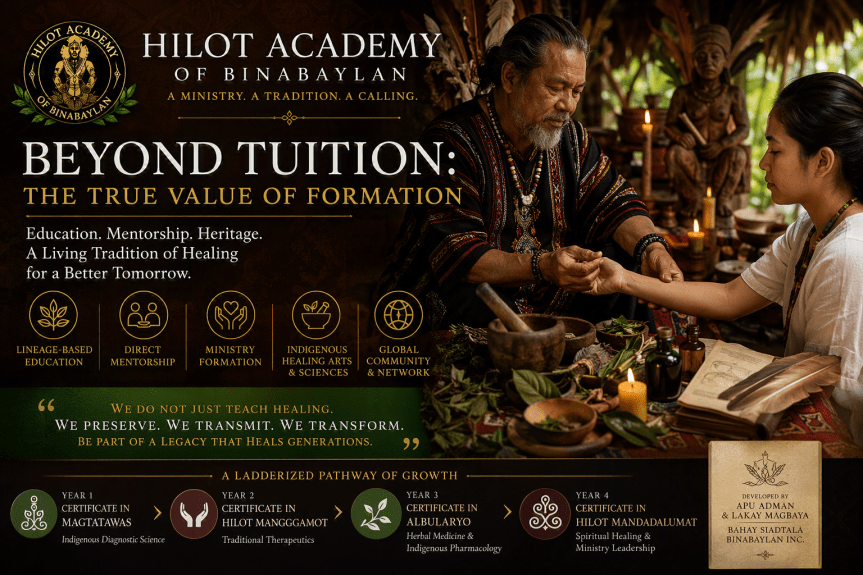
The Academy’s certification pathway follows a progressive educational structure:

Year 1

Certificate in Magtatawas

Students develop foundational skills in diagnosis, assessment, and indigenous healing sciences.

Year 2

Certificate in Hilot Manggagamot

Students advance into therapeutic interventions, rehabilitative techniques, and traditional treatment methodologies.

Year 3

Certificate in Albularyo

Students explore herbal medicine, indigenous pharmacology, ethnobotany, and community-based healing practices.

Year 4

Certificate in Hilot Mandadalumat

Students study advanced spiritual healing, indigenous metaphysics, ministry formation, and community healing leadership.

Together, these certifications form a comprehensive pathway toward mastery in Indigenous Filipino Healing Arts and Sciences.

Our Commitment to Excellence

Our goal has never been to become the largest training provider.

Our goal is to remain faithful to our mission:

To preserve, transmit, and cultivate Indigenous Filipino Healing Arts and Sciences through quality education, responsible mentorship, ethical practice, and cultural stewardship.

For this reason, we invest heavily in curriculum development, student support, practical training, and meaningful mentorship.

The fees associated with our programs reflect the resources required to sustain this mission while ensuring that students receive an authentic, transformative, and professionally guided educational experience.

A Final Reflection

When evaluating the cost of education, we invite prospective students to ask a different question.

Instead of asking:

“How many hours of instruction am I receiving?”

Consider asking:

“Who am I becoming through this learning journey?”

At Hilot Academy of Binabaylan, we believe the true value of education lies not only in knowledge acquired but in transformation achieved.

Our students do not simply complete courses.

They enter a lineage, embrace a calling, preserve a heritage, and become stewards of Indigenous Filipino Healing Arts for future generations.

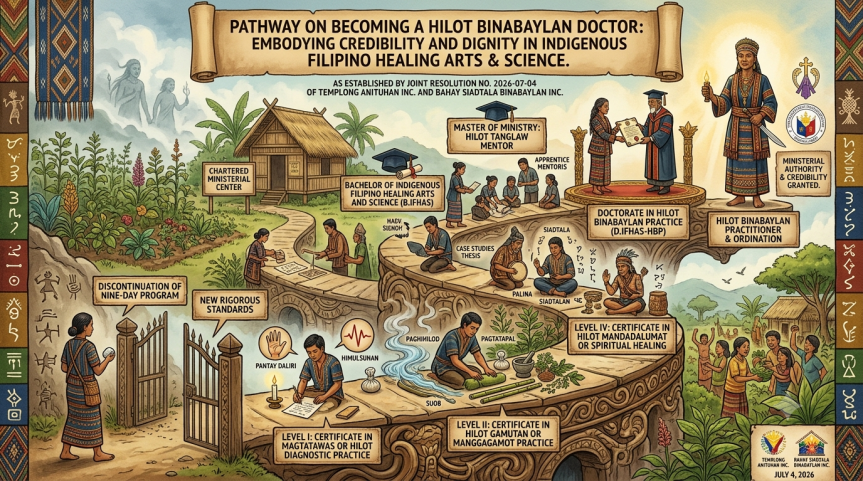
JOINT RESOLUTION NO. 2026-07-04: A JOINT RESOLUTION OF THE BOARD OF TRUSTEES OF TEMPLONG ANITUHAN INC. AND BAHAY SIADTALA BINABAYLAN INC. ESTABLISHING A NEW EDUCATIONAL, PROFESSIONAL, AND MINISTERIAL FRAMEWORK FOR HILOT BINABAYLAN PRACTICE; DISCONTINUING THE NINE-DAY INITIATORY PRACTITIONER PROGRAM; ELEVATING THE STANDARDS FOR PROFESSIONAL RECOGNITION; AND SAFEGUARDING THE INTEGRITY, DIGNITY, AUTHENTICITY, AND FUTURE OF INDIGENOUS FILIPINO HEALING ARTS AND SCIENCES.

WHEREAS, Templong Anituhan Inc. and Bahay SiAdtala Binabaylan Inc. are institutions dedicated to the preservation, promotion, protection, cultivation, and transmission of Indigenous Filipino Spirituality, Indigenous Filipino Healing Arts and Sciences, and the sacred traditions collectively known as Hilot Binabaylan Practice;

WHEREAS, Hilot Binabaylan Practice represents a holistic Indigenous Filipino system of healing that addresses the physical, emotional, mental, social, cultural, environmental, and spiritual dimensions of human life;

WHEREAS, the Founders and Trustees recognize their sacred duty as custodians, stewards, and guardians of the teachings, principles, practices, ethics, and heritage of Hilot Binabaylan Practice for present and future generations;

WHEREAS, it has come to the attention of the Trustees that certain individuals pursue enrollment in Hilot Binabaylan programs primarily for the acquisition of titles, credentials, ranks, and recognition without demonstrating a commitment to actual practice, community service, continuing education, and the preservation of the teachings;

WHEREAS, the Trustees have determined that the former Nine-Day Initiatory Hilot Binabaylan Practitioner Program is no longer sufficient to ensure competency, mastery, ethical conduct, accountability, scholarship, and stewardship of the tradition;

WHEREAS, the Trustees believe that the title and rank associated with Hilot Binabaylan Practice should only be conferred upon individuals who have undergone a rigorous process of education, training, research, supervised practice, community engagement, and competency assessment;

WHEREAS, it is necessary to establish a comprehensive educational ladder that reflects the level of knowledge, skill, responsibility, and leadership expected of those who will represent Hilot Binabaylan Practice both in the Philippines and internationally;

NOW, THEREFORE, BE IT RESOLVED, as it is hereby RESOLVED by the Board of Trustees of Templong Anituhan Inc. and Bahay SiAdtala Binabaylan Inc., that:

SECTION 1

DISCONTINUATION OF THE NINE-DAY INITIATORY PROGRAM

Effective immediately upon the adoption of this Resolution, the former Nine-Day Initiatory Hilot Binabaylan Practitioner Program is hereby abolished and shall no longer serve as a pathway for obtaining the title, rank, or designation of Hilot Binabaylan Practitioner.

All future applicants shall comply with the educational and competency requirements established under this Resolution.

SECTION 2

PURPOSE OF THE NEW FRAMEWORK

The purpose of this Resolution is to:

1. Preserve the integrity and authenticity of Hilot Binabaylan Practice.

2. Protect the dignity of Indigenous Filipino Healing Arts and Sciences.

3. Promote competency-based education and ethical practice.

4. Ensure that titles and ranks reflect demonstrated mastery rather than attendance alone.

5. Promote scholarship, research, and community service.

6. Strengthen international standards for Hilot Binabaylan education.

7. Develop future teachers, mentors, healers, and ministerial leaders.

8. Ensure the responsible transmission of Indigenous Filipino healing traditions.

SECTION 3

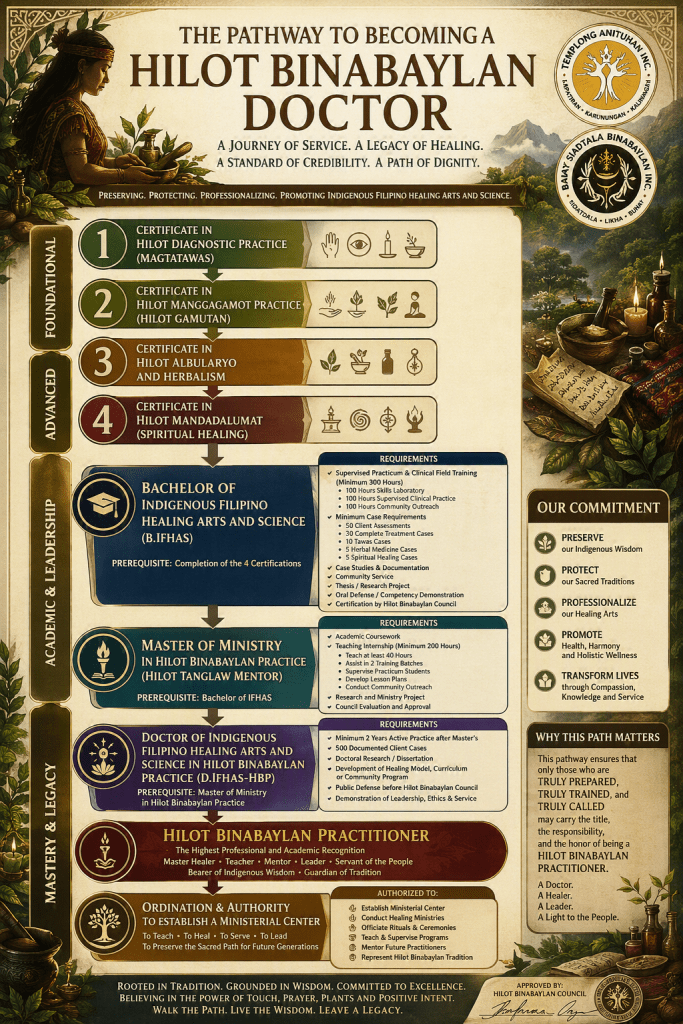
FOUR LEVEL PROFESSIONAL CERTIFICATION PATHWAY

The following certifications are hereby established as the foundational professional pathway of Hilot Binabaylan Practice:

LEVEL I

CERTIFICATE IN MAGTATAWAS OR HILOT DIAGNOSTIC PRACTICE

Competencies shall include:

• Pantay Daliri

• Tudluan

• Himulsuhan

• Pasubay (Physiognomy and Kinesics)

• Tawas sa Papel

• Tawas sa Kandila

• Tawas sa Itlog

LEVEL II

CERTIFICATE IN HILOT GAMUTAN OR MANGGAGAMOT PRACTICE

Cleansing Competencies:

• Pagbababad

• Paglalanggas

• Pagbubuhos

• Paghihilod

• Pagpupunas

• Pagsusuob

• Paglalabatiba

Treatment and Repair Competencies:

• Pagtatapal

• Pagbibigkis

• Dagdagay

• Pahid

• Haplas

• Masahe

• Bentusa

• Tawak

• Tandok

• Lunas Pilay (Traditional Bonesetting)

LEVEL III

CERTIFICATE IN HILOT ALBULARYO AND HERBALISM

Competencies shall include:

• Herbalist Philosophy

• Earth Stewardship

• Ethical Use of Herbs

• Commercial Herbs

• Wild and Natural Herbs

• Herbal Preparations

• Traditional Medicine Making

• Amulet, Charm, and Talisman Making

• Studies on Gayuma and Related Folk Traditions

LEVEL IV

CERTIFICATE IN HILOT MANDADALUMAT OR SPIRITUAL HEALING

Competencies shall include:

• Emotional Healing

• Mental Healing

• Social and Community Healing

• Healing of Usog

• Bati

• Dalaw

• Tawag

• Shamanic Illness

• Kulam-Related Healing Protocols

• Altar Set Up

• Kilubansa

• SiAdtala Baybayin Mystic Attunement

• Orasyon

• Luop and Palina

• Pagpag-Taboy

• Dampi-Pauli

• Rituals and Ceremonies

SECTION 4

BACHELOR OF INDIGENOUS FILIPINO HEALING ARTS AND SCIENCE (B.IFHAS)

Any individual who successfully completes all four (4) certification programs shall become eligible to apply for the Bachelor of Indigenous Filipino Healing Arts and Science (B.IFHAS).

To qualify for graduation and conferment of the bachelor’s diploma, the candidate must additionally complete the following requirements:

• Supervised Practicum and Clinical Field Training

• Documented Case Studies

• Community Service and Indigenous Health Outreach

• Research Project, Thesis, or Capstone Study

• Oral Defense, Competency Demonstration, or Scholarly Presentation

• Evaluation, Certification, and Approval by the Hilot Binabaylan Council

The Bachelor of Indigenous Filipino Healing Arts and Science shall recognize that the graduate has demonstrated foundational mastery and competency in Indigenous Filipino Healing Arts, Sciences, and Community Healing Service.

SECTION 5

MASTER OF MINISTRY IN HILOT BINABAYLAN PRACTICE

(HILOT TANGLAW MENTOR)

Only holders of the Bachelor of Indigenous Filipino Healing Arts and Science (B.IFHAS) shall be eligible for admission into the Master of Ministry in Hilot Binabaylan Practice Program.

Upon successful completion of all master’s degree requirements, the candidate shall be awarded the title:

HILOT TANGLAW MENTOR

The Hilot Tanglaw Mentor shall be authorized by the Hilot Binabaylan Council to:

• Teach approved Hilot Binabaylan courses

• Mentor students and apprentices

• Supervise practicum training

• Conduct educational outreach

• Participate in curriculum development

• Assist in community-based healing initiatives

• Serve as an official representative of the Hilot Binabaylan educational system

Such teaching authority shall remain subject to ethical conduct, continuing professional development, and compliance with Council standards and policies.

SECTION 6

DOCTORATE IN HILOT BINABAYLAN PRACTICE

Only individuals who have successfully completed the Master of Ministry in Hilot Binabaylan Practice Program shall be eligible for admission into the Doctorate Program.

Upon completion of all doctoral requirements prescribed by the Hilot Binabaylan Council, the candidate shall be awarded the degree:

DOCTOR OF INDIGENOUS FILIPINO HEALING ARTS AND SCIENCE IN HILOT BINABAYLAN PRACTICE

(D.IFHAS-HBP)

or such other doctoral designation as may be approved by the Council.

SECTION 7

CONFERMENT OF THE TITLE AND RANK OF HILOT BINABAYLAN PRACTITIONER

The title and rank of:

HILOT BINABAYLAN PRACTITIONER

shall be reserved exclusively for graduates of the Doctorate Level Program who have demonstrated exceptional knowledge, competence, ethical conduct, service, leadership, and commitment to the preservation of Hilot Binabaylan Practice.

The title shall represent the highest professional and academic recognition within the Hilot Binabaylan educational framework.

SECTION 8

ORDINATION AND MINISTERIAL AUTHORITY

Graduates holding the title of Hilot Binabaylan Practitioner may apply for ecclesiastical ordination under the authority of Templong Anituhan Inc. and Bahay SiAdtala Binabaylan Inc.

Candidates for ordination shall undergo review and approval by the Hilot Binabaylan Council and appropriate ecclesiastical authorities.

Upon successful ordination, the individual may be granted authority to:

• Establish and administer a Ministerial Center

• Conduct healing ministries

• Officiate approved rituals and ceremonies

• Teach and supervise educational programs

• Serve as an official ambassador of the Hilot Binabaylan tradition

SECTION 9

AUTHORIZATION OF MINISTERIAL CENTERS

No person shall establish, advertise, operate, franchise, charter, or represent an official Hilot Binabaylan Ministerial Center, Training Center, Academy, Seminary, or Educational Institution without prior authorization, recognition, charter, accreditation, or approval by the Hilot Binabaylan Council and the governing authorities of Templong Anituhan Inc. and Bahay SiAdtala Binabaylan Inc.

SECTION 10

CONTINUATION OF THE HILOT BINABAYLAN ALIGNMENT TRAINING PROGRAM

The Board hereby approves the continued offering of the Hilot Binabaylan Alignment Training Program for:

• Traditional Filipino healers without formal certification

• Hilot Wellness NC II holders

• Massage Therapy NC II holders

• Filipino individuals seeking foundational Hilot education

The program shall consist of twenty (20) weekly sessions and shall serve as a foundational education and orientation program in Indigenous Filipino Healing Arts and Sciences.

The approved twenty-session curriculum attached hereto as Annex “A” shall form an integral part of this Resolution.

SECTION 11

INTERNATIONAL APPLICATION

This educational framework shall apply to all local and international students, affiliates, ministerial centers, educational branches, and training programs operating under the authority, recognition, or affiliation of Templong Anituhan Inc., Bahay SiAdtala Binabaylan Inc., and the Hilot Binabaylan Council.

SECTION 12

EFFECTIVITY

This Resolution shall take effect immediately upon its approval and adoption on the Fourth Day of July Two Thousand Twenty-Six (July 4, 2026).

APPROVED AND ADOPTED THIS 4TH DAY OF JULY 2026.

FOR TEMPLONG ANITUHAN INC.

_______________________________

REV. ROLANDO G. COMON

Co-Trustee and Founder

_______________________________

REV. ALVIN L. SENTIN

Co-Trustee and Founder

FOR BAHAY SIADTALA BINABAYLAN INC.

_______________________________

REV. ROLANDO G. COMON

Co-Trustee and Founder

_______________________________

REV. ALVIN L. SENTIN

Co-Trustee and Founder

CERTIFIED TRUE AND CORRECT:

_______________________________

REV. ROLANDO G. COMON

Chairperson, Meeting

_______________________________

REV. ALVIN L. SENTIN

Secretary, Meeting

Resolution No. 2026-07-04

Adopted on July 4, 2026

ANNEX A HILOT BINABAYLAN ALIGNMENT TRAINING PROGRAM

Session 1 

1:00 PM- 2:00 PM Orientation/ terms and condition 

2:00 PM-3:00 PM Definition & History 

3:00 PM- 4:00 PM Hilot Philosophy and Principles 

4:00 PM- 5:00 PM Concept of Life, Health, Illness and Wellness 

5:00 PM- 6:00 PM Faculties and Concept of Man 

Session 2  

1:00 PM- 2:00 PM Traditional Health Care Delivery System 

2:00 PM- 3:00 PM Hilot Healing Process 

3:00 PM – 6:00 PM  Code of Ethics/ Laws/ Policies/ Regulation regarding the practice of Hilot 

Session 3 

1:00 PM- 3:00 PM Introduction to Human Body, Organismal System & Functions 

3:00 PM- 6:00 PM Anatomical Position & Basic Range of Motion 

Session 4 

1:00 PM- 2:00 PM Hilot Diagnostics 

2:00 PM- 3:00 PM Dimensions of Reality & Plane of Existence 

3:00 PM- 4:00 PM The 7 Souls according to our Indigenous Filipino Ancestors 

4:00 PM- 5:00 PM Traditional Alternative Wellness Analytic System (TAWAS) 

5:00 PM- 6:00 PM Finger Alignment 

Session 5 

1:00 PM- 2:00 PM Finger Poking 

2:00 PM- 3:00 PM Introduction to the Practice of Tawas 

3:00 PM- 4:00 PM Discussion on the Indigenous Spiritual Realms of the Filipino 

4:00 PM- 5:00 PM The Power of words in creation and destruction 

5:00 PM- 6:00 PM Recognizing Shapes and Symbols 

Session 6  

1:00 PM- 6:00 PM Demonstration and Practice of Tawas sa Papel 

Session 7 

1:00- 6:00 PM Demonstration and Practice of Tawas sa Kandila 

Session 8 

1:00 PM- 6:00 PM Demonstration and Practice of Tawas sa Itlog 

Session 9 

1:00 PM- 2:00 PM Hilot Body Parts 

2:00 PM- 3:00 PM Visual Assessment 

3:00 PM- 4:00 PM Auditory Assessment 

4:00 PM- 5:00 PM Olfactory Assessment 

5:00 PM- 6:00 PM Tactile Assessment 

Session 10 

1:00 PM- 2:00 PM Introduction to Vital Signs 

2:00 PM- 3:00 PM Elemental Correspondence of the Vital Signs of LIfe 

3:00 PM- 4:00 PM Tools used in Measuring Vital Signs 

4:00 PM- 5:00 PM Manual measurement of Respiration and Pulse Rate & use of Oxy Meter 

5:00 PM- 6:00 PM Manual measurement of Blood Pressure and use of sphygmomanometer and stethoscope 

Session 11 

1:00 PM- 2:00 PM Understanding Traditional Pulse Reading Analysis 

2:00 PM- 3:00 PM The Left and Right Pulse 

3:00 PM- 4:00 PM Determining the Distal, Medial, Proximal Radial Arterial Pulse Site 

4:00 PM- 5:00 PM Taking the Deep & Superficial Pulse  

5:00 PM- 6:00 PM Analyzing Pulse and Making Feed Back 

Session 12 

1:00 PM- 2:00 PM Importance of Cleansing in Healing the Physical and Spiritual Body 

2:00 PM- 3:00 PM Internal and External Cleansing 

3:00 PM- 4:00 PM Different Cleansing method and its indication 

4:00 PM- 5:00 PM Suob 

5:00 PM- 6:00 PM Paligo 

Session 13 

1:00 PM- 6:00 PM Dagdagay/ Kulis Traditional Filipino Stick Foot Massage 

Session 14 

1:00 PM- 6:00 PM Pagsasala Leaf Scanning 

Session 15 

1:00 PM- 6:00 PM Tawak/ Bentusa/ Tandok Treatment 

Session 16 

1:00 PM- 2:00 PM Pindot Earth Elemental Touch 

2:00 PM- 3:00 PM Haplos Spirit Elemental Touch 

3:00 PM- 4:00 PM Hagod Water Elemental Touch 

4:00 PM- 5:00 PM Pisil Air Elemental Touch 

5:00 PM- 6:00 PM Piga Fire Elemental Touch  

Session 17 

1:00- 6:00 PM Demonstration and Practice of Dry Hilot Touch Manipulation 

Session 18 

1:00 PM- 2:00 PM Hands, Arms & Shoulder 

2:00 PM- 3:00 PM Chest, Head & Face 

3:00 PM- 4:00 PM Stomach/ Abdomen 

4:00 PM- 5:00 PM Side Lying Position  

5:00 PM- 6:00 PM Side Feet, Calf and Legs and sitting as Final position 

Session 19 

Supervised Practice Session with client 

Session 20 

Graduation Ceremony & Ordination 

ADOPTED THIS 4TH DAY OF JULY 2026

Compassion, Not Harm: Understanding True Healing in Hilot Binabaylan Practice

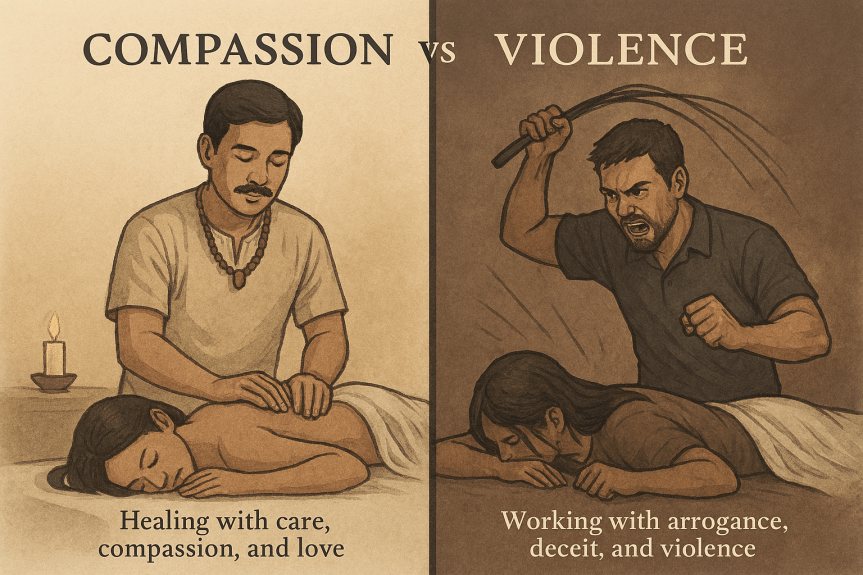
In recent times, a circulating video has raised serious concern within the healing community—a portrayal of a so-called “spiritual healer” using forceful and painful methods that appear violent, aggressive, and devoid of compassion. Such representations not only alarm the public but also mislead people about the true nature of traditional Filipino healing.

As practitioners and guardians of Hilot Binabaylan, it is our duty to clarify:
Authentic Hilot is not violence. It is healing grounded in care, alignment, and love.

Hilot Is Not Just Massage

One of the most common misconceptions is that Hilot is simply a form of massage meant for relaxation. This is not entirely accurate.

While massage focuses on soothing muscles and providing comfort, Hilot goes deeper. It is a traditional healing art that:

  • Identifies imbalances within the body
  • Restores alignment and energetic flow
  • Addresses physical, emotional, and spiritual disturbances

In Hilot Binabaylan, healing is intentional and corrective, not merely superficial.

Why Hilot Can Be Painful—But Only Briefly

It is true that Hilot can sometimes feel painful—but this must be properly understood.

The discomfort experienced during a Hilot session is not meant to harm. Rather, it is a natural response of the body when an imbalance is being corrected. When a part of the body is misaligned or blocked, the initial touch may trigger a moment of pain.

However, this follows a clear pattern:

  1. First stroke (unang hagod): discomfort or sharp sensation where imbalance exists
  2. Subsequent strokes: gradual reduction of pain
  3. Final phase: relief, lightness, and restored flow

The goal is not to inflict pain, but to reduce it until it completely disappears.

Gentleness Is Central to Hilot Practice

True Hilot is never executed through aggression.

A legitimate Hilot practitioner works with:

  • Controlled, gentle movements
  • Heightened awareness of the body’s response
  • Calm and focused intention
  • Respect for the patient’s limits

Healing is not achieved by force, anger, or punishment.
It is achieved through precision, sensitivity, and compassion.

The behavior shown in the viral video—violent striking, harsh handling, and use of instruments with aggression—does not represent Hilot Binabaylan.

Traditional Healing Tools: Purposeful, Not Harmful

Hilot does involve the use of tools, but always with therapeutic intention and care. These include:

  • Baso (glass cupping) for bentusa (suction therapy)
  • Leaves (dahon) used for scanning and diagnosing imbalances
  • Bamboo or guava sticks for controlled pressure application
  • Coconut midrib (tingting) used in gentle tapping techniques

For example, in the pa-tapik method using 13 coconut sticks, the tapping is light and rhythmic, designed to stimulate circulation—not to injure or punish the body.

Every tool in Hilot serves a healing purpose, never a destructive one.

Healing Is Rooted in Love and Care

The core principle of Hilot Binabaylan is simple yet profound:

Healing must come from love (pag-ibig) and compassion (pagmamalasakit).

Without these, any act cannot be called healing.

A true healer:

  • Does not dominate the patient
  • Does not inflict unnecessary pain
  • Does not act out of ego or anger

Instead, the healer becomes a channel of balance, care, and restoration.

Guidance for Patients Seeking Spiritual Healing

For those seeking the help of a spiritual healer, discernment is essential. Not all who claim to heal are legitimate practitioners.

Before entrusting your well-being, consider the following:

✅ Check for Ordination Credentials

A true spiritual healer should be ordained by a legitimate spiritual or religious institution, authorizing them to practice healing responsibly.

✅ Verify Legal Compliance

If they accept payments or donations:

  • Look for DTI Registration
  • Ensure they have a Mayor’s Permit

If they operate a chapel or organization:

  • Ask for SEC Registration
  • Confirm BIR Registration and official receipts

✅ Observe Their Conduct

A legitimate healer:

  • Works with calmness and respect
  • Explains the process clearly
  • Prioritizes your safety and consent

Never trust a healer who:

  • Uses fear, intimidation, or violence
  • Claims absolute power or authority over your body
  • Justifies harm as “necessary suffering”

A Call to Spiritual Healers: Walk the Path with Integrity

If you feel called to become a spiritual healer, remember that healing is not just a gift—it is a sacred responsibility. It requires proper guidance, ethical grounding, and spiritual accountability.

At the Hilot Academy of Binabaylan, we invite you to take a higher step in your journey by becoming a Certified Spiritual Wellness Facilitator.

This program is designed to:

  • Provide proper spiritual formation and guidance
  • Ground your healing practice in authentic Filipino Indigenous wisdom
  • Ensure your work is aligned with ethics, compassion, and legitimacy
  • Offer ordination credentials that affirm your role as a responsible healer

Ordination is not about titles—it is about accountability to the people you serve and the spiritual forces you work with.

If you are truly called to heal, then walk the path with discipline, humility, and love.

👉 Begin your journey today. Become an ordained Spiritual Wellness Facilitator.
Visit: https://www.hilotacademy.com

Let us uphold the honor of healing by becoming instruments of
care, not harm… balance, not fear… love, not violence.

The Sacred Hand: Living the Five-Element Prayer in Daily Life

A Teaching from Templong Anituhan and the Councils of the Diwata

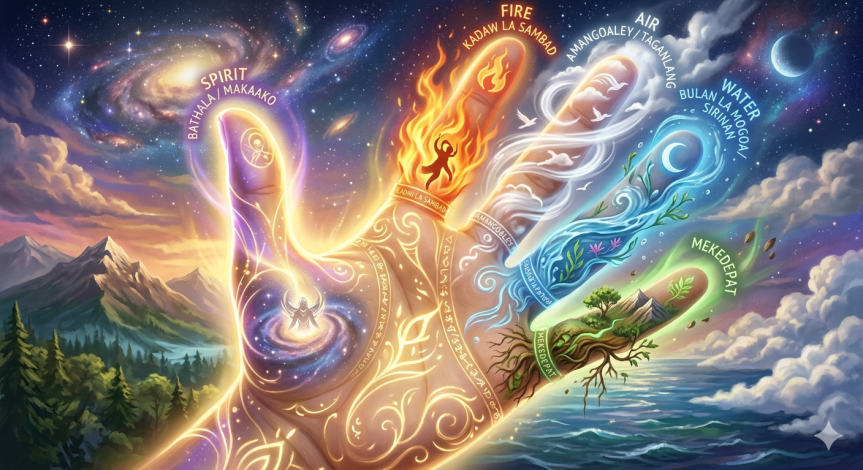
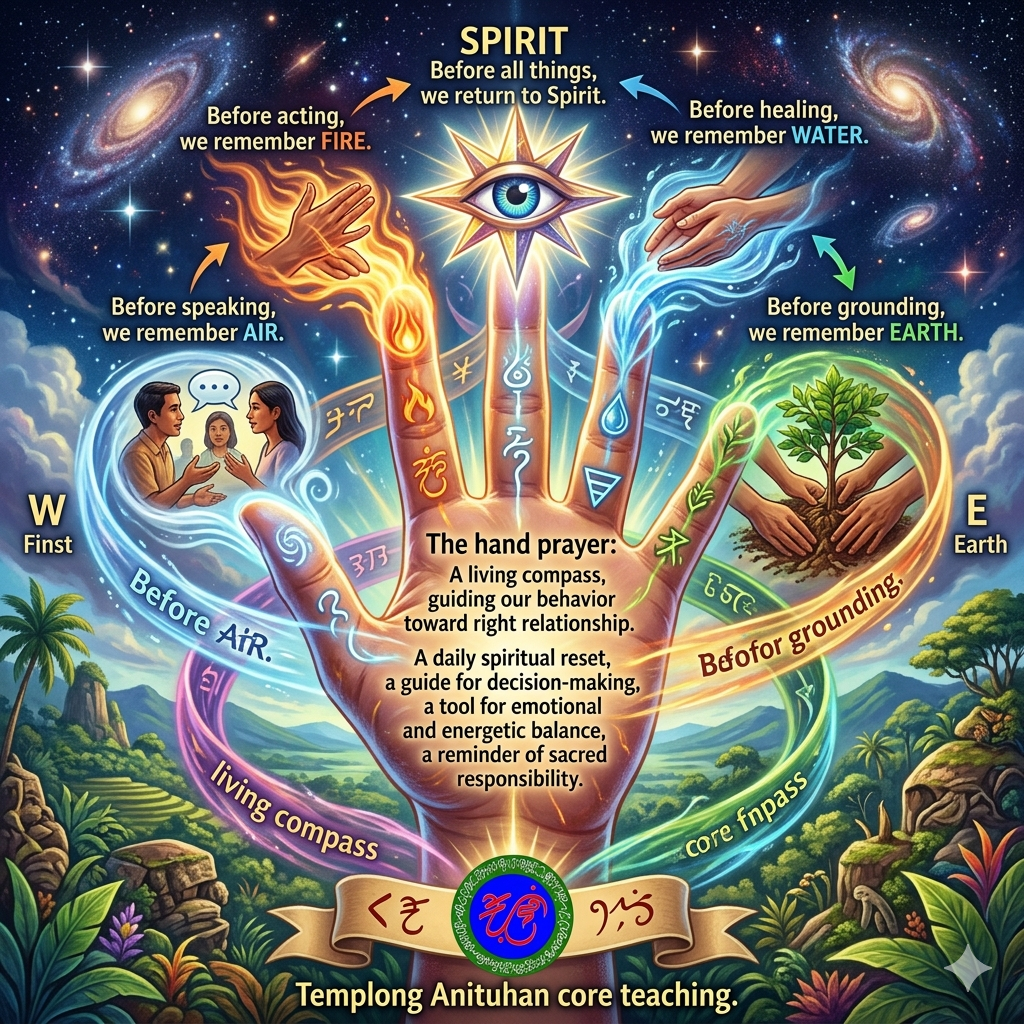
In the sacred teachings of Templong Anituhan, the body is not separate from spirit—it is a living altar, a vessel through which the wisdom of Bathala and the blessings of the Diwata are expressed. Among the most simple yet powerful spiritual practices is the Hand Prayer of the Five Elements, where each finger becomes a point of invocation, remembrance, and alignment.

This prayer is not merely recited—it is lived.

It is a daily act of returning to balance.
A gesture of remembering our sacred duty.
A guide for how we walk, speak, heal, teach, and serve.

Hand Prayer Before Hilot (Manghihilot Invocation)

(Touch each finger quietly before starting the session)

👍 Spirit – Bathala
Bathala, guide my spirit.

☝️ Fire – Kadaw La Sambad
Sacred Fire, empower my hands.

🖕 Air – Amagoaley / Taganlang
Holy Breath, clear my mind.

💍 Water – Bulan / Sirinan
Living Water, bring healing and peace.

🤙 Earth – Mekedepat
Sacred Earth, ground and stabilize this work.

🌀 Closing (place both hands over the client or your sariling puso)

Through Bathala and the Diwata,
May this healing flow in balance.

I serve as vessel—
Let the body be restored,
The spirit be at peace.

Mayari Na! PagAsatin!


The Hand as Sacred Map of Creation

In this practice, the hand becomes a microcosm of the universe, reflecting the elemental forces that govern existence:

  • Thumb – Spirit (Bathala / Makaako)
  • Forefinger – Fire (Kadaw La Sambad)
  • Middle Finger – Air (Amagoaley / Taganlang)
  • Ring Finger – Water (Bulan La Mogoaw / Sirinan)
  • Pinky Finger – Earth (Mekedepat / Taganlang)

Each finger, when touched with intention, is a prayer in motion—a direct connection to the Councils of the Diwata.

Through this, the practitioner is reminded:
We do not call the Diwata only in ritual—
We walk with them in every action.


More Than Prayer: A Discipline of Awareness

The importance of this practice lies in its simplicity and constancy.

Because the hand is always with us, the prayer becomes:

  • A daily spiritual reset
  • A guide for decision-making
  • A tool for emotional and energetic balance
  • A reminder of sacred responsibility

Before speaking, we remember Air.
Before acting, we remember Fire.
Before healing, we remember Water.
Before grounding, we remember Earth.
Before all things, we return to Spirit.

In this way, the hand prayer becomes a living compass, guiding our behavior toward right relationship—a core teaching of Templong Anituhan.


Alignment with the Councils of the Diwata

Each element is not abstract—it is embodied by the Diwata who govern it:

  • Bathala / Makaako (Spirit) reminds us of our divine origin and purpose
  • Kadaw La Sambad (Fire) empowers our will and transformation
  • Amagoaley / Taganlang (Air) governs clarity, breath, and communication
  • Bulan La Mogoaw / Sirinan (Water) nurtures healing and emotional flow
  • Mekedepat / Taganlang (Earth) grounds us in balance and responsibility

By invoking them through the hand, we are not merely asking—we are aligning ourselves with their nature.

This is the essence of embodiment:
Not to worship from afar,
But to live the qualities of the Diwata within us.


From Ritual to Daily Living

In Templong Anituhan, the highest form of devotion is not found only in ceremonies—but in how we live daily life.

The Hand Prayer becomes:

For the Manghihilot (Healer)

A preparation of hands as sacred instruments of healing.
It reminds the healer: You are not the source—the Diwata are.

For the Teacher or Mentor

A grounding of wisdom, speech, and presence.
It ensures that teaching flows from clarity, compassion, and truth.

For Daily Life

A return to balance in moments of stress, confusion, or action.
It transforms ordinary gestures into spiritual practice.

Even a simple act—touching the fingers quietly—
becomes a silent prayer and a re-centering of the self.


The Path of Sacred Trusteeship

At its core, this practice reflects a deeper teaching:
That we are not owners of our lives—but katiwala, sacred trustees.

The hand we use to work, to touch, to serve—
Is the same hand we offer in prayer.

And so we ask ourselves:

  • Are our actions guided by Spirit?
  • Are our deeds aligned with righteous Fire?
  • Are our words carried with clarity through Air?
  • Are our hearts flowing with compassion like Water?
  • Are we grounded in humility upon Earth?

This is the living question of stewardship.


A Living Reminder of Sacred Balance

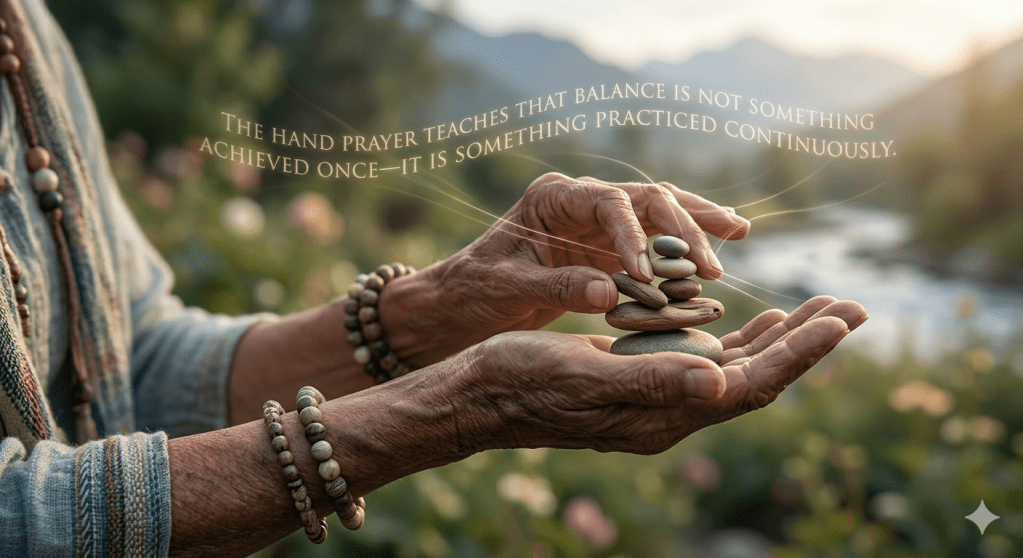
The Hand Prayer teaches that balance is not something achieved once—
It is something practiced continuously.

Each day, each interaction, each decision—
Is an opportunity to align again.

In a world that moves quickly and often forgets the sacred,
This prayer brings us back to stillness, intention, and awareness.

It is a portable altar,
A constant teacher,
A silent companion on the path.


Conclusion: Walking with the Diwata

To practice the Hand Prayer is to remember that:

We are never alone.
We are always guided.
We are always responsible.

Through Bathala,
Through the Diwata,
Through the Ancestors—

Our hands become instruments of healing,
Our words become carriers of wisdom,
And our lives become expressions of sacred balance.

This is the teaching of Templong Anituhan:
That spirituality is not separate from life—
It is lived through it.

And in every movement of the hand,
We remember who we are,
And who we are called to be.

Call to Practice: Pray With Your Hands, Live With Purpose

You carry this prayer with you at all times—
In your own hands.

Let it not remain words that are read,
But become a practice that is lived.

Each morning, before you begin your day—pause.
Touch each finger.
Call upon Bathala and the Diwata.
Align your spirit, your thoughts, your heart, your actions, and your path.

In moments of doubt—return to it.
In moments of healing—anchor yourself in it.
In moments of teaching—flow through it.

Make this prayer your daily discipline.
Make it your silent guide.
Make it your sacred habit.

For in doing so, you are not only praying—
You are remembering your role as katiwala,
A steward of life,
A servant of balance,
A living vessel of the Diwata.

Begin today.

Touch your hand.
Awaken the elements within you.
Walk in harmony.

And let your life itself become the prayer.

The Sanctity of the Hilot Binabaylan Lineage: Becoming an Instrument of the Divine

In the sacred path of Hilot Binabaylan, the title we carry is not merely a name—it is a responsibility, a vow, and a living embodiment of a lineage that traces back to the Divine Source of Life itself.

To be called a Hilot Binabaylan Practitioner is to stand as a bridge between the human and the sacred, between the seen and the unseen, between the suffering and the Source of healing. This title carries weight—not because it elevates the self, but because it demands humility, discipline, and deep surrender.

Who Truly Heals?

Recently, I spoke with a student who chose to stop practicing Hilot. His reason was filled with pain: despite his efforts, his practice did not heal his sick father.

In that moment, I asked him a simple question: “Who do you think truly heals? Who gave life to your father?”

This question brings us back to the very heart of Hilot Binabaylan.

It is not the practitioner who heals.
It is not the technique that restores life.

All healing comes from the Supreme Divine Creator—the Source of all life, breath, and existence.

What we do, as Hilot practitioners, is to participate in that sacred process. Our touch, our movements, our rituals, our presence—these are not acts of personal power. They are forms of prayer in motion, humble offerings that call upon the Divine to bring forth healing where it is needed.

We are not the source.
We are the instrument.

The Practice Beyond the Title

In today’s time, especially among those in the diaspora, there are individuals who hold tightly to the title of Hilot Binabaylan, yet hesitate to embody its practice. They speak about the tradition, identify with its name, but do not walk the path through action and service.

But lineage is not preserved through words alone.

It is lived.
It is practiced.
It is offered in service to others.

To carry the name without honoring its responsibility is to separate oneself from the living current of the lineage. Hilot is not an identity to display—it is a sacred duty to fulfill.

A Gift Belonging to the People

It must also be clearly understood:
Hilot is not owned by any institution, organization, or individual.

Hilot is a Divine Gift entrusted to the Filipino people—a sacred inheritance rooted in care, community, and connection to the natural and spiritual worlds.

What we uphold within:

  • Hilot Academy of Binabaylan
  • Templong Anituhan
  • Luntiang Aghama Natural Divine Arts Shrine of Healing Inc.
  • Bahay Siadtala Binabaylan Inc.

…is not ownership of Hilot itself.

Rather, what we offer is structure, guidance, and discipline through a carefully developed curriculum and standardized techniques—refined through decades of lived practice, from 1998 to the present, under my work as Apu Adman Aghama.

These frameworks exist to guide practitioners into integrity, not to claim authority over a sacred tradition that ultimately belongs to the Divine and the people.

Hilot as Complement, Not Competition

True Hilot does not seek to compete.

It does not position itself above other healing modalities, nor does it claim exclusivity in restoring health and well-being.

Instead, Hilot stands as a complementary sacred art, working in harmony with other forms of healing—modern and traditional alike. Its purpose is to serve, to contribute, and to integrate for the greater good of humanity.

Where there is suffering, Hilot offers support.
Where there is imbalance, Hilot offers alignment.
Where there is disconnection, Hilot restores relationship—with self, nature, and Spirit.

Honoring the Lineage

At the heart of Hilot Binabaylan is ancestral reverence.

We do not take pride in ourselves as healers.
We do not glorify the individual practitioner.

Instead, we give honor where it belongs:

  • To our ancestors, who preserved this knowledge through generations
  • To the Diwata and Anito, who guide and sustain the unseen realms
  • And ultimately, to the Supreme Divine Creator, from whom all healing flows

Our lineage is not something we invented—it is something we have received, honored, and are now entrusted to continue.

Walking as an Instrument of the Divine

To be a Hilot Binabaylan Practitioner is to live in constant remembrance:

  • That our hands are not our own—they are guided
  • That our knowledge is not for self-gain—it is for service
  • That our work is not to prove power—but to express devotion

Each session becomes a prayer.
Each touch becomes an offering.
Each healing moment becomes an act of surrender.

We do not command healing.
We invite it.

We do not create life.
We honor it.

We do not heal.
We become instruments through which the Divine heals.


A Call to Practitioners

Let this be a reminder to all who carry the name Hilot Binabaylan:

Walk the path.
Live the practice.
Serve with humility.

Return always to the Source.

For in the end, the sanctity of our lineage is not preserved by titles—but by the sincerity of our devotion, the integrity of our actions, and our unwavering recognition that we are, and will always be,

Instruments of the Divine.

DECLARATION ON THE RIGHTS OF HILOT BINABAYLAN PRACTITIONERS (A Declaration on the Rights of Manghihilot)

Preamble

We, the stewards, practitioners, and custodians of the sacred healing tradition known as Hilot Binabaylan, rooted in the indigenous knowledge systems of the Filipino people,

Recognizing that healing is a sacred exchange of energy, trust, and responsibility between the practitioner and the one seeking care;

Affirming that while the rights of patients are widely upheld and protected, there exists an equal necessity to recognize and protect the dignity, welfare, and integrity of the Hilot practitioner;

Guided by the principles enshrined in the 1987 Philippine Constitution, the Indigenous Peoples’ Rights Act (RA 8371), and the global recognition of traditional and indigenous healing systems;

We hereby declare and affirm the following rights of the Hilot Binabaylan Practitioner, to serve as a standard of ethical practice, cultural preservation, and professional respect within the Hilot Academy of Binabaylan and allied communities:

Article I: General Principles

Section 1. Sacred Nature of Practice

Hilot Binabaylan is recognized as a sacred and holistic healing practice, encompassing physical, emotional, mental, cultural, and spiritual dimensions.

Section 2. Equality of Dignity

The relationship between practitioner and client is founded on mutual respect, shared responsibility, and balanced dignity.

Article II: Rights of the Hilot Binabaylan Practitioner

Section 1. Right to Respect and Dignified Treatment

Every practitioner shall be accorded respect, honor, and recognition as a legitimate bearer of indigenous healing knowledge, free from discrimination, ridicule, or cultural invalidation.

Section 2. Right to Professional and Personal Boundaries

Every practitioner has the right to:

  • Establish and maintain appropriate professional, emotional, and spiritual boundaries
  • Refuse or discontinue services in cases that exceed their competence, ethical standards, or personal well-being

Section 3. Right to Safety and Protection

Every practitioner is entitled to a safe and secure environment, free from:

  • Harassment, abuse, coercion, or violence
  • Any condition that threatens physical, emotional, or spiritual well-being

The practitioner reserves the right to terminate sessions if safety is compromised.

Section 4. Right to Fair and Just Compensation

Every practitioner has the right to receive fair, agreed, and respectful compensation for services rendered, whether in monetary form, offerings, or other culturally appropriate exchanges, free from exploitation or undue pressure.

Section 5. Right to Recognition and Protection of Indigenous Knowledge

Every practitioner has the right to:

  • Uphold and preserve Hilot as part of Filipino indigenous cultural heritage
  • Protect their practices, rituals, and knowledge from misappropriation, misuse, or unauthorized representation

Section 6. Right to Informed Practice

Every practitioner has the right to receive complete, truthful, and accurate information from the client regarding their health condition, personal history, and relevant concerns, and may refuse responsibility in cases of withheld or falsified information.

Section 7. Right to Spiritual IntegrityEvery practitioner has the right to practice according to their:

  • Lineage, calling, and spiritual discipline
  • Guidance of the Diwata, Anito, and ancestral forces

No practitioner shall be compelled to alter or compromise sacred practices in violation of their spiritual integrity.

Section 8. Right to Rest and Energetic RenewalEvery practitioner has the right to:

  • Adequate rest, recovery, and energy protection
  • Engage in personal rituals of cleansing, grounding, and renewal
  • Decline or limit engagements to preserve their well-being

Section 9. Right to Continuing Development and Recognition

Every practitioner has the right to pursue continuous learning, training, and spiritual growth, and to receive appropriate recognition of their level of mastery within the Hilot Binabaylan tradition.

Section 10. Right to Ethical and Professional Protection

Every practitioner has the right to:

  • Protection against false accusations, misrepresentation, or reputational harm
  • Maintain confidentiality over sacred knowledge, methods, and practices in accordance with ethical and spiritual discretion

Article III: Implementation and Commitment

Section 1. Institutional Adoption

This Declaration shall serve as a guiding framework for all programs, trainings, and practices under the Hilot Academy of Binabaylan and its affiliated institutions.

Section 2. Ethical Standard

This Declaration shall be upheld as part of the Code of Ethics and Professional Conduct of all Hilot Binabaylan Practitioners.

Section 3. Advocacy and Cultural Preservation

This Declaration shall support ongoing efforts toward:

  • Recognition of Hilot in national and global health frameworks
  • Protection of indigenous healing systems
  • Promotion of ethical and culturally grounded healing practices

🌺 Closing Statement

In affirming these rights, we uphold that the Hilot Binabaylan Practitioner is not merely a service provider, but a guardian of balance, a vessel of ancestral wisdom, and a living bridge between the seen and unseen realms.

May this Declaration preserve the dignity of the healer, protect the sacredness of the practice, and ensure harmony in every act of healing.

“This Declaration shall serve as the foundational ethical and professional framework for the recognition and protection of Hilot Binabaylan Practitioners in the Philippines and internationally.”

Adopted by:

Hilot Academy of Binabaylan
Under the Spiritual Guidance of
Templong Anituhan ng Luntiang Aghama

Public Statement and ManifestoOn the Integrity of the Title “Hilot Doctor”

A Sacred Path, Not a Shortcut


In this time of renewed interest in complementary, integrative, and traditional healing, we at the Hilot Academy of Binabaylan express our deep gratitude to all who seek holistic approaches to health and wellness.
At the same time, we also recognize a growing concern:


The increasing use of titles such as “Doctor” in various alternative healing fields without a clear, consistent, and rigorous process of formation.

This reality invites us to speak—not in opposition, but in clarity, truth, and responsibility.

On the Use of the Title “Hilot Doctor”
Within our tradition, the title “Hilot Doctor” is not a label, a certification, or a title conferred by membership.
It is the fruit of a long-term journey of academic, cultural, and spiritual formation rooted in Indigenous Filipino Healing Arts and Sciences.

This pathway includes:


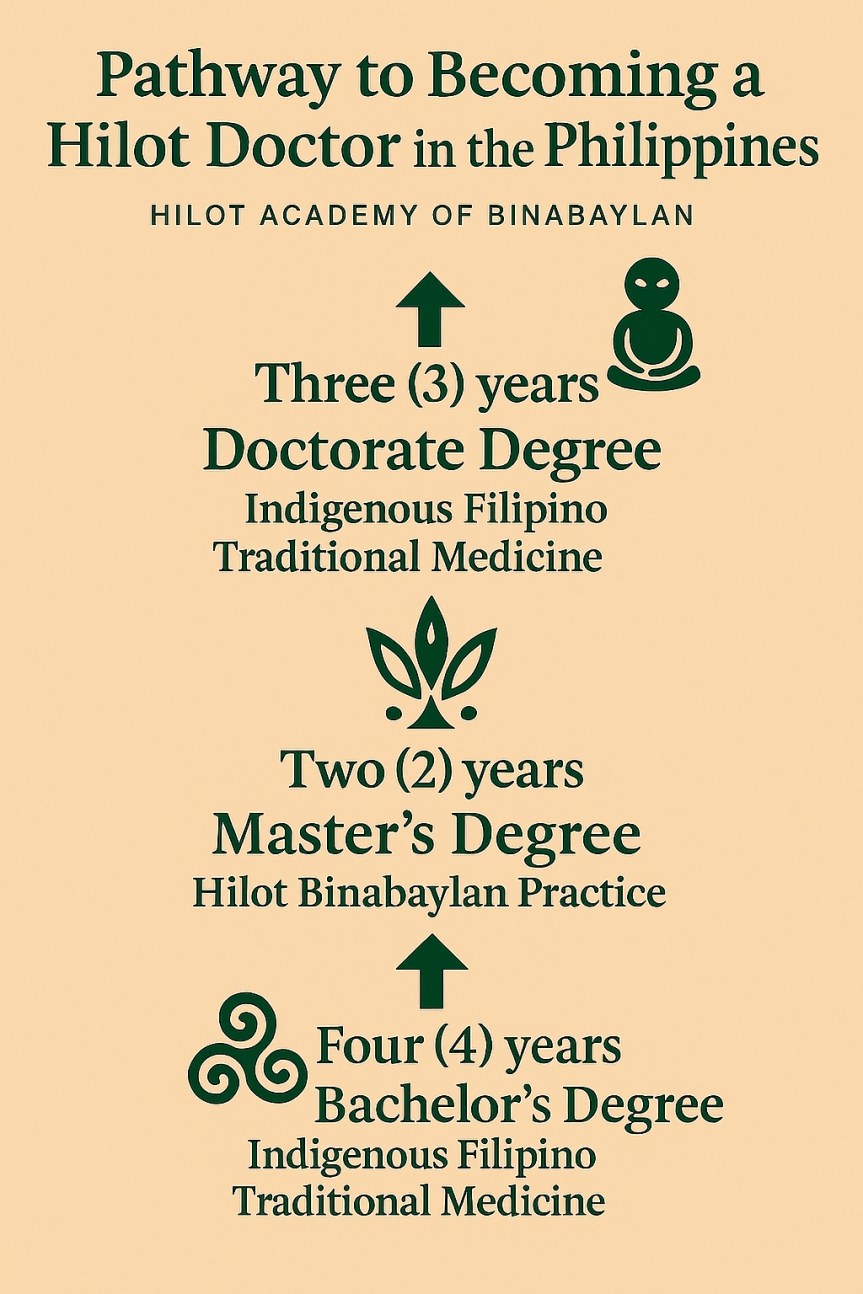
•Four (4) years — Bachelor’s Degree in Indigenous Filipino Healing Arts and Science
•Two (2) years — Master’s Degree in Ministry on Hilot Binabaylan Practice
•Three (3) years — Doctorate Degree in Indigenous Filipino Traditional Medicine

This nine-year formation is not only academic—it is experiential, relational, and sacred.


It involves:.


•Guided practice under lineage
•Cultural immersion
•Spiritual discipline and alignment
•Service to community

Formation Over Certification


We acknowledge that there are organizations that provide:


•Certificates
•Membership recognitions
•Internal accreditations

While these may serve their purpose within their respective communities, we respectfully affirm:


Certification is not equivalent to formation.

Recognition is not equivalent to mastery.
Membership is not equivalent to lineage.
The healing traditions of our ancestors cannot be reduced to short-term training or institutional titles detached from lived practice.

On Integrity and Responsibility


Hilot is not merely a technique.
Hilot is not a modality.


Hilot is:


•A cultural inheritance
•A spiritual calling
•A sacred responsibility to the people
To carry the title “Hilot Doctor” is to:
•Represent a lineage
•Embody a discipline
•Uphold the dignity of Indigenous knowledge

A Call to Discernment


We do not speak to invalidate others, nor to diminish the contributions of different healing systems.


Rather, we offer this as a call to:


•Discernment among practitioners
•Clarity among students
•Integrity within the healing community

We invite all who feel called to the path of Hilot to enter not for title, but for transformation.

Our Commitment


We remain steadfast in our mission:


To preserve, protect, and elevate Indigenous Filipino Healing Arts through authentic formation, responsible teaching, and sacred practice.


We will continue to:


•Uphold rigorous academic and spiritual standards
•Honor the guidance of the Diwata and the Anito
•Form healers who serve not only with skill, but with humility and wisdom

Closing Declaration


A title can be given in a moment.
But a healer is formed through years of discipline, devotion, and transformation.

In the Hilot Academy of Binabaylan,
we do not produce titles—
we cultivate lineage.

🌿 Mabuhay ang manggagamot ng bayan.
🌿 Mabuhay ang buhay na tradisyon ng Hilot.

Official Announcement: Program Fee Adjustment and Credential Update for Hilot Binabaylan Training (Effective 2026–2027)

In faithful service to the preservation, elevation, and global transmission of Indigenous Filipino healing traditions, the Hilot Academy of Binabaylan announces important updates regarding both program credentials and training program fees, effective June 2026 and January 2027 respectively.

I. Credential Update (Effective June 2026)

Beginning June 2026, all graduates of the Hilot Binabaylan Training Program shall be conferred the title:

Certified Hilot Binabaylan Practitioner (CHBP)

This development reflects the Academy’s commitment to aligning its certification structure with academic and ministerial standards, ensuring clarity in the distinction between foundational training and advanced theological education.

At the same time, the Academy affirms that:

The Master’s Degree in Ministry in Hilot Binabaylan Practice (M.Min.HBp.) shall be conferred only upon individuals who have successfully completed the required Bachelor’s Degree in Ministry in Indigenous Filipino Healing Arts and Science or its recognized equivalent.

This structured pathway ensures that advanced degrees are grounded in both academic formation and spiritual discipline, in accordance with the standards of the Templong Anituhan Religious Education Program.

II. Program Fee Adjustment (Effective January 2027)

Since 2023, the 9-Day Hilot Binabaylan Training Program has been offered at ₱70,000, providing a fully immersive and all-inclusive learning experience.

Due to the rising costs of operations—including transportation, accommodation, food, utilities, and personnel—the Academy will implement a program fee adjustment:

New Program Fee: ₱85,000 (Effective January 2027)

This adjustment ensures the continued delivery of high-quality training while sustaining the well-being of our trainers, staff, and facilities.

III. Comprehensive Program Inclusions

The Hilot Binabaylan Training remains a fully immersive, all-inclusive program, covering:

✈️ Transportation

  • Airport pick-up and drop-off (NAIA Terminal 1)
  • Daily hotel-to-training center transfers (up to 4 times per day)

🏨 Accommodation

  • 10-day stay at Channel Paris Overlooking Hotel or equivalent

🍽️ Nourishment

  • 5 meals daily for 10 days
    (Breakfast, Morning Snack, Lunch, Afternoon Snack, Dinner)

🧑‍🏫 Training & Learning

  • 9 days intensive Hilot Binabaylan Training
  • Venue use (including electricity and water)
  • Learning materials and instructional tools
  • Massage bed access and reading materials
  • Laundry services (training-related use)
  • Professional trainers and support staff

🎁 Cultural & Ceremonial Items

  • Dagdagay stick
  • Malong
  • Other ritual tools and materials

🎓 Certification

  • Title: Certified Hilot Binabaylan Practitioner (CHBP)
  • Training Certificate
  • Graduation rites and recognition ceremony

🌍 IV. Global Perspective and Value

Despite this adjustment, the Philippine-based training remains one of the most accessible and comprehensive programs globally:

  • United States Training: USD 4,995 (~₱300,000+)
    • Does not include food or accommodation
  • Philippine Training (2027): ₱85,000 (~USD 1,500)
    • Fully inclusive with cultural immersion

This positions the Academy as a global center for authentic, origin-based Indigenous healing education.


🌺 V. Commitment to Excellence and Living Tradition

These updates represent not only an operational adjustment but a reaffirmation of the Academy’s sacred mission:

To transmit Hilot Binabaylan as a living tradition, grounded in ancestral wisdom, spiritual integrity, and embodied healing practice.

Through this structured pathway of certification and education, the Academy ensures that every practitioner is formed with competence, discipline, and reverence for the lineage of the Binabaylan.


🌿 Closing Invitation

We warmly invite healers, seekers, and cultural practitioners from around the world to embark on this transformative journey.

The Hilot Binabaylan Training is more than a course—it is an initiation into ancestral knowledge, a deep healing experience, and a return to the sacred roots of Filipino identity.

For inquiries and enrollment:
Hilot Academy of Binabaylan