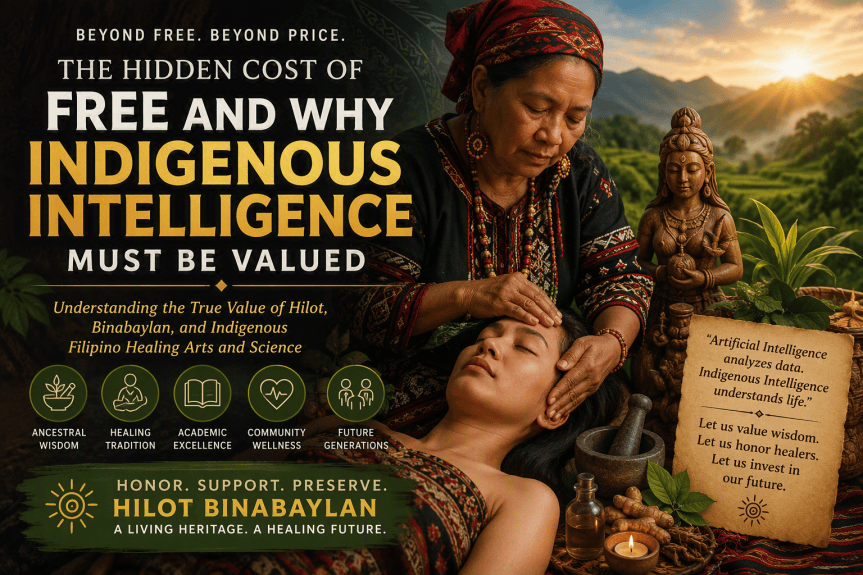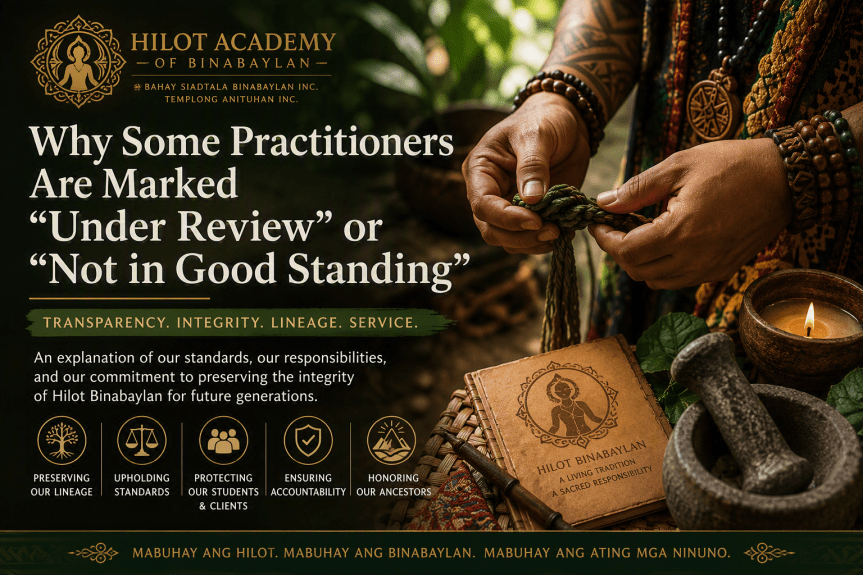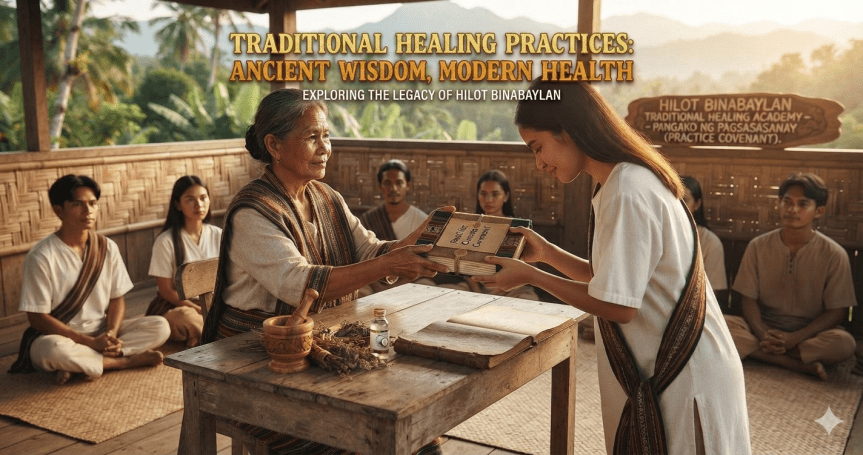
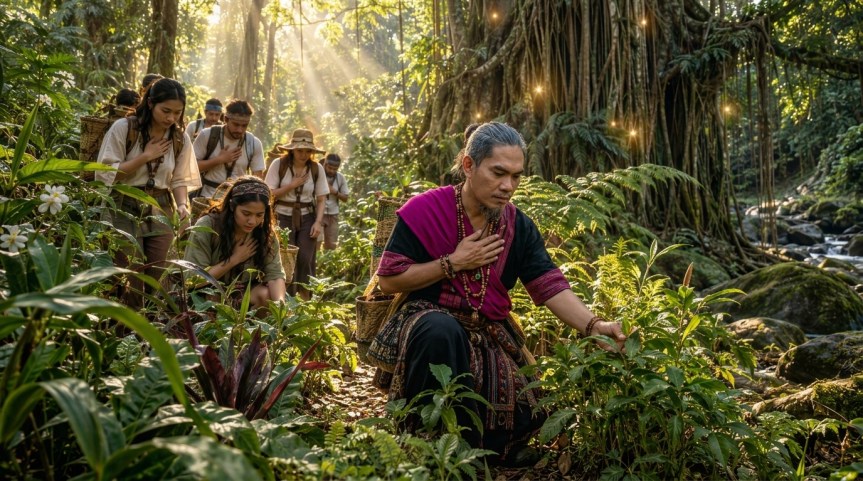
Sharing Hilot Binabaylan with the World

As we share the Hilot Binabaylan Practice with the world, we are not merely transmitting knowledge. We are forming people—developing their skills, refining their abilities, and nurturing the attitudes and values that define an authentic and genuine Hilot Binabaylan Practitioner.

Hilot Binabaylan is a living practice. It is meant to be applied, embodied, and shared—first within one’s family, then extended to the community. As a Mentor and initiator of this practice, my prayer is that those who are initiated will actively live the teachings, bringing healing to real people with real conditions, rooted in compassion, discipline, and accountability.

Beyond Being a Practitioner: The Call to Level Up

Those who are initiated into Hilot Binabaylan are encouraged not to remain practitioners alone. The path invites further growth—first into becoming a Hilot Tanglaw Mentor, and for some, eventually, a Hilot Doctor.

Each level represents not status, but service, mastery, and responsibility.

How to Climb the Ladder and Become a Hilot Tanglaw Mentor

As a Hilot Binabaylan Practitioner, you are expected to actively and consistently practice the Hilot Binabaylan Method for at least one (1) to two (2) years. This means:

  • Taking real clients
  • Performing full Hilot Binabaylan assessments
  • Applying appropriate traditional treatment protocols
  • Documenting your work through case studies

Required Practice Experience

  • Minimum: 1–4 clients per month
  • Total: At least 12 to 48 documented case studies per year

This sustained practice develops personal mastery, strengthens intuition, deepens diagnostic skills, and anchors the practitioner in ethical and professional discipline.

Case Study Documentation: A Core Requirement

Each practitioner aspiring to become a Hilot Tanglaw Mentor must submit detailed case study reports based on real treatments they have personally performed.

To respect privacy, real client names are not required. Instead, use a Case ID Code derived from the date, time, and condition treated.

Sample Case Format

  • Case ID: 5526-800-SN
  • Chief Complaint: Stiff Neck
  • History of Present Illness: Cellphone and computer work
  • Past Personal History: Taking medication for hypertension
  • Family Medical History: Hypertension and diabetes
  • Habits of Daily Living: Smoking cigarettes

All information should be gathered following the official Hilot Profile Form, which includes:

  • Personal and health background
  • Sensory assessments (visual, auditory, olfactory, tactile)
  • Traditional diagnostic techniques
  • Clear treatment recommendations

Treatment Application and Client Feedback

After documenting your assessment, you must clearly state:

  • The treatment plan you intend to perform
  • The specific Hilot Binabaylan techniques applied

During the actual treatment:

  • Observe the client’s reactions at every stage
  • Note physical, emotional, and energetic responses
  • Ask for client feedback after the session
  • Record the results, improvements, or challenges observed

These observations are crucial. They demonstrate your ability to reflect, evaluate, and refine your healing practice.

From Case Studies to Mentorship

The primary intention before elevating a practitioner into a Hilot Tanglaw Mentor is the accumulation of real, applied, and documented healing experience over one to two years.

From this direct practice and documentation, the practitioner develops:

  • Technical mastery of Hilot Binabaylan methods
  • Confidence in diagnosis and intervention
  • The ability to articulate processes and outcomes
  • Readiness to teach, guide, and mentor others

These competencies are essential, as Hilot Tanglaw Mentors will later share their lived knowledge during in‑person cohorts and apprenticeships.

Advancing Further: The Path to Hilot Doctor

Upon successful confirmation and service as a Hilot Tanglaw Mentor, those who wish to advance to the Doctorate level must fulfill the following:

  • Conduct or assist in the conduct of Hilot Binabaylan Cohorts
  • Complete a minimum of 100 documented case studies
  • Write and present a Dissertation grounded in Hilot Binabaylan practice
  • Submit and defend the work before the Hilot Binabaylan Council

This level represents the highest commitment to the preservation, refinement, and transmission of Hilot Binabaylan as an Indigenous Filipino healing system.

A Living Lineage of Healing

Hilot Binabaylan is not learned in theory alone—it is earned through practice, integrity, and service to others. Each step in the ladder ensures that those who teach and lead are deeply rooted in experience, humility, and responsibility.

May every practitioner who walks this path become not only a healer—but a bearer of light, wisdom, and cultural continuity for generations to come.

📜 Official Announcement: Transition of Academic Titles and the Professionalization of Hilot Binabaylan Practice

In partnership with Templong Anituhan Inc. and Bahay SiAdtala Binabaylan Inc.


The Hilot Academy of Binabaylan formally announces an important transition in its academic titles and credentialing system, undertaken to support the long‑term professionalization, integrity, and global recognition of Hilot Binabaylan Practice as an Indigenous Filipino Healing Art and Science.

Background

On August 8, 2025, Templong Anituhan Inc. and Bahay SiAdtala Binabaylan Inc. issued a joint resolution declaring that all graduates of the Nine (9)‑Day Hilot Binabaylan Training—from 2016 through June 18, 2025—were to be recognized as Masters of Ministry in Hilot Binabaylan Practice (M.Min.HBp). This declaration acknowledged the historical role of the 9‑day training as the foundational and terminal formation program during the early development of Hilot Academy of Binabaylan.

Final Conferral of the Master’s Degree under the 9‑Day Training

In line with the institutional resolution and its transitional provisions:

  • The Nine (9)‑Day Hilot Binabaylan Training Cohort held in Hawaii from April 11–19, 2026 is officially recognized as the final group to receive the Master of Ministry in Hilot Binabaylan Practice (M.Min.HBp) under the legacy training system.
  • Graduates of the Hilot Binabaylan Alignment Training in the Philippines, whose graduation ceremony was held on June 24, 2025, are likewise recognized within the transitional framework established prior to the implementation of the new academic structure.

All degrees and titles previously conferred remain valid, honored, and irrevocable.

New Credential Moving Forward

Beginning after April 2026, all individuals who complete the Nine (9)‑Day Hilot Binabaylan Training shall receive the professional credential:

Certified Hilot Binabaylan Practitioner (CHBP)

This title reflects professional competency and ethical authorization to practice Hilot Binabaylan, while distinguishing the 9‑day program from graduate‑level academic degrees.

Toward Full Academic Professionalization

This transition gives way to the formal academicization of Hilot Binabaylan through a structured degree pathway:

  • Bachelor’s Degree (4 years)
    Bachelor of Indigenous Filipino Healing Arts and Sciences
  • Master’s Degree in Ministry (2 years)
    Master of Ministry in Hilot Binabaylan Practice
  • Doctoral Degree in Ministry (3 years)
    Doctor of Ministry in Indigenous Filipino Healing Arts and Spirituality

This degree ladder ensures depth, rigor, accountability, and sustainability, while honoring both tradition and contemporary standards of ministerial and professional education.

A Word of Gratitude

We extend our deepest respect and gratitude to all graduates who carried the title Master of Ministry in Hilot Binabaylan Practice during its formative years. Your dedication, service, and leadership laid the foundation upon which this next chapter is being built.


For official guidelines, program updates, and future enrollment announcements, please continue to visit the Hilot Academy of Binabaylan website.

In service of healing, culture, and embodied wisdom.


Hilot Academy of Binabaylan
Templong Anituhan Inc.
Bahay SiAdtala Binabaylan Inc.

Hilot Is Not a Performance: A Statement from Hilot Academy of Binabaylan

In a time when healing arts are increasingly framed as performance—ranked, scored, displayed, and even competed for—Hilot Academy of Binabaylan finds it necessary to make a clear and grounded statement:

Hilot is not performance. Hilot is not competition. Hilot is compassion in action.

Healing Is Not an Arena

In competitive massage environments, practitioners are evaluated according to visible technique, speed, precision, and dramatic execution. The goal of competition is clear: to win, to outshine others, and to be crowned a champion. Competition demands comparison. It requires that one practitioner rise above another.

This framework, however useful for performance-based disciplines, does not belong to Hilot.

When someone enters a competition, their focus naturally turns inward:

  • Am I skilled enough?
  • How do I outdo my opponent?
  • How do I stand out to the judges?

Hilot does not ask these questions.

Hilot Is a Relationship, Not a Display

Hilot is rooted in malasakit—deep, embodied compassion. It is a healing relationship between manghihilot and patient, guided by listening, presence, and humility. The body is not a prop. Pain is not a problem to conquer. The person receiving Hilot is never a means to recognition or achievement.

In Hilot:

  • The goal is not applause, but relief.
  • The focus is not superiority, but service.
  • The outcome is not a trophy, but restored balance and quality of life.

Healing cannot be rushed for spectacle. It cannot be choreographed for judges. True healing unfolds quietly, often invisibly, and always uniquely.

Presence Over Performance

Performance culture rewards doing more—more pressure, more techniques, more flair. Hilot teaches discernment: knowing when to soften, pause, listen, and yield.

A manghihilot trained in the tradition of Hilot Academy of Binabaylan understands that mastery is not proven by dominance but by sensitivity. The hands are guided by empathy, not ego. The work is grounded in respect for the body’s own intelligence and the spirit’s pace of healing.

Compassion Is the True Measure of Skill

At Hilot Academy of Binabaylan, we do not train champions of competition.
We cultivate guardians of healing.

Skill in Hilot is measured not by comparison, but by:

  • How safely pain is eased
  • How gently trauma is acknowledged
  • How respectfully a life is supported toward wholeness

There is no opponent to defeat—only suffering to tend, imbalance to restore, and dignity to protect.

A Reminder to the Healing Community

As Hilot gains wider attention locally and globally, we caution against reducing it to a performative craft or competitive commodity. Doing so risks stripping Hilot of its soul and displacing the patient from the center of the practice.

Hilot is not about being the best.
Hilot is about doing good.

Our Call to Action

Hilot Academy of Binabaylan calls upon:

  • Practitioners to anchor their work in compassion, not comparison
  • Students to approach Hilot as a vocation of service, not a platform for recognition
  • Institutions and organizers to honor Hilot as a healing tradition, not a performance category

We invite all who feel called to healing—not competition—to walk this path with humility, discipline, and responsibility.

If your intention is to heal rather than win,
to serve rather than perform,
to restore life rather than impress an audience

Hilot may be your calling.

👉 Learn, study, and journey with us at Hilot Academy of Binabaylan, where healing is taught not as a spectacle, but as a sacred duty rooted in compassion, culture, and care.

Understanding the Doctor of Ministry in Indigenous Filipino Healing Arts and Sciences, with Specialization in Hilot Binabaylan Practice: Legitimacy, Context, and Alignment with Philippine and International Education Frameworks

As Indigenous knowledge systems reclaim their rightful place in global conversations on healing, education, and spirituality, the need for culturally appropriate doctoral pathways has become increasingly clear. One such pathway is the Doctor of Ministry (DMin) in Indigenous Filipino Healing Arts and Sciences, with Hilot Binabaylan Practice as a formal area of specialization.

This degree affirms Indigenous Filipino healing as a living, sacred, and community‑embedded practice, while remaining fully aligned with Philippine regulatory structures and international norms for professional and ecclesiastical education.

This article explains the nature of the degree, the role of Hilot Binabaylan as a specialization, and why this doctoral framework is legitimate, ethical, and non‑conflicting with governing accreditation agencies.

What Is a Doctor of Ministry (DMin)?

A Doctor of Ministry (DMin) is an internationally recognized professional, practice‑based doctoral degree designed for experienced practitioners engaged in leadership, ministry, and community service. Unlike a Doctor of Philosophy (PhD), which is primarily research‑oriented, the DMin emphasizes:

  • Advanced applied practice
  • Integration of theory, spirituality, and lived context
  • Ethical leadership and service
  • Formation within real communities

Globally, the DMin is regarded as a terminal doctorate for professional ministry, commonly offered by seminaries and religious institutions. It is not a medical degree, nor is it intended to lead to licensure in regulated professions such as medicine or allied health.

This definition is consistent across Asia, North America, and Europe and provides the correct academic and ethical container for Indigenous and spiritual forms of healing leadership.

Indigenous Filipino Healing as Ministry, Not Medicine

Indigenous Filipino healing traditions—including Hilot Binabaylan—operate within a worldview where healing is inseparable from:

  • Spiritual vocation
  • Ritual authority
  • Ancestral lineage
  • Communal responsibility
  • Ethical service to people and land

These traditions do not arise from biomedical paradigms, nor do they claim the authority of modern clinical medicine. Instead, they function as sacred healing ministries, transmitted through apprenticeship, ritual initiation, and cultural responsibility.

For this reason, a Doctor of Ministry—rather than a medical doctorate or purely academic PhD—is the most appropriate and non‑colonizing doctoral framework.

Hilot Binabaylan Practice as a Specialization

Within the Doctor of Ministry in Indigenous Filipino Healing Arts and Sciences, Hilot Binabaylan Practice functions as a focused area of specialization, allowing advanced practitioners to deepen, refine, and transmit this specific Indigenous healing tradition at the doctoral level.

What the Specialization Affirms

The Hilot Binabaylan specialization recognizes the practice as:

  • A comprehensive Indigenous Filipino healing system
  • Integrating bodywork (hilot), spiritual diagnostics, ritual, prayer, and herbal knowledge
  • Rooted in cosmology involving Diwata, Anito, Kalikasan, and ancestral guidance
  • Governed by ethical obligations to community, students, and lineage

At the doctoral level, specialization in Hilot Binabaylan does not merely teach techniques. It develops senior practitioners and stewards who are capable of:

  • Ethical leadership in healing communities
  • Teaching and mentoring future practitioners
  • Developing curricula and ritual frameworks
  • Articulating Indigenous healing in interfaith, intercultural, and academic spaces

“Healing Arts and Sciences”: A Legitimate Academic Framing

The phrase “Healing Arts and Sciences” is intentional and internationally understood.

  • Healing Arts refers to ritual practice, embodied skill, ceremonial work, and intuitive diagnostics.
  • Healing Sciences acknowledges structured bodies of Indigenous knowledge, including anatomy as understood in hilot, ethnomedicine, cosmology, psycho‑spiritual health, and community systems of care.

This framing does not imply biomedical practice and does not claim equivalence to medical licensure. Instead, it affirms that Indigenous healing traditions possess their own internal sciences, methods, and epistemologies.

Such language is widely used in Indigenous, traditional, and complementary healing education worldwide and is considered academically and culturally legitimate.

Alignment with CHED and Philippine Regulatory Frameworks

In the Philippines, the Commission on Higher Education (CHED) regulates civil, state‑recognized academic degrees that lead to regulated professions, licensure, or government employment ranking.

However, it is well established that:

  • Ecclesiastical, ministerial, and vocational degrees—including Doctor of Ministry programs—may operate lawfully outside CHED’s Special Order (SO) system when they do not claim civil professional status.
  • Many Philippine seminaries and religious institutions clearly state that their DMin degrees are professional and ecclesiastical, not civil licensure pathways.

The Doctor of Ministry in Indigenous Filipino Healing Arts and Sciences, including the Hilot Binabaylan specialization, follows this exact and lawful model:

  • It is explicitly a ministerial doctorate
  • It makes no claim to medical or allied health licensure
  • It does not represent itself as a CHED‑regulated professional qualification

For this reason, it does not conflict with CHED authority, nor does it encroach upon regulated healthcare professions.

International Context and Precedent

Internationally, Doctor of Ministry degrees are widely accepted as legitimate professional doctorates within religious and cultural education systems. Indigenous healing doctorates in other cultures—such as Native American Sacred Medicine or African Indigenous Healing—are similarly framed within:

  • Ecclesiastical authority
  • Cultural legitimacy
  • Community validation
  • Ethical self‑regulation

The DMin in Indigenous Filipino Healing Arts and Sciences, with specialization in Hilot Binabaylan Practice, stands comfortably within these global norms.

Legitimacy, in this context, is established through:

  • Transparency of scope
  • Accuracy of representation
  • Integrity of formation
  • Accountability to community and tradition

What This Degree Is—and Is Not

This Degree IS:

  • A professional doctorate in ministry
  • A recognition of advanced Indigenous Filipino healing leadership
  • A credential for senior practitioners, mentors, and ritual leaders
  • A framework for safeguarding and transmitting Hilot Binabaylan

This Degree IS NOT:

  • A medical doctorate (MD)
  • A substitute for regulated healthcare degrees
  • A biomedical or pharmaceutical qualification
  • A claim to clinical or hospital‑based licensure

Clear communication of these boundaries ensures legal clarity, ethical practice, and protection of the tradition.

Conclusion: Safeguarding Hilot Binabaylan Through the Right Doctorate

The Doctor of Ministry in Indigenous Filipino Healing Arts and Sciences, with Hilot Binabaylan Practice as a specialization, represents a conscious and responsible choice.

Rather than forcing Indigenous healing into unsuitable Western academic molds, it:

  • Honors ancestral authority
  • Respects Philippine regulatory boundaries
  • Aligns with international ecclesiastical practice
  • Protects Hilot Binabaylan as a living sacred science

In doing so, it affirms that Indigenous Filipino healing does not need to imitate biomedicine to be legitimate—it needs the right container, rooted in its own cosmology, ethics, and purpose.

The Role of a Doctor of Ministry in Indigenous Filipino Healing Arts and Sciences (Specialization in Hilot Binabaylan Practice)

A Doctor of Ministry in Indigenous Filipino Healing Arts and Sciences (DMin‑IFHAS), with specialization in Hilot Binabaylan Practice, is a senior practitioner, cultural steward, and spiritual leader. The role is grounded in service, ethical responsibility, and ancestral accountability, not in biomedical authority.

This doctorate recognizes mastery of practice and leadership, not clinical licensure.

Core Duties and Responsibilities

1. Custodian of Indigenous Filipino Healing Knowledge

A DMin‑IFHAS is entrusted with the protection, preservation, and proper transmission of Indigenous Filipino healing traditions, particularly Hilot Binabaylan.

This includes:

  • Safeguarding ritual integrity and sacred protocols
  • Preventing misuse, commercialization, or misrepresentation of hilot
  • Honoring ancestral lineages and spiritual authority
  • Ensuring teachings are transmitted responsibly and respectfully

Primary responsibility: protect the tradition from erosion, harm, and distortion.

2. Senior Practitioner of Hilot Binabaylan

As a doctoral‑level practitioner, the individual is expected to demonstrate advanced mastery of practice, not just knowledge.

This includes:

  • Ethical application of hilot bodywork
  • Spiritual diagnostics rooted in Indigenous cosmology
  • Ritual healing and prayer within the Binabaylan framework
  • Discernment of appropriate scope of practice

Key expectation: healing is offered as sacred service, not as commercial treatment.

3. Spiritual and Ministerial Leadership

Because this is a Doctor of Ministry, the individual functions as a healing minister, not merely a technician.

Duties include:

  • Providing spiritual guidance to individuals and communities
  • Leading healing rituals, commemorations, and rites
  • Offering pastoral‑style care during illness, grief, or transition
  • Serving as a moral and ethical presence in the community

People should expect: compassion, integrity, and spiritual maturity.

4. Teacher, Mentor, and Formation Guide

A doctoral holder is expected to form others, not merely to practice privately.

Responsibilities include:

  • Teaching Hilot Binabaylan within proper initiatory frameworks
  • Mentoring apprentices, students, or junior practitioners
  • Developing curricula, training materials, and learning pathways
  • Evaluating readiness, ethics, and character of learners

Emphasis: formation of healers, not mass production of certificates.

5. Cultural and Interfaith Representative

A DMin‑IFHAS often serves as a bridge figure between Indigenous Filipino healing traditions and wider society.

This includes:

  • Explaining hilot responsibly to institutions and the public
  • Participating in interfaith and intercultural dialogue
  • Advocating for Indigenous healing rights and dignity
  • Representing Filipino Indigenous spirituality with accuracy

Public role: educator and advocate, not polemicist.

6. Developer of Indigenous Healing Scholarship (Practice‑Based)

Although not a PhD researcher, a DMin holder contributes to practice‑based scholarship.

This may include:

  • Documenting lived healing practices
  • Writing reflective studies, manuals, or ritual texts
  • Producing community‑based research or capstone projects
  • Preserving oral traditions in ethical and consent‑based ways

Scholarship is grounded in lived practice, not detached theory.

7. Ethical Gatekeeper and Accountability Figure

A Doctor of Ministry bears heightened responsibility for ethical conduct.

This includes:

  • Clear boundaries with clients and students
  • Transparency about what hilot can and cannot do
  • Referrals to medical professionals when necessary
  • Refusal to claim biomedical authority or guaranteed cures

Ethics are non‑negotiable at the doctoral level.

What the Public Should Reasonably Expect

People engaging with a DMin‑IFHAS may rightly expect:

Respect for Indigenous knowledge
Spiritual depth and maturity
Clear ethical boundaries
No false medical claims
Honest referral when a case is outside scope
Teaching that honors culture, not ego

What the Public Should NOT Expect

It is equally important to state what should not be expected:

❌ Medical diagnosis or clinical treatment
❌ Hospital‑level care or biomedical procedures
❌ Replacement of licensed physicians
❌ Guaranteed cures or miracles
❌ Commercial exploitation of sacred rituals

A DMin‑IFHAS does not function as a medical doctor and should never be presented as such.

The Meaning of “Doctor” in This Context

The title “Doctor” in a Doctor of Ministry means:

  • A teacher and guide
  • A recognized authority within a specific tradition
  • A person entrusted with stewardship and formation
  • A senior practitioner of a sacred calling

It does not mean physician or biomedical expert.

This understanding is consistent worldwide for Doctor of Ministry degrees and Indigenous healing doctorates.

Summary: A Role of Service, Not Status

At its heart, a Doctor of Ministry in Indigenous Filipino Healing Arts and Sciences, specializing in Hilot Binabaylan Practice, carries a calling defined by:

Service over status
Responsibility over recognition
Stewardship over supremacy

The doctorate exists to protect the tradition, serve the people, and honor the ancestors, not to compete with modern medicine or claim inappropriate authority.

Code of Ethics

Doctor of Ministry in Indigenous Filipino Healing Arts and Sciences (Specialization in Hilot Binabaylan Practice)

Preamble

The Doctor of Ministry in Indigenous Filipino Healing Arts and Sciences, with specialization in Hilot Binabaylan Practice, is a sacred trust conferred upon senior practitioners who serve as healers, teachers, spiritual leaders, and custodians of Indigenous Filipino healing traditions.

This Code of Ethics articulates the moral, spiritual, professional, and cultural responsibilities of all who bear this title. It exists to protect the people, the tradition, the institution, and the ancestral lineage from harm, misuse, or misrepresentation.

Acceptance of this doctorate signifies a commitment to service over status, integrity over authority, and stewardship over personal gain.

I. Foundational Ethical Principles

All holders of this degree shall be guided by the following principles:

  1. Sacredness of Healing
    Healing is a sacred act rooted in ancestral wisdom, spiritual guidance, and service to the community.
  2. Ancestral Accountability
    The healer is accountable not only to institutions and communities, but to ancestors, lineage, and future generations.
  3. Respect for Human Dignity
    Every person is approached with respect, compassion, consent, and cultural sensitivity.
  4. Truthfulness and Transparency
    The healer commits to honesty in representation, practice, and communication.
  5. Decolonial Integrity
    Indigenous healing is honored on its own terms, not reshaped to imitate biomedical or colonial frameworks.

II. Scope of Practice and Professional Boundaries

  1. Non‑Medical Representation
    A DMin‑IFHAS holder shall not claim or imply status as a licensed medical doctor, physician, or healthcare professional.
  2. No Biomedical Diagnosis or Treatment
    The practitioner shall not diagnose diseases, prescribe pharmaceutical drugs, or perform clinical medical procedures.
  3. Clear Scope Disclosure
    Clients, students, and communities must be clearly informed that Hilot Binabaylan is an Indigenous spiritual and healing practice, not a replacement for modern medical care.
  4. Right to Referral
    When a condition is beyond the scope of Indigenous healing, the practitioner has an ethical duty to refer individuals to appropriate licensed medical professionals.

III. Ethical Practice of Hilot Binabaylan

  1. Competent and Trained Practice
    Healing practices shall only be performed within the practitioner’s level of training, initiation, and spiritual readiness.
  2. Consent and Volition
    No healing, ritual, or energetic work shall be performed without informed and voluntary consent.
  3. Non‑Exploitation
    The practitioner shall never exploit spiritual authority, dependency, vulnerability, or faith for personal, financial, or sexual gain.
  4. Integrity of Ritual
    Sacred rituals, prayers, and spiritual protocols shall not be altered, commercialized, or performed frivolously.

IV. Teaching, Initiation, and Transmission

  1. Responsible Transmission
    Hilot Binabaylan teachings shall be passed only to individuals who demonstrate readiness, ethical character, and respect for the tradition.
  2. No Mass Initiation
    The practitioner shall not dilute the tradition through mass certifications, instant initiation, or fraudulent credentialing.
  3. Mentorship and Discernment
    Teaching is a process of formation, mentorship, and discernment, not merely information transfer.
  4. Protection of Sacred Knowledge
    Certain teachings may remain restricted, oral, or lineage‑held and shall not be publicly disclosed without ancestral and institutional permission.

V. Cultural and Community Responsibility

  1. Cultural Respect
    The practitioner must honor the diverse Indigenous cultures, regional expressions, and lineages within Filipino spiritual traditions.
  2. Community Accountability
    Practice shall remain accountable to community elders, councils, or recognized spiritual authorities, not solely to individual interpretation.
  3. Advocacy Without Appropriation
    Advocacy for Indigenous healing must uplift the people and culture, not center personal charisma, branding, or dominance.

VI. Ethical Leadership and Ministry

  1. Servant Leadership
    A Doctor of Ministry leads through humility, service, and example—not coercion or authoritarianism.
  2. Pastoral Care Standards
    Spiritual counsel must be compassionate, non‑judgmental, and respectful of personal agency.
  3. Boundaries and Safeguards
    Clear emotional, sexual, financial, and spiritual boundaries shall be maintained at all times.
  4. Conflict Resolution
    Disputes shall be addressed through dialogue, mediation, and ancestral values, not public shaming or abuse of authority.

VII. Scholarship, Documentation, and Research Ethics

  1. Practice‑Based Scholarship
    Research and writing shall arise from lived practice and community engagement, not extraction or academic exploitation.
  2. Informed Consent in Documentation
    Stories, rituals, or practices shared publicly must have consent and must protect identities when needed.
  3. No Intellectual Theft
    Indigenous knowledge shall not be appropriated, plagiarized, or claimed as personal invention.

VIII. Integrity of the Doctoral Title

  1. Proper Use of the Title “Doctor”
    The title “Doctor” shall be used only in its ministerial and professional context, with clarity about its meaning.
  2. No Misleading Claims
    Marketing, teaching materials, or public statements shall not mislead others regarding authority, outcomes, or capabilities.
  3. Representation of the Institution and Tradition
    Holders of this degree are ambassadors of the institution and the tradition and shall act in a manner that upholds their dignity.

IX. Accountability and Consequences

  1. Ethical Review
    Alleged violations of this Code may be subject to review by an ethics council, elders’ council, or institutional authority.
  2. Corrective Measures
    Actions may include guidance, suspension, revocation of teaching authority, or withdrawal of credentials, depending on severity.
  3. Restorative Justice
    Wherever possible, accountability shall follow restorative and reconciliatory principles aligned with Indigenous values.

Closing Commitment

To accept the title Doctor of Ministry in Indigenous Filipino Healing Arts and Sciences (Hilot Binabaylan Practice) is to accept a lifelong obligation:

To heal without harm
To teach without ego
To lead without domination
To remember without distortion
And to serve with honor to the ancestors, the people, and the future

Guardians of the Sacred: A Declaration of Autonomy, Integrity, and Governance of Hilot Binabaylan

Hilot Binabaylan is an autonomous religious and cultural healing practice, self‑governed within its own spiritual tradition and operating independently of state credentialing or regulatory bodies such as TESDA and PITAHC. This autonomy, however, does not imply the absence of standards. On the contrary, it demands unwavering discipline, accountability, and integrity.

The standards that guide Hilot Binabaylan were established and continually strengthened by Apu Adman through decades of practice, study, and research. These standards are deeply rooted in his family lineage and further enriched by the wisdom of local healers and communities with whom he has worked over the years. They arise not from convenience or compliance, but from lived tradition and ancestral responsibility.

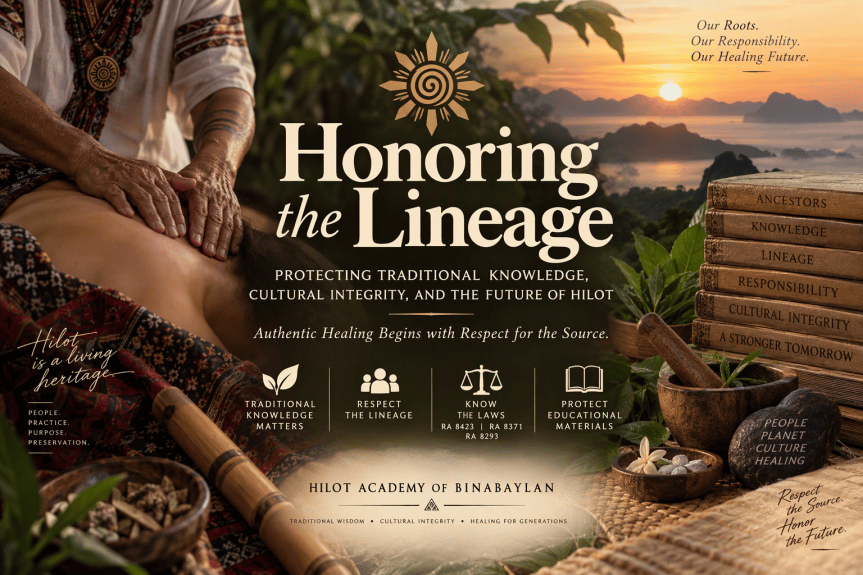
Hilot itself is neither owned nor created by Apu Adman, the Hilot Academy of Binabaylan, nor Templong Anituhan. Equally, it is not owned, developed, or defined by any government agency or private organization. Hilot is the collective heritage of the Filipino people. We therefore stand not as proprietors, but as trustees and stewards of the sacred healing arts and sciences entrusted to us by our ancestors.

Prior to the establishment of the Hilot Academy of Binabaylan, many sacred components of Hilot were gradually set aside in order to conform to modern social, medical, and institutional systems. Traditional birthing knowledge and practices, once integral to Hilot, were separated and absorbed into clinical settings, now primarily handled by licensed nurses and midwives in lying‑in and birthing centers. Traditional bone‑setting practices likewise yielded to osteopathic and orthopedic disciplines. More recently, even Hilot diagnostic practices have faced increasing pressure and risk of discontinuation due to perceived conflicts with prevailing religious beliefs in the Philippines.

In response to this steady erosion, Apu Adman took a deliberate and principled stand. Through sustained research and discernment, he formally established the Hilot Academy of Binabaylan on April 5, 2016, as a dedicated source and sanctuary of authentic Filipino indigenous and traditional healing arts and sciences—preserved in their original spirit and form, and not altered merely to fit modern trends, market demands, or institutional convenience.

As I continue to share the sacred knowledge and wisdom of our Filipino ancestral healing arts and sciences, it is my earnest intention that the practices transmitted through this lineage remain faithful to the teachings from which they arise. While Hilot Binabaylan has not yet been formally recognized by government agencies, it has gained resonance, legitimacy, and influence through the communities and practitioners we have formed both locally and internationally.

In this spirit, I call upon all practitioners of Hilot Binabaylan and Hilot Tanglaw to honor their vows and commitments, and to uphold the credibility, integrity, and living essence of this sacred practice.

Standards of Practice and Governance

  1. All practitioners of Hilot Binabaylan shall render practice only under the guidance and supervision of a duly accredited Hilot Doctor.
  2. Hilot Doctors are accredited authorities empowered to administer healing services, conduct formal training, and transmit teachings within duly recognized clinics and ministerial centers.
  3. Hilot Tanglaw practitioners shall possess demonstrable competence in knowledge, skills, abilities, and mentoring disposition. All mentoring activities must be conducted under the supervision and governance of an accredited Ministerial Center administered by an ordained and accredited Hilot Doctor.

When Capitalism Rewrites Culture: The Slow Erosion of Indigenous Lands and Indigenous Healing

There is a silent but deeply damaging pattern that continues to unfold in Indigenous communities across the Philippines—and many of us are only beginning to recognize it.

Indigenous Peoples are often subjected to systematic mental conditioning by capitalist forces. They are persuaded, lured, and sometimes coerced into selling their ancestral domains—lands that are not mere property, but living extensions of their identity, history, and spirituality. Once these lands are lost, many communities are pushed into economic dependency, surviving on government aid programs such as the Pantawid Pamilyang Pilipino Program (4Ps), rather than living with dignity through self-determination.

This tragedy is not limited to land alone.

The same pattern is happening to Hilot, the Indigenous healing system of the Filipino people.

Hilot: From Living Tradition to Marketable “Experience”

Hilot is not simply massage. It is not a spa service. It is not a wellness “add-on.”

Hilot is a holistic Indigenous medical system rooted in Filipino cosmology, spirituality, community wisdom, and intimate knowledge of the body, nature, and the unseen. It is practiced by healers who understand balance—between lamig and init, katawan and diwa, lupa and espiritu.

Yet today, Hilot is being slowly stripped of its soul.

Under the influence of the modern wellness tourism industry, Hilot is increasingly repackaged into something more “palatable” to foreign markets and upper-class consumers. It is marketed as exotic relaxation, luxury therapy, or spa culture—divorced from its cultural roots and spiritual framework.

In this process, the taal—the original, Indigenous essence of Hilot—is erased.

The Colonial Logic of “Modernization”

Capitalism has a familiar script:

  • Indigenous knowledge is labeled primitive
  • Traditional systems are framed as outdated
  • Western or “modern” approaches are positioned as superior

This logic convinces communities to abandon their own wisdom in favor of externally imposed standards. Just as ancestral lands are sold in exchange for short-term economic relief, Indigenous healing traditions are traded for commercial viability and institutional acceptance.

What remains is a hollow version of the original—lucrative, marketable, and disconnected.

Dependency Replaces Sovereignty

When Indigenous Peoples lose their land, they lose autonomy. When healers lose their tradition, they lose authority.

Instead of empowering communities to sustain themselves through ancestral knowledge, capitalist systems create dependency—whether on government subsidies or on tourism-driven income that benefits corporations more than culture bearers.

Hilot practitioners are encouraged to align with certification systems that prioritize profitability over lineage, technique without spirit, and branding without cultural accountability.

This is not progress. This is erasure disguised as development.

Remembering Is an Act of Resistance

To remember Hilot in its Indigenous form is a political, cultural, and spiritual act.

It means honoring:

  • Ancestral transmission over commercial training
  • Healing as service, not spectacle
  • Community wellness over individual luxury
  • Cultural integrity over tourist expectations

The survival of Hilot depends not on how well it performs in spas, but on how firmly it is rooted in its Indigenous worldview.

Just as ancestral domains are sacred, so too is ancestral knowledge.

To protect Hilot is to protect Filipino identity. To practice it fully is to reclaim sovereignty over our body, spirit, and memory.

The question is not whether Hilot can survive in the modern world.

The real question is: Will we remember what Hilot truly is before it disappears beneath the weight of “wellness”?

The Healing Power of Shared Meals: Food as Nourishment of Body, Heart, and Spirit

In modern society, food is often evaluated through numbers and labels—calories, nutrients, price, or presentation. We ask: Is it healthy? Is it delicious? Is it affordable? While these questions are important, they do not fully capture the deeper meaning of food.

From an indigenous and holistic perspective, the true richness of food is revealed not only in what we eat, but in how and with whom we eat.

The delight of food is not measured by taste, nutrition, or price. 
Its true richness is measured by how it is shared—especially when it is shared with someone you love.

Food as Relationship, Not Just Consumption

In traditional Filipino culture, pagkain is never merely an individual act. It is relational. Meals are invitations to connect—with family, community, ancestors, and the unseen. A simple dish, when shared, becomes abundant. A modest table, when surrounded by loved ones, becomes sacred.

This reflects an ancient wisdom: healing does not happen in isolation. Just as Hilot views the body as interconnected—physical, emotional, mental, spiritual, and cultural—food too nourishes more than the body. It nourishes belonging.

Shared Meals as a Form of Healing

In Hilot Binabaylan practice, imbalance often arises not only from physical causes but from emotional and relational disconnection. Loneliness, grief, and separation weaken the spirit. In contrast, shared meals restore harmony.

When food is shared:
– The body receives nourishment 
– The heart feels seen and included 
– The spirit experiences warmth and grounding 

This is why meals prepared with care and shared in love often feel more satisfying than expensive or elaborate food eaten alone.

Love as an Invisible Ingredient

There is an ingredient that cannot be measured or listed on any label: pagmamahal.

Food prepared or shared with love carries a different quality. It slows us down. It opens conversation. It invites presence. In many indigenous traditions, intention is as important as the material itself. What we feel and offer while eating becomes part of what we ingest.

In this way, every shared meal becomes a quiet ritual—a moment of embodiment, where care is made tangible.

Embodiment in Everyday Life

At Hilot Academy of Binabaylan, we speak of embodiment—not only as a concept, but as a lived practice. Embodiment happens when wisdom is expressed through daily acts: how we touch, how we listen, how we eat, and how we gather.

Sharing food is one of the simplest yet most profound ways to embody healing values:
– Presence over haste 
– Relationship over consumption 
– Gratitude over excess 

A Gentle Reminder

In a world that often eats quickly and alone, let us remember:
Food heals best when it is shared. 
Nourishment deepens when love is present. 
And the table, no matter how simple, becomes a place of restoration when hearts meet.

This is the kind of wellness we uphold at Hilot Academy of Binabaylan—a healing that honors the body, strengthens relationships, and nourishes the spirit.

The Alchemy of Balance: Rehabilitation and the Power of the “Maaram”

Introduction: Redefining Rehabilitation

In the modern world, rehabilitation is often viewed as a clinical process—a way to fix a broken body or a wayward mind. However, in the heart of Philippine tradition, rehabilitation is restoration. It is the act of bringing a person, a family, or a community back into a state of Harmony (Pagkakaisa) and Balance (Patas).

The Anatomy of Imbalance: Pasmo, Bughat, and Baldao Traditional healing recognizes that “damage” isn’t just physical. Baldao (Ilocano): A physical dislocation that requires the manual “resetting” of the frame. Pasmo: A thermal and energetic imbalance caused by the collision of “hot” and “cold,” often manifesting as tremors or weakness. Bughat/Binat: A spiritual and physical relapse. It is a reminder that the body is a temple that requires “sealing” and respect after a period of opening, such as illness or childbirth.

In these cases, the Hilot or Albularyo acts as the architect of recovery, using herbs, heat, and touch to reconstruct what was lost. The “Maaram” and the Neutrality of Knowledge At the center of this world is the Maaram (The Knower/The Wise). The etymology of the word—rooted in Alam (Knowledge)—parallels the English “Witch,” which comes from Wit (to know). A true Maaram is a Keeper of Ancient Mysteries.

They understand that knowledge is a neutral tool, like electricity or a blade. It has no inherent “color” until it is dyed by the Intention of the user. White Intent: Used for healing and protection.

Black Intent (Kulam): Traditionally defined by colonial history as “evil,” but philosophically viewed as the use of power to inflict consequence.

Kulam: The Tool of Restorative Justice Our discussion challenged the modern “demonization” of Kulam. Rather than a purely destructive act, Kulam can be viewed as a constructive tool for the oppressed.

A Self-Defense Mechanism: For those who are poor or powerless against the “rich” or the “mighty,” the cry for divine help awakens the Mangkukulam within.

A Teacher of Lessons: It serves as a spiritual classroom where pain is the medium for a lesson. It forces the offender to face their guilt and restore what they have stolen or broken.

The Universal Ki: This power is not reserved for “special” people. It is the Ki or Chi—the life force—within every individual. It is the manifestation of the human will to defend its own dignity and restore universal balance.

Conclusion: The Flow of Life The ultimate goal of all these mysteries is to ensure that life energy flows freely. Whether through the gentle touch of a healer or the sharp “correction” of a manifest intent, the purpose is the same: to maintain the harmony of the whole. The Maaram does not seek fame or fortune, but lives an ordinary life as a silent guardian of these laws. Knowledge, like Ki, must flow to give life to those who need it. When the “Mangkukulam within” awakens, it is not an act of evil, but the soul’s natural response to restore what is broken.

Hilot Then and Now: Autonomy, Community, and a Modern Framework for Continuity 

By Rev. Rolando Gomez Comon (Apu Adman), Developer and Reviver of Hilot Binabaylan, Founder of Hilot Academy of Binabaylan


Overview

This article clarifies three intertwined questions:

  1. Was hilot a “business” in pre‑colonial times?
  2. How do “necessity” and “commodity” differ—and where does hilot belong?
  3. Did manghihilot have formal groups and leaders in ancient times—and how does that history inform modern debates over legitimacy and leadership?

It closes with a Position Paper presenting the historical‑theological justification for the leadership of the Hilot Academy of Binabaylan, and a peaceful indigenous response to critiques of legitimacy—grounded in culture, service, and spiritual calling.


I. Was Hilot a “Business” in Pre‑Colonial Times?

Short answer: No—not in the modern market sense. In pre‑colonial Philippine communities, hilot was a community health service embedded in spiritual practice, herbal knowledge, and manual healing, provided by manghihilot, albularyo, and babaylan. Compensation typically came through reciprocity—food, portions of harvest, help, or other gifts—rather than profit margins or standardized prices. The work was spirit‑led and community‑validated, not market‑driven.
Sources: Overviews consistently describe hilot as a holistic, culturally embedded practice rather than mere massage or commerce, emphasizing its role in childbirth, midwifery, herbalism, and spiritual healing. [beholdphil…ppines.com], [en.wikipedia.org], [nipino.com]


II. Necessity vs. Commodity—And Where Hilot Belongs

A. Definitions

  • Necessity: Goods or services essential to life and well‑being; demand is relatively inelastic because people need them regardless of price (e.g., food, water, shelter, basic healthcare). [difference.wiki], [fiveable.me]
  • Commodity: A good or service produced for trade, often fungible (interchangeable) and subject to market pricing and speculation (e.g., grains, metals, oil). [en.wikipedia.org], [merriam-webster.com]

B. Where Hilot Belongs

Pre‑colonial hilot functioned as a necessity: it was the primary healthcare for many communities—covering musculoskeletal care, prenatal and childbirth support, herbal medicine, and spiritual balance. Its demand derived from communal need and spiritual obligation, not price sensitivity or brand competition. [beholdphil…ppines.com], [nipino.com]

Modern hilot can be commodified (e.g., spa menus, wellness tourism, branded trainings) when offered through market channels with fees, packages, and certifications. That shift—from necessity to commodity—is a feature of contemporary market systems, not ancient practice. [insights.m…ourism.com]


III. Did Ancient Manghihilot Have Groups and Leadership?

A. Autonomy and Place‑Based Calling

Pre‑colonial healers (manghihilot, babaylan/katalonan, mumbaki, walian, etc.) were typically autonomous, place‑based, and lineage/apprenticeship‑trained. Their recognition flowed from efficacy, ritual authority, and the community’s trust, rather than from a centralized guild or national hierarchy. [en.wikipedia.org], [centerforb…tudies.org]

B. Functional Differentiation, Not Bureaucratic Hierarchy

Communities often distinguished roles—e.g., bone setting and soft‑tissue manipulation (manghihilot), herbal pharmacopeia (albularyo), and ritual leadership (babaylan). This was functional diversity, not a top‑down chain of command. [en.wikipedia.org]

C. Spirit‑Led Leadership

Authority was relational, situational, and spirit‑led. Healers “bowed” to Divine/Diwata/Anito and served communal welfare. Their “leadership” was service‑based: respected because their practice worked, their counsel guided, and their rituals healed. [en.wikipedia.org]

Conclusion: Your understanding is correct. Ancient healers were independent and community‑anchored; modern inter‑group competition is largely a post‑colonial/market phenomenon.


IV. Why Do Modern Legitimacy Conflicts Arise?

  1. Marketization & Branding: As hilot enters market frameworks (pricing, certifications, brand identities), groups understandably advocate for their models and standards—sometimes sliding into competitive claims. [insights.m…ourism.com]
  2. Colonial & Post‑Colonial Disruptions: Historic suppression of indigenous spiritual healing fractured lineages, creating a vacuum later filled by new institutions seeking validation—occasionally through gatekeeping or delegitimization. Scholarly descriptions of babaylan roles and suppression across the archipelago contextualize this dynamic. [en.wikipedia.org]

V. The Role of Hilot Academy of Binabaylan (HAB)

The Hilot Academy of Binabaylan is not a “supreme authority.” It is a modern container—a learning community that preserves, organizes, and passes on indigenous healing knowledge responsibly. HAB provides structure for continuity amidst contemporary realities (urbanization, fragmented lineages, global students), while honoring spirit‑led autonomy and community service as the core of hilot. [beholdphil…ppines.com], [nipino.com]


VI. Position Paper

Historical‑Theological Justification of Leadership in the Hilot Academy of Binabaylan

A. Premises

  1. Historical Continuity: Pre‑colonial hilot thrived as a necessity embedded in communal life, stewarded by healers recognized through efficacy and service, not bureaucratic titles. [beholdphil…ppines.com], [en.wikipedia.org]
  2. Disruption and Need for a Modern Framework: Colonial/post‑colonial disruptions fragmented lineages and ritual ecologies, necessitating contemporary educational structures to safeguard and transmit knowledge. [en.wikipedia.org]
  3. Theological Grounding: In indigenous perspectives, calling (tawag) originates from the Divine/Diwata/Anito. Leadership is diakonia (service), not dominion: a covenant with community well‑being and spiritual balance. [en.wikipedia.org]

B. Claim

HAB leadership is an instrumental guardianship—a service mandate to preserve and cultivate Hilot Binabaylan as living tradition within modern contexts. It organizes curricula, mentorships, and ethics not to supplant community healers but to support, strengthen, and transmit the practice responsibly.

C. Justification

  1. Historical Justification: Establishing an academy aligns with historical patterns of apprenticeship and communal validation, translated into a modern educational container because the original village matrices are often unavailable. [beholdphil…ppines.com]
  2. Theological Justification: Leadership is vocational—rooted in a call to serve. As with babaylan, authority is measured by healing efficacy, ethical conduct, and faithfulness to the spirits and community, not by claims of supremacy. HAB’s leadership adopts this servant‑covenant model. [en.wikipedia.org]
  3. Cultural Justification: HAB functions as cultural stewardship against commodification without context—ensuring that when hilot enters modern venues (spas, tourism, global education), it carries its cosmology, ethics, and community orientation intact. [insights.m…ourism.com]

D. Principles of HAB Leadership

  • Service over Supremacy: Leadership exists to equip, not to dominate.
  • Spirit‑Led Autonomy: Honor practitioners’ place‑based callings and local lineages. [en.wikipedia.org]
  • Community‑First Ethics: Measure success in community welfare and healing outcomes, not in market share. [beholdphil…ppines.com]
  • Scholarly Integrity: Teach hilot’s history, techniques, and cosmology with rigor and respect. [en.wikipedia.org]
  • Reciprocity and Respect: Maintain mutual recognition across diverse hilot traditions and regions. [centerforb…tudies.org]

VII. Peaceful Indigenous Response to Critiques of Legitimacy

When confronted with questions about legitimacy or leadership, HAB offers this peaceful, culturally rooted response:

  1. Affirm the Shared Ground “We honor all who respond to the call of healing. Our ancestors recognized many paths—manghihilot, albularyo, babaylan—each serving the people.”
    Rationale: Pre‑colonial healing was plural, autonomous, and community‑validated. [en.wikipedia.org]
  2. Clarify HAB’s Role “We are an academy—an educational home—built to preserve, teach, and responsibly transmit Hilot Binabaylan amidst modern realities. We do not claim supremacy; we offer structure for continuity.”
    Rationale: HAB is a container, not an empire. [beholdphil…ppines.com]
  3. Invite Reciprocity “Let us collaborate on standards that protect communities and learners—grounded in cosmology, efficacy, ethics, and service—so hilot remains a necessity, not merely a commodity.”
    Rationale: Collaboration resists commodification without context and prioritizes community health. [insights.m…ourism.com]
  4. Return to Calling and Outcomes “Authority in hilot arises from calling, conduct, and healing outcomes. Where practice heals and uplifts, legitimacy follows.”
    Rationale: Spirit‑led, outcome‑based validation mirrors ancestral norms. [en.wikipedia.org]
  5. Keep the Conversation Sacred > “We offer dialogue with respect, mindful that hilot is a sacred trust. May our words and works serve the people and honor the spirits.”
    > Rationale: Ritual respect maintains cultural integrity. [centerforb…tudies.org]

VIII. Practical Implications for Modern Practitioners and Groups

  • For Practitioners: Cultivate efficacy, ethics, community relationships, and ongoing learning. Let your legitimacy arise from service and outcomes. [beholdphil…ppines.com]
  • For Schools/Groups: Build curricula that embed cosmology, herbal knowledge, manual techniques, ritual respect, and community‑first ethics—not just marketable skills. [en.wikipedia.org]
  • For the Public/Students: Seek training that honors hilot’s identity as necessity (health service) rather than commodity (brand alone). Verify community impact and cultural grounding. [difference.wiki], [en.wikipedia.org]

IX. Summary Table (Conceptual)

DimensionPre‑Colonial HilotModern Hilot (Market Context)
Economic NatureNecessity (community health)Commodity (when branded/sold)
ValidationCommunity & Spirits (efficacy, ethics)Market & Certification (branding, fees)
LeadershipAutonomous, spirit‑ledInstitutional roles (school, org leaders)
Core AimHealing & BalanceHealing + structure for continuity
RiskNone (market)Commodification without cultural context

Sources across sections: [beholdphil…ppines.com], [en.wikipedia.org], [nipino.com], [insights.m…ourism.com], [en.wikipedia.org], [centerforb…tudies.org], [difference.wiki], [en.wikipedia.org], [fiveable.me]


X. Closing

Hilot Binabaylan is not a brand to win a market contest; it is a living covenant between healer, community, and the spirits. The Hilot Academy of Binabaylan stands as a modern sanctuary—preserving, teaching, and transmitting a tradition whose legitimacy rests upon calling, conduct, and healing. In dialogue and collaboration, may we ensure that hilot remains what it has always been at heart: a necessity of communal life, not merely a commodity on the shelf.


References

  • Behold Philippines, Hilot: The Ancient Filipino Art of Healing (Aug 14, 2024) – overview of hilot as holistic tradition and community healthcare. [beholdphil…ppines.com]
  • Wikipedia, Hilot – origins, practices, and relation to shamanic traditions. [en.wikipedia.org]
  • Wikipedia, Filipino shamans (babaylan) – roles, spiritual mediation, and community significance. [en.wikipedia.org]
  • Center for Babaylan Studies, What is Babaylan? – descriptions of indigenous spiritual leadership and healing roles. [centerforb…tudies.org]
  • Medical Tourism Magazine, The Ancient Practice of Hilot: Traditional Healing in the Modern World – modern integration and wellness contexts. [insights.m…ourism.com]
  • Nipino.com, Hilot: Nurturing Body, Mind, and Spirit in Traditional Filipino Healing – historical roots and holistic principles. [nipino.com]
  • Merriam‑Webster, Commodity – definitions and market framing. [merriam-webster.com]
  • Wikipedia, Commodity – economic features and fungibility. [en.wikipedia.org]
  • Fiveable, Necessities – Principles of Economics Key Term – demand inelasticity and essential goods. [fiveable.me]

Is Hilot Filipino, or Is Hilot Human?  A Manifesto and Practical Guide for Ethical Practice

Hilot is often asked to define itself.
Is it Filipino, or is it human?

This question does not seek to divide—it seeks clarity: Who may carry the wisdom of Hilot? How is it practiced with integrity today? And how do we safeguard it from appropriation while allowing it to heal beyond borders?

The answer is both simple and sacred:

Hilot is Filipino in ancestry, human in service, and Divine in origin.

Hilot: Filipino in Origin, Human in Purpose

Hilot is undeniably Filipino in origin, born from the land, the ancestors, and the cosmology of the Philippine archipelago. Its rituals, medicines, and ethics were shaped by our relationship with nature and the unseen world.

Yet Hilot is also human in purpose. 
Healing does not discriminate. When someone comes before a healer, we do not ask if they are Filipino or foreigner, wealthy or poor, male, female, lesbian, gay, transgender, or cisgender, religious or non‑religious, left or right in politics.

We see first a soul in need of care.

And Hilot reminds us of a profound truth: the medicine we need is where we live. The healer’s task is to restore right relationship with place—learning from the plants in the yard, the trees in the neighborhood, the waters, winds, and soils that hold the wisdom of our locality. In this way, Hilot is rooted, not replicated; contextual, not colonial.

Who Is a Cultural Bearer Today?

In our time, being a bearer of indigenous wisdom is not only a matter of birth—it is a matter of devotion, discipline, and continuity.

History shows that some who were not indigenous by birth nonetheless served as careful documentarians and allies of Filipino lifeways. But their contributions never replace indigenous voices; they demonstrate that calling and responsibility sometimes transcend ancestry—provided that practice remains accountable to community custodians, elders, and ethical boards.

We also face a poignant reality: many are disconnected from indigenous lifeways due to colonization, modernization, and survival pressures. Meanwhile, some sacred roles—Babaylan, Mumbaki—are sometimes reduced to performance rather than vocation. Authenticity demands daily discipline, ethical responsibility, and living relationship with the ancestors, the Diwata, the land, and community.

The invitation is not to gatekeep healing, but to guard its integrity.

Foundational Manifesto of the Hilot Path


*For Hilot Academy of Binabaylan • Templong Anituhan • Bahay SiAdtala Binabaylan*

Preamble


Hilot is Filipino in ancestry, human in service, and Divine in origin.*
We affirm Hilot as a sacred healing tradition entrusted to humanity through ancestral wisdom and relationship with place. We commit to carrying it as a living vocation—never as spectacle—so its compassion endures and its integrity is preserved.

Vision


A world where ancestral healing is practiced with dignity, ecological reciprocity, and spiritual integrity—bringing balance to individuals, families, and communities across cultures, while honoring Hilot’s Filipino roots.

Core Premises


1. Ancestry & Universality: Hilot’s origin is Filipino; its service is human; its source is Divine. 
2. Place‑Based Medicine: Healing begins with the medicine of one’s own land—plants, elements, and local ecology. 
3. Relational Ethics: Hilot is sustained by right relationship with elders, community, land, spirit, and the person seeking care. 
4. Consent & Sovereignty: Knowledge custodians and communities hold the right to decide how, when, and by whom sacred teachings are shared. 
5. Guardianship of Knowledge: Rites, names, language, symbols, and cosmology are protected against exploitation and misuse. 
6. Economic Justice: We reject profiteering and extractive commerce; we practice fair exchange and prioritize community benefit. 
7. Ecological Reciprocity: We take only what is needed, replant and restore, and leave no harm in our healing. 
8. Accountability: We welcome feedback, submit to ethical review, and repair trust when harm occurs.

Commitments (Practitioner Oath)


As a bearer of the Hilot Path, I pledge to:
– Serve all who seek healing, without discrimination or gatekeeping. 
– Honor elders and cite teachers, sources, and lineages. 
– Practice with place—prioritize local plants, elements, and ecology. 
– Seek consent from community custodians before sharing sensitive rites. 
– Name Hilot as Filipino ancestral medicine; never erase its origin. 
– Avoid appropriation: no rebranding, repackaging, or commercialization of sacred rites. 
– Maintain fair pricing and community care provisions (scholarships, clinics). 
– Keep ritual discipline—study, supervision, reflection, and service. 
– Uphold safety and competence, referring out when needed. 
– Respect interfaith diversity and spiritual autonomy. 
– Build global solidarity without diluting the tradition.

Operational Standards


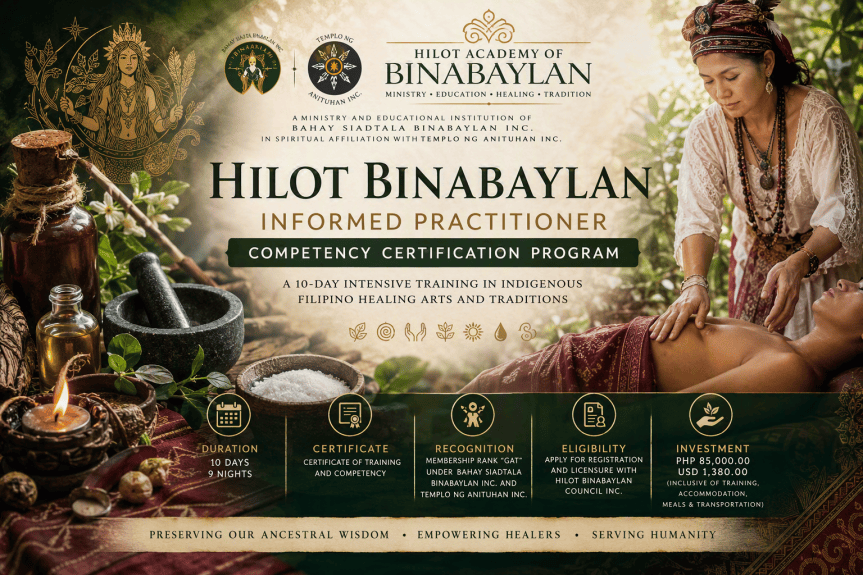
– Training Pathways: Study via Hilot Academy of Binabaylan programs—Hilot Binabaylan Training, Aghamic Divinity & Ministry, and the Master’s in Ministry on Hilot Binabaylan Practice. 
– Supervision: Maintain mentorship under recognized practitioners and engage in peer review. 
– Practice Protocols: Use thorough assessment, place‑based pharmacognosy, ethical bodywork, and culturally rooted ritual. 
– Community Protocols: Offer free/low‑cost clinics; respond to disaster recovery with trauma‑informed care; contribute to local public health. 
– Safeguarding: Establish ethics boards to protect sacred rites, names, and symbols; require consent for publication or teaching.

Public Pledge (Publishable)


I recognize Hilot as Filipino ancestral medicine gifted by the Divine. I vow to study with integrity, practice with humility, honor the elders, protect sacred knowledge, and serve all who seek healing. I will not exploit, rebrand, or commercialize rites. I will learn from the land where I stand, give credit where due, share benefits fairly, and remain accountable to community and spirit. So I pledge, as a guardian of the Hilot Path.

How to Walk the Hilot Path—Without Appropriation


*A Practical Guide for Seekers, Practitioners, and Allies*

Why This Matters


When Hilot is shared without context or consent, its integrity is eroded and communities are harmed. When it is learned responsibly—through relationship, study, and reciprocity—Hilot lives and heals across generations.

What Is Cultural Appropriation?


– Appropriation is taking elements of a tradition without permission, context, or benefit to its source community—often for profit or prestige. 
-Respectful participation means practicing with consent, mentorship, proper attribution, cultural context, and fair benefit‑sharing.

12 Practical Steps to Walk the Path Responsibly


1. Self‑Location: Name who you are (ancestry, location, privilege, purpose). Know your motivations and limits. 
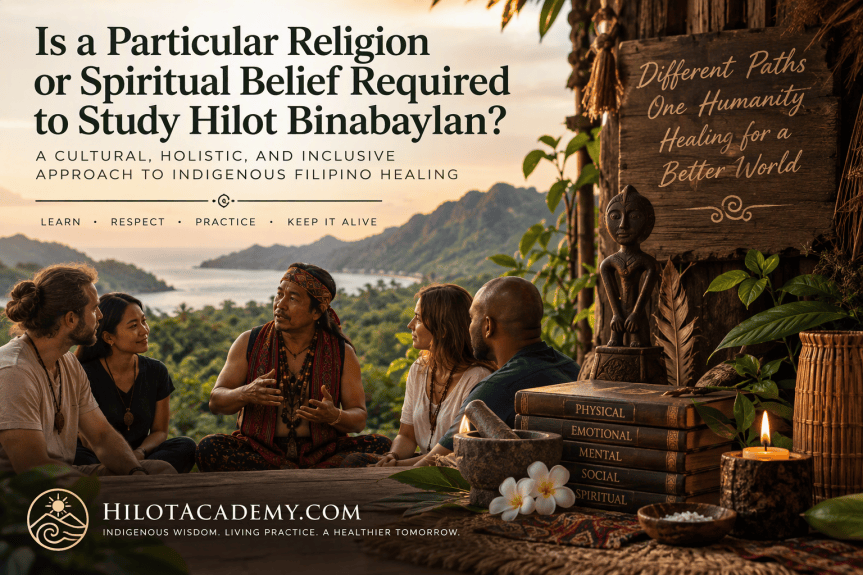
2. Relationship First: Seek elders, recognized practitioners, or community leaders. Prioritize listening and service over performing. 
3. Formal Study & Supervision: Enroll in Hilot Academy of Binabaylan programs; commit to ongoing mentorship and peer review. 
4. Place‑Based Practice: Use local plants and ecology; avoid importing materials to claim authenticity. 
5. Learn the Language & Cosmology: Study terms (Diwata, Anito), prayers, ethics, and context. 
6. Consent & Boundaries: Ask before teaching or sharing rites; honor restrictions and lineage‑specific practices. 
7. Transparent Attribution: Always credit teachers, elders, communities, and sources. Never rename Hilot into your brand. 
8. Fair Exchange & Community Benefit: Price ethically, offer scholarships, and reinvest in community health initiatives. 
9. Safeguard Sacred Rites: Distinguish public vs. restricted ceremonies; avoid filming or publishing sacred moments without consent. 
10. Accountability Mechanisms: Join an ethics circle, invite feedback, and repair harm with humility and tangible action. 
11. Responsible Storytelling: Avoid sensationalizing “exotic” elements; share narratives that uplift dignity and context. 
12. Sustainable Ecology: Harvest respectfully, replant, and favor non‑extractive methods; the land is a teacher, not a resource.

Before You Offer a Hilot Service (Checklist)


– Have you completed recognized study and secured mentorship? 
– Do you understand assessment, contraindications, and safe practice? 
– Have you obtained consent for any ritual or cultural element you’ll use? 
– Is your pricing aligned with fair exchange and community benefit? 
– Are your materials sourced ecologically and locally when possible? 
– Do you have a plan for referrals and ongoing supervision?

Red Flags vs. Green Flags


– 🚩 Red Flags: Rebranding Hilot; selling sacred rites as workshops; using imported herbs to claim authenticity; no elders credited; filming rituals without consent; “instant certification.” 
– ✅ Green Flags: Clear lineage and teachers; consent protocols; place‑based medicine; ethics policy; mentorship; fair pricing; community clinics.

Scenarios & Guidance
– Diaspora Filipino: Reconnect through study, language, and local ecology; serve your local Filipino community with consent and accountability. 
– Non‑Filipino Practitioner: Name Hilot’s Filipino ancestry; commit to mentorship and benefit‑sharing; avoid rebranding; listen more than you speak. 
– Wellness Entrepreneur: Build models that prioritize community benefit over profit; never commodify sacred rites; maintain transparent attribution. 
– Content Creator: Obtain permission; avoid filming sacred rites; credit sources; educate without sensationalism. 
– Academic Researcher: Practice ethical review; co‑author with community where applicable; share results and benefits transparently.

How to Start—Today


1. Enroll in Hilot Academy’s orientation and foundational training. 
2. Join a mentorship circle with recognized Hilot Binabaylan practitioners. 
3. Map local plants and ecological allies where you live. 
4. Draft your personal ethics statement aligned with the Foundational Manifesto. 
5. Offer one community service per month (clinic, class, or garden day). 
6. Set a learning plan: cosmology, language, ritual, clinical safety.

From Curiosity to Commitment: A Convincing Call to Action

Do not merely learn Hilot. 
Live it.

Do not consume indigenous wisdom. 
Serve it.

Do not ask what Hilot can give you. 
Ask what you are willing to give—time, humility, discipline, and respect—to ensure its survival for generations to come.

If you feel called to:


– study Hilot beyond technique, 
– honor Filipino indigenous spirituality with integrity, 
– and practice healing rooted in responsibility, not entitlement—

then the door is open.

Answer the Call


– Sign the Manifesto: Publicly pledge to ethical practice and guardianship. 
– Join Mentorship: Enroll in Hilot Academy of Binabaylan programs and secure supervision with recognized Hilot Binabaylan mentors. 
– Build Local Practice: Create community clinics, plant medicine gardens, and ethical service models where you live. 
– Protect the Sacred: Form or join a local ethics circle to safeguard rites, names, and symbols.

📩 Ready to begin?
Reply with “Hilot Orientation” to receive your introductory session, the Foundational Manifesto signatory form, and the mentorship pathway through Hilot Academy of Binabaylan and Templong Anituhan.

🌱 The ancestors are calling. The Diwata are watching. 
Will you carry this medicine with integrity?