Reclaiming the Soul: Understanding Modern Anxiety and Depression as Indigenous Spiritual Illnesses

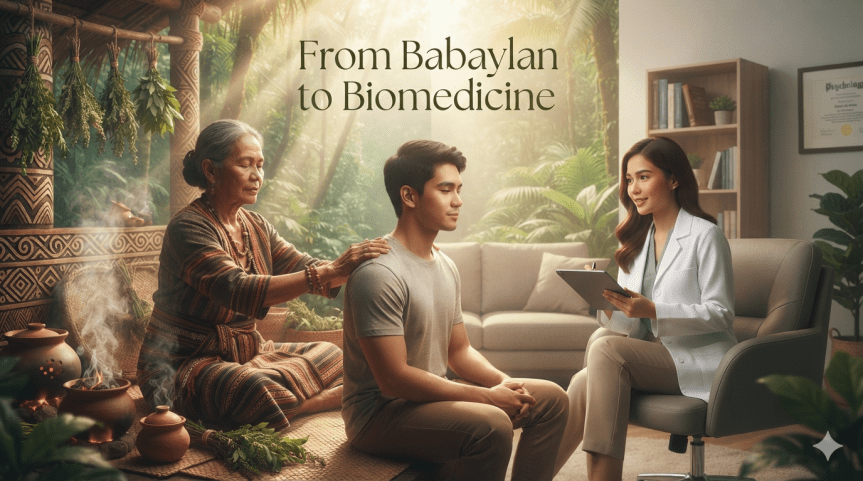
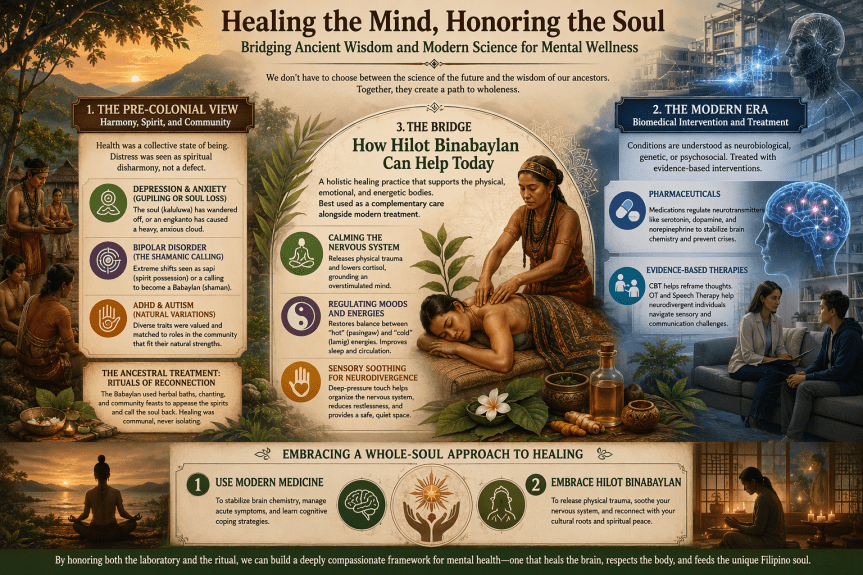
In our fast-paced, hyper-individualized modern world, mental health struggles have reached unprecedented levels. Modern medicine neatly categorizes chronic anxiety and deep depression as chemical imbalances, neurological firing errors, or clinical disorders. While pharmaceutical and psychological interventions have their place, they often treat only the physical symptoms of a much deeper, unseen crisis.

From the perspective of Filipino Indigenous Spiritual Healing (Hilot Binabaylan), anxiety and depression are not merely failures of brain chemistry. They are spiritual illnesses (sakit sa espiritu)—profound disruptions of a person’s life force (ginhawa), a fracturing of the soul (kaluluwa), or an energetic disconnection from nature and community (kapwa).

When the modern world becomes too heavy, the spiritual vessel breaks. Here, we look at these contemporary ailments through the lens of ancient Filipino mysticism and explore the time-tested, multi-layered ritual sequence used by a Binabaylan to restore complete harmony.

The Diagnostics: Translating Modern Pain into Spiritual Imbalance

To heal an illness, we must first understand its true root. Traditional Filipino medicine goes beyond localized concepts like usog, bati, or kulam, utilizing foundational diagnostic frameworks to trace modern emotional trauma:

1. Lawayan (Soul-Wandering & Depression)

  • The Diagnostic Connection: In indigenous cosmology, a human being is whole only when the physical body and the kaluluwa (soul/astral double) are perfectly aligned. When a person experiences prolonged grief, severe burnout, or systemic trauma, the environment becomes too hostile. To survive, the kaluluwa fractures or steps away from the physical vessel.
  • The Symptoms: This manifests as the heavy numbness, chronic fatigue, hopelessness, and inner emptiness characteristic of clinical depression. The person is physically functioning, but their “spark” or spiritual core is missing—the body has become a hollow house.

2. Gulo ng Ginhawa (Disruption of the Vital Force & Anxiety)

  • The Diagnostic Connection: Ginhawa is our vital breath, life force, and seat of emotional well-being, traditionally centered in the chest and abdomen. Modern society traps us in a perpetual survival mode—constant financial stress, sensory overload, and hyper-vigilance.
  • The Symptoms: This continuous pressure constricts the breath and creates an energetic blockage, trapping toxic, volatile heat in the chest. This manifests precisely as panic attacks, short breathing, a racing pulse, irrational dread, and physical chest tightness.

3. Pasma sa Kalooban (Emotional Shock & Stagnation)

  • The Diagnostic Connection: Just as physical pasma occurs when hot muscles are suddenly exposed to freezing water, Pasma sa Kalooban is an energetic shock to the emotional body. It happens when deep trauma, unexpressed anger, or intense shame (hiya) are forcefully suppressed or internalized over time.
  • The Symptoms: This emotional freezing paralyzes the energetic body. The patient becomes completely unable to process joy, feeling “stuck” in a cyclic loop of past traumas, resulting in generalized anxiety or emotional numbness.

The Path to Cure: The Multi-Step Binabaylan Ritual Sequence

True indigenous healing recognizes that a pill cannot patch a fractured soul. To completely relieve and cure these modern spiritual illnesses, the Binabaylan guides the patient through a rigorous, elemental, and highly structured protocol designed to negotiate with the unseen world and seal the patient’s defenses.

 [1. TAWAS] ──► [2. PAG-AATANG] ──► [3. SUOB & PALINA] ──► [4. SEALING & HOME CARE]
(Diagnosis & (Appeasement & (Thermodynamic (Anointing Oil &
Dialogue) Negotiation) Cleansing) Amulet Anchors)

Step 1: Tawas (Spiritual Diagnosis & Higher-Self Dialogue)

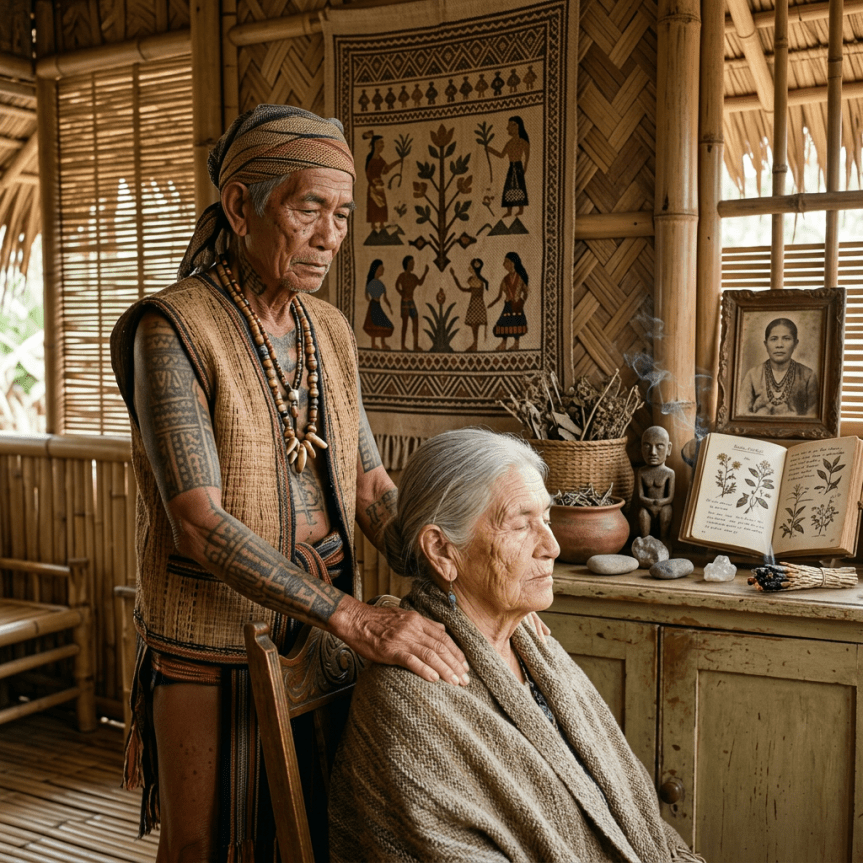
The healing journey always begins with Tawas, the spiritual cross-examination. Rather than merely looking at physical symptoms, the Binabaylan utilizes a physical medium (such as candle wax, water, or alum crystal) to read the energetic disruptions.

Crucially, a deep dialogue and negotiation takes place during this stage. The shaman enters a meditative state to communicate directly with the higher self of the patient, as well as their ancestral spirits and spirit guides. The Binabaylan asks: Where did the soul wander? What boundary was crossed? What ancestral trauma is being repeated? Through this divine conversation, the root cause of the anxiety or depression is brought from the shadows into the light.

Step 2: Pag-aatang or Pag-aalay (Appeasement & Sacrifice)

Once the spiritual diagnosis identifies the nature of the energetic debt or boundaries crossed, the Pag-aatang (or Pag-aalay) is executed. If a person’s soul is being held or disturbed by environmental spirits or disgruntled ancestors, a formal peace offering must be made.

The Binabaylan prepares a ritual basket of native foods, root crops, or symbolic offerings to appease the spirits. This act represents a sacred negotiation—a life-for-life or energy-for-energy trade that formally settles the grievance. It ensures that the negative entities willingly release their grip on the patient’s buhay (life force), clearing the path for the spiritual eviction.

Step 3: Elemental Cleansing (Herbal Suob and Palina/Pausok)

With the spiritual negotiations settled, the patient’s physical and subtle bodies must be thoroughly purged of residual spiritual impurities and trapped trauma. This is done through a powerful thermodynamic cycle of elements:

  • Steam Vapor Herbal Suob (The Extraction): The patient sits over a pot of boiling water infused with highly potent, aromatic medicinal leaves. The rising herbal steam opens the physical and spiritual pores of the patient. As the patient sweats, the heat acts as an extractor, pulling the heavy, toxic, and stagnant pasma sa kalooban and negative energies out of the nervous system. This is immediately followed by a cleansing bath using the cooled herbal infusion to wash the impurities completely away.
  • Dry Herbal Fumigation via Palina/Pausok (The Shield): Next, the Binabaylan burns dry medicinal leaves, roots, or sacred resins (like kamangyan). The patient is enveloped in this holy smoke. While suob opens and extracts, palina closes and purifies, neutralizing any lingering spiritual parasites and creating a formidable energetic barrier around the aura.

Step 4: Anointing and Home Care Maintenance (Sealing the Vessel)

The extraction and cleansing are complete, but a freshly cleaned vessel is highly sensitive. The Binabaylan must permanently seal the patient’s energy before they return to the modern world.

The healer performs a sacred anointing, rubbing custom-infused healing oils onto the patient’s pulse points, forehead, and crown to lock in the ginhawa (vitality). Finally, to ensure long-term recovery, the patient is sent home with “home care maintenance” amulets—tangible, active proxies of the shaman’s protection. Whether it is a dedicated bottle of Bote Natura (nature in a bottle) oil for daily topical grounding, or handcrafted habak, necklaces, and bracelets strung with protective seeds and woods, these talismans stand as a continuous shield against unseen harm.

A Return to Wholeness

Anxiety and depression are loud alarms telling us that the soul is starving, fragmented, or displaced by the weight of modern living. By stepping away from hyper-isolated perspectives and returning to the holistic wisdom of Hilot Binabaylan, we remember that we are part of a larger tapestry. Through the structured path of Tawas, Atang, Suob, and Palina, we do not just suppress the symptoms of mental illness—we welcome our wandering souls back home.

Bridging Tradition and Science: The Art of Finger Poking Diagnosis (Tudluan) Using Black Coral

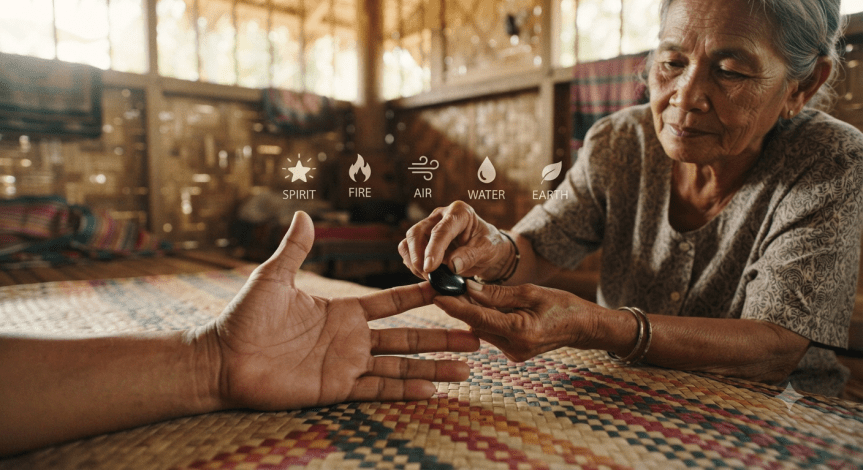
In traditional energy medicine, each finger serves as a gateway to the cosmos, representing the five great elements:

  • Thumb: Spirit (Ether)
  • Forefinger: Fire
  • Middle Finger: Air
  • Ring Finger: Water
  • Pinky Finger: Earth

When an imbalance or “blockage” (bara) exists within an element, the Black Coral pendant acts as a conductor, reacting physically by becoming heavy, throbbing, or generating intense heat.

While this practice holds deep spiritual roots, modern science and medicine offer an equally profound explanation for why these intense physical sensations occur at the fingertips during a session. Here is how the worlds of folk healing and anatomy collide.

The Conductor: Why Black Coral?

Before diving into human anatomy, we must look at the tool itself. True Banaog (Black Coral) is a highly dense, organic marine material. Because it is incredibly compact and naturally rich in organic oils, it does not absorb water or decay easily. It possesses an excellent thermal and tactile conductivity. This means any minute change in human skin temperature, sweat, or pressure is immediately amplified by the coral, making it the perfect tool for a sensitive practitioner.

The Psychological & Neurological Reflexes

When a practitioner presses the Black Coral against a client’s finger, the physical reactions felt—such as sudden warmth, a “magnetic” heaviness, or a sudden twitch—can be mapped directly to human psychology and neurology.

1. Galvanic Skin Response (GSR)

The human autonomic nervous system controls our stress, anxiety, and emotional responses through the sympathetic branch. The fingertips contain one of the highest concentrations of eccrine sweat glands and nerve endings in the entire body.

When a client is anxious, in pain, or deeply focused during a diagnosis, their nervous system triggers microscopic amounts of moisture to release from these glands. Even if the skin looks dry, this micro-sweat changes the skin’s electrical conductance. When the dense Black Coral touches this moisture, it alters the friction and thermal trap between the skin and the object. This creates a sudden sensation of heaviness or warmth, indicating emotional or physical stress in the patient.

2. The Ideomotor Phenomenon

Folk healing requires immense mental focus and deep connection between the healer and the patient. This focus can trigger the Ideomotor Phenomenon—a scientifically proven psychological reaction where the brain signals the muscles to make microscopic, involuntary movements (unconscious micro-movements) based on an expectation.

Because an experienced healer subconsciously picks up on the patient’s body language, breathing, and facial tension, the healer’s hand might subtly shift its grip, angle, or pressure on the coral. This micro-adjustment is felt by both the healer and patient as a sudden throb, prick, or pulse from the wood, which traditional arts interpret as the element “speaking.”

The Medical Reality of Energetic “Blockages”

In Hilot, a cold, numb, or painful reaction in a specific finger indicates a blockage (bara). In modern medicine, these exact symptoms in the fingertips are primary indicators of underlying neurological and cardiovascular conditions.

1. Peripheral Neuropathy (Nerve Damage)

Our fingertips are packed with delicate nerve endings. If a patient suffers from underlying issues like high blood sugar (Diabetes), Vitamin B deficiencies, or chronic nerve compression, they may develop Peripheral Neuropathy.

Damaged nerves send erratic, hyper-sensitive electrical signals to the brain. When the hard, dense Black Coral presses against a finger with neuropathy, it can trigger an immediate sharp pain, tingling, or “electric shock” sensation, perfectly aligning with the traditional diagnosis of a severe elemental blockage.

2. Poor Blood Circulation

A “cold” blockage or a lack of energy response in a finger often points to poor blood circulation. Conditions like Raynaud’s Phenomenon or narrowed arteries cause the blood vessels in the fingers to spasm and constrict, drastically reducing blood flow.

When the coral touches these specific fingers, the skin is naturally much colder and less responsive, and it rapidly siphons the warmth away from the healer’s hand. Medicine views this as poor vascular health, while tradition views it as a lack of vital life force (isang nanunuyo o malamig na bara).

3. Somatoform and Stress-Related Disorders

The mind and body are intrinsically linked. When individuals suffer from severe emotional trauma, chronic anxiety, or unexpressed depression, the brain often translates this mental anguish into very real physical symptoms—a condition known as a somatoform disorder.

These patients constantly live in a “fight-or-flight” state, causing rapid heart rates, shallow breathing, and erratic hand temperatures. During a Tudluan session, their highly sensitive nervous system reacts intensely to the touch of the coral, manifesting as a profound energetic imbalance across the elements.

Conclusion: Two Sides of the Same Coin

Understanding the science behind Tudluan does not diminish the magic or historical value of traditional Filipino healing. Instead, it validates it.

Ancient healers did not have access to modern neurological equipment, yet they intuitively understood that the fingertips were the map to a person’s inner health. By using Black Coral as a physical diagnostic amplifier, practitioners were—and still are—successfully detecting real, physical markers of stress, circulatory issues, and nerve sensitivity.

By combining the spiritual comfort of traditional Hilot with the awareness of modern medicine, folk practices can safely continue to provide holistic comfort, stress relief, and early warnings for those seeking balance in a chaotic world.

The Shield of Siyargaw, the Hope of Esperanza: The Living Lineage of Rev. Rolando Gomez Comon

Deep within the vast mangrove channels of Del Carmen, Siargao, sits a coastal enclave named Barangay Esperanza. To the untrained eye, it is a serene village defined by the rhythmic tides of the Philippine Sea. But to those who carry its blood, it is a sanctuary of profound spiritual and civic guardianship. The name Esperanza translates directly to “Hope”—a title born out of a centuries-old prayer for resilience against the storms of nature and history.


Directly in front of the community’s spiritual anchor, the San Vicente Ferrer Chapel, sits an ancestral property belonging to the Comon family. This house was never just a residence; it was the unofficial session hall, the refuge for weary travelers, and the epicenter of community survival. The Comon lineage is inextricably woven into the very fabric of Del Carmen. In the 1960s, it was Mayor Galo C. Comon who legally reshaped the municipality’s modern identity, bridging the town’s ancient roots with its contemporary future.


Yet, the truest power of this lineage did not live in political offices, but in the hands of a man who stood as the spiritual custodian of the village: Diomedes Paqueo Comon, affectionately revered by his people as Lolo Mede.

    ┌─────────────────────────────────────────────────────────────┐
    │                THE COMON ANCESTRAL TRAJECTORY               │
    └──────────────────────────────┬──────────────────────────────┘
                                   │
         ┌─────────────────────────┴─────────────────────────┐
         ▼                                                   ▼
┌─────────────────────────────────┐                 ┌─────────────────────────────────┐
│        THE CIVIC SHIELD         │                 │      THE SPIRITUAL MEDICINE     │
├─────────────────────────────────┤                 ├─────────────────────────────────┤
│ Mayor Galo Comon & Lay Leaders  │                 │ Lolo Mede Comon (*Tambalan*)    │
│ Securing the town’s governance  │                 │ Preserving ancient indigenous   │
│ and colonial-era chapel.        │                 │ wisdom, herbalism, and *Hilot*. │
└─────────────────────────────────┘                 └─────────────────────────────────┘
                                   │
                                   ▼
                ┌─────────────────────────────────────┐
                │        THE MODERN BINABAYLAN        │
                ├─────────────────────────────────────┤
                │      REV. ROLANDO GOMEZ COMON       │
                │ Keeping the Lineage Alive: Ancestral│
                │ Reclamation & Indigenous Medicine.  │
                └─────────────────────────────────────┘

The Legacy of Lolo Mede: The Binisaya Healer


In traditional Visayan (Binisaya) culture, the line between the physical world and the spiritual realm is completely fluid. Lolo Mede was a famous mananambal (native healer)—the historical evolution of the pre-colonial Babaylan.
While Spanish colonizers sought to erase indigenous shamanism, the master healers of Siargao adapted to survive. Lolo Mede harmonized his ancient gifts with the modern church, serving as a trusted chapel lay leader. He understood that the earth was a divine pharmacy. Utilizing the immense biodiversity of the Del Carmen mangrove forests—the very siyargaw trees that gave the island its name and served as a natural barrier against deadly typhoons—he harvested barks, resins, and roots to cure the ailing.
Through the physical manipulation of Hilot (traditional bone-setting and massage), vapor therapies (tuob), and the whispering of sacred orasyon (chanted prayers), Lolo Mede did not just treat bodies; he restored the ginhawa (the breath and vital life force) of his people.


The Phenomena of Taliwala: An Unbroken Spiritual Inheritance

For decades after his passing, the healing fires of the family seemed quiet. But indigenous gifts are rarely lost; they merely sleep, waiting for the right vessel. In Binisaya spiritual tradition, there is a phenomenon known as Taliwala or Abat—the ancestral rebirth of a gift. It is the belief that a profound spiritual inheritance (gasa) will deliberately bypass children to reawaken vibrantly in a specific grandchild.


Today, that reawakening has found its vessel in his grandson, Rev. Rolando Gomez Comon.
When distant relatives look upon Rev. Rolando, they often experience a startling sense of recognition. They mistake the grandson for Lolo Mede himself, sensing an ancient, familiar healing frequency vibrating through his presence. This is not an optical illusion or a simple mistake; it is the community’s instinctual recognition of an unbroken spiritual lineage. The ginhawa (life force) of the grandfather has stepped across time into the hands of the grandson.


The Vital Imperative: Keeping the Comon Lineage Alive


To walk the contemporary path as a Hilot Binabaylan while holding the title of Rev. Rolando Gomez Comon is to carry an immense, sacred responsibility. In an era where Siargao Islands are globally romanticized as a modern tourist playground, the authentic spiritual and cultural identity of its native people faces the quiet threat of erasure. For Rev. Rolando, continuing this lineage is not a choice—it is a vital imperative to honor the Comon ancestors of Barangay Esperanza.


┌────────────────────────────────────────────────────────────────────────┐
│             WHY THE LIVING COMON LINEAGE MUST BE PRESERVED             │
├────────────────────────────────────────────────────────────────────────┤
│ • CULTURAL ANCHOR: Shields Siargao’s native identity from tourism.     │
│ • MEDICINAL RECLAMATION: Keeps the *Binisaya* healing sciences alive.   │
│ • DECOLONIAL BRIDGE: Unites ancient *Diwata* roots with modern faith.  │
│ • LIVING SANCTUARY: Sustains Esperanza’s historical role of protection.│
└────────────────────────────────────────────────────────────────────────┘


1. Resisting Cultural Displacement
As commercial developments reshape the coastlines of Siargao, the deep, foundational history of towns like Del Carmen risks becoming a footnote. By openly practicing as a Hilot Binabaylan, Rev. Rolando ensures that the Comon family remains what they have always been: guardians of the land. It broadcasts a powerful reminder that before the island was a destination for surfers, it was—and still is—a sacred territory of mystics, prayer warriors, and traditional healers.

2. Safeguarding Indigenous Medicine as a Living Science
Lolo Mede’s medicine was a sophisticated, intuitive science built on centuries of observing the island’s ecosystems. When traditional healing lines break, the deep knowledge of native flora, the spiritual mechanics of Hilot, and the protective energetic boundaries of the mangroves die with them. By keeping this practice alive, Rev. Rolando acts as a living archive, ensuring that the indigenous Binisaya wellness systems remain dynamic, active, and accessible to those who need healing.

3. A Legacy of Decolonial Reclamation
While Lolo Mede had to shield his indigenous mysticism within the protective, acceptable boundaries of a Catholic chapel to survive his era, Rev. Rolando steps into the lineage during an age of awakening. His work is an act of spiritual decolonization. He bridges the sacred mechanics of traditional Hilot and the ancient worldview of the Diwata (nature spirits) with modern spiritual leadership. He vindicates the ancestors by bringing their hidden practices completely into the light, showing that native spirituality is not something to be feared, but a holy gift to be revered.

The Fire Endures in Esperanza

The story of the Comon lineage is a testament to the absolute resilience of Siargao’s true indigenous spirit. The ancestral home still stands proud directly across from the chapel in Barangay Esperanza, serving as a physical monument to a family that chose to stay, protect, govern, and heal.
The ancestors are not gone; they live on in the marrow of their descendants. Through the hands, prayers, and calling of Rev. Rolando Gomez Comon, the sacred fire of Lolo Mede burns as brightly as ever. The lineage remains fiercely alive—honoring those who walked before, protecting the sanctity of Esperanza, and continuing to offer a true sanctuary of hope to a world longing to remember its roots.

📜 Official Announcement: Transition of Academic Titles and the Professionalization of Hilot Binabaylan Practice

In partnership with Templong Anituhan Inc. and Bahay SiAdtala Binabaylan Inc.


The Hilot Academy of Binabaylan formally announces an important transition in its academic titles and credentialing system, undertaken to support the long‑term professionalization, integrity, and global recognition of Hilot Binabaylan Practice as an Indigenous Filipino Healing Art and Science.

Background

On August 8, 2025, Templong Anituhan Inc. and Bahay SiAdtala Binabaylan Inc. issued a joint resolution declaring that all graduates of the Nine (9)‑Day Hilot Binabaylan Training—from 2016 through June 18, 2025—were to be recognized as Masters of Ministry in Hilot Binabaylan Practice (M.Min.HBp). This declaration acknowledged the historical role of the 9‑day training as the foundational and terminal formation program during the early development of Hilot Academy of Binabaylan.

Final Conferral of the Master’s Degree under the 9‑Day Training

In line with the institutional resolution and its transitional provisions:

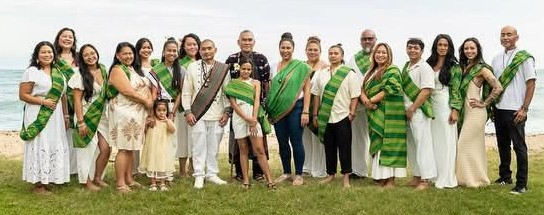
  • The Nine (9)‑Day Hilot Binabaylan Training Cohort held in Hawaii from April 11–19, 2026 is officially recognized as the final group to receive the Master of Ministry in Hilot Binabaylan Practice (M.Min.HBp) under the legacy training system.
  • Graduates of the Hilot Binabaylan Alignment Training in the Philippines, whose graduation ceremony was held on June 24, 2025, are likewise recognized within the transitional framework established prior to the implementation of the new academic structure.

All degrees and titles previously conferred remain valid, honored, and irrevocable.

New Credential Moving Forward

Beginning after April 2026, all individuals who complete the Nine (9)‑Day Hilot Binabaylan Training shall receive the professional credential:

Certified Hilot Binabaylan Practitioner (CHBP)

This title reflects professional competency and ethical authorization to practice Hilot Binabaylan, while distinguishing the 9‑day program from graduate‑level academic degrees.

Toward Full Academic Professionalization

This transition gives way to the formal academicization of Hilot Binabaylan through a structured degree pathway:

  • Bachelor’s Degree (4 years)
    Bachelor of Indigenous Filipino Healing Arts and Sciences
  • Master’s Degree in Ministry (2 years)
    Master of Ministry in Hilot Binabaylan Practice
  • Doctoral Degree in Ministry (3 years)
    Doctor of Ministry in Indigenous Filipino Healing Arts and Spirituality

This degree ladder ensures depth, rigor, accountability, and sustainability, while honoring both tradition and contemporary standards of ministerial and professional education.

A Word of Gratitude

We extend our deepest respect and gratitude to all graduates who carried the title Master of Ministry in Hilot Binabaylan Practice during its formative years. Your dedication, service, and leadership laid the foundation upon which this next chapter is being built.


For official guidelines, program updates, and future enrollment announcements, please continue to visit the Hilot Academy of Binabaylan website.

In service of healing, culture, and embodied wisdom.


Hilot Academy of Binabaylan
Templong Anituhan Inc.
Bahay SiAdtala Binabaylan Inc.

The Healing Power of Shared Meals: Food as Nourishment of Body, Heart, and Spirit

In modern society, food is often evaluated through numbers and labels—calories, nutrients, price, or presentation. We ask: Is it healthy? Is it delicious? Is it affordable? While these questions are important, they do not fully capture the deeper meaning of food.

From an indigenous and holistic perspective, the true richness of food is revealed not only in what we eat, but in how and with whom we eat.

The delight of food is not measured by taste, nutrition, or price. 
Its true richness is measured by how it is shared—especially when it is shared with someone you love.

Food as Relationship, Not Just Consumption

In traditional Filipino culture, pagkain is never merely an individual act. It is relational. Meals are invitations to connect—with family, community, ancestors, and the unseen. A simple dish, when shared, becomes abundant. A modest table, when surrounded by loved ones, becomes sacred.

This reflects an ancient wisdom: healing does not happen in isolation. Just as Hilot views the body as interconnected—physical, emotional, mental, spiritual, and cultural—food too nourishes more than the body. It nourishes belonging.

Shared Meals as a Form of Healing

In Hilot Binabaylan practice, imbalance often arises not only from physical causes but from emotional and relational disconnection. Loneliness, grief, and separation weaken the spirit. In contrast, shared meals restore harmony.

When food is shared:
– The body receives nourishment 
– The heart feels seen and included 
– The spirit experiences warmth and grounding 

This is why meals prepared with care and shared in love often feel more satisfying than expensive or elaborate food eaten alone.

Love as an Invisible Ingredient

There is an ingredient that cannot be measured or listed on any label: pagmamahal.

Food prepared or shared with love carries a different quality. It slows us down. It opens conversation. It invites presence. In many indigenous traditions, intention is as important as the material itself. What we feel and offer while eating becomes part of what we ingest.

In this way, every shared meal becomes a quiet ritual—a moment of embodiment, where care is made tangible.

Embodiment in Everyday Life

At Hilot Academy of Binabaylan, we speak of embodiment—not only as a concept, but as a lived practice. Embodiment happens when wisdom is expressed through daily acts: how we touch, how we listen, how we eat, and how we gather.

Sharing food is one of the simplest yet most profound ways to embody healing values:
– Presence over haste 
– Relationship over consumption 
– Gratitude over excess 

A Gentle Reminder

In a world that often eats quickly and alone, let us remember:
Food heals best when it is shared. 
Nourishment deepens when love is present. 
And the table, no matter how simple, becomes a place of restoration when hearts meet.

This is the kind of wellness we uphold at Hilot Academy of Binabaylan—a healing that honors the body, strengthens relationships, and nourishes the spirit.

Hilot Then and Now: Autonomy, Community, and a Modern Framework for Continuity 

By Rev. Rolando Gomez Comon (Apu Adman), Developer and Reviver of Hilot Binabaylan, Founder of Hilot Academy of Binabaylan


Overview

This article clarifies three intertwined questions:

  1. Was hilot a “business” in pre‑colonial times?
  2. How do “necessity” and “commodity” differ—and where does hilot belong?
  3. Did manghihilot have formal groups and leaders in ancient times—and how does that history inform modern debates over legitimacy and leadership?

It closes with a Position Paper presenting the historical‑theological justification for the leadership of the Hilot Academy of Binabaylan, and a peaceful indigenous response to critiques of legitimacy—grounded in culture, service, and spiritual calling.


I. Was Hilot a “Business” in Pre‑Colonial Times?

Short answer: No—not in the modern market sense. In pre‑colonial Philippine communities, hilot was a community health service embedded in spiritual practice, herbal knowledge, and manual healing, provided by manghihilot, albularyo, and babaylan. Compensation typically came through reciprocity—food, portions of harvest, help, or other gifts—rather than profit margins or standardized prices. The work was spirit‑led and community‑validated, not market‑driven.
Sources: Overviews consistently describe hilot as a holistic, culturally embedded practice rather than mere massage or commerce, emphasizing its role in childbirth, midwifery, herbalism, and spiritual healing. [beholdphil…ppines.com], [en.wikipedia.org], [nipino.com]


II. Necessity vs. Commodity—And Where Hilot Belongs

A. Definitions

  • Necessity: Goods or services essential to life and well‑being; demand is relatively inelastic because people need them regardless of price (e.g., food, water, shelter, basic healthcare). [difference.wiki], [fiveable.me]
  • Commodity: A good or service produced for trade, often fungible (interchangeable) and subject to market pricing and speculation (e.g., grains, metals, oil). [en.wikipedia.org], [merriam-webster.com]

B. Where Hilot Belongs

Pre‑colonial hilot functioned as a necessity: it was the primary healthcare for many communities—covering musculoskeletal care, prenatal and childbirth support, herbal medicine, and spiritual balance. Its demand derived from communal need and spiritual obligation, not price sensitivity or brand competition. [beholdphil…ppines.com], [nipino.com]

Modern hilot can be commodified (e.g., spa menus, wellness tourism, branded trainings) when offered through market channels with fees, packages, and certifications. That shift—from necessity to commodity—is a feature of contemporary market systems, not ancient practice. [insights.m…ourism.com]


III. Did Ancient Manghihilot Have Groups and Leadership?

A. Autonomy and Place‑Based Calling

Pre‑colonial healers (manghihilot, babaylan/katalonan, mumbaki, walian, etc.) were typically autonomous, place‑based, and lineage/apprenticeship‑trained. Their recognition flowed from efficacy, ritual authority, and the community’s trust, rather than from a centralized guild or national hierarchy. [en.wikipedia.org], [centerforb…tudies.org]

B. Functional Differentiation, Not Bureaucratic Hierarchy

Communities often distinguished roles—e.g., bone setting and soft‑tissue manipulation (manghihilot), herbal pharmacopeia (albularyo), and ritual leadership (babaylan). This was functional diversity, not a top‑down chain of command. [en.wikipedia.org]

C. Spirit‑Led Leadership

Authority was relational, situational, and spirit‑led. Healers “bowed” to Divine/Diwata/Anito and served communal welfare. Their “leadership” was service‑based: respected because their practice worked, their counsel guided, and their rituals healed. [en.wikipedia.org]

Conclusion: Your understanding is correct. Ancient healers were independent and community‑anchored; modern inter‑group competition is largely a post‑colonial/market phenomenon.


IV. Why Do Modern Legitimacy Conflicts Arise?

  1. Marketization & Branding: As hilot enters market frameworks (pricing, certifications, brand identities), groups understandably advocate for their models and standards—sometimes sliding into competitive claims. [insights.m…ourism.com]
  2. Colonial & Post‑Colonial Disruptions: Historic suppression of indigenous spiritual healing fractured lineages, creating a vacuum later filled by new institutions seeking validation—occasionally through gatekeeping or delegitimization. Scholarly descriptions of babaylan roles and suppression across the archipelago contextualize this dynamic. [en.wikipedia.org]

V. The Role of Hilot Academy of Binabaylan (HAB)

The Hilot Academy of Binabaylan is not a “supreme authority.” It is a modern container—a learning community that preserves, organizes, and passes on indigenous healing knowledge responsibly. HAB provides structure for continuity amidst contemporary realities (urbanization, fragmented lineages, global students), while honoring spirit‑led autonomy and community service as the core of hilot. [beholdphil…ppines.com], [nipino.com]


VI. Position Paper

Historical‑Theological Justification of Leadership in the Hilot Academy of Binabaylan

A. Premises

  1. Historical Continuity: Pre‑colonial hilot thrived as a necessity embedded in communal life, stewarded by healers recognized through efficacy and service, not bureaucratic titles. [beholdphil…ppines.com], [en.wikipedia.org]
  2. Disruption and Need for a Modern Framework: Colonial/post‑colonial disruptions fragmented lineages and ritual ecologies, necessitating contemporary educational structures to safeguard and transmit knowledge. [en.wikipedia.org]
  3. Theological Grounding: In indigenous perspectives, calling (tawag) originates from the Divine/Diwata/Anito. Leadership is diakonia (service), not dominion: a covenant with community well‑being and spiritual balance. [en.wikipedia.org]

B. Claim

HAB leadership is an instrumental guardianship—a service mandate to preserve and cultivate Hilot Binabaylan as living tradition within modern contexts. It organizes curricula, mentorships, and ethics not to supplant community healers but to support, strengthen, and transmit the practice responsibly.

C. Justification

  1. Historical Justification: Establishing an academy aligns with historical patterns of apprenticeship and communal validation, translated into a modern educational container because the original village matrices are often unavailable. [beholdphil…ppines.com]
  2. Theological Justification: Leadership is vocational—rooted in a call to serve. As with babaylan, authority is measured by healing efficacy, ethical conduct, and faithfulness to the spirits and community, not by claims of supremacy. HAB’s leadership adopts this servant‑covenant model. [en.wikipedia.org]
  3. Cultural Justification: HAB functions as cultural stewardship against commodification without context—ensuring that when hilot enters modern venues (spas, tourism, global education), it carries its cosmology, ethics, and community orientation intact. [insights.m…ourism.com]

D. Principles of HAB Leadership

  • Service over Supremacy: Leadership exists to equip, not to dominate.
  • Spirit‑Led Autonomy: Honor practitioners’ place‑based callings and local lineages. [en.wikipedia.org]
  • Community‑First Ethics: Measure success in community welfare and healing outcomes, not in market share. [beholdphil…ppines.com]
  • Scholarly Integrity: Teach hilot’s history, techniques, and cosmology with rigor and respect. [en.wikipedia.org]
  • Reciprocity and Respect: Maintain mutual recognition across diverse hilot traditions and regions. [centerforb…tudies.org]

VII. Peaceful Indigenous Response to Critiques of Legitimacy

When confronted with questions about legitimacy or leadership, HAB offers this peaceful, culturally rooted response:

  1. Affirm the Shared Ground “We honor all who respond to the call of healing. Our ancestors recognized many paths—manghihilot, albularyo, babaylan—each serving the people.”
    Rationale: Pre‑colonial healing was plural, autonomous, and community‑validated. [en.wikipedia.org]
  2. Clarify HAB’s Role “We are an academy—an educational home—built to preserve, teach, and responsibly transmit Hilot Binabaylan amidst modern realities. We do not claim supremacy; we offer structure for continuity.”
    Rationale: HAB is a container, not an empire. [beholdphil…ppines.com]
  3. Invite Reciprocity “Let us collaborate on standards that protect communities and learners—grounded in cosmology, efficacy, ethics, and service—so hilot remains a necessity, not merely a commodity.”
    Rationale: Collaboration resists commodification without context and prioritizes community health. [insights.m…ourism.com]
  4. Return to Calling and Outcomes “Authority in hilot arises from calling, conduct, and healing outcomes. Where practice heals and uplifts, legitimacy follows.”
    Rationale: Spirit‑led, outcome‑based validation mirrors ancestral norms. [en.wikipedia.org]
  5. Keep the Conversation Sacred > “We offer dialogue with respect, mindful that hilot is a sacred trust. May our words and works serve the people and honor the spirits.”
    > Rationale: Ritual respect maintains cultural integrity. [centerforb…tudies.org]

VIII. Practical Implications for Modern Practitioners and Groups

  • For Practitioners: Cultivate efficacy, ethics, community relationships, and ongoing learning. Let your legitimacy arise from service and outcomes. [beholdphil…ppines.com]
  • For Schools/Groups: Build curricula that embed cosmology, herbal knowledge, manual techniques, ritual respect, and community‑first ethics—not just marketable skills. [en.wikipedia.org]
  • For the Public/Students: Seek training that honors hilot’s identity as necessity (health service) rather than commodity (brand alone). Verify community impact and cultural grounding. [difference.wiki], [en.wikipedia.org]

IX. Summary Table (Conceptual)

DimensionPre‑Colonial HilotModern Hilot (Market Context)
Economic NatureNecessity (community health)Commodity (when branded/sold)
ValidationCommunity & Spirits (efficacy, ethics)Market & Certification (branding, fees)
LeadershipAutonomous, spirit‑ledInstitutional roles (school, org leaders)
Core AimHealing & BalanceHealing + structure for continuity
RiskNone (market)Commodification without cultural context

Sources across sections: [beholdphil…ppines.com], [en.wikipedia.org], [nipino.com], [insights.m…ourism.com], [en.wikipedia.org], [centerforb…tudies.org], [difference.wiki], [en.wikipedia.org], [fiveable.me]


X. Closing

Hilot Binabaylan is not a brand to win a market contest; it is a living covenant between healer, community, and the spirits. The Hilot Academy of Binabaylan stands as a modern sanctuary—preserving, teaching, and transmitting a tradition whose legitimacy rests upon calling, conduct, and healing. In dialogue and collaboration, may we ensure that hilot remains what it has always been at heart: a necessity of communal life, not merely a commodity on the shelf.


References

  • Behold Philippines, Hilot: The Ancient Filipino Art of Healing (Aug 14, 2024) – overview of hilot as holistic tradition and community healthcare. [beholdphil…ppines.com]
  • Wikipedia, Hilot – origins, practices, and relation to shamanic traditions. [en.wikipedia.org]
  • Wikipedia, Filipino shamans (babaylan) – roles, spiritual mediation, and community significance. [en.wikipedia.org]
  • Center for Babaylan Studies, What is Babaylan? – descriptions of indigenous spiritual leadership and healing roles. [centerforb…tudies.org]
  • Medical Tourism Magazine, The Ancient Practice of Hilot: Traditional Healing in the Modern World – modern integration and wellness contexts. [insights.m…ourism.com]
  • Nipino.com, Hilot: Nurturing Body, Mind, and Spirit in Traditional Filipino Healing – historical roots and holistic principles. [nipino.com]
  • Merriam‑Webster, Commodity – definitions and market framing. [merriam-webster.com]
  • Wikipedia, Commodity – economic features and fungibility. [en.wikipedia.org]
  • Fiveable, Necessities – Principles of Economics Key Term – demand inelasticity and essential goods. [fiveable.me]

Is Hilot Filipino, or Is Hilot Human?  A Manifesto and Practical Guide for Ethical Practice

Hilot is often asked to define itself.
Is it Filipino, or is it human?

This question does not seek to divide—it seeks clarity: Who may carry the wisdom of Hilot? How is it practiced with integrity today? And how do we safeguard it from appropriation while allowing it to heal beyond borders?

The answer is both simple and sacred:

Hilot is Filipino in ancestry, human in service, and Divine in origin.

Hilot: Filipino in Origin, Human in Purpose

Hilot is undeniably Filipino in origin, born from the land, the ancestors, and the cosmology of the Philippine archipelago. Its rituals, medicines, and ethics were shaped by our relationship with nature and the unseen world.

Yet Hilot is also human in purpose. 
Healing does not discriminate. When someone comes before a healer, we do not ask if they are Filipino or foreigner, wealthy or poor, male, female, lesbian, gay, transgender, or cisgender, religious or non‑religious, left or right in politics.

We see first a soul in need of care.

And Hilot reminds us of a profound truth: the medicine we need is where we live. The healer’s task is to restore right relationship with place—learning from the plants in the yard, the trees in the neighborhood, the waters, winds, and soils that hold the wisdom of our locality. In this way, Hilot is rooted, not replicated; contextual, not colonial.

Who Is a Cultural Bearer Today?

In our time, being a bearer of indigenous wisdom is not only a matter of birth—it is a matter of devotion, discipline, and continuity.

History shows that some who were not indigenous by birth nonetheless served as careful documentarians and allies of Filipino lifeways. But their contributions never replace indigenous voices; they demonstrate that calling and responsibility sometimes transcend ancestry—provided that practice remains accountable to community custodians, elders, and ethical boards.

We also face a poignant reality: many are disconnected from indigenous lifeways due to colonization, modernization, and survival pressures. Meanwhile, some sacred roles—Babaylan, Mumbaki—are sometimes reduced to performance rather than vocation. Authenticity demands daily discipline, ethical responsibility, and living relationship with the ancestors, the Diwata, the land, and community.

The invitation is not to gatekeep healing, but to guard its integrity.

Foundational Manifesto of the Hilot Path


*For Hilot Academy of Binabaylan • Templong Anituhan • Bahay SiAdtala Binabaylan*

Preamble


Hilot is Filipino in ancestry, human in service, and Divine in origin.*
We affirm Hilot as a sacred healing tradition entrusted to humanity through ancestral wisdom and relationship with place. We commit to carrying it as a living vocation—never as spectacle—so its compassion endures and its integrity is preserved.

Vision


A world where ancestral healing is practiced with dignity, ecological reciprocity, and spiritual integrity—bringing balance to individuals, families, and communities across cultures, while honoring Hilot’s Filipino roots.

Core Premises


1. Ancestry & Universality: Hilot’s origin is Filipino; its service is human; its source is Divine. 
2. Place‑Based Medicine: Healing begins with the medicine of one’s own land—plants, elements, and local ecology. 
3. Relational Ethics: Hilot is sustained by right relationship with elders, community, land, spirit, and the person seeking care. 
4. Consent & Sovereignty: Knowledge custodians and communities hold the right to decide how, when, and by whom sacred teachings are shared. 
5. Guardianship of Knowledge: Rites, names, language, symbols, and cosmology are protected against exploitation and misuse. 
6. Economic Justice: We reject profiteering and extractive commerce; we practice fair exchange and prioritize community benefit. 
7. Ecological Reciprocity: We take only what is needed, replant and restore, and leave no harm in our healing. 
8. Accountability: We welcome feedback, submit to ethical review, and repair trust when harm occurs.

Commitments (Practitioner Oath)


As a bearer of the Hilot Path, I pledge to:
– Serve all who seek healing, without discrimination or gatekeeping. 
– Honor elders and cite teachers, sources, and lineages. 
– Practice with place—prioritize local plants, elements, and ecology. 
– Seek consent from community custodians before sharing sensitive rites. 
– Name Hilot as Filipino ancestral medicine; never erase its origin. 
– Avoid appropriation: no rebranding, repackaging, or commercialization of sacred rites. 
– Maintain fair pricing and community care provisions (scholarships, clinics). 
– Keep ritual discipline—study, supervision, reflection, and service. 
– Uphold safety and competence, referring out when needed. 
– Respect interfaith diversity and spiritual autonomy. 
– Build global solidarity without diluting the tradition.

Operational Standards


– Training Pathways: Study via Hilot Academy of Binabaylan programs—Hilot Binabaylan Training, Aghamic Divinity & Ministry, and the Master’s in Ministry on Hilot Binabaylan Practice. 
– Supervision: Maintain mentorship under recognized practitioners and engage in peer review. 
– Practice Protocols: Use thorough assessment, place‑based pharmacognosy, ethical bodywork, and culturally rooted ritual. 
– Community Protocols: Offer free/low‑cost clinics; respond to disaster recovery with trauma‑informed care; contribute to local public health. 
– Safeguarding: Establish ethics boards to protect sacred rites, names, and symbols; require consent for publication or teaching.

Public Pledge (Publishable)


I recognize Hilot as Filipino ancestral medicine gifted by the Divine. I vow to study with integrity, practice with humility, honor the elders, protect sacred knowledge, and serve all who seek healing. I will not exploit, rebrand, or commercialize rites. I will learn from the land where I stand, give credit where due, share benefits fairly, and remain accountable to community and spirit. So I pledge, as a guardian of the Hilot Path.

How to Walk the Hilot Path—Without Appropriation


*A Practical Guide for Seekers, Practitioners, and Allies*

Why This Matters


When Hilot is shared without context or consent, its integrity is eroded and communities are harmed. When it is learned responsibly—through relationship, study, and reciprocity—Hilot lives and heals across generations.

What Is Cultural Appropriation?


– Appropriation is taking elements of a tradition without permission, context, or benefit to its source community—often for profit or prestige. 
-Respectful participation means practicing with consent, mentorship, proper attribution, cultural context, and fair benefit‑sharing.

12 Practical Steps to Walk the Path Responsibly


1. Self‑Location: Name who you are (ancestry, location, privilege, purpose). Know your motivations and limits. 
2. Relationship First: Seek elders, recognized practitioners, or community leaders. Prioritize listening and service over performing. 
3. Formal Study & Supervision: Enroll in Hilot Academy of Binabaylan programs; commit to ongoing mentorship and peer review. 
4. Place‑Based Practice: Use local plants and ecology; avoid importing materials to claim authenticity. 
5. Learn the Language & Cosmology: Study terms (Diwata, Anito), prayers, ethics, and context. 
6. Consent & Boundaries: Ask before teaching or sharing rites; honor restrictions and lineage‑specific practices. 
7. Transparent Attribution: Always credit teachers, elders, communities, and sources. Never rename Hilot into your brand. 
8. Fair Exchange & Community Benefit: Price ethically, offer scholarships, and reinvest in community health initiatives. 
9. Safeguard Sacred Rites: Distinguish public vs. restricted ceremonies; avoid filming or publishing sacred moments without consent. 
10. Accountability Mechanisms: Join an ethics circle, invite feedback, and repair harm with humility and tangible action. 
11. Responsible Storytelling: Avoid sensationalizing “exotic” elements; share narratives that uplift dignity and context. 
12. Sustainable Ecology: Harvest respectfully, replant, and favor non‑extractive methods; the land is a teacher, not a resource.

Before You Offer a Hilot Service (Checklist)


– Have you completed recognized study and secured mentorship? 
– Do you understand assessment, contraindications, and safe practice? 
– Have you obtained consent for any ritual or cultural element you’ll use? 
– Is your pricing aligned with fair exchange and community benefit? 
– Are your materials sourced ecologically and locally when possible? 
– Do you have a plan for referrals and ongoing supervision?

Red Flags vs. Green Flags


– 🚩 Red Flags: Rebranding Hilot; selling sacred rites as workshops; using imported herbs to claim authenticity; no elders credited; filming rituals without consent; “instant certification.” 
– ✅ Green Flags: Clear lineage and teachers; consent protocols; place‑based medicine; ethics policy; mentorship; fair pricing; community clinics.

Scenarios & Guidance
– Diaspora Filipino: Reconnect through study, language, and local ecology; serve your local Filipino community with consent and accountability. 
– Non‑Filipino Practitioner: Name Hilot’s Filipino ancestry; commit to mentorship and benefit‑sharing; avoid rebranding; listen more than you speak. 
– Wellness Entrepreneur: Build models that prioritize community benefit over profit; never commodify sacred rites; maintain transparent attribution. 
– Content Creator: Obtain permission; avoid filming sacred rites; credit sources; educate without sensationalism. 
– Academic Researcher: Practice ethical review; co‑author with community where applicable; share results and benefits transparently.

How to Start—Today


1. Enroll in Hilot Academy’s orientation and foundational training. 
2. Join a mentorship circle with recognized Hilot Binabaylan practitioners. 
3. Map local plants and ecological allies where you live. 
4. Draft your personal ethics statement aligned with the Foundational Manifesto. 
5. Offer one community service per month (clinic, class, or garden day). 
6. Set a learning plan: cosmology, language, ritual, clinical safety.

From Curiosity to Commitment: A Convincing Call to Action

Do not merely learn Hilot. 
Live it.

Do not consume indigenous wisdom. 
Serve it.

Do not ask what Hilot can give you. 
Ask what you are willing to give—time, humility, discipline, and respect—to ensure its survival for generations to come.

If you feel called to:


– study Hilot beyond technique, 
– honor Filipino indigenous spirituality with integrity, 
– and practice healing rooted in responsibility, not entitlement—

then the door is open.

Answer the Call


– Sign the Manifesto: Publicly pledge to ethical practice and guardianship. 
– Join Mentorship: Enroll in Hilot Academy of Binabaylan programs and secure supervision with recognized Hilot Binabaylan mentors. 
– Build Local Practice: Create community clinics, plant medicine gardens, and ethical service models where you live. 
– Protect the Sacred: Form or join a local ethics circle to safeguard rites, names, and symbols.

📩 Ready to begin?
Reply with “Hilot Orientation” to receive your introductory session, the Foundational Manifesto signatory form, and the mentorship pathway through Hilot Academy of Binabaylan and Templong Anituhan.

🌱 The ancestors are calling. The Diwata are watching. 
Will you carry this medicine with integrity?

🌸 New Year Message from Templong Anituhan & Hilot Academy 🌸

Happy New Year 2026!


As we welcome this new cycle of life, we reaffirm our sacred mission: to revive and nurture the optimum health and wellness of our people through the wisdom of Hilot Binabaylan.

Today, we share an important truth: 

Hilot Binabaylan Practitioners are not mere healers—they are Ordained Clergy of Templong Anituhan.Our ministry is rooted in the divine covenant of life. We do not serve “patients” in a commercial sense; we serve devotees of life itself—those who honor the sacred gift of existence bestowed by the Divine.

This distinction matters: 


– Devotees are not required to be temple members. Anyone who seeks harmony and wellness is welcome. 
– Health care is not a commodity. It is an essential aspect of life, a sacred responsibility, and a spiritual act of service. 
– Our work is not commercialized; it is a ministry of love, care, and balance, guided by ancestral wisdom and divine purpose.

In a world where health is often treated as a business, we stand firm in our belief:

Wellness is a birthright, not a product. Through Hilot, we restore not only the body but the spirit, reconnecting each devotee to the rhythms of nature and the divine source of life.

As we step into 2026, let us embrace this calling with humility and strength. May this year bring you healing, harmony, and holistic well-being.


Mabuhay ang buhay! Mabuhay ang Hilot!

🌿 Templong Anituhan & Hilot Academy of Binabaylan

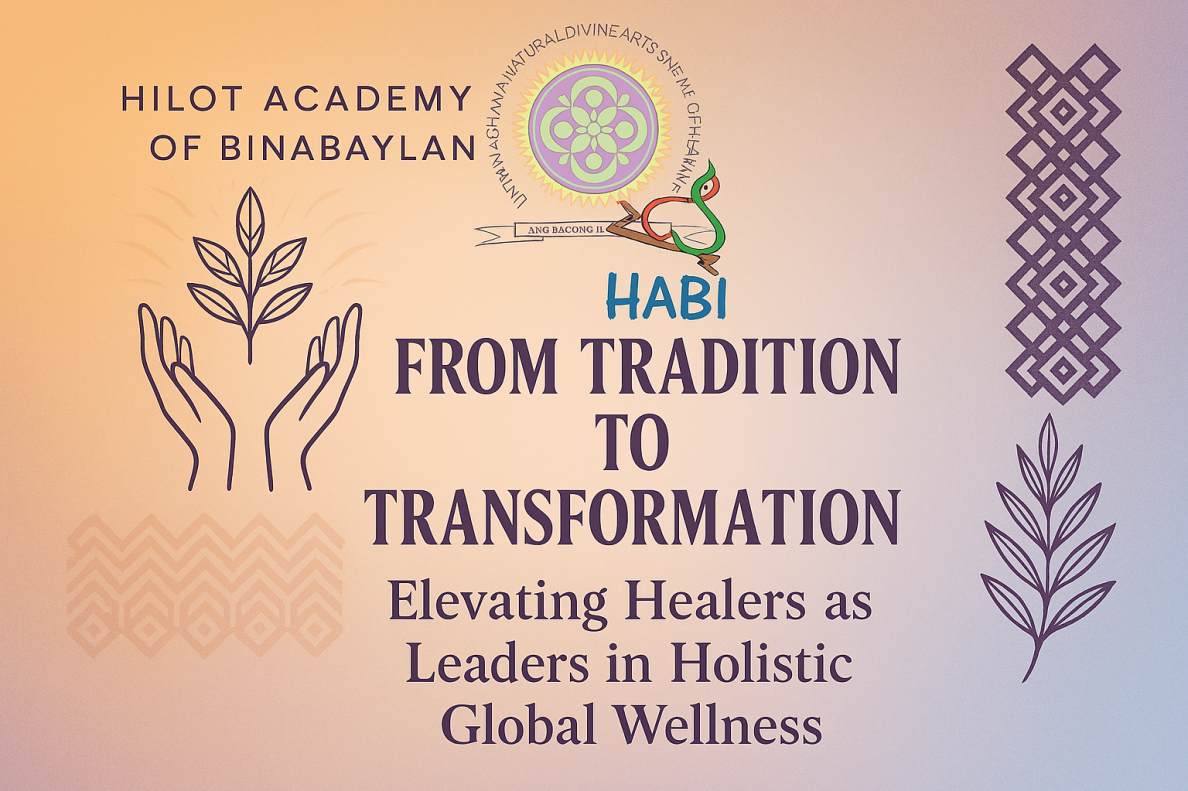
From Tradition to Transformation: Elevating Healers as Leaders in Holistic Global Wellness

San Jose Del Monte, Bulacan – January 1, 2026
As we welcome the new year, Hilot Academy of Binabaylan proudly announces its theme for 2026:
“From Tradition to Transformation: Elevating Healers as Leaders in Holistic Global Wellness.”

Why This Theme Matters

Hilot is more than a healing art—it is a living tradition deeply rooted in Filipino culture and spirituality. For centuries, Hilot has nurtured communities through its holistic approach to health and well-being. Today, the world is seeking authentic, natural, and integrative healing systems. This is where Hilot steps forward—not just as a practice, but as a global movement.

From Tradition to Transformation

This theme reflects our commitment to preserve the wisdom of our ancestors while embracing innovation. Hilot Academy continues to teach the sacred knowledge of Hilot Binabaylan, integrating it with modern wellness principles to meet the needs of a changing world.

Elevating Healers as Leaders

Our graduates are more than practitioners—they are leaders and advocates for holistic health. Through ministerial education, ethical standards, and continuous learning, Hilot Academy empowers healers to take leadership roles in global wellness communities. Professionalization in holistic health does not depend solely on secular academic degrees; it thrives on competence, ethics, and cultural authenticity—values that Hilot Academy upholds.

Major Initiatives for 2026

This year marks a significant milestone for Hilot Academy as we launch programs and partnerships that embody our theme:

Hilot Tanglaw Mentorship Program
We are introducing Hilot Tanglaw, a continuing professional development initiative designed to elevate Hilot Binabaylan practitioners into mentors and leaders. This program strengthens our network and ensures that the wisdom of Hilot is passed on with integrity and excellence.

Global Expansion: Bahay International Hilot Centre
In line with our vision of global wellness leadership, we have passed a resolution to establish the Bahay International Hilot Centre in Toronto, Canada. This center will serve as a hub for Hilot education and practice for Filipinos and international students seeking authentic indigenous healing.

Negotiations for London Training Center
We are also in active conversations to open a Hilot Training Center in London, bringing Hilot Binabaylan practice to Europe and expanding our reach to a global audience.

Holistic Global Wellness

The future of healthcare is holistic. By elevating Hilot into the global wellness conversation, we offer a unique contribution: a healing system that honors body, mind, spirit, and culture. Our mission is clear—to transform healers into leaders who inspire wellness worldwide.


Join us in this journey of transformation.
For enrollment and partnership inquiries, visit www.hilotacademy.com or email us at hilotacademy@luntiangaghama.org

The True Essence of a Healer: A Creed for Hilot Binabaylan Practitioners

In a world where healing is often measured by degrees, diplomas, and monetary value, I stand firm in the belief that the gift of knowledge entrusted to me through Hilot is overflowing—not because of wealth or status, but because of the love and compassion that move me to serve.

I do not claim that I can heal every illness a person may suffer. My heart and mind simply tell me to help and share my energy with every individual who genuinely seeks healing. Like all traditional folk healers, I acknowledge this truth: we are not the ones who heal. We are instruments of the Divine, channels through which healing flows.

Traditional medicine teaches that every individual has the innate ability to heal themselves. We, as healers, are catalysts—facilitators of that process. This wisdom was echoed by Doctor Ruben M. Galang Jr., who taught us that healing is a partnership. Even if I were the greatest healer in the land, if the person does not participate in their own healing, no true healing can occur.

As a Hilot Binabaylan, I am deeply grateful to every patient who knocks on my door. Their trust is a sacred gift. I am equally grateful to the Anito and the Diwata for entrusting me with this ability to care—not only with compassion but also with the little knowledge of human science that complements our ancestral wisdom.

Today, I realize that being a healer is not about academic degrees, certificates, or diplomas. It is about the degree of love and care that moves you to heal an individual. Healing is priceless because it springs from the heart.


Why I Heal on a Donation Basis
This afternoon, I spoke with Cris, our custodian who tends to our chickens. I asked him why he thinks I offer Hilot on a donation basis or sometimes for free. He guessed that I do so because I earn through teaching Hilot. While that is partly true, it is not the whole story. Teaching does not always guarantee income—this year, I only had one class in Hawaii last August and one enrollee this December. What they pay is a small amount, enough to sustain our work at the Hilot Academy of Binabaylan.

The real reason is this: if I charged the same rates I once did in Makati—₱1,800 to ₱2,500 per hourly session—many in my community could not afford it. And what I give is priceless. Healing is not a commodity; it is a sacred act of service.


The Creed of Hilot Binabaylan
From this reflection, I offer these guiding principles for all who walk the path of Hilot Binabaylan:

1. We are instruments of the Divine. Healing flows through us, not from us.
2. Healing is a partnership. The patient must actively participate for true healing to occur.
3. Love and compassion are our greatest credentials. Degrees and certificates do not define a healer—the heart does.
4. Gratitude is our foundation. We honor those who seek our help and the spiritual forces that guide us.
5. Healing is priceless. It cannot be measured by money but by the transformation it brings.
6. We serve with humility. Our work is not for fame or fortune but for the well-being of all.


Final Thoughts
To be a healer is to embody love, care, and service. It is to walk with humility, guided by the wisdom of our ancestors and the grace of the Divine. May this creed inspire every Hilot Binabaylan to uphold the sacred calling of healing—not as a profession, but as a lifelong mission of compassion.