Bridging Ethical Practice and Sacred Autonomy: A Reflection on Spiritual Healing

In recent days, a meaningful exchange took place between our institution—the Hilot Academy of Binabaylan under Templong Anituhan Inc.—and the Philippine Institute of Traditional and Alternative Health Care (PITAHC).

What began as a simple letter expressing concern over certain healing methods has opened a deeper conversation—one that touches on ethics, responsibility, tradition, and the sacred nature of healing.

This moment invites reflection, not division.

A Shared Commitment to Ethical Healing

At the heart of our communication is a shared truth:

Healing must always be grounded in compassion, dignity, and non-violence.

We recognize and affirm the important role of PITAHC in:

  • Promoting safety and accountability
  • Establishing standards in traditional healing
  • Protecting communities from harm

These are necessary and valuable contributions to public well-being.

At the same time, our reflection arises from a deeper concern:

👉 That all healing—whether physical, emotional, or spiritual—must never involve harm, coercion, or distress.

Healing is not domination.
Healing is not force.
Healing is the gentle restoration of balance.

The Distinction of Spiritual Healing

While many healing systems fall within the scope of regulation and certification, there exists a domain that is fundamentally different:

Spiritual Healing rooted in Indigenous and Sacred Traditions

Hilot Binabaylan, as practiced in our institution, belongs to this sacred domain.

It is not merely a technique.
It is not only a method.
It is a way of being, a calling, and a spiritual ministry.

It integrates:

  • The body (physical wellness)
  • The mind (awareness and intention)
  • The spirit (sacred connection and ancestral guidance)

In this sense, it transcends the framework of conventional healthcare systems.

On Regulation and Sacred Boundaries

In response to our letter, PITAHC kindly suggested applying for certification or recognition.

We receive this with respect.

However, it is important to clarify:

👉 Our intention was never to seek certification.

This is not out of resistance, but out of responsibility to the nature of our work.

Spiritual healing—particularly those rooted in indigenous traditions—belongs to a space that is:

  • Protected by freedom of religion and belief
  • Guided by ancestral knowledge systems
  • Sustained through initiation, formation, and spiritual lineage

To subject such practices to formal regulation in the same way as physical modalities risks something deeper:

It may unintentionally limit, redefine, or diminish the spiritual essence of the practice.

Sacred traditions are not merely systems to be standardized.
They are living relationships—with spirit, land, and community.

Indigenous Wisdom and Ethical Responsibility

This position is not a rejection of accountability.

On the contrary, Indigenous spiritual traditions carry their own forms of responsibility:

  • Eldership and mentorship
  • Ritual discipline
  • Spiritual discernment
  • Community-based validation

These are not lesser forms of accountability—they are simply different in nature.

In fact, they demand:

  • Deeper humility
  • Greater integrity
  • And a lifelong commitment to ethical service

Toward a Framework of Shared Ethical Principles

Rather than viewing regulation and spiritual autonomy as opposing forces, we see an opportunity:

A space for dialogue and collaboration grounded in shared values

Such a framework may include:

  • Non-violence in all forms of healing
  • Respect for human dignity and consent
  • Protection of vulnerable individuals
  • Cultural sensitivity and Indigenous respect
  • Clarity between physical, therapeutic, and spiritual practices

In this shared space:

  • Government institutions can safeguard public welfare
  • Spiritual institutions can preserve sacred integrity

Both serve the same people.

A Living Conversation

This is not the end of a discussion—it is the beginning of one.

We remain open to meaningful dialogue with PITAHC and other institutions, not to conform or to control, but to:

🌿 Co-create a holistic and ethical landscape of healing in the Philippines

One that honors:

  • Science and spirit
  • Safety and sacredness
  • Regulation and freedom

Closing Reflection

As we continue our work in Hilot Binabaylan and the ministry of Templong Anituhan, we hold firmly to this guiding truth:

Healing is sacred.
And what is sacred must be protected—not only from harm, but from being reduced to something it is not.

May we move forward together—with wisdom, humility, and respect for all paths that lead toward healing.

Compassion, Not Harm: Understanding True Healing in Hilot Binabaylan Practice

In recent times, a circulating video has raised serious concern within the healing community—a portrayal of a so-called “spiritual healer” using forceful and painful methods that appear violent, aggressive, and devoid of compassion. Such representations not only alarm the public but also mislead people about the true nature of traditional Filipino healing.

As practitioners and guardians of Hilot Binabaylan, it is our duty to clarify:
Authentic Hilot is not violence. It is healing grounded in care, alignment, and love.

Hilot Is Not Just Massage

One of the most common misconceptions is that Hilot is simply a form of massage meant for relaxation. This is not entirely accurate.

While massage focuses on soothing muscles and providing comfort, Hilot goes deeper. It is a traditional healing art that:

  • Identifies imbalances within the body
  • Restores alignment and energetic flow
  • Addresses physical, emotional, and spiritual disturbances

In Hilot Binabaylan, healing is intentional and corrective, not merely superficial.

Why Hilot Can Be Painful—But Only Briefly

It is true that Hilot can sometimes feel painful—but this must be properly understood.

The discomfort experienced during a Hilot session is not meant to harm. Rather, it is a natural response of the body when an imbalance is being corrected. When a part of the body is misaligned or blocked, the initial touch may trigger a moment of pain.

However, this follows a clear pattern:

  1. First stroke (unang hagod): discomfort or sharp sensation where imbalance exists
  2. Subsequent strokes: gradual reduction of pain
  3. Final phase: relief, lightness, and restored flow

The goal is not to inflict pain, but to reduce it until it completely disappears.

Gentleness Is Central to Hilot Practice

True Hilot is never executed through aggression.

A legitimate Hilot practitioner works with:

  • Controlled, gentle movements
  • Heightened awareness of the body’s response
  • Calm and focused intention
  • Respect for the patient’s limits

Healing is not achieved by force, anger, or punishment.
It is achieved through precision, sensitivity, and compassion.

The behavior shown in the viral video—violent striking, harsh handling, and use of instruments with aggression—does not represent Hilot Binabaylan.

Traditional Healing Tools: Purposeful, Not Harmful

Hilot does involve the use of tools, but always with therapeutic intention and care. These include:

  • Baso (glass cupping) for bentusa (suction therapy)
  • Leaves (dahon) used for scanning and diagnosing imbalances
  • Bamboo or guava sticks for controlled pressure application
  • Coconut midrib (tingting) used in gentle tapping techniques

For example, in the pa-tapik method using 13 coconut sticks, the tapping is light and rhythmic, designed to stimulate circulation—not to injure or punish the body.

Every tool in Hilot serves a healing purpose, never a destructive one.

Healing Is Rooted in Love and Care

The core principle of Hilot Binabaylan is simple yet profound:

Healing must come from love (pag-ibig) and compassion (pagmamalasakit).

Without these, any act cannot be called healing.

A true healer:

  • Does not dominate the patient
  • Does not inflict unnecessary pain
  • Does not act out of ego or anger

Instead, the healer becomes a channel of balance, care, and restoration.

Guidance for Patients Seeking Spiritual Healing

For those seeking the help of a spiritual healer, discernment is essential. Not all who claim to heal are legitimate practitioners.

Before entrusting your well-being, consider the following:

Check for Ordination Credentials

A true spiritual healer should be ordained by a legitimate spiritual or religious institution, authorizing them to practice healing responsibly.

Verify Legal Compliance

If they accept payments or donations:

  • Look for DTI Registration
  • Ensure they have a Mayor’s Permit

If they operate a chapel or organization:

  • Ask for SEC Registration
  • Confirm BIR Registration and official receipts

Observe Their Conduct

A legitimate healer:

  • Works with calmness and respect
  • Explains the process clearly
  • Prioritizes your safety and consent

Never trust a healer who:

  • Uses fear, intimidation, or violence
  • Claims absolute power or authority over your body
  • Justifies harm as “necessary suffering”

A Call to Spiritual Healers: Walk the Path with Integrity

If you feel called to become a spiritual healer, remember that healing is not just a gift—it is a sacred responsibility. It requires proper guidance, ethical grounding, and spiritual accountability.

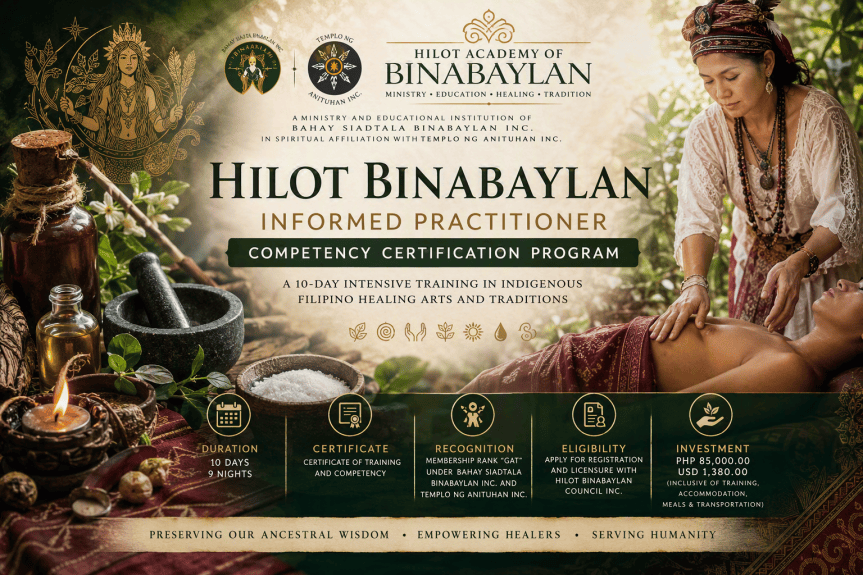
At the Hilot Academy of Binabaylan, we invite you to take a higher step in your journey by becoming a Certified Spiritual Wellness Facilitator.

This program is designed to:

  • Provide proper spiritual formation and guidance
  • Ground your healing practice in authentic Filipino Indigenous wisdom
  • Ensure your work is aligned with ethics, compassion, and legitimacy
  • Offer ordination credentials that affirm your role as a responsible healer

Ordination is not about titles—it is about accountability to the people you serve and the spiritual forces you work with.

If you are truly called to heal, then walk the path with discipline, humility, and love.

👉 Begin your journey today. Become an ordained Spiritual Wellness Facilitator.
Visit: https://www.hilotacademy.com

Let us uphold the honor of healing by becoming instruments of
care, not harm… balance, not fear… love, not violence.

The Shield of Siyargaw, the Hope of Esperanza: The Living Lineage of Rev. Rolando Gomez Comon

Deep within the vast mangrove channels of Del Carmen, Siargao, sits a coastal enclave named Barangay Esperanza. To the untrained eye, it is a serene village defined by the rhythmic tides of the Philippine Sea. But to those who carry its blood, it is a sanctuary of profound spiritual and civic guardianship. The name Esperanza translates directly to “Hope”—a title born out of a centuries-old prayer for resilience against the storms of nature and history.


Directly in front of the community’s spiritual anchor, the San Vicente Ferrer Chapel, sits an ancestral property belonging to the Comon family. This house was never just a residence; it was the unofficial session hall, the refuge for weary travelers, and the epicenter of community survival. The Comon lineage is inextricably woven into the very fabric of Del Carmen. In the 1960s, it was Mayor Galo C. Comon who legally reshaped the municipality’s modern identity, bridging the town’s ancient roots with its contemporary future.


Yet, the truest power of this lineage did not live in political offices, but in the hands of a man who stood as the spiritual custodian of the village: Diomedes Paqueo Comon, affectionately revered by his people as Lolo Mede.

    ┌─────────────────────────────────────────────────────────────┐
    │                THE COMON ANCESTRAL TRAJECTORY               │
    └──────────────────────────────┬──────────────────────────────┘
                                   │
         ┌─────────────────────────┴─────────────────────────┐
         ▼                                                   ▼
┌─────────────────────────────────┐                 ┌─────────────────────────────────┐
│        THE CIVIC SHIELD         │                 │      THE SPIRITUAL MEDICINE     │
├─────────────────────────────────┤                 ├─────────────────────────────────┤
│ Mayor Galo Comon & Lay Leaders  │                 │ Lolo Mede Comon (*Tambalan*)    │
│ Securing the town’s governance  │                 │ Preserving ancient indigenous   │
│ and colonial-era chapel.        │                 │ wisdom, herbalism, and *Hilot*. │
└─────────────────────────────────┘                 └─────────────────────────────────┘
                                   │
                                   ▼
                ┌─────────────────────────────────────┐
                │        THE MODERN BINABAYLAN        │
                ├─────────────────────────────────────┤
                │      REV. ROLANDO GOMEZ COMON       │
                │ Keeping the Lineage Alive: Ancestral│
                │ Reclamation & Indigenous Medicine.  │
                └─────────────────────────────────────┘

The Legacy of Lolo Mede: The Binisaya Healer


In traditional Visayan (Binisaya) culture, the line between the physical world and the spiritual realm is completely fluid. Lolo Mede was a famous mananambal (native healer)—the historical evolution of the pre-colonial Babaylan.
While Spanish colonizers sought to erase indigenous shamanism, the master healers of Siargao adapted to survive. Lolo Mede harmonized his ancient gifts with the modern church, serving as a trusted chapel lay leader. He understood that the earth was a divine pharmacy. Utilizing the immense biodiversity of the Del Carmen mangrove forests—the very siyargaw trees that gave the island its name and served as a natural barrier against deadly typhoons—he harvested barks, resins, and roots to cure the ailing.
Through the physical manipulation of Hilot (traditional bone-setting and massage), vapor therapies (tuob), and the whispering of sacred orasyon (chanted prayers), Lolo Mede did not just treat bodies; he restored the ginhawa (the breath and vital life force) of his people.


The Phenomena of Taliwala: An Unbroken Spiritual Inheritance

For decades after his passing, the healing fires of the family seemed quiet. But indigenous gifts are rarely lost; they merely sleep, waiting for the right vessel. In Binisaya spiritual tradition, there is a phenomenon known as Taliwala or Abat—the ancestral rebirth of a gift. It is the belief that a profound spiritual inheritance (gasa) will deliberately bypass children to reawaken vibrantly in a specific grandchild.


Today, that reawakening has found its vessel in his grandson, Rev. Rolando Gomez Comon.
When distant relatives look upon Rev. Rolando, they often experience a startling sense of recognition. They mistake the grandson for Lolo Mede himself, sensing an ancient, familiar healing frequency vibrating through his presence. This is not an optical illusion or a simple mistake; it is the community’s instinctual recognition of an unbroken spiritual lineage. The ginhawa (life force) of the grandfather has stepped across time into the hands of the grandson.


The Vital Imperative: Keeping the Comon Lineage Alive


To walk the contemporary path as a Hilot Binabaylan while holding the title of Rev. Rolando Gomez Comon is to carry an immense, sacred responsibility. In an era where Siargao Islands are globally romanticized as a modern tourist playground, the authentic spiritual and cultural identity of its native people faces the quiet threat of erasure. For Rev. Rolando, continuing this lineage is not a choice—it is a vital imperative to honor the Comon ancestors of Barangay Esperanza.


┌────────────────────────────────────────────────────────────────────────┐
│             WHY THE LIVING COMON LINEAGE MUST BE PRESERVED             │
├────────────────────────────────────────────────────────────────────────┤
│ • CULTURAL ANCHOR: Shields Siargao’s native identity from tourism.     │
│ • MEDICINAL RECLAMATION: Keeps the *Binisaya* healing sciences alive.   │
│ • DECOLONIAL BRIDGE: Unites ancient *Diwata* roots with modern faith.  │
│ • LIVING SANCTUARY: Sustains Esperanza’s historical role of protection.│
└────────────────────────────────────────────────────────────────────────┘


1. Resisting Cultural Displacement
As commercial developments reshape the coastlines of Siargao, the deep, foundational history of towns like Del Carmen risks becoming a footnote. By openly practicing as a Hilot Binabaylan, Rev. Rolando ensures that the Comon family remains what they have always been: guardians of the land. It broadcasts a powerful reminder that before the island was a destination for surfers, it was—and still is—a sacred territory of mystics, prayer warriors, and traditional healers.

2. Safeguarding Indigenous Medicine as a Living Science
Lolo Mede’s medicine was a sophisticated, intuitive science built on centuries of observing the island’s ecosystems. When traditional healing lines break, the deep knowledge of native flora, the spiritual mechanics of Hilot, and the protective energetic boundaries of the mangroves die with them. By keeping this practice alive, Rev. Rolando acts as a living archive, ensuring that the indigenous Binisaya wellness systems remain dynamic, active, and accessible to those who need healing.

3. A Legacy of Decolonial Reclamation
While Lolo Mede had to shield his indigenous mysticism within the protective, acceptable boundaries of a Catholic chapel to survive his era, Rev. Rolando steps into the lineage during an age of awakening. His work is an act of spiritual decolonization. He bridges the sacred mechanics of traditional Hilot and the ancient worldview of the Diwata (nature spirits) with modern spiritual leadership. He vindicates the ancestors by bringing their hidden practices completely into the light, showing that native spirituality is not something to be feared, but a holy gift to be revered.

The Fire Endures in Esperanza

The story of the Comon lineage is a testament to the absolute resilience of Siargao’s true indigenous spirit. The ancestral home still stands proud directly across from the chapel in Barangay Esperanza, serving as a physical monument to a family that chose to stay, protect, govern, and heal.
The ancestors are not gone; they live on in the marrow of their descendants. Through the hands, prayers, and calling of Rev. Rolando Gomez Comon, the sacred fire of Lolo Mede burns as brightly as ever. The lineage remains fiercely alive—honoring those who walked before, protecting the sanctity of Esperanza, and continuing to offer a true sanctuary of hope to a world longing to remember its roots.

The Sanctity of the Hilot Binabaylan Lineage: Becoming an Instrument of the Divine

In the sacred path of Hilot Binabaylan, the title we carry is not merely a name—it is a responsibility, a vow, and a living embodiment of a lineage that traces back to the Divine Source of Life itself.

To be called a Hilot Binabaylan Practitioner is to stand as a bridge between the human and the sacred, between the seen and the unseen, between the suffering and the Source of healing. This title carries weight—not because it elevates the self, but because it demands humility, discipline, and deep surrender.

Who Truly Heals?

Recently, I spoke with a student who chose to stop practicing Hilot. His reason was filled with pain: despite his efforts, his practice did not heal his sick father.

In that moment, I asked him a simple question: “Who do you think truly heals? Who gave life to your father?”

This question brings us back to the very heart of Hilot Binabaylan.

It is not the practitioner who heals.
It is not the technique that restores life.

All healing comes from the Supreme Divine Creator—the Source of all life, breath, and existence.

What we do, as Hilot practitioners, is to participate in that sacred process. Our touch, our movements, our rituals, our presence—these are not acts of personal power. They are forms of prayer in motion, humble offerings that call upon the Divine to bring forth healing where it is needed.

We are not the source.
We are the instrument.

The Practice Beyond the Title

In today’s time, especially among those in the diaspora, there are individuals who hold tightly to the title of Hilot Binabaylan, yet hesitate to embody its practice. They speak about the tradition, identify with its name, but do not walk the path through action and service.

But lineage is not preserved through words alone.

It is lived.
It is practiced.
It is offered in service to others.

To carry the name without honoring its responsibility is to separate oneself from the living current of the lineage. Hilot is not an identity to display—it is a sacred duty to fulfill.

A Gift Belonging to the People

It must also be clearly understood:
Hilot is not owned by any institution, organization, or individual.

Hilot is a Divine Gift entrusted to the Filipino people—a sacred inheritance rooted in care, community, and connection to the natural and spiritual worlds.

What we uphold within:

  • Hilot Academy of Binabaylan
  • Templong Anituhan
  • Luntiang Aghama Natural Divine Arts Shrine of Healing Inc.
  • Bahay Siadtala Binabaylan Inc.

…is not ownership of Hilot itself.

Rather, what we offer is structure, guidance, and discipline through a carefully developed curriculum and standardized techniques—refined through decades of lived practice, from 1998 to the present, under my work as Apu Adman Aghama.

These frameworks exist to guide practitioners into integrity, not to claim authority over a sacred tradition that ultimately belongs to the Divine and the people.

Hilot as Complement, Not Competition

True Hilot does not seek to compete.

It does not position itself above other healing modalities, nor does it claim exclusivity in restoring health and well-being.

Instead, Hilot stands as a complementary sacred art, working in harmony with other forms of healing—modern and traditional alike. Its purpose is to serve, to contribute, and to integrate for the greater good of humanity.

Where there is suffering, Hilot offers support.
Where there is imbalance, Hilot offers alignment.
Where there is disconnection, Hilot restores relationship—with self, nature, and Spirit.

Honoring the Lineage

At the heart of Hilot Binabaylan is ancestral reverence.

We do not take pride in ourselves as healers.
We do not glorify the individual practitioner.

Instead, we give honor where it belongs:

  • To our ancestors, who preserved this knowledge through generations
  • To the Diwata and Anito, who guide and sustain the unseen realms
  • And ultimately, to the Supreme Divine Creator, from whom all healing flows

Our lineage is not something we invented—it is something we have received, honored, and are now entrusted to continue.

Walking as an Instrument of the Divine

To be a Hilot Binabaylan Practitioner is to live in constant remembrance:

  • That our hands are not our own—they are guided
  • That our knowledge is not for self-gain—it is for service
  • That our work is not to prove power—but to express devotion

Each session becomes a prayer.
Each touch becomes an offering.
Each healing moment becomes an act of surrender.

We do not command healing.
We invite it.

We do not create life.
We honor it.

We do not heal.
We become instruments through which the Divine heals.


A Call to Practitioners

Let this be a reminder to all who carry the name Hilot Binabaylan:

Walk the path.
Live the practice.
Serve with humility.

Return always to the Source.

For in the end, the sanctity of our lineage is not preserved by titles—but by the sincerity of our devotion, the integrity of our actions, and our unwavering recognition that we are, and will always be,

Instruments of the Divine.

Understanding the Doctor of Ministry in Indigenous Filipino Healing Arts and Sciences, with Specialization in Hilot Binabaylan Practice: Legitimacy, Context, and Alignment with Philippine and International Education Frameworks

As Indigenous knowledge systems reclaim their rightful place in global conversations on healing, education, and spirituality, the need for culturally appropriate doctoral pathways has become increasingly clear. One such pathway is the Doctor of Ministry (DMin) in Indigenous Filipino Healing Arts and Sciences, with Hilot Binabaylan Practice as a formal area of specialization.

This degree affirms Indigenous Filipino healing as a living, sacred, and community‑embedded practice, while remaining fully aligned with Philippine regulatory structures and international norms for professional and ecclesiastical education.

This article explains the nature of the degree, the role of Hilot Binabaylan as a specialization, and why this doctoral framework is legitimate, ethical, and non‑conflicting with governing accreditation agencies.

What Is a Doctor of Ministry (DMin)?

A Doctor of Ministry (DMin) is an internationally recognized professional, practice‑based doctoral degree designed for experienced practitioners engaged in leadership, ministry, and community service. Unlike a Doctor of Philosophy (PhD), which is primarily research‑oriented, the DMin emphasizes:

  • Advanced applied practice
  • Integration of theory, spirituality, and lived context
  • Ethical leadership and service
  • Formation within real communities

Globally, the DMin is regarded as a terminal doctorate for professional ministry, commonly offered by seminaries and religious institutions. It is not a medical degree, nor is it intended to lead to licensure in regulated professions such as medicine or allied health.

This definition is consistent across Asia, North America, and Europe and provides the correct academic and ethical container for Indigenous and spiritual forms of healing leadership.

Indigenous Filipino Healing as Ministry, Not Medicine

Indigenous Filipino healing traditions—including Hilot Binabaylan—operate within a worldview where healing is inseparable from:

  • Spiritual vocation
  • Ritual authority
  • Ancestral lineage
  • Communal responsibility
  • Ethical service to people and land

These traditions do not arise from biomedical paradigms, nor do they claim the authority of modern clinical medicine. Instead, they function as sacred healing ministries, transmitted through apprenticeship, ritual initiation, and cultural responsibility.

For this reason, a Doctor of Ministry—rather than a medical doctorate or purely academic PhD—is the most appropriate and non‑colonizing doctoral framework.

Hilot Binabaylan Practice as a Specialization

Within the Doctor of Ministry in Indigenous Filipino Healing Arts and Sciences, Hilot Binabaylan Practice functions as a focused area of specialization, allowing advanced practitioners to deepen, refine, and transmit this specific Indigenous healing tradition at the doctoral level.

What the Specialization Affirms

The Hilot Binabaylan specialization recognizes the practice as:

  • A comprehensive Indigenous Filipino healing system
  • Integrating bodywork (hilot), spiritual diagnostics, ritual, prayer, and herbal knowledge
  • Rooted in cosmology involving Diwata, Anito, Kalikasan, and ancestral guidance
  • Governed by ethical obligations to community, students, and lineage

At the doctoral level, specialization in Hilot Binabaylan does not merely teach techniques. It develops senior practitioners and stewards who are capable of:

  • Ethical leadership in healing communities
  • Teaching and mentoring future practitioners
  • Developing curricula and ritual frameworks
  • Articulating Indigenous healing in interfaith, intercultural, and academic spaces

“Healing Arts and Sciences”: A Legitimate Academic Framing

The phrase “Healing Arts and Sciences” is intentional and internationally understood.

  • Healing Arts refers to ritual practice, embodied skill, ceremonial work, and intuitive diagnostics.
  • Healing Sciences acknowledges structured bodies of Indigenous knowledge, including anatomy as understood in hilot, ethnomedicine, cosmology, psycho‑spiritual health, and community systems of care.

This framing does not imply biomedical practice and does not claim equivalence to medical licensure. Instead, it affirms that Indigenous healing traditions possess their own internal sciences, methods, and epistemologies.

Such language is widely used in Indigenous, traditional, and complementary healing education worldwide and is considered academically and culturally legitimate.

Alignment with CHED and Philippine Regulatory Frameworks

In the Philippines, the Commission on Higher Education (CHED) regulates civil, state‑recognized academic degrees that lead to regulated professions, licensure, or government employment ranking.

However, it is well established that:

  • Ecclesiastical, ministerial, and vocational degrees—including Doctor of Ministry programs—may operate lawfully outside CHED’s Special Order (SO) system when they do not claim civil professional status.
  • Many Philippine seminaries and religious institutions clearly state that their DMin degrees are professional and ecclesiastical, not civil licensure pathways.

The Doctor of Ministry in Indigenous Filipino Healing Arts and Sciences, including the Hilot Binabaylan specialization, follows this exact and lawful model:

  • It is explicitly a ministerial doctorate
  • It makes no claim to medical or allied health licensure
  • It does not represent itself as a CHED‑regulated professional qualification

For this reason, it does not conflict with CHED authority, nor does it encroach upon regulated healthcare professions.

International Context and Precedent

Internationally, Doctor of Ministry degrees are widely accepted as legitimate professional doctorates within religious and cultural education systems. Indigenous healing doctorates in other cultures—such as Native American Sacred Medicine or African Indigenous Healing—are similarly framed within:

  • Ecclesiastical authority
  • Cultural legitimacy
  • Community validation
  • Ethical self‑regulation

The DMin in Indigenous Filipino Healing Arts and Sciences, with specialization in Hilot Binabaylan Practice, stands comfortably within these global norms.

Legitimacy, in this context, is established through:

  • Transparency of scope
  • Accuracy of representation
  • Integrity of formation
  • Accountability to community and tradition

What This Degree Is—and Is Not

This Degree IS:

  • A professional doctorate in ministry
  • A recognition of advanced Indigenous Filipino healing leadership
  • A credential for senior practitioners, mentors, and ritual leaders
  • A framework for safeguarding and transmitting Hilot Binabaylan

This Degree IS NOT:

  • A medical doctorate (MD)
  • A substitute for regulated healthcare degrees
  • A biomedical or pharmaceutical qualification
  • A claim to clinical or hospital‑based licensure

Clear communication of these boundaries ensures legal clarity, ethical practice, and protection of the tradition.

Conclusion: Safeguarding Hilot Binabaylan Through the Right Doctorate

The Doctor of Ministry in Indigenous Filipino Healing Arts and Sciences, with Hilot Binabaylan Practice as a specialization, represents a conscious and responsible choice.

Rather than forcing Indigenous healing into unsuitable Western academic molds, it:

  • Honors ancestral authority
  • Respects Philippine regulatory boundaries
  • Aligns with international ecclesiastical practice
  • Protects Hilot Binabaylan as a living sacred science

In doing so, it affirms that Indigenous Filipino healing does not need to imitate biomedicine to be legitimate—it needs the right container, rooted in its own cosmology, ethics, and purpose.

The Role of a Doctor of Ministry in Indigenous Filipino Healing Arts and Sciences (Specialization in Hilot Binabaylan Practice)

A Doctor of Ministry in Indigenous Filipino Healing Arts and Sciences (DMin‑IFHAS), with specialization in Hilot Binabaylan Practice, is a senior practitioner, cultural steward, and spiritual leader. The role is grounded in service, ethical responsibility, and ancestral accountability, not in biomedical authority.

This doctorate recognizes mastery of practice and leadership, not clinical licensure.

Core Duties and Responsibilities

1. Custodian of Indigenous Filipino Healing Knowledge

A DMin‑IFHAS is entrusted with the protection, preservation, and proper transmission of Indigenous Filipino healing traditions, particularly Hilot Binabaylan.

This includes:

  • Safeguarding ritual integrity and sacred protocols
  • Preventing misuse, commercialization, or misrepresentation of hilot
  • Honoring ancestral lineages and spiritual authority
  • Ensuring teachings are transmitted responsibly and respectfully

Primary responsibility: protect the tradition from erosion, harm, and distortion.

2. Senior Practitioner of Hilot Binabaylan

As a doctoral‑level practitioner, the individual is expected to demonstrate advanced mastery of practice, not just knowledge.

This includes:

  • Ethical application of hilot bodywork
  • Spiritual diagnostics rooted in Indigenous cosmology
  • Ritual healing and prayer within the Binabaylan framework
  • Discernment of appropriate scope of practice

Key expectation: healing is offered as sacred service, not as commercial treatment.

3. Spiritual and Ministerial Leadership

Because this is a Doctor of Ministry, the individual functions as a healing minister, not merely a technician.

Duties include:

  • Providing spiritual guidance to individuals and communities
  • Leading healing rituals, commemorations, and rites
  • Offering pastoral‑style care during illness, grief, or transition
  • Serving as a moral and ethical presence in the community

People should expect: compassion, integrity, and spiritual maturity.

4. Teacher, Mentor, and Formation Guide

A doctoral holder is expected to form others, not merely to practice privately.

Responsibilities include:

  • Teaching Hilot Binabaylan within proper initiatory frameworks
  • Mentoring apprentices, students, or junior practitioners
  • Developing curricula, training materials, and learning pathways
  • Evaluating readiness, ethics, and character of learners

Emphasis: formation of healers, not mass production of certificates.

5. Cultural and Interfaith Representative

A DMin‑IFHAS often serves as a bridge figure between Indigenous Filipino healing traditions and wider society.

This includes:

  • Explaining hilot responsibly to institutions and the public
  • Participating in interfaith and intercultural dialogue
  • Advocating for Indigenous healing rights and dignity
  • Representing Filipino Indigenous spirituality with accuracy

Public role: educator and advocate, not polemicist.

6. Developer of Indigenous Healing Scholarship (Practice‑Based)

Although not a PhD researcher, a DMin holder contributes to practice‑based scholarship.

This may include:

  • Documenting lived healing practices
  • Writing reflective studies, manuals, or ritual texts
  • Producing community‑based research or capstone projects
  • Preserving oral traditions in ethical and consent‑based ways

Scholarship is grounded in lived practice, not detached theory.

7. Ethical Gatekeeper and Accountability Figure

A Doctor of Ministry bears heightened responsibility for ethical conduct.

This includes:

  • Clear boundaries with clients and students
  • Transparency about what hilot can and cannot do
  • Referrals to medical professionals when necessary
  • Refusal to claim biomedical authority or guaranteed cures

Ethics are non‑negotiable at the doctoral level.

What the Public Should Reasonably Expect

People engaging with a DMin‑IFHAS may rightly expect:

Respect for Indigenous knowledge
Spiritual depth and maturity
Clear ethical boundaries
No false medical claims
Honest referral when a case is outside scope
Teaching that honors culture, not ego

What the Public Should NOT Expect

It is equally important to state what should not be expected:

❌ Medical diagnosis or clinical treatment
❌ Hospital‑level care or biomedical procedures
❌ Replacement of licensed physicians
❌ Guaranteed cures or miracles
❌ Commercial exploitation of sacred rituals

A DMin‑IFHAS does not function as a medical doctor and should never be presented as such.

The Meaning of “Doctor” in This Context

The title “Doctor” in a Doctor of Ministry means:

  • A teacher and guide
  • A recognized authority within a specific tradition
  • A person entrusted with stewardship and formation
  • A senior practitioner of a sacred calling

It does not mean physician or biomedical expert.

This understanding is consistent worldwide for Doctor of Ministry degrees and Indigenous healing doctorates.

Summary: A Role of Service, Not Status

At its heart, a Doctor of Ministry in Indigenous Filipino Healing Arts and Sciences, specializing in Hilot Binabaylan Practice, carries a calling defined by:

Service over status
Responsibility over recognition
Stewardship over supremacy

The doctorate exists to protect the tradition, serve the people, and honor the ancestors, not to compete with modern medicine or claim inappropriate authority.

Code of Ethics

Doctor of Ministry in Indigenous Filipino Healing Arts and Sciences (Specialization in Hilot Binabaylan Practice)

Preamble

The Doctor of Ministry in Indigenous Filipino Healing Arts and Sciences, with specialization in Hilot Binabaylan Practice, is a sacred trust conferred upon senior practitioners who serve as healers, teachers, spiritual leaders, and custodians of Indigenous Filipino healing traditions.

This Code of Ethics articulates the moral, spiritual, professional, and cultural responsibilities of all who bear this title. It exists to protect the people, the tradition, the institution, and the ancestral lineage from harm, misuse, or misrepresentation.

Acceptance of this doctorate signifies a commitment to service over status, integrity over authority, and stewardship over personal gain.

I. Foundational Ethical Principles

All holders of this degree shall be guided by the following principles:

  1. Sacredness of Healing
    Healing is a sacred act rooted in ancestral wisdom, spiritual guidance, and service to the community.
  2. Ancestral Accountability
    The healer is accountable not only to institutions and communities, but to ancestors, lineage, and future generations.
  3. Respect for Human Dignity
    Every person is approached with respect, compassion, consent, and cultural sensitivity.
  4. Truthfulness and Transparency
    The healer commits to honesty in representation, practice, and communication.
  5. Decolonial Integrity
    Indigenous healing is honored on its own terms, not reshaped to imitate biomedical or colonial frameworks.

II. Scope of Practice and Professional Boundaries

  1. Non‑Medical Representation
    A DMin‑IFHAS holder shall not claim or imply status as a licensed medical doctor, physician, or healthcare professional.
  2. No Biomedical Diagnosis or Treatment
    The practitioner shall not diagnose diseases, prescribe pharmaceutical drugs, or perform clinical medical procedures.
  3. Clear Scope Disclosure
    Clients, students, and communities must be clearly informed that Hilot Binabaylan is an Indigenous spiritual and healing practice, not a replacement for modern medical care.
  4. Right to Referral
    When a condition is beyond the scope of Indigenous healing, the practitioner has an ethical duty to refer individuals to appropriate licensed medical professionals.

III. Ethical Practice of Hilot Binabaylan

  1. Competent and Trained Practice
    Healing practices shall only be performed within the practitioner’s level of training, initiation, and spiritual readiness.
  2. Consent and Volition
    No healing, ritual, or energetic work shall be performed without informed and voluntary consent.
  3. Non‑Exploitation
    The practitioner shall never exploit spiritual authority, dependency, vulnerability, or faith for personal, financial, or sexual gain.
  4. Integrity of Ritual
    Sacred rituals, prayers, and spiritual protocols shall not be altered, commercialized, or performed frivolously.

IV. Teaching, Initiation, and Transmission

  1. Responsible Transmission
    Hilot Binabaylan teachings shall be passed only to individuals who demonstrate readiness, ethical character, and respect for the tradition.
  2. No Mass Initiation
    The practitioner shall not dilute the tradition through mass certifications, instant initiation, or fraudulent credentialing.
  3. Mentorship and Discernment
    Teaching is a process of formation, mentorship, and discernment, not merely information transfer.
  4. Protection of Sacred Knowledge
    Certain teachings may remain restricted, oral, or lineage‑held and shall not be publicly disclosed without ancestral and institutional permission.

V. Cultural and Community Responsibility

  1. Cultural Respect
    The practitioner must honor the diverse Indigenous cultures, regional expressions, and lineages within Filipino spiritual traditions.
  2. Community Accountability
    Practice shall remain accountable to community elders, councils, or recognized spiritual authorities, not solely to individual interpretation.
  3. Advocacy Without Appropriation
    Advocacy for Indigenous healing must uplift the people and culture, not center personal charisma, branding, or dominance.

VI. Ethical Leadership and Ministry

  1. Servant Leadership
    A Doctor of Ministry leads through humility, service, and example—not coercion or authoritarianism.
  2. Pastoral Care Standards
    Spiritual counsel must be compassionate, non‑judgmental, and respectful of personal agency.
  3. Boundaries and Safeguards
    Clear emotional, sexual, financial, and spiritual boundaries shall be maintained at all times.
  4. Conflict Resolution
    Disputes shall be addressed through dialogue, mediation, and ancestral values, not public shaming or abuse of authority.

VII. Scholarship, Documentation, and Research Ethics

  1. Practice‑Based Scholarship
    Research and writing shall arise from lived practice and community engagement, not extraction or academic exploitation.
  2. Informed Consent in Documentation
    Stories, rituals, or practices shared publicly must have consent and must protect identities when needed.
  3. No Intellectual Theft
    Indigenous knowledge shall not be appropriated, plagiarized, or claimed as personal invention.

VIII. Integrity of the Doctoral Title

  1. Proper Use of the Title “Doctor”
    The title “Doctor” shall be used only in its ministerial and professional context, with clarity about its meaning.
  2. No Misleading Claims
    Marketing, teaching materials, or public statements shall not mislead others regarding authority, outcomes, or capabilities.
  3. Representation of the Institution and Tradition
    Holders of this degree are ambassadors of the institution and the tradition and shall act in a manner that upholds their dignity.

IX. Accountability and Consequences

  1. Ethical Review
    Alleged violations of this Code may be subject to review by an ethics council, elders’ council, or institutional authority.
  2. Corrective Measures
    Actions may include guidance, suspension, revocation of teaching authority, or withdrawal of credentials, depending on severity.
  3. Restorative Justice
    Wherever possible, accountability shall follow restorative and reconciliatory principles aligned with Indigenous values.

Closing Commitment

To accept the title Doctor of Ministry in Indigenous Filipino Healing Arts and Sciences (Hilot Binabaylan Practice) is to accept a lifelong obligation:

To heal without harm
To teach without ego
To lead without domination
To remember without distortion
And to serve with honor to the ancestors, the people, and the future

When Capitalism Rewrites Culture: The Slow Erosion of Indigenous Lands and Indigenous Healing

There is a silent but deeply damaging pattern that continues to unfold in Indigenous communities across the Philippines—and many of us are only beginning to recognize it.

Indigenous Peoples are often subjected to systematic mental conditioning by capitalist forces. They are persuaded, lured, and sometimes coerced into selling their ancestral domains—lands that are not mere property, but living extensions of their identity, history, and spirituality. Once these lands are lost, many communities are pushed into economic dependency, surviving on government aid programs such as the Pantawid Pamilyang Pilipino Program (4Ps), rather than living with dignity through self-determination.

This tragedy is not limited to land alone.

The same pattern is happening to Hilot, the Indigenous healing system of the Filipino people.

Hilot: From Living Tradition to Marketable “Experience”

Hilot is not simply massage. It is not a spa service. It is not a wellness “add-on.”

Hilot is a holistic Indigenous medical system rooted in Filipino cosmology, spirituality, community wisdom, and intimate knowledge of the body, nature, and the unseen. It is practiced by healers who understand balance—between lamig and init, katawan and diwa, lupa and espiritu.

Yet today, Hilot is being slowly stripped of its soul.

Under the influence of the modern wellness tourism industry, Hilot is increasingly repackaged into something more “palatable” to foreign markets and upper-class consumers. It is marketed as exotic relaxation, luxury therapy, or spa culture—divorced from its cultural roots and spiritual framework.

In this process, the taal—the original, Indigenous essence of Hilot—is erased.

The Colonial Logic of “Modernization”

Capitalism has a familiar script:

  • Indigenous knowledge is labeled primitive
  • Traditional systems are framed as outdated
  • Western or “modern” approaches are positioned as superior

This logic convinces communities to abandon their own wisdom in favor of externally imposed standards. Just as ancestral lands are sold in exchange for short-term economic relief, Indigenous healing traditions are traded for commercial viability and institutional acceptance.

What remains is a hollow version of the original—lucrative, marketable, and disconnected.

Dependency Replaces Sovereignty

When Indigenous Peoples lose their land, they lose autonomy. When healers lose their tradition, they lose authority.

Instead of empowering communities to sustain themselves through ancestral knowledge, capitalist systems create dependency—whether on government subsidies or on tourism-driven income that benefits corporations more than culture bearers.

Hilot practitioners are encouraged to align with certification systems that prioritize profitability over lineage, technique without spirit, and branding without cultural accountability.

This is not progress. This is erasure disguised as development.

Remembering Is an Act of Resistance

To remember Hilot in its Indigenous form is a political, cultural, and spiritual act.

It means honoring:

  • Ancestral transmission over commercial training
  • Healing as service, not spectacle
  • Community wellness over individual luxury
  • Cultural integrity over tourist expectations

The survival of Hilot depends not on how well it performs in spas, but on how firmly it is rooted in its Indigenous worldview.

Just as ancestral domains are sacred, so too is ancestral knowledge.

To protect Hilot is to protect Filipino identity. To practice it fully is to reclaim sovereignty over our body, spirit, and memory.

The question is not whether Hilot can survive in the modern world.

The real question is: Will we remember what Hilot truly is before it disappears beneath the weight of “wellness”?

The Alchemy of Balance: Rehabilitation and the Power of the “Maaram”

Introduction: Redefining Rehabilitation

In the modern world, rehabilitation is often viewed as a clinical process—a way to fix a broken body or a wayward mind. However, in the heart of Philippine tradition, rehabilitation is restoration. It is the act of bringing a person, a family, or a community back into a state of Harmony (Pagkakaisa) and Balance (Patas).

The Anatomy of Imbalance: Pasmo, Bughat, and Baldao Traditional healing recognizes that “damage” isn’t just physical. Baldao (Ilocano): A physical dislocation that requires the manual “resetting” of the frame. Pasmo: A thermal and energetic imbalance caused by the collision of “hot” and “cold,” often manifesting as tremors or weakness. Bughat/Binat: A spiritual and physical relapse. It is a reminder that the body is a temple that requires “sealing” and respect after a period of opening, such as illness or childbirth.

In these cases, the Hilot or Albularyo acts as the architect of recovery, using herbs, heat, and touch to reconstruct what was lost. The “Maaram” and the Neutrality of Knowledge At the center of this world is the Maaram (The Knower/The Wise). The etymology of the word—rooted in Alam (Knowledge)—parallels the English “Witch,” which comes from Wit (to know). A true Maaram is a Keeper of Ancient Mysteries.

They understand that knowledge is a neutral tool, like electricity or a blade. It has no inherent “color” until it is dyed by the Intention of the user. White Intent: Used for healing and protection.

Black Intent (Kulam): Traditionally defined by colonial history as “evil,” but philosophically viewed as the use of power to inflict consequence.

Kulam: The Tool of Restorative Justice Our discussion challenged the modern “demonization” of Kulam. Rather than a purely destructive act, Kulam can be viewed as a constructive tool for the oppressed.

A Self-Defense Mechanism: For those who are poor or powerless against the “rich” or the “mighty,” the cry for divine help awakens the Mangkukulam within.

A Teacher of Lessons: It serves as a spiritual classroom where pain is the medium for a lesson. It forces the offender to face their guilt and restore what they have stolen or broken.

The Universal Ki: This power is not reserved for “special” people. It is the Ki or Chi—the life force—within every individual. It is the manifestation of the human will to defend its own dignity and restore universal balance.

Conclusion: The Flow of Life The ultimate goal of all these mysteries is to ensure that life energy flows freely. Whether through the gentle touch of a healer or the sharp “correction” of a manifest intent, the purpose is the same: to maintain the harmony of the whole. The Maaram does not seek fame or fortune, but lives an ordinary life as a silent guardian of these laws. Knowledge, like Ki, must flow to give life to those who need it. When the “Mangkukulam within” awakens, it is not an act of evil, but the soul’s natural response to restore what is broken.

Hilot Then and Now: Autonomy, Community, and a Modern Framework for Continuity 

By Rev. Rolando Gomez Comon (Apu Adman), Developer and Reviver of Hilot Binabaylan, Founder of Hilot Academy of Binabaylan


Overview

This article clarifies three intertwined questions:

  1. Was hilot a “business” in pre‑colonial times?
  2. How do “necessity” and “commodity” differ—and where does hilot belong?
  3. Did manghihilot have formal groups and leaders in ancient times—and how does that history inform modern debates over legitimacy and leadership?

It closes with a Position Paper presenting the historical‑theological justification for the leadership of the Hilot Academy of Binabaylan, and a peaceful indigenous response to critiques of legitimacy—grounded in culture, service, and spiritual calling.


I. Was Hilot a “Business” in Pre‑Colonial Times?

Short answer: No—not in the modern market sense. In pre‑colonial Philippine communities, hilot was a community health service embedded in spiritual practice, herbal knowledge, and manual healing, provided by manghihilot, albularyo, and babaylan. Compensation typically came through reciprocity—food, portions of harvest, help, or other gifts—rather than profit margins or standardized prices. The work was spirit‑led and community‑validated, not market‑driven.
Sources: Overviews consistently describe hilot as a holistic, culturally embedded practice rather than mere massage or commerce, emphasizing its role in childbirth, midwifery, herbalism, and spiritual healing. [beholdphil…ppines.com], [en.wikipedia.org], [nipino.com]


II. Necessity vs. Commodity—And Where Hilot Belongs

A. Definitions

  • Necessity: Goods or services essential to life and well‑being; demand is relatively inelastic because people need them regardless of price (e.g., food, water, shelter, basic healthcare). [difference.wiki], [fiveable.me]
  • Commodity: A good or service produced for trade, often fungible (interchangeable) and subject to market pricing and speculation (e.g., grains, metals, oil). [en.wikipedia.org], [merriam-webster.com]

B. Where Hilot Belongs

Pre‑colonial hilot functioned as a necessity: it was the primary healthcare for many communities—covering musculoskeletal care, prenatal and childbirth support, herbal medicine, and spiritual balance. Its demand derived from communal need and spiritual obligation, not price sensitivity or brand competition. [beholdphil…ppines.com], [nipino.com]

Modern hilot can be commodified (e.g., spa menus, wellness tourism, branded trainings) when offered through market channels with fees, packages, and certifications. That shift—from necessity to commodity—is a feature of contemporary market systems, not ancient practice. [insights.m…ourism.com]


III. Did Ancient Manghihilot Have Groups and Leadership?

A. Autonomy and Place‑Based Calling

Pre‑colonial healers (manghihilot, babaylan/katalonan, mumbaki, walian, etc.) were typically autonomous, place‑based, and lineage/apprenticeship‑trained. Their recognition flowed from efficacy, ritual authority, and the community’s trust, rather than from a centralized guild or national hierarchy. [en.wikipedia.org], [centerforb…tudies.org]

B. Functional Differentiation, Not Bureaucratic Hierarchy

Communities often distinguished roles—e.g., bone setting and soft‑tissue manipulation (manghihilot), herbal pharmacopeia (albularyo), and ritual leadership (babaylan). This was functional diversity, not a top‑down chain of command. [en.wikipedia.org]

C. Spirit‑Led Leadership

Authority was relational, situational, and spirit‑led. Healers “bowed” to Divine/Diwata/Anito and served communal welfare. Their “leadership” was service‑based: respected because their practice worked, their counsel guided, and their rituals healed. [en.wikipedia.org]

Conclusion: Your understanding is correct. Ancient healers were independent and community‑anchored; modern inter‑group competition is largely a post‑colonial/market phenomenon.


IV. Why Do Modern Legitimacy Conflicts Arise?

  1. Marketization & Branding: As hilot enters market frameworks (pricing, certifications, brand identities), groups understandably advocate for their models and standards—sometimes sliding into competitive claims. [insights.m…ourism.com]
  2. Colonial & Post‑Colonial Disruptions: Historic suppression of indigenous spiritual healing fractured lineages, creating a vacuum later filled by new institutions seeking validation—occasionally through gatekeeping or delegitimization. Scholarly descriptions of babaylan roles and suppression across the archipelago contextualize this dynamic. [en.wikipedia.org]

V. The Role of Hilot Academy of Binabaylan (HAB)

The Hilot Academy of Binabaylan is not a “supreme authority.” It is a modern container—a learning community that preserves, organizes, and passes on indigenous healing knowledge responsibly. HAB provides structure for continuity amidst contemporary realities (urbanization, fragmented lineages, global students), while honoring spirit‑led autonomy and community service as the core of hilot. [beholdphil…ppines.com], [nipino.com]


VI. Position Paper

Historical‑Theological Justification of Leadership in the Hilot Academy of Binabaylan

A. Premises

  1. Historical Continuity: Pre‑colonial hilot thrived as a necessity embedded in communal life, stewarded by healers recognized through efficacy and service, not bureaucratic titles. [beholdphil…ppines.com], [en.wikipedia.org]
  2. Disruption and Need for a Modern Framework: Colonial/post‑colonial disruptions fragmented lineages and ritual ecologies, necessitating contemporary educational structures to safeguard and transmit knowledge. [en.wikipedia.org]
  3. Theological Grounding: In indigenous perspectives, calling (tawag) originates from the Divine/Diwata/Anito. Leadership is diakonia (service), not dominion: a covenant with community well‑being and spiritual balance. [en.wikipedia.org]

B. Claim

HAB leadership is an instrumental guardianship—a service mandate to preserve and cultivate Hilot Binabaylan as living tradition within modern contexts. It organizes curricula, mentorships, and ethics not to supplant community healers but to support, strengthen, and transmit the practice responsibly.

C. Justification

  1. Historical Justification: Establishing an academy aligns with historical patterns of apprenticeship and communal validation, translated into a modern educational container because the original village matrices are often unavailable. [beholdphil…ppines.com]
  2. Theological Justification: Leadership is vocational—rooted in a call to serve. As with babaylan, authority is measured by healing efficacy, ethical conduct, and faithfulness to the spirits and community, not by claims of supremacy. HAB’s leadership adopts this servant‑covenant model. [en.wikipedia.org]
  3. Cultural Justification: HAB functions as cultural stewardship against commodification without context—ensuring that when hilot enters modern venues (spas, tourism, global education), it carries its cosmology, ethics, and community orientation intact. [insights.m…ourism.com]

D. Principles of HAB Leadership

  • Service over Supremacy: Leadership exists to equip, not to dominate.
  • Spirit‑Led Autonomy: Honor practitioners’ place‑based callings and local lineages. [en.wikipedia.org]
  • Community‑First Ethics: Measure success in community welfare and healing outcomes, not in market share. [beholdphil…ppines.com]
  • Scholarly Integrity: Teach hilot’s history, techniques, and cosmology with rigor and respect. [en.wikipedia.org]
  • Reciprocity and Respect: Maintain mutual recognition across diverse hilot traditions and regions. [centerforb…tudies.org]

VII. Peaceful Indigenous Response to Critiques of Legitimacy

When confronted with questions about legitimacy or leadership, HAB offers this peaceful, culturally rooted response:

  1. Affirm the Shared Ground “We honor all who respond to the call of healing. Our ancestors recognized many paths—manghihilot, albularyo, babaylan—each serving the people.”
    Rationale: Pre‑colonial healing was plural, autonomous, and community‑validated. [en.wikipedia.org]
  2. Clarify HAB’s Role “We are an academy—an educational home—built to preserve, teach, and responsibly transmit Hilot Binabaylan amidst modern realities. We do not claim supremacy; we offer structure for continuity.”
    Rationale: HAB is a container, not an empire. [beholdphil…ppines.com]
  3. Invite Reciprocity “Let us collaborate on standards that protect communities and learners—grounded in cosmology, efficacy, ethics, and service—so hilot remains a necessity, not merely a commodity.”
    Rationale: Collaboration resists commodification without context and prioritizes community health. [insights.m…ourism.com]
  4. Return to Calling and Outcomes “Authority in hilot arises from calling, conduct, and healing outcomes. Where practice heals and uplifts, legitimacy follows.”
    Rationale: Spirit‑led, outcome‑based validation mirrors ancestral norms. [en.wikipedia.org]
  5. Keep the Conversation Sacred > “We offer dialogue with respect, mindful that hilot is a sacred trust. May our words and works serve the people and honor the spirits.”
    > Rationale: Ritual respect maintains cultural integrity. [centerforb…tudies.org]

VIII. Practical Implications for Modern Practitioners and Groups

  • For Practitioners: Cultivate efficacy, ethics, community relationships, and ongoing learning. Let your legitimacy arise from service and outcomes. [beholdphil…ppines.com]
  • For Schools/Groups: Build curricula that embed cosmology, herbal knowledge, manual techniques, ritual respect, and community‑first ethics—not just marketable skills. [en.wikipedia.org]
  • For the Public/Students: Seek training that honors hilot’s identity as necessity (health service) rather than commodity (brand alone). Verify community impact and cultural grounding. [difference.wiki], [en.wikipedia.org]

IX. Summary Table (Conceptual)

DimensionPre‑Colonial HilotModern Hilot (Market Context)
Economic NatureNecessity (community health)Commodity (when branded/sold)
ValidationCommunity & Spirits (efficacy, ethics)Market & Certification (branding, fees)
LeadershipAutonomous, spirit‑ledInstitutional roles (school, org leaders)
Core AimHealing & BalanceHealing + structure for continuity
RiskNone (market)Commodification without cultural context

Sources across sections: [beholdphil…ppines.com], [en.wikipedia.org], [nipino.com], [insights.m…ourism.com], [en.wikipedia.org], [centerforb…tudies.org], [difference.wiki], [en.wikipedia.org], [fiveable.me]


X. Closing

Hilot Binabaylan is not a brand to win a market contest; it is a living covenant between healer, community, and the spirits. The Hilot Academy of Binabaylan stands as a modern sanctuary—preserving, teaching, and transmitting a tradition whose legitimacy rests upon calling, conduct, and healing. In dialogue and collaboration, may we ensure that hilot remains what it has always been at heart: a necessity of communal life, not merely a commodity on the shelf.


References

  • Behold Philippines, Hilot: The Ancient Filipino Art of Healing (Aug 14, 2024) – overview of hilot as holistic tradition and community healthcare. [beholdphil…ppines.com]
  • Wikipedia, Hilot – origins, practices, and relation to shamanic traditions. [en.wikipedia.org]
  • Wikipedia, Filipino shamans (babaylan) – roles, spiritual mediation, and community significance. [en.wikipedia.org]
  • Center for Babaylan Studies, What is Babaylan? – descriptions of indigenous spiritual leadership and healing roles. [centerforb…tudies.org]
  • Medical Tourism Magazine, The Ancient Practice of Hilot: Traditional Healing in the Modern World – modern integration and wellness contexts. [insights.m…ourism.com]
  • Nipino.com, Hilot: Nurturing Body, Mind, and Spirit in Traditional Filipino Healing – historical roots and holistic principles. [nipino.com]
  • Merriam‑Webster, Commodity – definitions and market framing. [merriam-webster.com]
  • Wikipedia, Commodity – economic features and fungibility. [en.wikipedia.org]
  • Fiveable, Necessities – Principles of Economics Key Term – demand inelasticity and essential goods. [fiveable.me]

Freedom Over Restriction: Rethinking Public Health Policies in the Philippines

In the Philippines, government agencies such as the Department of Health (DOH) often resort to bans and prohibitions as their primary tool for addressing public health concerns. From smoking restrictions to regulations on vaping and sugary drinks, these measures are typically justified as necessary for the greater good. But while the intention may be noble, the approach raises a critical question: Are we sacrificing freedom for safety in ways that undermine trust and progress?

The Problem with Restrictive Governance

Bans and prohibitions are quick fixes. They create an illusion of control and immediate compliance, but they rarely address the root causes of public health issues. Worse, they often breed resentment and resistance. When people feel their autonomy is curtailed, they are less likely to cooperate willingly. Instead of fostering a culture of responsibility, restrictive policies can lead to a cycle of enforcement and evasion.

Consider the Tobacco Regulation Act of 2003 (RA 9211), which prohibits smoking in public places and bans tobacco advertising. While this law contributed to reducing smoking prevalence from 29.7% in 2009 to 19.5% in 2021, enforcement challenges persist, and smoking remains a leading cause of death in the country. Similarly, the Vaporized Nicotine and Non-Nicotine Products Regulation Act (RA 11900) introduced strict rules on e-cigarettes, including age restrictions and flavor bans. Yet, youth vaping surged by 110% between 2015 and 2019, showing that prohibition alone cannot solve behavioral health issues. [academic.oup.com] [global.lockton.com], [publications.aap.org]

These examples illustrate a pattern: restrictive policies may reduce harm in the short term but fail to build long-term health literacy and voluntary compliance.

Why Freedom Matters in Public Health

Freedom is not the enemy of health; it is its ally. When individuals are empowered to make informed choices, they become active participants in their well-being. Public health thrives in an environment where education, transparency, and trust replace coercion.

Countries that prioritize empowerment over restriction often see better long-term outcomes. Why? Because informed citizens adopt healthy behaviors voluntarily—not because they are forced, but because they understand the benefits.

A Better Way Forward: Empowerment Over Enforcement

Instead of implementing limiting factors, government agencies should embrace strategies that promote freedom while safeguarding health. Here’s how:

  1. Education Over Prohibition
    Launch comprehensive education campaigns that explain the risks and benefits of certain behaviors. For example, rather than banning sugary drinks outright, teach communities about nutrition and provide healthier alternatives.
  2. Incentives for Healthy Choices
    Replace bans with positive reinforcement. Countries like Indonesia and Cameroon have experimented with performance-based grants and incentives to improve health and education outcomes, proving that rewards can drive behavior change without coercion. [worldbank.org]
  3. Community Engagement and Co-Creation
    Involve communities in policy-making. When people feel heard and included, they are more likely to support and comply with health initiatives.
  4. Transparency and Trust
    Communicate the rationale behind every policy clearly. Trust grows when citizens understand the “why” behind the “what.”

International Best Practices

Global health authorities emphasize empowerment-based approaches. The WHO Global Framework on Well-being advocates for health promotion strategies that integrate education, community participation, and equity rather than punitive measures. Similarly, the OECD Guidebook on Best Practices in Public Health highlights interventions that prioritize effectiveness, equity, and evidence-based education over restrictive enforcement. [cdn.who.int] [oecd.org]

The Health-Promoting Schools Initiative by WHO and UNESCO is another example. Instead of banning unhealthy behaviors, it creates environments where students learn health skills, access nutritious food, and engage in physical activity—empowering them to make lifelong healthy choices. [who.int], [unesco.org]

Freedom and Responsibility: A Balanced Approach

Promoting freedom does not mean abandoning responsibility. It means creating a system where individuals are trusted and empowered to make decisions that benefit both themselves and society. A government that prioritizes liberty while fostering accountability will not only protect public health but also strengthen democracy.

The Call to Action

It’s time for the Philippine government to shift from a culture of restriction to a culture of empowerment. Citizens should demand policies that respect their autonomy and promote informed decision-making. Public health should be a partnership, not a dictatorship.

We call on the DOH and other agencies to:

  • Review existing bans and evaluate their necessity and effectiveness.
  • Invest in education and community-based programs that encourage voluntary compliance.
  • Create incentive-driven initiatives that make healthy choices accessible and attractive.

Freedom is not a privilege; it is a right. And in the realm of public health, it is the foundation for lasting change. Let us move beyond fear-driven policies and embrace a future where health and liberty coexist harmoniously.

Policy on Enrollment for Specialized Programs

At Hilot Academy of Binabaylan, we uphold the sacred responsibility of preserving and promoting Authentic Indigenous Filipino Traditional Healthcare Practices. Our programs are designed not merely as technical training but as a spiritual and cultural journey rooted in the wisdom of our ancestors.

Why We Require Initiation Before Advanced Programs

The Family Care Hilot Treatment Program is a Continuing Study Program exclusively offered to graduates of our Hilot Binabaylan Practice Master Degree Program. This prerequisite ensures that every participant:

  • Embodies the Core Values of Hilot Binabaylan
    Our 9-day initiation and training program equips practitioners with the knowledge, skills, abilities, and attitude necessary to uphold the integrity of Hilot.
  • Protects the Authenticity of Our Tradition
    We do not allow the integration of Hilot techniques with Western or other modalities. Combining Hilot with foreign practices risks cultural dilution and dishonors the uniqueness of each healing art.
  • Advances Our Advocacy, Not Commercialization
    Our mission is principle-driven, not profit-driven. Enrollment decisions are guided by our commitment to cultural preservation and spiritual integrity, not financial gain.

Our Stand Against Cultural Colonization

Modern spas often offer “Combination Massage,” blending different modalities without respect for their origins. We reject this approach. Hilot is a complete and holistic system that stands on its own—just as our ancestors practiced it for generations.

Policy for International Students

It is our established policy that international students enrolling in the 9-day Hilot Binabaylan Training Program are required to stay with us at our designated accommodation. This includes food and lodging, provided for the following reasons:

  • Safety and Comfort
    As visitors to the Philippines, we prioritize your well-being and security throughout your stay.
  • Focus on Learning
    Classes begin at 8:00 AM and may extend until 8:00 PM. Commuting daily would consume energy and distract from the immersive learning experience. Staying onsite ensures that students can fully concentrate on the training and spiritual journey.

This policy reflects our commitment to creating a safe, comfortable, and focused environment for all participants.

Our Commitment

By maintaining these standards, we ensure that Hilot remains authentic, genuine, and deeply rooted in Filipino Indigenous Wisdom, empowering practitioners to serve their communities with integrity.