In the sacred traditions of Hilot Binabaylan and other indigenous healing practices, the body is not merely a biological structure—it is a vessel of spirit, emotion, and ancestral memory. Among its many parts, the breast holds a special place as a source of nourishment, love, and life.
Just as a cell can be likened to a room in a house, the breast can be seen as a pantry or kitchen—a place where nourishment is prepared and offered. When this room is clean, organized, and filled with love, it supports the health of the entire house. But when it is filled with spoiled food, clutter, or emotional toxins, it can become a source of disease.
Breast cancer, in this metaphor, is not just a physical illness. It is a reflection of emotional and spiritual imbalance. Sama ng loob—resentment, grief, hatred—when stored in the chest, can energetically spoil the sacred vessel of the breast. The nurturing space becomes a container of pain, and this emotional toxicity may feed the energy of cancer.
In Hilot Binabaylan, healing is holistic. It involves not only physical cleansing but also emotional release and spiritual restoration. Through rituals, prayers, and acts of humility, one can clear the breast of hatred and refill it with love.
Spiritual Insight: “Kung ang dibdib ay sisidlan ng pag-ibig, huwag hayaang mapuno ito ng galit. Dahil ang galit ay lason sa gatas ng buhay.”
“If the chest is a vessel of love, do not let it be filled with anger. For anger is poison to the milk of life.”
Call to Action: Preventing Cancer Holistically
Release Emotional Burdens – Practice forgiveness, humility, and open-heartedness. Let go of sama ng loob.
Nurture Your Body – Eat nourishing food, exercise, and rest. Treat your body as a sacred home.
Connect Spiritually – Engage in rituals, meditation, and prayer to restore balance.
Seek Early Detection – Regular check-ups and self-examinations can save lives.
Educate and Empower Others – Share this wisdom with your community. Healing is collective.
Let us reclaim the breast as a vessel of love, not pain. Let us clean the rooms of our body and spirit, so that life may flow freely and abundantly.
In the sacred teachings of Hilot Binabaylan, we recognize two distinct types of death: Natural Death and Unnatural Death.
Natural Death occurs due to aging or illness. It is part of the life cycle and often comes with signs and spiritual preparation.
Unnatural Death, on the other hand, happens suddenly—through accidents, murder, warfare, or hate crimes. It disrupts the natural rhythm of life and the soul’s journey.
While natural death can be delayed or prevented through healing and spiritual alignment, the question arises: Can we prevent unnatural death?
From the lens of Hilot Binabaylan, the answer is yes—but it requires conscious spiritual practice, community awareness, and elemental harmony.
1. Maintain Elemental Balance
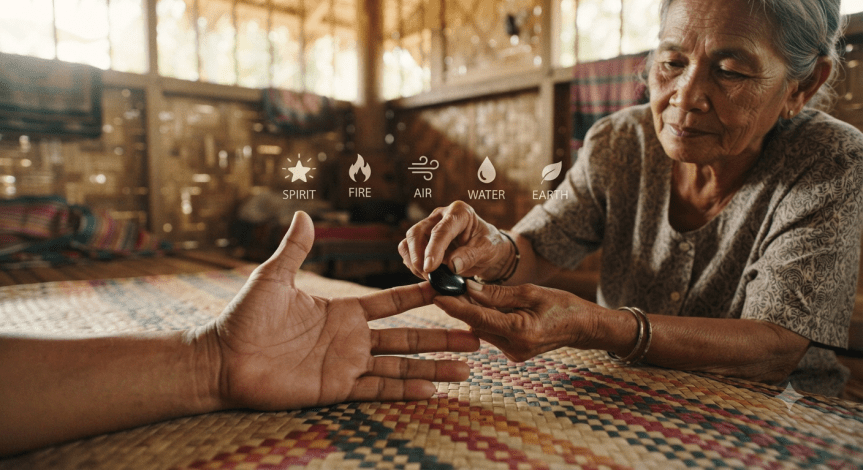
The human body is composed of the elements—Fire, Water, Air, and Earth. Imbalance among these can lead to confusion, weakness, and vulnerability to accidents. Through Hilot healing, Bato Omo assessment, and rituals invoking Diwatang Kilubansa, we restore harmony and strengthen the body’s resilience.
2. Strengthen the Soul’s Shield
Spiritual protection is essential. Binabaylan practitioners use:
Blessed oils (lana) and herbal poultices (tapal)
Prayers and offerings to Anito and Diwata
Consecrated amulets or agimat that serve as spiritual guardians
These tools help shield the soul from harmful energies and sudden spiritual disconnection.
3. Avoid Spiritually Dangerous Places and Activities
Some locations are known to harbor malevolent spirits or chaotic energies. Binabaylan are trained to sense these places and perform ritual cleansing or protective markings. Awareness and respect for these spaces can prevent misfortune.
4. Strengthen Community Bonds
Unnatural death caused by violence or war often stems from social disconnection and unresolved anger. Hilot Binabaylan teachings promote peace, unity, and mutual respect. By fostering harmony within the community, we reduce the risk of conflict and harm.
5. Recognize and Prevent Hate Crimes
Sometimes, unnatural death arises from hate crimes—acts of violence driven by prejudice, discrimination, or intolerance. These are especially tragic because they target individuals based on identity, belief, or background.
Examples of Hate Crimes That May Lead to Death:
Racial or ethnic violence
Religious persecution
Gender-based violence
Attacks on LGBTQ+ individuals
Political or ideological assassinations
Cultural erasure and indigenous targeting
How Can We Prevent and Lessen Hate Crimes?
Education and Awareness: Teach respect for diversity and the sacredness of all life.
Community Dialogue: Create safe spaces for interfaith and intercultural conversations.
Spiritual Advocacy: Use rituals and teachings to promote compassion and understanding.
Protection of Vulnerable Groups: Offer spiritual and emotional support to those at risk.
Empowerment through Identity: Encourage people to embrace their heritage and spirituality without fear.
In Hilot Binabaylan, we believe that every soul carries divine essence. Hate crimes are not just physical attacks—they are spiritual wounds that affect the collective soul of humanity. Healing these wounds requires both ritual and action.
6. Listen to Nature and the Diwata
The Diwata often send warnings through dreams, visions, or intuitive feelings. Being attuned to these signs allows us to avoid danger before it manifests. Binabaylan are trained to interpret these messages and guide others accordingly.
7. Care for the Body and Mind
Physical weakness and mental confusion can lead to accidents. Hilot Binabaylan emphasizes proper nutrition, movement, and mental clarity. A strong body and focused mind are less likely to fall victim to sudden harm.
A Call to Ritual and Reflection
As spiritual healers and leaders, we are called not only to heal but to protect life. Perhaps it is time to create a Ritual of Protection Against Unnatural Death, invoking the blessings of Diwatang Balantay, Kilubansa, and other guardian spirits. This can be integrated into the ceremonies of Templong Anituhan and offered to the community as a sacred shield.
Would you like to collaborate on crafting this ritual and its invocation? Together, we can empower our people to walk safely and consciously in both the physical and spiritual realms.
As we celebrate Philippine Traditional and Alternative Medicine Month, I invite you to reflect on a vital question: How well do Filipinos—both here and abroad—truly understand Hilot? For many of us, Hilot is a memory passed down from our lolo, lola, nanay, tatay, tito, and tita. It is a healing tradition rooted in our homes and communities. Yet today, Hilot is often mistaken for mere massage therapy offered in luxury spas, stripped of its deeper wisdom and purpose.
Let me ask: Do we still remember what “Pilay” is? Do we still recognize the Manghihilot as the community’s first line of defense in health care?
Sadly, our Traditional Healing Arts and Sciences are being commercialized and standardized in ways that leave ordinary Filipinos disconnected from their own healing heritage. Once, the Manghihilot was a trusted health care provider in the barangay. Now, even prescribing herbal remedies requires a medical license.
I have been monitoring the Philippine Institute of Traditional and Alternative Health Care (PITAHC) from 2020 to 2023, and I ask: Where is the support for Hilot? As of this year, only 27 Manghihilot practitioners are listed in PITAHC’s registry. Compare this to other modalities:
Certified Acupuncture Practitioners: 1,099
Certified Chiropractic Practitioners: 87
Certified Naturopath Practitioners: 249
Certified Hilot Practitioners: 27
This disparity is alarming. PITAHC’s mandate clearly states its goal to promote safe, effective, and culturally consistent health care modalities. But where is the Indigenous Traditional Medicine of the Filipino people in this promotion?
Our elder Manghihilot are aging. If we do not act now, their wisdom will be lost forever.
I respectfully call on PITAHC to:
Recognize Manghihilot in the barrios without charging registration fees.
Make Hilot Congress attendance free, especially for grassroots healers.
Allocate government funds toward Filipino traditional medicine—not just foreign modalities.
Extend PITAHC’s reach to regional, provincial, city, and municipal health centers to identify and support Manghihilot in every barangay.
Issue a memorandum circular to protect Hilot practices, just as one was issued to regulate Hilot Paanak.
Include accredited Hilot Healing Centers in PhilHealth coverage, just like birthing centers.
To all Manghihilot—whether certified by TESDA, PITAHC, or trained through ancestral lineage—you have the right to be recognized.
Join me on November 8, 2025, from 4:00 PM to 6:00 PM for a Free Online Webinar via Google Meet. Let us come together to reclaim our healing traditions and advocate for their rightful place in our national health care system.
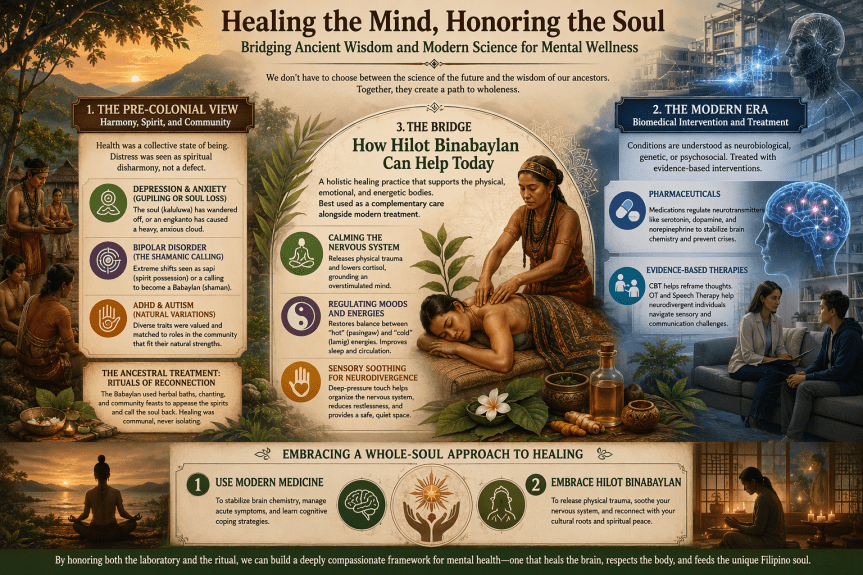
Hilot, the ancient healing art of the Filipino people, is more than just a massage technique—it is a sacred embodiment of our Indigenous Knowledge Systems and Practices (IKSP). Rooted in the wisdom of our ancestors, Hilot is a holistic approach to healing that integrates the body, mind, and spirit, guided by the rhythms of nature, the presence of the Diwata and Anito, and the elemental balance of Apoy, Tubig, Hangin, and Lupa.
The Essence of Hilot as Indigenous Knowledge
In its original form, Hilot is a spiritual and cosmological practice. It is performed by Binabaylan, spiritual healers who walk between realms, invoking divine guidance and ancestral wisdom. Hilot is not merely about physical relief—it is about restoring harmony within the person and their environment. It includes:
Energetic diagnostics through pulse, heat, and intuition
Rituals and prayers to the Diwata and Anito
Herbal medicine and elemental therapy
Soul healing and spiritual alignment
This depth of practice reflects the Indigenous Filipino worldview, where health is not just physical wellness but a state of spiritual balance and ancestral connection.
The Role of TESDA and PITAHC
In recent years, TESDA and PITAHC have taken steps to promote Hilot as part of the national healthcare system. Their efforts have helped:
Provide training and certification for practitioners
Ensure safety and professionalism
Introduce Hilot to a wider audience seeking alternative wellness
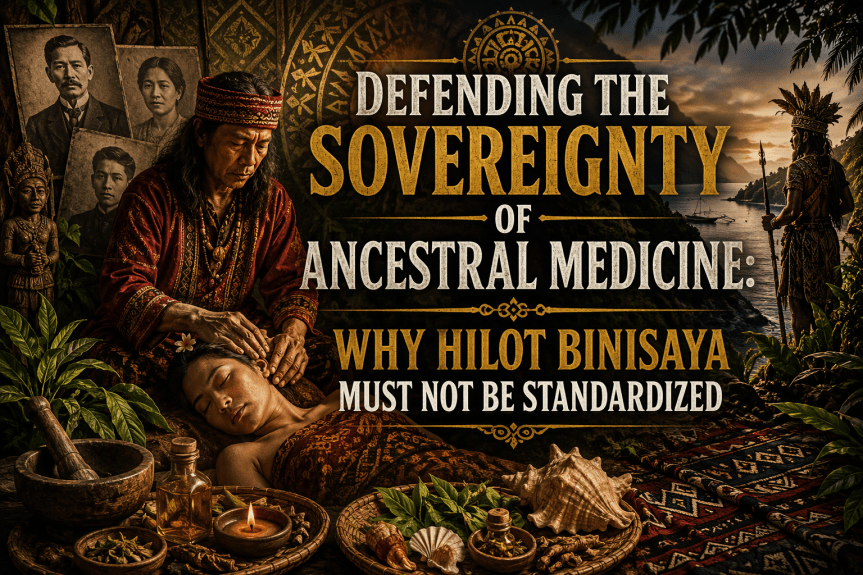
These contributions are valuable and necessary. However, the institutional framing of Hilot has narrowed its scope, often reducing it to massage and relaxation therapy, detached from its Indigenous roots.
The Risk of Cultural Dilution
When Hilot is stripped of its spiritual and ancestral dimensions, it loses its identity as Indigenous Knowledge. It becomes a commodified service, disconnected from the cosmology that gives it meaning. This not only misrepresents the practice but also disempowers Indigenous communities who have preserved it for generations.
A Call for Dual Recognition
We advocate for a dual-pathway approach to Hilot:
Institutional Hilot – promoted by TESDA and PITAHC for therapeutic and wellness purposes.
Indigenous Hilot Binabaylan – preserved in its original form by spiritual communities like Templong Anituhan, emphasizing holistic healing of the body, mind, and spirit.
This approach allows Hilot to evolve and reach modern audiences without losing its soul. It respects the sovereignty of Indigenous communities and honors the sacredness of Hilot as a spiritual ministry.
Protecting Hilot as Indigenous Knowledge
We call upon:
NCIP to uphold Hilot as IKSP under R.A. 8371
IPOPHL to protect its Indigenous Intellectual Property
Educational institutions to include Hilot Binabaylan in cultural and spiritual curricula
Healthcare systems to recognize the value of spiritual healing in holistic wellness
Call to Action: Join Us in Reclaiming Hilot
To deepen this conversation and celebrate the wisdom of our ancestors, we invite you to join our free online event:
🕓 Date & Time: November 8, 2025, from 4:00 PM to 6:00 PM 📍 Platform: Google Meet 🎉 Event Title:Panibagong Sigla: Indigenous Healing Wisdom for Modern Wellness
This gathering will feature Hilot practitioners, Binabaylan leaders, and cultural advocates sharing insights on how Hilot can be preserved, practiced, and promoted in its full Indigenous form.
As the rainy season and colder months arrive, communities across the Philippines experience a rise in Influenza-like Illness (ILI)—a condition marked by fever, cough, sore throat, body aches, and fatigue. Though not always caused by the influenza virus, ILI can be triggered by various respiratory infections, including COVID-19, RSV, and adenoviruses.
While modern medicine offers vaccines and antiviral treatments, Filipino Indigenous Healing—particularly Hilot Binabaylan—offers a holistic and culturally rooted approach to preventing illness and strengthening immunity.
🦠 What is Influenza-Like Illness?
ILI is a clinical diagnosis based on symptoms that resemble the flu. It spreads through:
Airborne droplets from coughing or sneezing
Touching contaminated surfaces
Close contact with infected individuals
ILI is not a single disease but a syndrome, and its prevention requires both physical and energetic care.
🌺 How Hilot Binabaylan Helps
Hilot Binabaylan is more than just massage—it is a sacred healing art that integrates:
Energetic balancing
Herbal medicine
Spiritual rituals
Community wellness education
Here’s how it supports immunity and prevents ILI:
1. Energetic Realignment
Hilot techniques like Panghihilot and Pagpapainit release stagnant energies and restore elemental harmony (Lupa, Hangin, Apoy, Tubig), which strengthens the body’s natural defenses.
2. Herbal and Natural Remedies
Binabaylan practitioners use indigenous herbs such as:
Lagundi for cough and fever
Tanglad and Luya for respiratory relief
Sambong for detoxification
These are prepared as teas, oils, or poultices to support healing and immunity.
3. Spiritual Protection and Cleansing
Rituals invoking Diwata and Anito help cleanse spiritual imbalances that may manifest as physical illness. Seasonal rites during Full Moon, Ghost Month, and Undas align the community with nature’s healing cycles.
4. Community Education and Advocacy
Hilot Binabaylan promotes preventive care through teachings on hygiene, nutrition, emotional wellness, and ancestral wisdom. The creation of Dambana ng Ginhawa serves as a communal healing space for rest and renewal.
5. Touch Therapy and Soul Activation
Through sacred touch, Hilot awakens the UliRat (life force) and Malay (recognition soul), activating the body’s inner healing intelligence and reducing stress—a key factor in immune suppression.
🌞 A Call to Action
As caretakers of both body and spirit, Binabaylan healers are called to lead the community in resilience and renewal. By integrating ancestral knowledge with modern awareness, Hilot Binabaylan becomes a powerful ally in the fight against seasonal illness.
Let us walk the path of healing together guided by the spirits, grounded in the earth, and united in the rhythm of life.
In both Oriental medicine and Indigenous Filipino healing traditions, illness is not merely a physical condition—it is a manifestation of imbalance in the body, mind, and spirit. Among the most subtle yet destructive imbalances are arrogance and pride. Though often praised in modern society as confidence or ambition, these traits, when excessive, are seen by traditional healers as spiritual toxins that block the flow of healing.
**Arrogance and Pride as Illness**
In **Traditional Chinese Medicine (TCM)**, emotions are directly linked to organ systems. Excessive pride and arrogance are seen as disturbances of the **Heart**, which houses the **Shen**—the spirit or consciousness. When the Heart is overstimulated by ego-driven emotions, it can lead to restlessness, insomnia, and even mental confusion. The Liver, associated with anger and control, may also be affected, creating internal heat and stagnation.
In Hilot Binabaylan practice, arrogance is viewed as a **pagmamataas**—the inner self that connects us to the divine, to nature, and to our ancestors.
Pride separates the person from the community, from humility, and from the sacred flow of life. It is a spiritual disconnection that can manifest as physical illness, emotional instability, and relational disharmony.
**The Healing Power of Humility and Sincerity**
True healing begins not with medicine, but with attitude. The Binabaylan teaches that humility (pagpapakumbaba) is the gateway to receiving healing. It is the act of surrendering ego, acknowledging one’s limitations, and opening the heart to divine guidance.
Sincerity (katapatan) is the companion of humility. It is the honest desire to be healed—not for power, prestige, or gain, but for restoration, balance, and service to others.
When a person approaches healing with humility and sincerity:
– The spirit becomes receptive to ancestral wisdom. – The body relaxes, allowing energy to flow freely. – The mind clears, making space for insight and transformation. – The community responds, offering support and collective strength.
*Healing Is a Sacred Relationship*
In Indigenous Filipino spirituality, healing is not transactional—it is **relational**. It involves the healer, the patient, the spirits, the ancestors, and the natural elements. Arrogance breaks this relationship. Humility restores it.
To be healed, one must be willing to be seen, to be vulnerable, and to be guided. The Binabaylan does not heal alone; healing is a dance of energies, a ritual of reconnection, and a gift of grace.
🌟 **A Call to the Wounded Healer**
If you are seeking healing—whether physical, emotional, or spiritual—begin with humility. Speak sincerely. Offer yourself not as a master, but as a student of life. Let go of pride, and you will find that healing flows not from force, but from grace.
And if you are called to be a healer, remember: the most powerful healers are those who have first healed themselves through humility. The Binabaylan walks not with arrogance, but with reverence.
WHEREAS, the Hilot Binabaylan Training Program has been elevated to a Master’s in Ministry Degree Program on Hilot Binabaylan Practice, reflecting its comprehensive curriculum on Indigenous Filipino Health Care Practices;
WHEREAS, Bahay Siadtala Binabaylan Inc., a Ministerial Center of Templong Anituhan Inc., has assumed full jurisdiction over the said training program;
WHEREAS, the Hilot Academy of Binabaylan recognizes the need for continuing professional development and mentorship to sustain and elevate the practice of Hilot Binabaylan;
NOW THEREFORE, BE IT RESOLVED, AS IT IS HEREBY RESOLVED, that the Board of Bahay Siadtala Binabaylan Inc. adopts the following amendments and additions:
I. Master’s in Ministry Degree Program on Hilot Binabaylan Practice
Program Title and Jurisdiction The training shall be officially known as the Master’s in Ministry Degree Program on Hilot Binabaylan Practice, administered by Bahay Siadtala Binabaylan Inc., located at No. 88 Pres. Quirino St., Brgy. South Signal Village, Zone 6, Taguig City, Metro Manila, Philippines.
Eligibility for Enrollment
Open to individuals of any nationality with the capacity for independent decision-making.
Must possess basic healthcare knowledge, including Human Anatomy and Physiology and Vital Signs Taking.
Mode of Delivery
Conducted in-person and face-to-face, requiring physical attendance.
Enrollment Fee and Inclusions
Standard fee: USD 1,250.00 or local equivalent.
Includes:
Hotel accommodation
Five meals per training day
Learning materials
Certificates of completion and ordination
Curriculum Requirements Completion of the following modules is required:
Credentialing and Recognition Graduates shall receive:
Certificate of Completion
Ordination Credentials
Title designation of Lakan or Dayang, signifying membership in Templong Anituhan Inc.
II. Hilot Tanglaw Mentorship Program
Program Overview The Hilot Tanglaw Program is a continuing professional development initiative of the Hilot Academy of Binabaylan, designed to elevate qualified Hilot Binabaylan Practitioners into Hilot Binabaylan Mentors.
Mentor Responsibilities As Hilot Tanglaw, mentors shall:
Provide Guidance and Advice
Offer Support and Encouragement
Facilitate Skill Development
Assist in Goal Setting and Accountability
Enable Networking and Opportunities
Serve as Role Models of integrity and professionalism
Enrollment and Application
Applicants must fill out a Mentorship Application Form, declaring:
Subjects they wish to mentor (may select all)
Number of students to be mentored
Scheduled training dates
Fee Structure and Remittance
Each student pays USD 1,250.00 for a 9-day mentorship program
Mentor receives USD 875.00 as stipend
USD 375.00 (30%) is remitted to the Hilot Academy of Binabaylan
Validation and Graduation
Upon completion, mentors shall schedule their protégés for online validation
Validation fee: USD 100.00, paid to the Hilot Binabaylan Council
The Council shall:
Conduct validation
Schedule graduation and ordination
Issue signed certificates and official seals
RESOLVED FURTHER, that this resolution shall take effect immediately and be disseminated to all concerned parties for implementation and compliance.
APPROVED this 16 day of August, 2025 at Bahay Siadtala Binabaylan Inc., Taguig City, Metro Manila, Philippines.
Certified True and Correct:
Rev. Alvin L. Sentin D.D.Min. IFS IFM Co-Founder/Director on Local Community Affairs Relations/ Hilot Binabaylan Council
Rev. Rolando G. Comon D.D.Min. IFS IFM Co-Founder/ Program Director/ Hilot Binabaylan Council
Rev. Maria M. Haswell D.D.Min. IFS IFM Co-Founder/Director on International Affairs Relations/ Hilot Binabaylan Council
The Philippine Institute of Traditional and Alternative Health Care (PITAHC) plays a vital role in regulating and promoting traditional Filipino healing practices, including Hilot. For organizations and practitioners involved in Hilot, understanding the accreditation and certification process is essential for legal recognition, professional credibility, and ethical practice.
✅ Benefits of PITAHC Accreditation
1. Legal Authority to Operate
Accredited Hilot organizations are officially recognized by the Department of Health through PITAHC, granting them the legal right to conduct training and healing services.
2. Certification of Practitioners
Organizations can issue:
Certificates of Registration to formally trained Hilot practitioners.
Certificates of Recognition to community-recognized Manghihilot with at least 10 years of practice.
3. Accredited Training and Healing Centers
Accredited institutions may operate:
Hilot Training Centers for formal education.
Hilot Healing Centers in homes, clinics, spas, resorts, and hospitals.
4. Participation in National Health System
Accredited organizations help integrate Hilot into the national healthcare delivery system.
5. Representation and Advocacy
Organizations may nominate representatives to the National Certification Committee for Hilot (NCCH), influencing policy and ethical standards.
6. Protection Against Unregulated Practices
Only PITAHC-accredited entities are authorized to train and certify Hilot practitioners, ensuring safety and credibility.
🧪 Competency Assessment by NCCH
For Formally Trained Practitioners
Completion of training from a PITAHC-accredited center.
Submission of a portfolio with at least 100 patient cases.
Passing a competency assessment that includes practical demonstrations and ethical evaluations.
For Community-Recognized Manghihilot
Minimum of 10 years of practice.
Endorsement by community leaders.
Sponsorship by a PITAHC-recognized organization.
Submission of a portfolio and testimonials.
Committee Composition
The NCCH includes:
Manghihilot and Hilot practitioners.
Medical doctors practicing Hilot.
Trainers from accredited centers.
PITAHC officials.
💰 Fee Guidelines
The official fee for the competency assessment is ₱500.00. This is a one-time application fee mandated by PITAHC Circular No. 01, Series of 2016.
⚠️ Reporting Overcharging Violations
If an organization charges more than ₱500 for the assessment alone:
Request a Fee Breakdown to verify additional charges.
Report to PITAHC with documentation (receipts, advisories).
Contact NCCH for clarification and investigation.
Overcharging may lead to administrative sanctions and, if fraudulent, could result in criminal liability.
📞 Contact Information
To reach the National Certification Committee for Hilot:
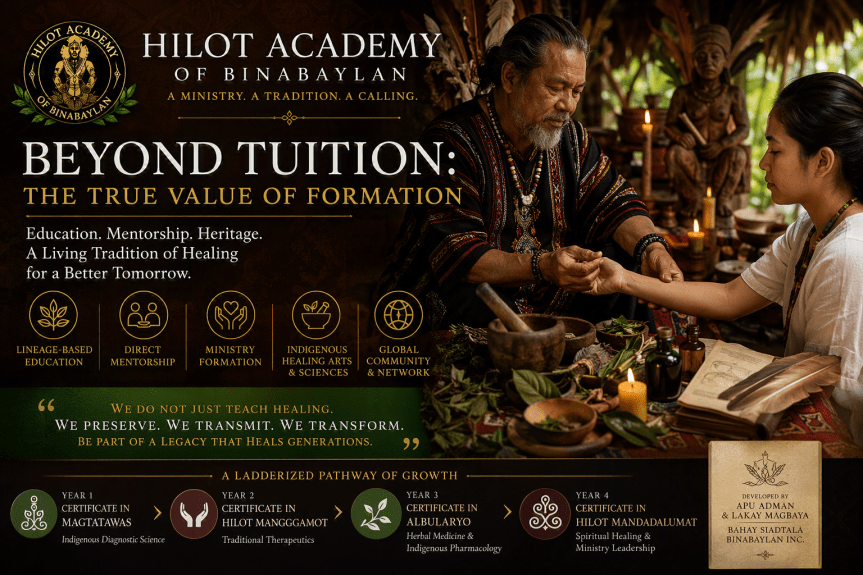
For over nine years, Hilot Academy of Binabaylan, the educational ministry arm of Luntiang Aghama Natural Divine Arts Shrine of Healing Inc. (also known as Landas ng Lahi), has been a beacon of ancestral wisdom and healing. Since our founding, we have produced 64 Hilot Binabaylan Practitioners who now serve their communities across the globe—many of whom are part of the Filipino diaspora returning home to reconnect with our sacred healing traditions.
These students had the option to study Hilot through government-accredited institutions such as TESDA or PITAHC, yet they chose us. Why? Because our teachings resonate with their spiritual calling. They sought not just technical skills, but a deeper understanding of Hilot as a sacred art and science—a practice rooted in the soul of our people.
Reclaiming the Sacred in Healing
From the beginning, we made a vow: to share the personal and ancestral knowledge of Hilot, including the practice of Tawas—a spiritual diagnostic method used by traditional Manghihilot. We have demystified Orasyon, reframing it as Therapeutic Communication and Timing, recognizing that words and timing can profoundly affect the mind, emotions, and healing process of the patient.
In our academy, Hilot is soul healing. We believe that the health of the body is inseparable from the health of the spirit. When the soul departs from the body, life ceases. Thus, healing must begin with the soul.
The Struggle for Accreditation
In our early years, we wrestled with the idea of seeking accreditation from government bodies. I personally contributed to the development of Hilot curricula for institutions like the Hilot Philippines Development Center, a legacy school of Dr. Mina Gabor, former Secretary of the Department of Tourism. I also helped establish the Philippine Japan Hilot Association, which gained accreditation from TESDA and the Department of Tourism.
But when it came to Hilot Academy of Binabaylan, we chose a different path.
Why? Because the current accreditation standards forbid the inclusion of Tawas and Orasyon in the curriculum. They limit spiritual practices to Christian and Islamic prayers, excluding indigenous expressions of faith and healing. This reflects a colonial mindset that prioritizes physical health while neglecting the soul.
Standing for Decolonization and Spiritual Integrity
We teach decolonization. We honor the wisdom of our ancestors. We believe that healing is not just clinical—it is spiritual, emotional, and cultural. To conform to accreditation standards would mean compromising our identity and silencing the soul of Hilot.
Unless PITAHC or other bodies are willing to fund research that validates Tawas as a legitimate diagnostic method, we remain in a dilemma: Do we embrace autonomy or submit to colonized standards?
A Vision for the Future
Despite these challenges, we continue to dream. We envision a future where Hilot Binabaylan is not only an ecclesiastical degree in ministry but also recognized as an academic degree. We are committed to ensuring that our graduates are employable, empowered, and respected as Hilot Binabaylan Practitioners—both in the Philippines and around the world.
We walk the path of the Binabaylan: bridging worlds, healing souls, and reclaiming our sacred traditions. And we invite you to walk with us.
A call for alignment training program on becoming a Hilot Binabaylan has completed from March 23, 2025 to August 10, 2025. It’s 13 lessons for more than 13 Sundays that we have spent in order to form the necessary competency that an individual must have in order to become a Hilot Binabaylan. From our forms record there are 10 people who signed up but in actual formation only 6 people have complied.
Dante Nolido, Ge Ygay, Sasa Cabalquinto, Darlene Honrubia, Emman Castillo and Jerson Casol
These individuals coming from North NCR to South NCR who sacrificed their Sunday afternoon just to come to our Temple in order to received the Wisdom of Hilot Binabaylan. And through their hardwork and dedication in relearning the skills, they have successfully achieved the status on becoming a M.Min.Hbp or Master’s in Ministry on Hilot Binabaylan Practice.
And through their ordination we have established the Hilot Binabaylan Network which is a community of graduates and practitioners dedicated to the continued growth, support, and collaboration within the sacred practice of Hilot Binabaylan. This network serves as a platform for members to:
Share experiences and insights from their healing practices, fostering collective wisdom and deeper understanding.
Connect and collaborate with fellow practitioners across regions, enabling referrals and support for cases that require local or specialized attention.
Provide mutual support through dialogue, case discussions, and spiritual companionship, strengthening the bond among healers and enhancing their capacity to serve.
Uphold and promote the values of Hilot Binabaylan, ensuring the integrity and authenticity of the practice in every community it touches.
Through this network, we honor the ancestral wisdom of Hilot Binabaylan and empower each practitioner to walk their healing path with confidence, connection, and compassion. Our Goal in establishing Hilot Binabaylan Network is to:
Foster Community and Connection
Create a strong network of Hilot Binabaylan practitioners across regions.
Encourage regular communication and collaboration among members.
Facilitate Knowledge Sharing
Provide a platform for practitioners to share case studies, healing experiences, and traditional wisdom.
Organize forums, webinars, and discussion groups to deepen understanding of Hilot Binabaylan practices.
Support Professional Development
Offer continuing education opportunities, mentorship, and skill enhancement programs.
Recognize and celebrate achievements and contributions of members.
Enable Regional Referrals and Collaboration
Maintain a directory of practitioners to facilitate referrals and support in nearby areas.
Encourage cooperative healing efforts for complex or unique cases.
Provide Emotional and Spiritual Support
Serve as a support group for practitioners, offering a safe space for reflection, encouragement, and healing.
Promote wellness and balance among members through shared rituals and practices.
Preserve and Promote Indigenous Healing Traditions
Advocate for the recognition and respect of Hilot Binabaylan as a vital cultural and spiritual heritage.
Engage in outreach and education to raise awareness about the practice in broader communities.
Ensure Ethical and Authentic Practice
Uphold standards of integrity, respect, and responsibility in all healing work.
Encourage accountability and ethical conduct among members.
Guiding Principle of the Hilot Binabaylan Network
“Healing in Harmony with Nature, Spirit, and Community.”
This principle embodies the sacred foundation of Hilot Binabaylan practice, which is rooted in:
Ancestral Wisdom – Honoring the teachings and traditions passed down through generations of healers.
Spiritual Integrity – Practicing with reverence, humility, and alignment with the spiritual forces that guide healing.
Compassionate Service – Offering healing with love, empathy, and respect for the dignity of every person.
Community Collaboration – Supporting one another through shared knowledge, mutual aid, and collective growth.
Holistic Balance – Promoting harmony between body, mind, spirit, and environment in every healing encounter.
The Officers of Hilot Binabaylan Network
Emmanuel Castillo President
Darla Honrubia– Vice President for Internal Affairs
Sasa Cabalquinto-Vice President for External Affairs
Ge Ygay– Secretary
Dante Nolido– Treasurer
Jerson Casol Jr.- Auditor
Hilot Binabaylan Network – Officers and Their Roles
President – Emman Castillo
Job Description: The President serves as the chief executive officer of the network, providing overall leadership, direction, and representation.
Duties and Responsibilities:
Lead and oversee all activities and initiatives of the network.
Represent the network in official functions, partnerships, and public engagements.
Convene and preside over meetings of officers and members.
Ensure alignment of programs with the network’s purpose and guiding principles.
Provide strategic vision and decision-making for the growth of the organization.
Vice President for Internal Affairs – Darla Honrubia
Vice President for External Affairs – Sasa Cabalquinto
Job Description: The Vice Presidents support the President in managing the network’s operations, with Darla focusing on internal coordination and Sasa on external relations.
Duties and Responsibilities:
VP for Internal Affairs – Darla Honrubia
Coordinate internal programs, member engagement, and organizational development.
Facilitate communication among members and officers.
Organize internal events, trainings, and support activities.
Assist in resolving internal concerns and maintaining harmony within the network.
VP for External Affairs – Sasa Cabalquinto
Build relationships with external partners, communities, and institutions.
Promote the network’s visibility and advocacy efforts.
Represent the network in outreach activities and collaborations.
Seek opportunities for partnerships and resource mobilization.
Secretary – Ge Ygay
Job Description: The Secretary manages documentation, communication, and record-keeping for the network.
Duties and Responsibilities:
Prepare and maintain minutes of meetings, reports, and official documents.
Handle correspondence and announcements to members.
Maintain an updated directory of members and officers.
Assist in organizing meetings and ensuring proper documentation.
Treasurer – Dante Nolido
Job Description: The Treasurer oversees the financial affairs of the network, ensuring transparency and accountability.
Duties and Responsibilities:
Manage the network’s funds, budget, and financial records.
Prepare financial reports and statements for meetings.
Ensure proper collection and disbursement of funds.
Coordinate fundraising activities and financial planning.
Auditor – Jerson Casol Jr.
Job Description: The Auditor ensures the integrity of the network’s financial operations through regular review and evaluation.
Duties and Responsibilities:
Conduct audits of financial records and transactions.
Provide independent assessment of financial practices.
Recommend improvements for financial transparency and efficiency.
Submit audit reports to the officers and members.
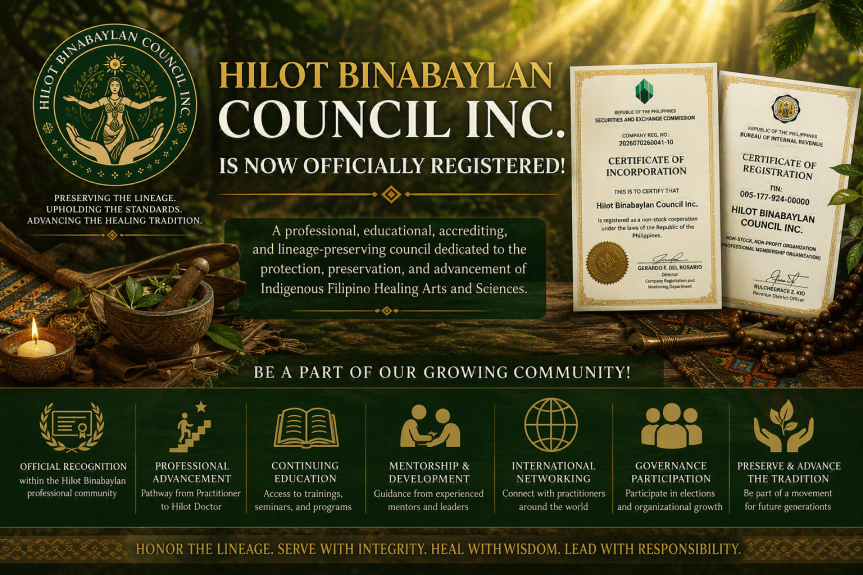
and through their election, we have also official declare the creation of Hilot Binabaylan Council which serves as the spiritual and strategic advisory body of the Hilot Binabaylan Network. It is composed of esteemed elders and leaders who guide the organization in preserving the sacred traditions of Hilot Binabaylan, ensuring its ethical practice, and fostering unity among practitioners both locally and globally.
The Council provides wisdom, oversight, and direction in matters of cultural integrity, community engagement, and international relations, upholding the values and guiding principles of the network.
Rev. Alvin L. Sentin D.D.Min. IFS IFM-co founder/ Adviser on Local Community Affairs Relations
You must be logged in to post a comment.