By Apu Adman Aghama
Founder, Hilot Academy of Binabaylan
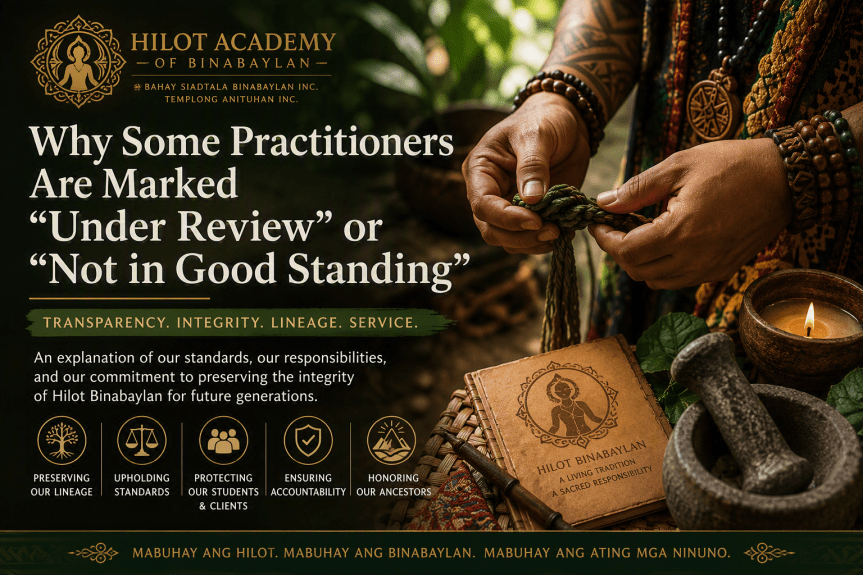
In recent months, several people have asked why some graduates listed on the Our Manghihilot page of the Hilot Academy of Binabaylan website are marked as “Under Review” or “Not in Good Standing.” We welcome these questions because transparency is an important part of maintaining trust, accountability, and the integrity of our healing tradition.
First and foremost, these designations are not intended to shame, attack, or diminish anyone’s personal journey, skills, or experiences. Every student who enters our programs invests time, energy, and commitment in learning. We recognize and honor that effort.
However, it is equally important to understand that completing a training program and remaining an authorized representative of a lineage-based healing school are two different matters.
Beyond Graduation: The Importance of Continuing Standards
In conventional education, a student may complete a degree program in nursing, medicine, physical therapy, or another healthcare profession. Graduation alone does not automatically grant professional authority. Graduates must often pass licensure examinations, meet professional requirements, and adhere to ethical standards established by regulatory bodies.
Within the broader field of Academic Hilot in the Philippines, organizations such as TESDA and PITAHC help establish competency standards, training frameworks, and professional recognition.
At the Hilot Academy of Binabaylan, however, our approach to Hilot extends beyond physical wellness. While we value anatomy, physiology, bodywork, and traditional healing techniques, we also recognize the spiritual, cultural, ethical, and ancestral dimensions of Hilot Binabaylan.
Because of this unique responsibility, we established the Hilot Binabaylan Council to provide ongoing assessment and guidance regarding the use, teaching, and representation of Hilot Binabaylan teachings.
Why We Established the Hilot Binabaylan Council
The Hilot Binabaylan Council exists to help preserve the integrity of the teachings entrusted to our academy.
Its role is not merely to evaluate technical competency. The Council also considers whether practitioners remain aligned with the:
- Mission of Hilot Academy of Binabaylan
- Vision of Bahay SiAdtala Binabaylan Inc.
- Core Values of Templong Anituhan Inc.
- Ethical principles of Hilot Binabaylan practice
- Standards of cultural and spiritual stewardship
A practitioner may possess strong technical skills and yet no longer be aligned with the values, responsibilities, or commitments that accompany authorized representation of the lineage.
For this reason, authorization is not viewed as a one-time achievement. It is an ongoing relationship built upon integrity, ethical conduct, accountability, respect for lineage, and commitment to community standards.
What Does “Under Review” Mean?
When a practitioner is marked “Under Review,” it simply means that the individual’s current status is being assessed by the appropriate bodies of the academy.
This may involve reviewing:
- Educational completion requirements
- Practice standards
- Ethical concerns
- Representation of the lineage
- Compliance with academy policies
- Authorization to teach or certify others
An “Under Review” designation is not a final judgment. It is a period of evaluation intended to ensure fairness, due process, and accountability.
What Does “Not in Good Standing” Mean?
A designation of “Not in Good Standing” indicates that the individual is not currently authorized to represent, teach, certify, or publicly use the authority of Hilot Academy of Binabaylan as an official lineage representative.
This does not necessarily mean the person lacks healing knowledge. It does not invalidate their personal experiences or independent practice.
Rather, it means that they are presently not recognized by the academy as an authorized representative of the Hilot Binabaylan lineage and educational system.
This distinction is important for students, clients, and members of the public who seek authentic instruction and services connected specifically to the Hilot Academy of Binabaylan tradition.
The Challenge of Preserving a Healing Lineage
One of the realities of contemporary wellness practice is the increasing tendency to combine multiple modalities, systems, and techniques into a single treatment approach.
This can certainly be appropriate in many professions and healing traditions. However, for a lineage-based educational institution committed to preserving a specific body of knowledge, it can create challenges.
Our concern is not that people study other healing methods. Learning is a lifelong journey.
Our concern is preserving the distinct identity, philosophy, ceremonial framework, terminology, ethics, and methodology of Hilot Binabaylan.
When teachings become excessively altered, diluted, or mixed without proper context, future generations may lose sight of what makes the tradition unique. Over time, the original teachings can become fragmented or misrepresented.
Preservation requires more than teaching. It requires stewardship.
Why We Publish These Statuses Publicly
The Hilot Academy of Binabaylan website serves as a public information portal.
Its purpose is to help individuals identify:
- Practitioners who have completed training
- Practitioners currently authorized by the academy
- Individuals permitted to teach academy programs
- Practitioners who remain aligned with academy standards
- Current standing within the Hilot Binabaylan lineage
This transparency benefits the public by allowing prospective students and clients to make informed decisions regarding who is officially authorized to provide services and educational instruction under the Hilot Academy of Binabaylan framework.
The publication of these statuses is not a punishment. It is a public accountability measure designed to protect students, clients, the integrity of the lineage, and the future of the tradition itself.
Honoring the Ancestors Through Responsible Stewardship
At the heart of this matter is a simple belief:
The teachings of Hilot Binabaylan are not merely techniques. They are a living heritage.
We have received these teachings through years of study, practice, cultural preservation, and spiritual responsibility. As caretakers of this tradition, we believe we have an obligation to ensure that future generations receive the teachings with clarity, authenticity, and integrity.
We honor our ancestors by preserving what they entrusted to us.
We honor our students by maintaining standards.
We honor the public by providing transparency.
And we honor the future by ensuring that Hilot Binabaylan remains a living tradition rooted in wisdom, responsibility, and service.
Learn More
To better understand the principles behind these standards and the role of lineage, accountability, and ethical practice within Hilot Binabaylan, we invite you to watch the following presentation by Apu Adman Aghama:
🎥 Watch the Video:
For questions regarding the standing of any practitioner, please contact Hilot Academy of Binabaylan through our official communication channels.
Mabuhay ang Hilot. Mabuhay ang Binabaylan. Mabuhay ang ating mga Ninuno.







You must be logged in to post a comment.