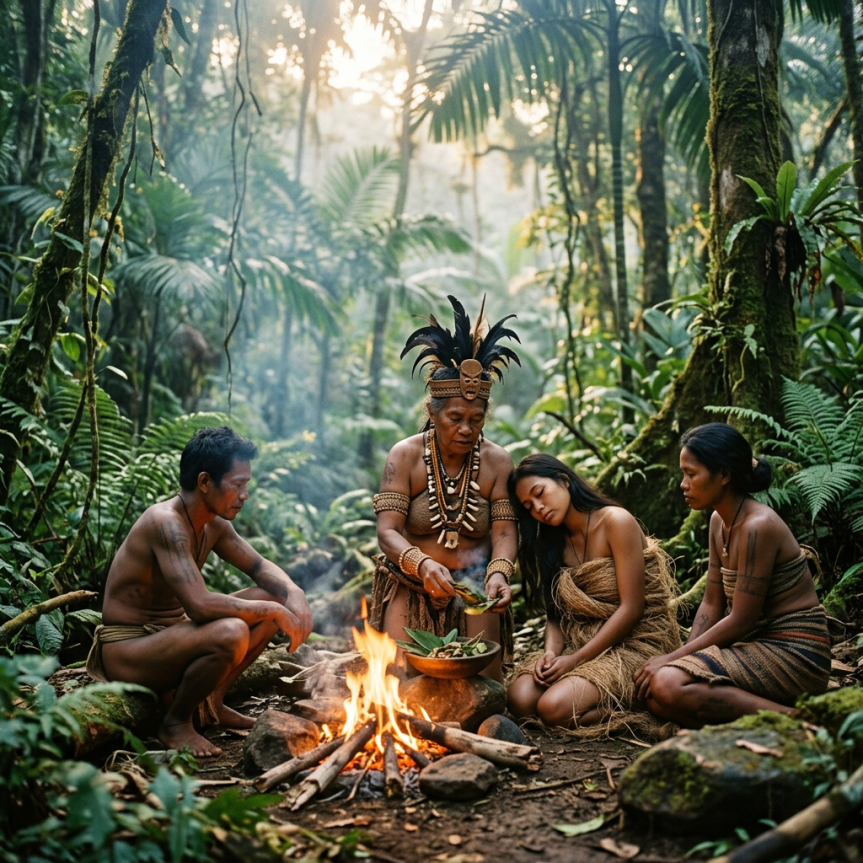
In both Oriental medicine and Indigenous Filipino healing traditions, illness is not merely a physical condition—it is a manifestation of imbalance in the body, mind, and spirit. Among the most subtle yet destructive imbalances are arrogance and pride. Though often praised in modern society as confidence or ambition, these traits, when excessive, are seen by traditional healers as spiritual toxins that block the flow of healing.
**Arrogance and Pride as Illness**
In **Traditional Chinese Medicine (TCM)**, emotions are directly linked to organ systems. Excessive pride and arrogance are seen as disturbances of the **Heart**, which houses the **Shen**—the spirit or consciousness. When the Heart is overstimulated by ego-driven emotions, it can lead to restlessness, insomnia, and even mental confusion. The Liver, associated with anger and control, may also be affected, creating internal heat and stagnation.
In Hilot Binabaylan practice, arrogance is viewed as a **pagmamataas**—the inner self that connects us to the divine, to nature, and to our ancestors.
Pride separates the person from the community, from humility, and from the sacred flow of life. It is a spiritual disconnection that can manifest as physical illness, emotional instability, and relational disharmony.
**The Healing Power of Humility and Sincerity**
True healing begins not with medicine, but with attitude. The Binabaylan teaches that humility (pagpapakumbaba) is the gateway to receiving healing. It is the act of surrendering ego, acknowledging one’s limitations, and opening the heart to divine guidance.
Sincerity (katapatan) is the companion of humility. It is the honest desire to be healed—not for power, prestige, or gain, but for restoration, balance, and service to others.
When a person approaches healing with humility and sincerity:
– The spirit becomes receptive to ancestral wisdom. – The body relaxes, allowing energy to flow freely. – The mind clears, making space for insight and transformation. – The community responds, offering support and collective strength.
*Healing Is a Sacred Relationship*
In Indigenous Filipino spirituality, healing is not transactional—it is **relational**. It involves the healer, the patient, the spirits, the ancestors, and the natural elements. Arrogance breaks this relationship. Humility restores it.
To be healed, one must be willing to be seen, to be vulnerable, and to be guided. The Binabaylan does not heal alone; healing is a dance of energies, a ritual of reconnection, and a gift of grace.
🌟 **A Call to the Wounded Healer**
If you are seeking healing—whether physical, emotional, or spiritual—begin with humility. Speak sincerely. Offer yourself not as a master, but as a student of life. Let go of pride, and you will find that healing flows not from force, but from grace.
And if you are called to be a healer, remember: the most powerful healers are those who have first healed themselves through humility. The Binabaylan walks not with arrogance, but with reverence.
A call for alignment training program on becoming a Hilot Binabaylan has completed from March 23, 2025 to August 10, 2025. It’s 13 lessons for more than 13 Sundays that we have spent in order to form the necessary competency that an individual must have in order to become a Hilot Binabaylan. From our forms record there are 10 people who signed up but in actual formation only 6 people have complied.
Dante Nolido, Ge Ygay, Sasa Cabalquinto, Darlene Honrubia, Emman Castillo and Jerson Casol
These individuals coming from North NCR to South NCR who sacrificed their Sunday afternoon just to come to our Temple in order to received the Wisdom of Hilot Binabaylan. And through their hardwork and dedication in relearning the skills, they have successfully achieved the status on becoming a M.Min.Hbp or Master’s in Ministry on Hilot Binabaylan Practice.
And through their ordination we have established the Hilot Binabaylan Network which is a community of graduates and practitioners dedicated to the continued growth, support, and collaboration within the sacred practice of Hilot Binabaylan. This network serves as a platform for members to:
Share experiences and insights from their healing practices, fostering collective wisdom and deeper understanding.
Connect and collaborate with fellow practitioners across regions, enabling referrals and support for cases that require local or specialized attention.
Provide mutual support through dialogue, case discussions, and spiritual companionship, strengthening the bond among healers and enhancing their capacity to serve.
Uphold and promote the values of Hilot Binabaylan, ensuring the integrity and authenticity of the practice in every community it touches.
Through this network, we honor the ancestral wisdom of Hilot Binabaylan and empower each practitioner to walk their healing path with confidence, connection, and compassion. Our Goal in establishing Hilot Binabaylan Network is to:
Foster Community and Connection
Create a strong network of Hilot Binabaylan practitioners across regions.
Encourage regular communication and collaboration among members.
Facilitate Knowledge Sharing
Provide a platform for practitioners to share case studies, healing experiences, and traditional wisdom.
Organize forums, webinars, and discussion groups to deepen understanding of Hilot Binabaylan practices.
Support Professional Development
Offer continuing education opportunities, mentorship, and skill enhancement programs.
Recognize and celebrate achievements and contributions of members.
Enable Regional Referrals and Collaboration
Maintain a directory of practitioners to facilitate referrals and support in nearby areas.
Encourage cooperative healing efforts for complex or unique cases.
Provide Emotional and Spiritual Support
Serve as a support group for practitioners, offering a safe space for reflection, encouragement, and healing.
Promote wellness and balance among members through shared rituals and practices.
Preserve and Promote Indigenous Healing Traditions
Advocate for the recognition and respect of Hilot Binabaylan as a vital cultural and spiritual heritage.
Engage in outreach and education to raise awareness about the practice in broader communities.
Ensure Ethical and Authentic Practice
Uphold standards of integrity, respect, and responsibility in all healing work.
Encourage accountability and ethical conduct among members.
Guiding Principle of the Hilot Binabaylan Network
“Healing in Harmony with Nature, Spirit, and Community.”
This principle embodies the sacred foundation of Hilot Binabaylan practice, which is rooted in:
Ancestral Wisdom – Honoring the teachings and traditions passed down through generations of healers.
Spiritual Integrity – Practicing with reverence, humility, and alignment with the spiritual forces that guide healing.
Compassionate Service – Offering healing with love, empathy, and respect for the dignity of every person.
Community Collaboration – Supporting one another through shared knowledge, mutual aid, and collective growth.
Holistic Balance – Promoting harmony between body, mind, spirit, and environment in every healing encounter.
The Officers of Hilot Binabaylan Network
Emmanuel Castillo President
Darla Honrubia– Vice President for Internal Affairs
Sasa Cabalquinto-Vice President for External Affairs
Ge Ygay– Secretary
Dante Nolido– Treasurer
Jerson Casol Jr.- Auditor
Hilot Binabaylan Network – Officers and Their Roles
President – Emman Castillo
Job Description: The President serves as the chief executive officer of the network, providing overall leadership, direction, and representation.
Duties and Responsibilities:
Lead and oversee all activities and initiatives of the network.
Represent the network in official functions, partnerships, and public engagements.
Convene and preside over meetings of officers and members.
Ensure alignment of programs with the network’s purpose and guiding principles.
Provide strategic vision and decision-making for the growth of the organization.
Vice President for Internal Affairs – Darla Honrubia
Vice President for External Affairs – Sasa Cabalquinto
Job Description: The Vice Presidents support the President in managing the network’s operations, with Darla focusing on internal coordination and Sasa on external relations.
Duties and Responsibilities:
VP for Internal Affairs – Darla Honrubia
Coordinate internal programs, member engagement, and organizational development.
Facilitate communication among members and officers.
Organize internal events, trainings, and support activities.
Assist in resolving internal concerns and maintaining harmony within the network.
VP for External Affairs – Sasa Cabalquinto
Build relationships with external partners, communities, and institutions.
Promote the network’s visibility and advocacy efforts.
Represent the network in outreach activities and collaborations.
Seek opportunities for partnerships and resource mobilization.
Secretary – Ge Ygay
Job Description: The Secretary manages documentation, communication, and record-keeping for the network.
Duties and Responsibilities:
Prepare and maintain minutes of meetings, reports, and official documents.
Handle correspondence and announcements to members.
Maintain an updated directory of members and officers.
Assist in organizing meetings and ensuring proper documentation.
Treasurer – Dante Nolido
Job Description: The Treasurer oversees the financial affairs of the network, ensuring transparency and accountability.
Duties and Responsibilities:
Manage the network’s funds, budget, and financial records.
Prepare financial reports and statements for meetings.
Ensure proper collection and disbursement of funds.
Coordinate fundraising activities and financial planning.
Auditor – Jerson Casol Jr.
Job Description: The Auditor ensures the integrity of the network’s financial operations through regular review and evaluation.
Duties and Responsibilities:
Conduct audits of financial records and transactions.
Provide independent assessment of financial practices.
Recommend improvements for financial transparency and efficiency.
Submit audit reports to the officers and members.
and through their election, we have also official declare the creation of Hilot Binabaylan Council which serves as the spiritual and strategic advisory body of the Hilot Binabaylan Network. It is composed of esteemed elders and leaders who guide the organization in preserving the sacred traditions of Hilot Binabaylan, ensuring its ethical practice, and fostering unity among practitioners both locally and globally.
The Council provides wisdom, oversight, and direction in matters of cultural integrity, community engagement, and international relations, upholding the values and guiding principles of the network.
Rev. Alvin L. Sentin D.D.Min. IFS IFM-co founder/ Adviser on Local Community Affairs Relations
In the heart of Filipino ancestral wisdom lies a sacred tradition that continues to transform lives—Hilot. More than just a healing technique, Hilot is a spiritual calling, a way of life, and a commitment to serve others with compassion, integrity, and respect.
As the world seeks deeper, more holistic approaches to wellness, Hilot stands as a beacon of hope—reminding us that healing begins from within and is nurtured by the wisdom of our ancestors.
Why Hilot Matters Today
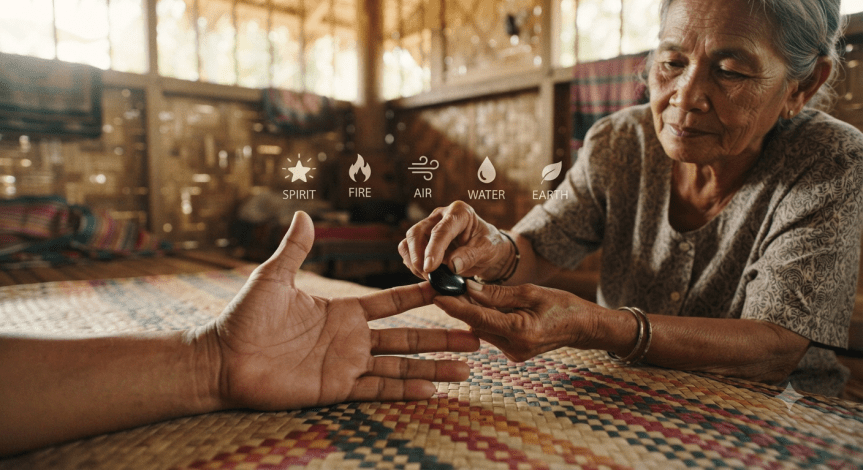
Modern healthcare often focuses on symptoms, but Hilot looks deeper. It recognizes that illness can stem from emotional, spiritual, and environmental imbalances. Through intuitive diagnostics like Tawas, sacred rituals, and personalized care, Hilot practitioners help individuals restore harmony in body, mind, and spirit.
But with this sacred power comes great responsibility. That’s why every Manghihilot must uphold the Hilot Code of Ethics and Healing Principles—a living covenant that guides our practice and protects those we serve.
🌿 The Hilot Code of Ethics: A Sacred Commitment
As a Manghihilot, you are not just a healer—you are a steward of life. The Code of Ethics ensures that your practice is rooted in:
Compassionate Care: Facilitating healing, not controlling it.
Respect for Individuality: Every soul is unique; every treatment is personalized.
Professional Integrity: Referring patients when conditions are beyond your scope.
Cultural Wisdom: Honoring ancestral knowledge while embracing modern insights.
Non-Discrimination: Serving all people regardless of background, identity, or status.
This code is not just a guideline—it is a spiritual vow to uphold the dignity and well-being of every person who seeks your help.
✨ Healing Principles That Guide the Manghihilot
Hilot is more than technique—it is philosophy. As a practitioner, you will learn to:
Recognize that healing begins within.
Understand that illness may be spiritual, emotional, or physical—and often all three.
Use cleansing rituals to remove the source of illness and replace it with positive energy.
Respect the natural environment as a vital part of healing.
Accept death as a transition, not an enemy, and help others live meaningfully.
These principles empower you to become a healer who not only treats symptoms but transforms lives.
🎓 Why You Should Enroll in Hilot Training
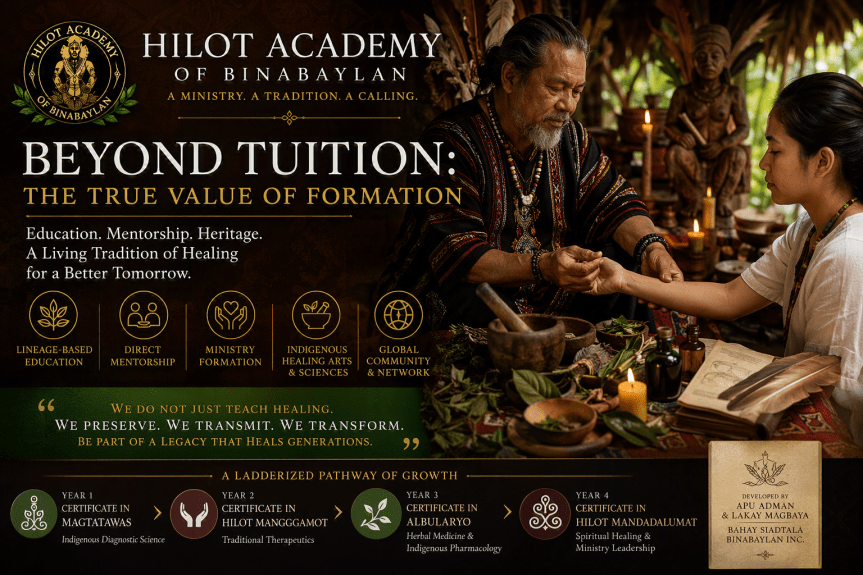
Whether you are a healthcare professional, spiritual seeker, or someone looking for a meaningful path, Hilot offers a journey of healing, purpose, and connection.
By enrolling in our Hilot training program, you will:
✅ Learn authentic Hilot techniques from certified practitioners ✅ Receive spiritual and cultural education rooted in Filipino traditions ✅ Be part of a movement to preserve and elevate Indigenous healing arts ✅ Earn credentials that recognize your role as a traditional healthcare provider ✅ Transform your life—and the lives of those you serve
🌕 Enrollment for 2026 class is Now Open!
Join the Hilot Academy of Binabaylan and become a certified Manghihilot. Let your hands be instruments of healing. Let your heart be a vessel of compassion. Let your spirit carry the wisdom of our ancestors into the future.
📩 Message us today to reserve your spot. 🌿 Limited slots available. Begin your journey now.
In the heart of Filipino culture lies a healing tradition that predates modern medicine—Hilot. More than just a massage, Hilot is a holistic approach to wellness that addresses the body, mind, and spirit. As the Philippines continues to modernize its healthcare system, there is a growing movement to reclaim and integrate Hilot into the national healthcare delivery system.
🏛️ A Legal Foundation: RA 8423
The integration of Hilot is not just a cultural aspiration—it is supported by law. Republic Act No. 8423, also known as the Traditional and Alternative Medicine Act (TAMA) of 1997, mandates the promotion and integration of traditional and alternative healthcare practices into the national health system. This law led to the creation of the Philippine Institute of Traditional and Alternative Health Care (PITAHC), which now oversees the certification and regulation of traditional healers, including Hilot practitioners.
🔍 Understanding the Types of Hilot
There are three primary streams of Hilot practice in the Philippines:
Hilot Binabaylan: Rooted in indigenous spirituality, this form of Hilot is passed down through oral tradition and spiritual calling. It involves rituals, energy healing, and ancestral wisdom.
TESDA Hilot: Offered as a vocational course under TESDA, this version focuses on massage therapy and wellness, preparing practitioners for work in spas and wellness centers.
PITAHC Hilot: Recognized by the Department of Health, this form integrates traditional diagnostic and healing methods with public health services, emphasizing herbal medicine, community wellness, and preventive care.
🌀 A Framework for Integration
To fully integrate Hilot into the national healthcare system, a structured approach is essential. Here’s a five-phase model:
1. Diagnostic Phase
Recognize Hilot’s traditional diagnostic methods—such as pulse reading and energy assessment—as complementary to biomedical diagnostics, especially in rural health units.
2. Cleansing Phase
Train Hilot practitioners to offer non-invasive cleansing techniques like pahid, tuob, and ventosa in barangay health centers as part of wellness and preventive care.
3. Repair Phase
Allow certified Hilot practitioners to provide therapeutic massage and herbal remedies under DOH supervision, in collaboration with PITAHC-recognized healing centers.
4. Strengthening Phase
Mobilize Hilot practitioners to lead community herbal gardens and ethnobotanical documentation, in partnership with LGUs and the Department of Agriculture.
5. Maintenance Phase
Empower Hilot practitioners to serve as health coaches, teaching traditional wellness practices, nutrition, and stress management in barangay health education programs.
🤝 Policy and Institutional Support
PITAHC’s Circular No. 01, s. 2016 provides a clear pathway for:
Certification of Hilot practitioners
Accreditation of Hilot training and healing centers
Integration into public health services
With the legal and institutional framework in place, what’s needed now is community support, local government action, and national recognition of Hilot’s value in building a healthier, more culturally grounded Philippines.
📣 Final Thoughts
Integrating Hilot into the national healthcare system is more than a policy move—it’s a cultural revival. It honors our ancestors, empowers our communities, and offers a holistic path to wellness that is uniquely Filipino.
In our Code of Ethics, we have mentioned that we are Healthcare providers whose goals consist of prevention of premature death and disability, maintenance or improvement of life, maximization of personal growth and development, and preparation for a good death.
As a manghihilot, our role is not to promise a long life to our patients. Instead, we offer something deeper—we help them embrace life fully, with all its challenges and transitions. We guide them to find comfort, meaning, and joy in every moment, no matter how difficult.
We do not see death as an enemy to be fought. Rather, we recognize it as a gentle guide—one that reminds us to live with purpose, to cherish our relationships, and to find peace in the present. In our healing practice, death is not the end, but a companion that helps us appreciate the beauty of life.
“It has been taught to us as Manghihilot, our role in caring is from the time of conception to the moment of transition from this plane of existence to the next life.”
In our tradition as Manghihilot, healing is not just a profession—it is a sacred calling. We are taught that our responsibility begins at the very start of life, even before birth, and continues until the final breath. Our care spans the entire human journey, from conception to transition, from the womb to the world beyond.
More Than Healing the Body
Our work is not limited to treating physical ailments. We are called to listen deeply—to the body, the spirit, and the emotions. We understand that true healing involves the whole person, and that pain can come not only from the body, but also from the heart and mind.
Honoring Life and Death
As Manghihilot, we do not fear death. We do not see it as something to fight or avoid. Instead, we recognize it as a natural part of life’s sacred cycle. We walk with our patients through every stage of life, including the final one, offering comfort, peace, and dignity.
A Tradition That Evolves
Our practice is rooted in the wisdom of our ancestors, but it is not stuck in the past. We continue to learn, grow, and adapt—bringing Hilot into the modern world while staying true to its spiritual essence. We believe that healing is a lifelong journey, and our presence is a gift of love and service from beginning to end.
Recently, a graduate of the Hilot Academy asked me whether we have any documented cases involving palliative care or end-of-life care within the practice of Hilot. Regretfully, I had to respond that we do not. The graduate pointed out that other traditional healing modalities have such documentation, while Hilot appears to lack it.
This absence is not due to a lack of experience or wisdom among Manghihilot, but rather a reflection of how our tradition has been preserved. Most Manghihilot have not been formally educated in colleges or universities. Their knowledge is deeply rooted in oral tradition and lived experience. They act rather than write. Their learning is carried in the mind and heart, passed down through narration and demonstration, not through modules or modern training materials.
This way of transmission is sacred and powerful, but it also means that much of our healing work remains undocumented. As we move forward, perhaps it is time to begin bridging the gap—honoring our oral traditions while also finding ways to preserve them in written form, so that future generations may continue to learn, grow, and share the wisdom of Hilot.
“In the sacred silence between life and death, the Manghihilot does not surrender—he pleads, he prays, and he offers his soul in service, asking for one more chance to heal.”
For the sake of documentation, I want to share a personal experience on how I, as a Manghihilot, have cared for a dying patient.
First and foremost, it is never our intention for a patient to die under our care. If that were the case, why would we devote time, energy, and spirit to preserving life? Our role is rooted in the belief that life is sacred and worth fighting for—even in its most fragile moments.
When a patient is facing a serious illness, it may seem that death is near. But as Manghihilot, we do not simply accept this. Instead, we plead with death—asking it to grant the patient another chance to live. It is a spiritual negotiation, a bargaining of life with death.
And if death allows the patient to stay, a promise must be made and fulfilled. This promise is not just a ritual—it is a sacred commitment to honor the life that was spared. In this way, our healing practice becomes not only physical but deeply spiritual, rooted in reverence for both life and the mystery of death.
“In the quiet moments before farewell, the Manghihilot becomes not just a healer—but a guide, preparing the soul for its sacred journey home.”
I remember my 80-year-old neighbor, Tata Piyo, who was undergoing dialysis for a kidney condition. His daughter, Ate Belen, came to me one day and asked for help in caring for her father. Despite his age and fragile condition, we chose to fight for life. As a Manghihilot, I did everything I could to ease his suffering—applying hilot pahid to relieve his pain, performing suob and paligo, and even designing a special diet to support his condition.
One day, Tata Piyo was in great pain. Ate Belen rushed to my house, asking me to attend to him. When I entered his bedroom, he looked at me and said in Tagalog, “Ihatid mo na ako.” I responded in a light-hearted way, “Where do you want me to send you? Don’t worry, when you regain your strength, we’ll go to Jollibee.” He laughed, gathering all his remaining strength, and replied, “Hindi, ihatid mo na ako sa ating Ama sa langit.”
I wasn’t prepared for those words. But I kept my composure and gently asked Ate Belen to call the rest of the family. I told them that Tata Piyo was asking to rest, and that the decision must come from them—not from me.
Together, we discussed whether to continue fighting for his life or to let him go peacefully. The family, acknowledging his age, his weakened body, and their readiness to accept his passing, decided to let him go. They remained composed, not wanting Tata Piyo to see them cry.
Everyone began preparing his clothes—underwear, socks, pants, t-shirt, and barong. I clipped his fingernails and toenails and gave him his last bed bath, ensuring he was clean and dignified for his journey.
At exactly 6:00 PM, Tata Piyo took his final breath.
This experience reminded me that as Manghihilot, our care extends beyond healing—it reaches into the sacred space between life and death. We do not just treat the body; we honor the soul. And in moments like these, we become witnesses to the most profound transitions of life.
Last Sunday March 23,2025 by 1:00 PM to 6:00 PM, we have started our Hilot Binabaylan Alignment Training Program for Local Filipino that is living nearby in Luzon. Unlike our Regular Training which we only serve 1 student maximum of 3. Our Weekly learning sessions can accommodate from 4 to 10 individuals. But our current enrollee now is 4 which we have started transferring our Knowledge through Sharing.
The topics we discussed on our first day.
In Class, we have emphasized the importance of understanding the Souls of Human being as it helps us in determining how we can help our Patient to heal them.
These four individuals have their own background being a healer using different modalities and through our alignment training program we are in High Hope that we will produce local Hilot Binabaylan practitioners to serve our fellow Filipino living in the Philippines.
We are still open to accept Enrollee to be part of this class by filling up the form on this link. Our Sunday Class will start 1:00 PM and End by 6:00 PM. And the topics to be discussed on March 30 are the following:
Happy Philippine Traditional Alternative HealthCare Month. Yesterday November 2, we have successfully conducted our First Free Webinar as we discuss the Fundamental of Hilot Practice and share the Definition, History, Principles and Philosophy of Hilot.
The Webinar yesterday was attended by 17 participants coming from different parts of the world, and they are the following:
Siesta is a short nap taken in the early afternoon, often after mid-day lunch meal. This tradition is mostly an influence from our Spanish Colonizers which the word is derived from Sixta Hora or the 6th Hour of the day. As early Filipino woke up most likely before the sunrise and lunch time which is the 6th hours from the rising of the sun. When growing up as Pinoy Kid, we have been told a story about Juan Tamad or Lazy Juan which our Spanish Colonizers depiction to a common Filipino. And aside from Nap Time, there are many make up stories, that our mother’s told us as a kid why we should take a nap after meal. Common mothers would encourage their children to take a nap after lunch meal so that children will not go out of their home to play on the Street. Nap time for Children allows mothers to continue doing their household chores also to give time for themselves to relax and care for themselves.
Out of this practice, a make story about an engkanto that is known as Taong Araw which is a very bright white complexion that sucks of life force from the persons they meet on the street during noon time, especially children. Other benefit of Siesta that is not scary is that it helps a Child to grow faster. But having Siesta in our Class is not that we teach laziness to our students, but instead we intend to immerse our students/participants to Filipino Culture and instill the value of rest as part of healing process.
1300 BC is part of the Iron Age in prehistory. Though we all know that the first recorded History of the Philippines was dated April 21 year 900 AD on the Laguna Copperplate Inscription. But when I searched the World Wide Web, I found in Wikipedia the name Amaron which is said to be a Legendary Supreme Ruler of the Philippines who ruled during 1300 BC.
Amaron
Of Course, If Amaron is a leader in 1300 BC that means he has constituents to lead on. And these constituents are composed of people who reside in the area where Amaron was supreme. And these people have a life to live. And living their life, they have a system in taking care of their health to maintain life force in their physical body.
So, Hilot does not start during the influence of the Sri Vijayan Empire, it even dates back far beyond the Birth of Jesus Christ.
And there is also another ruler named Gat Pangil, on which is believed where Pangil, Laguna has derived.
Imagine how do we live now if our Ancestors did not know how to care for themselves. Our History as Filipino People does not start from the coming of Spain in our Archipelago. When Ferdinand Magellan arrives, he was welcomed by Rajah Humabon on March 21, 1521. This only signifies that prior to the coming of Spain in our Archipelago, human beings (which is part of our ancestry) already existed in our land. So, imagine at that time, how do the Spanish Colonizer found our Ancestors, how do they look like? and how do they live before they came? Actually, they already have their Civilizations. People know how to wear clothes, they have jewelries and other accessories, they eat and drink. They also have mode of transportation and so as politics and government system. That is why we all know that there is also Lapu Lapu who killed Magellan. But that is different story to tell. What I want to point out here that our ancestors are already Civilized.
Though we may connect the lineage of Rajah Humabon to the 10 Bornean datu who fled and find refuge to our country during the 13th century. But even though these Bornean datu take refuge to our land, they are also welcomed by native inhabitant of our Archipelago which is an Aeta Chieftain named Datu Marikudo. And historically it is known that the Negrito Groups are the first inhabitants of our Archipelago which is now known as the Philippines which can be dated back 47,000 years ago.
And according to archeologist, the first human existed in our Archipelago besides from the Negrito group are the ones that can be found in Callao Cave in Cagayan. Their existence gives us idea on how they live 67,000 years ago. Of course, we do not look like them now, but their wisdom on survival still exists as of this day. And Hilot Academy of Binabaylan, credit our Hilot Healing Modality to them. As the way of Hilot is how to maintain life within our physical body and to keep us safe. Our Work as Manghihilot is not just to heal illnesses and ailments, but also to protect our Physical, Emotional, Mental, Social and Spiritual Body from harm.
And through this, aside from the Historical Evidence of our Ancestral Healing Arts and Science, the month of November has been declared as Traditional and Alternative Health Care Month by the virtue of Republic Act 8423 or the Philippine Traditional Alternative Medicine Act of 1997. and through this, Hilot Academy of Binabaylan will provide a month- long Free Webinar on the Fundamentals of Hilot Practice that will happen on the following dates and the topics to be discussed:
November 2, 2024 – Definition, History, Philosophies and Principles of Hlot
November 9, 2024- Hilot concept of Life, Health, Illness & Wellness
November 16, 2024- Faculties and Aspect of Man
November 23, 2024- Traditional Health Care Delivery and Hilot Treatment Methodologies
November 30, 2024- Laws, Policies, Standards and regulations on the Practice of Hilot & Hilot Code of Ethics
To those who are interested to attend, kindly fill out the form through the link below. We are going to issue Certificate of Attendance to those who will attend the online class which can be credited to our Alignment Program on becoming a Hilot Binabaylan.
You must be logged in to post a comment.