For over nine years, Hilot Academy of Binabaylan, the educational ministry arm of Luntiang Aghama Natural Divine Arts Shrine of Healing Inc. (also known as Landas ng Lahi), has been a beacon of ancestral wisdom and healing. Since our founding, we have produced 64 Hilot Binabaylan Practitioners who now serve their communities across the globe—many of whom are part of the Filipino diaspora returning home to reconnect with our sacred healing traditions.
These students had the option to study Hilot through government-accredited institutions such as TESDA or PITAHC, yet they chose us. Why? Because our teachings resonate with their spiritual calling. They sought not just technical skills, but a deeper understanding of Hilot as a sacred art and science—a practice rooted in the soul of our people.
Reclaiming the Sacred in Healing
From the beginning, we made a vow: to share the personal and ancestral knowledge of Hilot, including the practice of Tawas—a spiritual diagnostic method used by traditional Manghihilot. We have demystified Orasyon, reframing it as Therapeutic Communication and Timing, recognizing that words and timing can profoundly affect the mind, emotions, and healing process of the patient.
In our academy, Hilot is soul healing. We believe that the health of the body is inseparable from the health of the spirit. When the soul departs from the body, life ceases. Thus, healing must begin with the soul.
The Struggle for Accreditation
In our early years, we wrestled with the idea of seeking accreditation from government bodies. I personally contributed to the development of Hilot curricula for institutions like the Hilot Philippines Development Center, a legacy school of Dr. Mina Gabor, former Secretary of the Department of Tourism. I also helped establish the Philippine Japan Hilot Association, which gained accreditation from TESDA and the Department of Tourism.
But when it came to Hilot Academy of Binabaylan, we chose a different path.
Why? Because the current accreditation standards forbid the inclusion of Tawas and Orasyon in the curriculum. They limit spiritual practices to Christian and Islamic prayers, excluding indigenous expressions of faith and healing. This reflects a colonial mindset that prioritizes physical health while neglecting the soul.
Standing for Decolonization and Spiritual Integrity
We teach decolonization. We honor the wisdom of our ancestors. We believe that healing is not just clinical—it is spiritual, emotional, and cultural. To conform to accreditation standards would mean compromising our identity and silencing the soul of Hilot.
Unless PITAHC or other bodies are willing to fund research that validates Tawas as a legitimate diagnostic method, we remain in a dilemma: Do we embrace autonomy or submit to colonized standards?
A Vision for the Future
Despite these challenges, we continue to dream. We envision a future where Hilot Binabaylan is not only an ecclesiastical degree in ministry but also recognized as an academic degree. We are committed to ensuring that our graduates are employable, empowered, and respected as Hilot Binabaylan Practitioners—both in the Philippines and around the world.
We walk the path of the Binabaylan: bridging worlds, healing souls, and reclaiming our sacred traditions. And we invite you to walk with us.
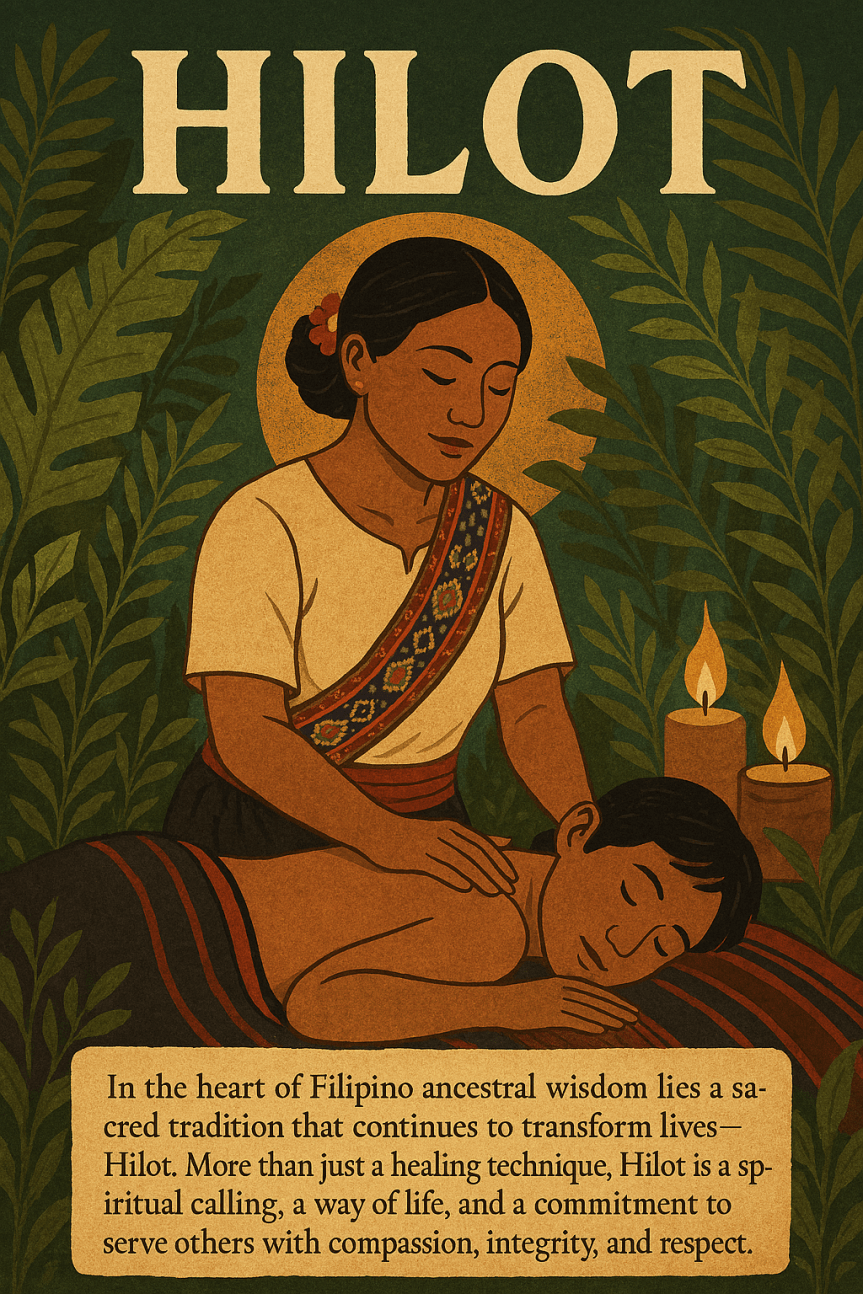
In the heart of Filipino ancestral wisdom lies a sacred tradition that continues to transform lives—Hilot. More than just a healing technique, Hilot is a spiritual calling, a way of life, and a commitment to serve others with compassion, integrity, and respect.
As the world seeks deeper, more holistic approaches to wellness, Hilot stands as a beacon of hope—reminding us that healing begins from within and is nurtured by the wisdom of our ancestors.
Why Hilot Matters Today
Modern healthcare often focuses on symptoms, but Hilot looks deeper. It recognizes that illness can stem from emotional, spiritual, and environmental imbalances. Through intuitive diagnostics like Tawas, sacred rituals, and personalized care, Hilot practitioners help individuals restore harmony in body, mind, and spirit.
But with this sacred power comes great responsibility. That’s why every Manghihilot must uphold the Hilot Code of Ethics and Healing Principles—a living covenant that guides our practice and protects those we serve.
🌿 The Hilot Code of Ethics: A Sacred Commitment
As a Manghihilot, you are not just a healer—you are a steward of life. The Code of Ethics ensures that your practice is rooted in:
Compassionate Care: Facilitating healing, not controlling it.
Respect for Individuality: Every soul is unique; every treatment is personalized.
Professional Integrity: Referring patients when conditions are beyond your scope.
Cultural Wisdom: Honoring ancestral knowledge while embracing modern insights.
Non-Discrimination: Serving all people regardless of background, identity, or status.
This code is not just a guideline—it is a spiritual vow to uphold the dignity and well-being of every person who seeks your help.
✨ Healing Principles That Guide the Manghihilot
Hilot is more than technique—it is philosophy. As a practitioner, you will learn to:
Recognize that healing begins within.
Understand that illness may be spiritual, emotional, or physical—and often all three.
Use cleansing rituals to remove the source of illness and replace it with positive energy.
Respect the natural environment as a vital part of healing.
Accept death as a transition, not an enemy, and help others live meaningfully.
These principles empower you to become a healer who not only treats symptoms but transforms lives.
🎓 Why You Should Enroll in Hilot Training
Whether you are a healthcare professional, spiritual seeker, or someone looking for a meaningful path, Hilot offers a journey of healing, purpose, and connection.
By enrolling in our Hilot training program, you will:
✅ Learn authentic Hilot techniques from certified practitioners ✅ Receive spiritual and cultural education rooted in Filipino traditions ✅ Be part of a movement to preserve and elevate Indigenous healing arts ✅ Earn credentials that recognize your role as a traditional healthcare provider ✅ Transform your life—and the lives of those you serve
🌕 Enrollment for 2026 class is Now Open!
Join the Hilot Academy of Binabaylan and become a certified Manghihilot. Let your hands be instruments of healing. Let your heart be a vessel of compassion. Let your spirit carry the wisdom of our ancestors into the future.
📩 Message us today to reserve your spot. 🌿 Limited slots available. Begin your journey now.
Recently, the Traditional Hilot Society, Inc. (THSI) issued a public advisory warning against the practice of Hilot by individuals and groups not accredited by PITAHC (Philippine Institute of Traditional and Alternative Health Care). While we respect their efforts to professionalize Hilot within the health care system, we must raise a critical concern: Can Hilot be monopolized?
The answer is a resounding no.
🧓 Hilot: A Sacred Tradition, Not a Trademark
Hilot is not a brand. It is a living tradition, a spiritual calling, and a cultural heritage passed down through generations of Filipino healers, midwives, and spiritual leaders. It belongs to the people, not to any single organization.
To claim exclusive authority over Hilot is to erase the ancestral wisdom of countless Manghihilot who have served their communities long before PITAHC or THSI existed.
⚖️ Our Legal and Constitutional Rights
We assert our right to practice Hilot based on the following:
1987 Philippine Constitution
Article XIV, Section 17–22: Protects indigenous cultural communities and their traditions.
Article III, Section 5: Guarantees freedom of religion and spiritual practice.
Article XIII, Section 6: Upholds the right to livelihood and self-determination.
Republic Act No. 8371 – Indigenous Peoples’ Rights Act (IPRA)
Recognizes the right of Indigenous Peoples to preserve and develop their traditional healing systems.
Republic Act No. 8423 – Traditional and Alternative Medicine Act (TAMA)
Encourages the development of traditional health care without monopolizing it.
Affirms the protection of indigenous knowledge and practices.
🛡️ Our Position
We, the Hilot Academy of Binabaylan, Templong Anituhan, and independent Manghihilot practitioners, affirm that:
Hilot is a cultural and spiritual practice, not merely a health service.
Manghihilot practitioners, whether PITAHC-certified or not, have the right to practice in accordance with their traditions.
Spiritual and cultural institutions have the right to train and ordain Hilot practitioners under their own customary laws and beliefs.
🤝 A Call for Unity, Not Division
We invite THSI and PITAHC to recognize the plurality of Hilot traditions in the Philippines. Let us work together to honor our ancestors, protect our heritage, and serve our communities—not through exclusion, but through collaboration.
✍️ Final Words
Hilot is not owned. It is lived. It is not regulated by paper alone—it is guided by spirit, breath, and touch. Let us keep it sacred, inclusive, and true to its roots.
Hilot, the ancient Filipino art of healing, is steadily gaining global recognition as a powerful modality for wellness and spiritual restoration. As more people seek natural and culturally rooted approaches to health, Hilot stands out as a sacred tradition that bridges body, mind, and spirit.
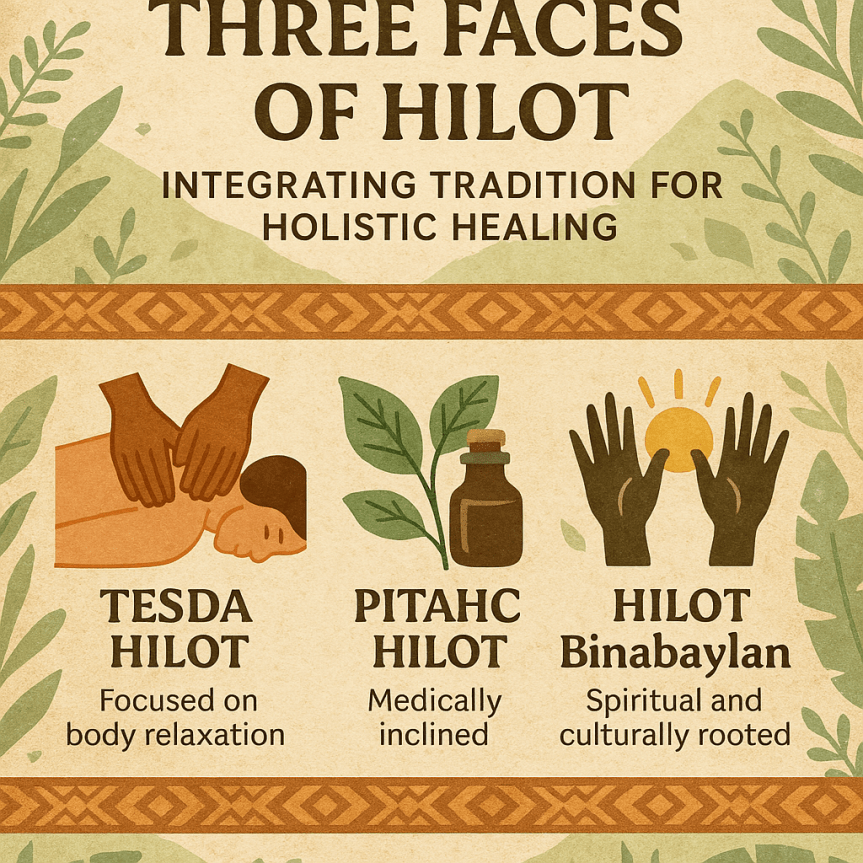
At the Hilot Academy of Binabaylan, we honor the richness and diversity within this practice. Through years of study and experience, we have identified three distinct expressions of Hilot, each serving a unique purpose in the journey toward holistic well-being:
1️⃣ TESDA Hilot
This form of Hilot is widely taught through the Technical Education and Skills Development Authority (TESDA) and focuses primarily on physical relaxation and massage therapy. It is designed to relieve stress, promote circulation, and support general wellness through touch and bodywork.
2️⃣ PITAHC Hilot
Recognized by the Philippine Institute of Traditional and Alternative Health Care (PITAHC), this approach integrates Hilot into the realm of complementary and alternative medicine. It is medically inclined, emphasizing diagnostic techniques and therapeutic interventions that align with traditional healthcare systems.
3️⃣ Hilot Binabaylan
This is our sacred path—Hilot Binabaylan—a culturally and spiritually rooted practice that draws from indigenous Filipino wisdom. It involves rituals, connection with nature, and ancestral guidance to heal not just the body, but also the soul. It is a spiritual calling that honors the sacred relationship between healer, patient, and the unseen forces of life.
🌺 A Gathering of Healing and Unity
On October 5, 2025, we will host a special gathering to celebrate and acknowledge these three expressions of Hilot. This event is not about division, but integration—recognizing that each form of Hilot contributes to a greater whole. When combined, they offer a comprehensive and deeply transformative healing experience.
Rather than contradicting one another, these approaches can be harmonized to provide optimum benefits for those we serve. Whether through physical touch, medical insight, or spiritual connection, Hilot remains a living tradition that continues to evolve and empower.
✨ Let us unite in honoring our heritage and empowering our future through the sacred art of Hilot. ✨
In our Code of Ethics, we have mentioned that we are Healthcare providers whose goals consist of prevention of premature death and disability, maintenance or improvement of life, maximization of personal growth and development, and preparation for a good death.
As a manghihilot, our role is not to promise a long life to our patients. Instead, we offer something deeper—we help them embrace life fully, with all its challenges and transitions. We guide them to find comfort, meaning, and joy in every moment, no matter how difficult.
We do not see death as an enemy to be fought. Rather, we recognize it as a gentle guide—one that reminds us to live with purpose, to cherish our relationships, and to find peace in the present. In our healing practice, death is not the end, but a companion that helps us appreciate the beauty of life.
“It has been taught to us as Manghihilot, our role in caring is from the time of conception to the moment of transition from this plane of existence to the next life.”
In our tradition as Manghihilot, healing is not just a profession—it is a sacred calling. We are taught that our responsibility begins at the very start of life, even before birth, and continues until the final breath. Our care spans the entire human journey, from conception to transition, from the womb to the world beyond.
More Than Healing the Body
Our work is not limited to treating physical ailments. We are called to listen deeply—to the body, the spirit, and the emotions. We understand that true healing involves the whole person, and that pain can come not only from the body, but also from the heart and mind.
Honoring Life and Death
As Manghihilot, we do not fear death. We do not see it as something to fight or avoid. Instead, we recognize it as a natural part of life’s sacred cycle. We walk with our patients through every stage of life, including the final one, offering comfort, peace, and dignity.
A Tradition That Evolves
Our practice is rooted in the wisdom of our ancestors, but it is not stuck in the past. We continue to learn, grow, and adapt—bringing Hilot into the modern world while staying true to its spiritual essence. We believe that healing is a lifelong journey, and our presence is a gift of love and service from beginning to end.
Recently, a graduate of the Hilot Academy asked me whether we have any documented cases involving palliative care or end-of-life care within the practice of Hilot. Regretfully, I had to respond that we do not. The graduate pointed out that other traditional healing modalities have such documentation, while Hilot appears to lack it.
This absence is not due to a lack of experience or wisdom among Manghihilot, but rather a reflection of how our tradition has been preserved. Most Manghihilot have not been formally educated in colleges or universities. Their knowledge is deeply rooted in oral tradition and lived experience. They act rather than write. Their learning is carried in the mind and heart, passed down through narration and demonstration, not through modules or modern training materials.
This way of transmission is sacred and powerful, but it also means that much of our healing work remains undocumented. As we move forward, perhaps it is time to begin bridging the gap—honoring our oral traditions while also finding ways to preserve them in written form, so that future generations may continue to learn, grow, and share the wisdom of Hilot.
“In the sacred silence between life and death, the Manghihilot does not surrender—he pleads, he prays, and he offers his soul in service, asking for one more chance to heal.”
For the sake of documentation, I want to share a personal experience on how I, as a Manghihilot, have cared for a dying patient.
First and foremost, it is never our intention for a patient to die under our care. If that were the case, why would we devote time, energy, and spirit to preserving life? Our role is rooted in the belief that life is sacred and worth fighting for—even in its most fragile moments.
When a patient is facing a serious illness, it may seem that death is near. But as Manghihilot, we do not simply accept this. Instead, we plead with death—asking it to grant the patient another chance to live. It is a spiritual negotiation, a bargaining of life with death.
And if death allows the patient to stay, a promise must be made and fulfilled. This promise is not just a ritual—it is a sacred commitment to honor the life that was spared. In this way, our healing practice becomes not only physical but deeply spiritual, rooted in reverence for both life and the mystery of death.
“In the quiet moments before farewell, the Manghihilot becomes not just a healer—but a guide, preparing the soul for its sacred journey home.”
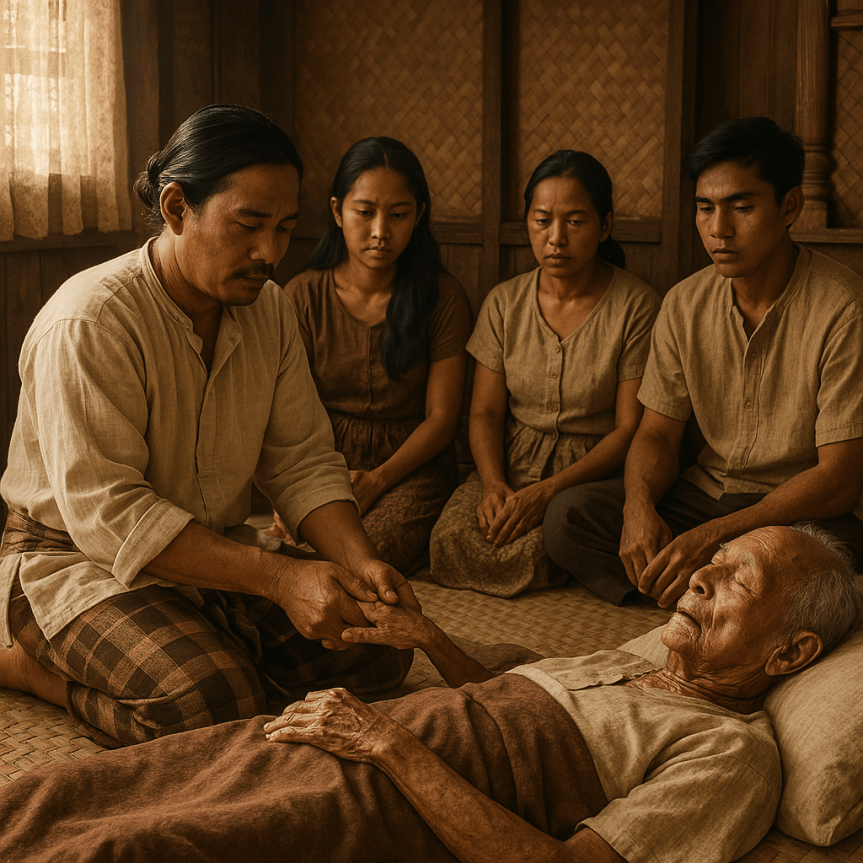
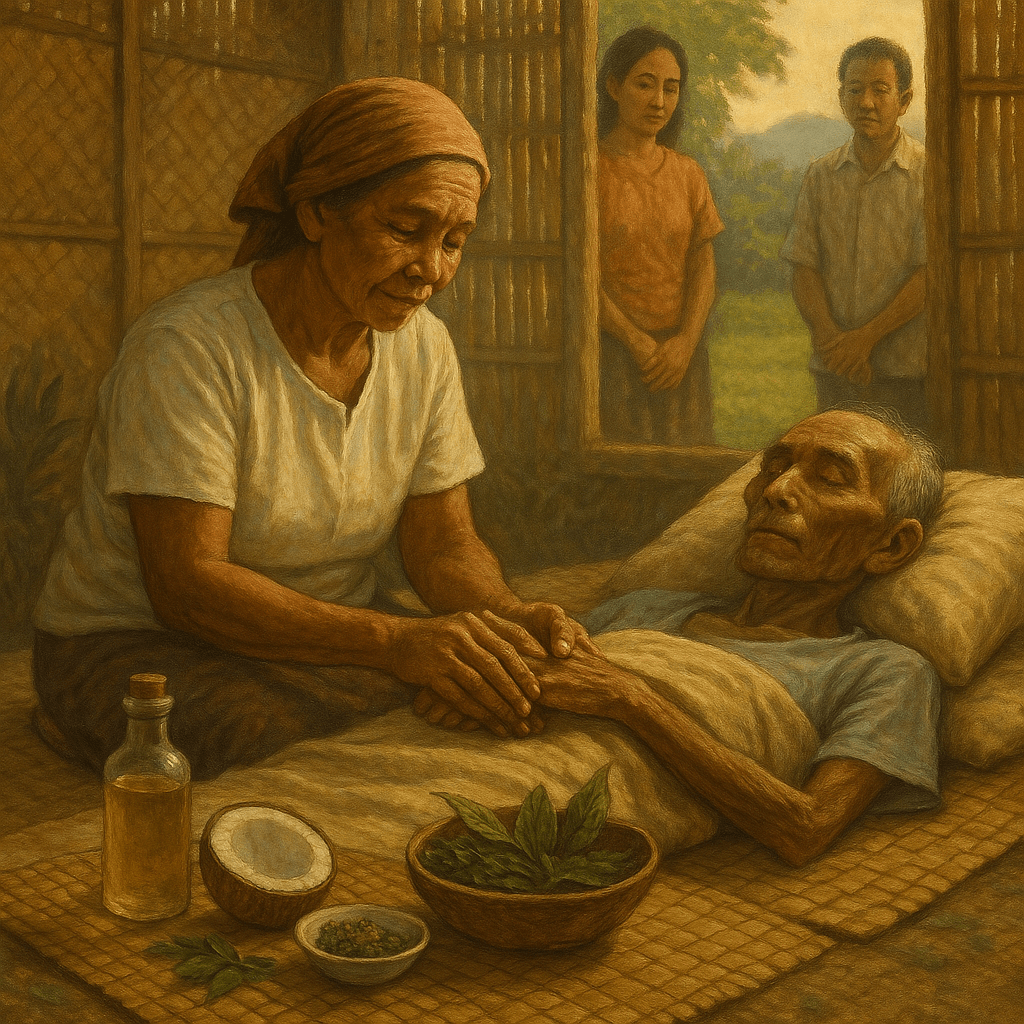
I remember my 80-year-old neighbor, Tata Piyo, who was undergoing dialysis for a kidney condition. His daughter, Ate Belen, came to me one day and asked for help in caring for her father. Despite his age and fragile condition, we chose to fight for life. As a Manghihilot, I did everything I could to ease his suffering—applying hilot pahid to relieve his pain, performing suob and paligo, and even designing a special diet to support his condition.
One day, Tata Piyo was in great pain. Ate Belen rushed to my house, asking me to attend to him. When I entered his bedroom, he looked at me and said in Tagalog, “Ihatid mo na ako.” I responded in a light-hearted way, “Where do you want me to send you? Don’t worry, when you regain your strength, we’ll go to Jollibee.” He laughed, gathering all his remaining strength, and replied, “Hindi, ihatid mo na ako sa ating Ama sa langit.”
I wasn’t prepared for those words. But I kept my composure and gently asked Ate Belen to call the rest of the family. I told them that Tata Piyo was asking to rest, and that the decision must come from them—not from me.
Together, we discussed whether to continue fighting for his life or to let him go peacefully. The family, acknowledging his age, his weakened body, and their readiness to accept his passing, decided to let him go. They remained composed, not wanting Tata Piyo to see them cry.
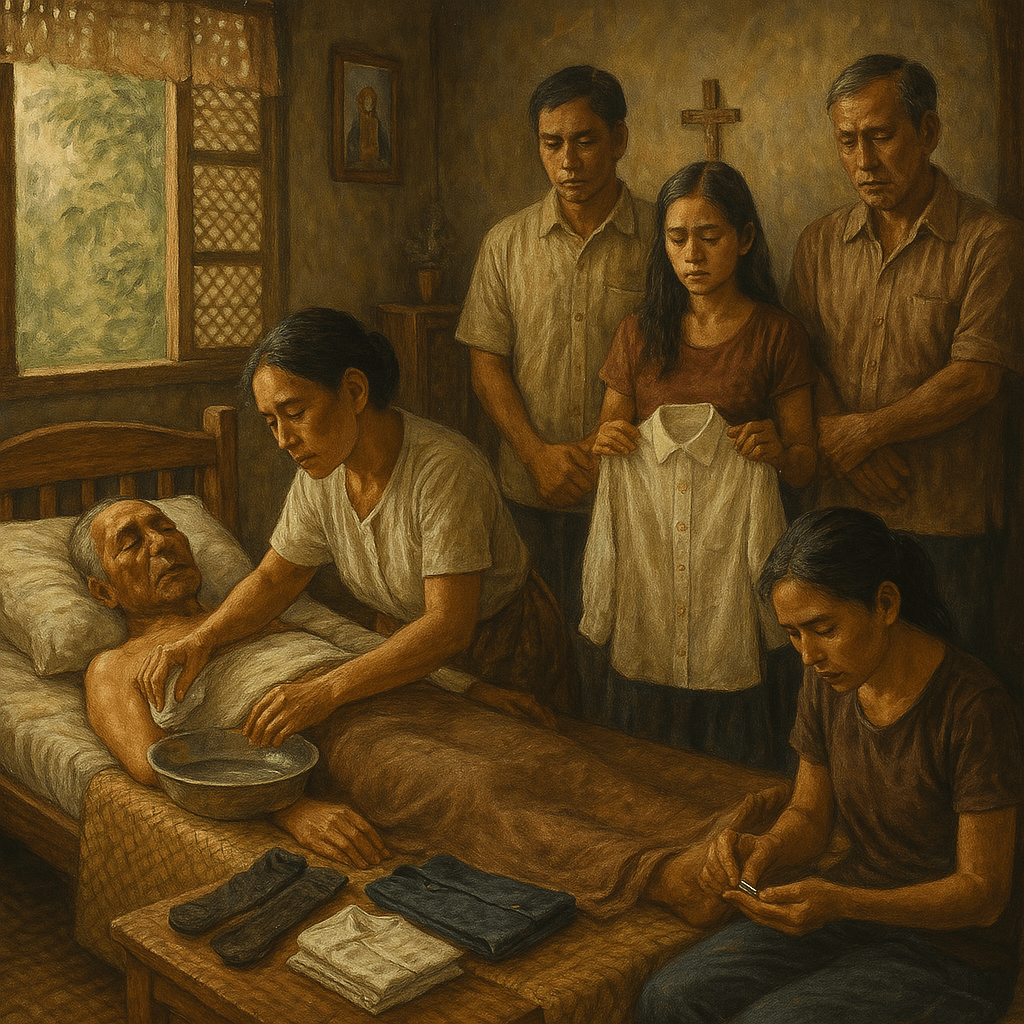
Everyone began preparing his clothes—underwear, socks, pants, t-shirt, and barong. I clipped his fingernails and toenails and gave him his last bed bath, ensuring he was clean and dignified for his journey.
At exactly 6:00 PM, Tata Piyo took his final breath.
This experience reminded me that as Manghihilot, our care extends beyond healing—it reaches into the sacred space between life and death. We do not just treat the body; we honor the soul. And in moments like these, we become witnesses to the most profound transitions of life.
I am always amazed to have people in our class that have the same flow of thoughts running in their mind and the class that they are taking with us serve as an affirmation to the calling that they have and long to manifest in their life.
Hilot Academy was established on April 5, 2016, which is now celebrating our 9th Year Anniversary, which start to aim just to provide skills training that is aligned to the Standards and Regulation of Technical Skills and Development Authority (TESDA). But as time goes by, the need of preserving the knowledge of our Indigenous Traditional Medicine Practices prevails that we cut our self from any Governing and Accrediting Body that forbids some of our Healing practices which only limits the practitioner in providing Massage such as the Hilot Wellness Massage NC2 provided by Tesda accredited Training Center.
On 2020 at the time of Pandemic, the former Tourism Secretary have searched for us and ask us to help her establish Hilot School under the International School of Sustainable Tourism that is located in Silang, Cavite, Philippines. And through the effort that we exert in creating Hilot Philippines Development Center, Hilot Academy, Philippine Institute of Traditional Alternative Health Care (PITAHC), and Technical Education Skills Development Authority (TESDA) were able to have a dialogue about the scope of practices and certification of Hilot Practitioner which unfortunately, the agreed Memorandum Circular promised by former Pitahc Director General was not made due to the shuffling or change of person in authority that manage TESDA and the retirement of PITAHC Director General.
We were ambitious at the start of the new decade hoping that the work of Hilot will be recognized and be preserved by our Government Authority but to my regret, they have a blind eye and deaf hears and are convinced that Hilot is just a massage and Tawas should be excluded. Though many of their invited expert to convey the importance of Hilot in delivering health care do believe in Tawas being part of Hilot Modality, they are still bound to bow down to what the Roman Catholic Church would say specially from the Archdiocese of Manila Office of Exorcism that they gave reminder of not to teach tawas to the public as it invokes the devil in accordance to their teaching.
The Goal of lifting up the Practice of Hilot by professionalizing it has been hindered not only by modern science but also by the modern religion. The hope of calling our Manghihilot as Indigenous Traditional Filipino Medicine Doctor has been halted due to their not willingness to spend time in studying Hilot and find science on our healing modality.
As founder of Hilot Academy of Binabaylan, professionalizing our practice requires an Indepth study. This is why we do our effort to upgrade our curriculum. Our 9 days and 13 days course are just a familiarization course as many people whether Filipino or Foreigner do not know yet what is Hilot all about. But soon as we move forward to the future we can make it into a Bachelor’s degree course that is 4 years with Masteral and Doctorate Degree just like other Traditional Medicine Practices.
Lana is a Cebuano word that pertains to the Coconut Oil. It is said that Coconut is endemic to the Indo-Pacific Region which includes the SouthEast Asia, Indian subcontinent and the Pacific Islands. This is why there are noticeable similarity of our Culture and even on Healing practices on the said Region.
But in terms of the use of Coconut Oil, it has been used by our Ancestors thousand years ago even prior to the coming of the Spanish Colonizers. Aside from the medicinal properties of Coconut oil, our Ancestors know that it has a Sacred origins, as the Tagalog people believe that the Coconut is a sacred to our Ancient God named Bathala. In one of my Blog at Why Healing oil is the common medicine for the rural Filipino? – Hilot Academy of Binabaylan I wrote:
Healing Oil has been a Powerful Tool of many Filipino in Healthcare even prior to Colonization and arrival of modern Medicine in the Philippines.
It is prescribed by our Ancestors that has direct lineage to our God which we call us Anito. This belief has been strengthened when the Kingdom of India have reached out our Country during the 3rd to 6th Century.
The belief that the oil derived from the Coconut is a byproduct of the Divine Body of the Gods Ulilang Kaluluwa (lonely soul) and Galang Kaluluwa (wondering soul) in the Katagalugan Pantheon.
While in Mindanao by the Talaandig Tribe it was prescribed by their Holy Propher Apu Agbibilin to use Coconut oil and Lemon grass in Peace Making as a sign of the God Magbabaya through the God of Peace Agta Yabun Magbaya.- End of Qoute
Even up to now, many Filipinos are still using Coconut Oil (Healing Oil) in managing their illnesses, especially those are who are deprived of Financial Stability and hard to access Health Care facilities; they use it by applying it externally and even ingest it Internally especially during the time of Pandemic that it has been used to treat persons with Corona Virus.
Aside from its medicinal properties, Coconut oil has its Magical/Spiritual properties that has been established by our Ancestors in protection against Evil Spirits such as the Busaw or Po-oy. It also has been used as Spirit Detector when the bottle of coconut oil boils or shown bubbles which means there are presence of evil spirit.
Manufacturing or Making of Coconut oil is being done Ritually. Specially with the Healers of Siquijor which is part of the Central Visayas Region. It starts 6 Friday before Good Friday on the Lenten Season, this will make Good Friday as the 7th Friday. For this year, this ritual will start on March 7, 2025. This Pangalap Ritual Gathering of Herbs invokes the Spirit of Pakikipagkapwa, as this gathering are not limited to local Healers and Witches of Siquijor but also with other Provinces Healers and Witches in honoring the Power of Nature.
Hilot Academy of Binabaylan through Luntiang Aghama Natural Divine Arts of Healing Inc. adopts this practice and teach it through our future Cultural Bearer and Ancestral Wisdom Keeper known as Hilot Binabaylan that we may preserve it for the benefit of our Future Generation.
Paghimo sang Lana is usually made in the Morning which is the preparation of Herbs and cooked by 12 Noon and distribute it among participants before 3 PM specially if made with a large group of Healer.
A question has been asked to me by a student if the Philippines has not been Christianized so there will be no Holy Week, when do our PreColonial Ancestors make their Healing Oil? That was a good question that requires a good answer as well. In analyzing the day of making or cooking oil which are mostly done by Folk Catholics, Christian Mystics and some animist healers, they do it during Good Friday which in accordance to Catholic Faith, it was adjusted near Full Moon which Christ was nailed on the Cross on a Full Moon. Though our precolonial beliefs is not based on Jesus Christ, but Full Moon is sacred and powerful enough that aside from following the movement of the Sun, the Phases of the Moon is also observed. So, Paghimo sang Lana is best done on the day of Full Moon that may invoke the perfect balance of Sun and Moon which are the Children of Bathala being Apolaki-the Sun and Mayari – the Moon.
We are already in our Training Center at Bahay Siadtala in Taguig City to prepare for tomorrows first day of Class. I woke up early and check my Emails and upon checking I browse at Bing.Com and my mind plays if Bing knows what is Binabaylan. Of course, just like Google it knows almost everything, but what I am amazed on what it says are the following:
Binabaylan is a term associated with the indigenous healing practices of the Philippines. Let’s explore its significance:
Binabaylan: The term binabaylan refers to a shaman, healer, or spiritual leader in Filipino indigenous cultures. These individuals play a vital role in their communities, acting as intermediaries between the physical world and the spiritual realm. Binabaylans are deeply connected to nature, ancestral spirits, and ancient wisdom. Their practices involve healing, divination, and maintaining harmony within the community. The role of a binabaylan is multifaceted, encompassing spiritual guidance, herbal medicine, rituals, and ceremonies. Historically, babaylans were often women, but in modern times, both men and women can take on this sacred role.
Healing Arts and Practices: Binabaylans utilize various traditional and natural healing arts: Hilot: A form of massage and energy healing that involves touch, herbal remedies, and manipulation of energy pathways. Magtatawas: Practitioners who perform tawas, a form of divination using water and candles to diagnose illnesses or spiritual disturbances. Manggagamot: Healers who use herbs, chants, and rituals to address physical and spiritual ailments. Albularyo: Folk healers who combine indigenous knowledge with Catholic elements. Their practices are deeply rooted in animism, ancestor veneration, and indigenous spirituality .
Revival and Recognition: In recent years, there has been a revival of interest in binabaylan practices, especially among those seeking alternative healing methods. Efforts are being made to preserve and honor these ancient traditions, recognizing their cultural significance and wisdom. Binabaylans continue to serve their communities, bridging the gap between tradition and modernity. In summary, binabaylans are revered as guardians of ancestral knowledge, healers, and spiritual guides, embodying the rich cultural heritage of the Philippines. 🌿
I am very honored that our efforts are being recognized even it is only online. But our work in Touching People lives will continue until we have #HealTheWorldWithHilot.




 Hilot Academy of Binabaylan
You must be logged in to post a comment.