In the modern world, rehabilitation is often viewed as a clinical process—a way to fix a broken body or a wayward mind. However, in the heart of Philippine tradition, rehabilitation is restoration. It is the act of bringing a person, a family, or a community back into a state of Harmony (Pagkakaisa) and Balance (Patas).
The Anatomy of Imbalance: Pasmo, Bughat, and Baldao Traditional healing recognizes that “damage” isn’t just physical. Baldao (Ilocano): A physical dislocation that requires the manual “resetting” of the frame. Pasmo: A thermal and energetic imbalance caused by the collision of “hot” and “cold,” often manifesting as tremors or weakness. Bughat/Binat: A spiritual and physical relapse. It is a reminder that the body is a temple that requires “sealing” and respect after a period of opening, such as illness or childbirth.
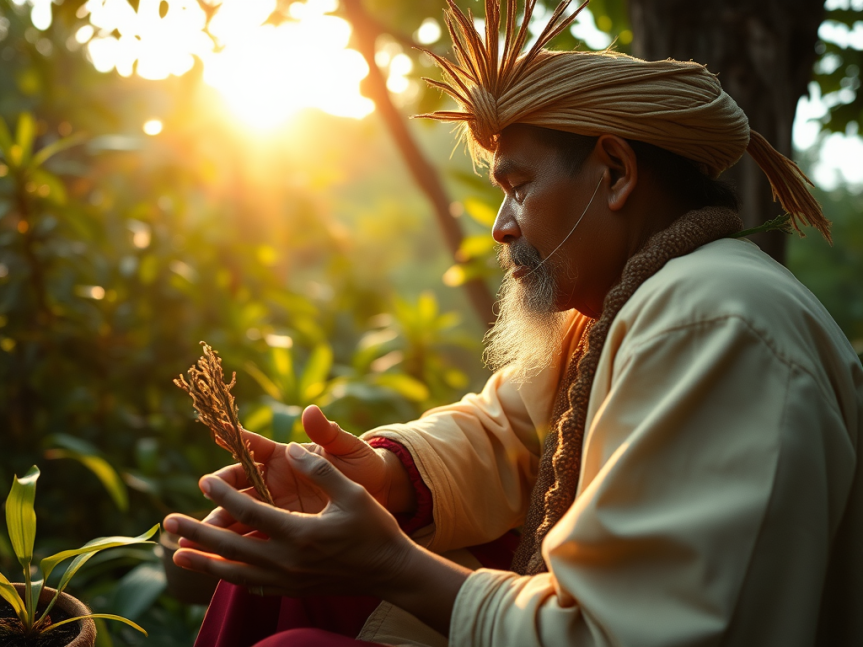
In these cases, the Hilot or Albularyo acts as the architect of recovery, using herbs, heat, and touch to reconstruct what was lost. The “Maaram” and the Neutrality of Knowledge At the center of this world is the Maaram (The Knower/The Wise). The etymology of the word—rooted in Alam (Knowledge)—parallels the English “Witch,” which comes from Wit (to know). A true Maaram is a Keeper of Ancient Mysteries.
They understand that knowledge is a neutral tool, like electricity or a blade. It has no inherent “color” until it is dyed by the Intention of the user. White Intent: Used for healing and protection.
Black Intent (Kulam): Traditionally defined by colonial history as “evil,” but philosophically viewed as the use of power to inflict consequence.
Kulam: The Tool of Restorative Justice Our discussion challenged the modern “demonization” of Kulam. Rather than a purely destructive act, Kulam can be viewed as a constructive tool for the oppressed.
A Self-Defense Mechanism: For those who are poor or powerless against the “rich” or the “mighty,” the cry for divine help awakens the Mangkukulam within.
A Teacher of Lessons: It serves as a spiritual classroom where pain is the medium for a lesson. It forces the offender to face their guilt and restore what they have stolen or broken.
The Universal Ki: This power is not reserved for “special” people. It is the Ki or Chi—the life force—within every individual. It is the manifestation of the human will to defend its own dignity and restore universal balance.
Conclusion: The Flow of Life The ultimate goal of all these mysteries is to ensure that life energy flows freely. Whether through the gentle touch of a healer or the sharp “correction” of a manifest intent, the purpose is the same: to maintain the harmony of the whole. The Maaram does not seek fame or fortune, but lives an ordinary life as a silent guardian of these laws. Knowledge, like Ki, must flow to give life to those who need it. When the “Mangkukulam within” awakens, it is not an act of evil, but the soul’s natural response to restore what is broken.
By Rev. Rolando Gomez Comon (Apu Adman), Developer and Reviver of Hilot Binabaylan, Founder of Hilot Academy of Binabaylan
Overview
This article clarifies three intertwined questions:
Was hilot a “business” in pre‑colonial times?
How do “necessity” and “commodity” differ—and where does hilot belong?
Did manghihilot have formal groups and leaders in ancient times—and how does that history inform modern debates over legitimacy and leadership?
It closes with a Position Paper presenting the historical‑theological justification for the leadership of the Hilot Academy of Binabaylan, and a peaceful indigenous response to critiques of legitimacy—grounded in culture, service, and spiritual calling.
I. Was Hilot a “Business” in Pre‑Colonial Times?
Short answer: No—not in the modern market sense. In pre‑colonial Philippine communities, hilot was a community health service embedded in spiritual practice, herbal knowledge, and manual healing, provided by manghihilot, albularyo, and babaylan. Compensation typically came through reciprocity—food, portions of harvest, help, or other gifts—rather than profit margins or standardized prices. The work was spirit‑led and community‑validated, not market‑driven. Sources: Overviews consistently describe hilot as a holistic, culturally embedded practice rather than mere massage or commerce, emphasizing its role in childbirth, midwifery, herbalism, and spiritual healing. [beholdphil…ppines.com], [en.wikipedia.org], [nipino.com]
II. Necessity vs. Commodity—And Where Hilot Belongs
A. Definitions
Necessity: Goods or services essential to life and well‑being; demand is relatively inelastic because people need them regardless of price (e.g., food, water, shelter, basic healthcare). [difference.wiki], [fiveable.me]
Commodity: A good or service produced for trade, often fungible (interchangeable) and subject to market pricing and speculation (e.g., grains, metals, oil). [en.wikipedia.org], [merriam-webster.com]
B. Where Hilot Belongs
Pre‑colonial hilot functioned as a necessity: it was the primary healthcare for many communities—covering musculoskeletal care, prenatal and childbirth support, herbal medicine, and spiritual balance. Its demand derived from communal need and spiritual obligation, not price sensitivity or brand competition. [beholdphil…ppines.com], [nipino.com]
Modern hilot can be commodified (e.g., spa menus, wellness tourism, branded trainings) when offered through market channels with fees, packages, and certifications. That shift—from necessity to commodity—is a feature of contemporary market systems, not ancient practice. [insights.m…ourism.com]
III. Did Ancient Manghihilot Have Groups and Leadership?
A. Autonomy and Place‑Based Calling
Pre‑colonial healers (manghihilot, babaylan/katalonan, mumbaki, walian, etc.) were typically autonomous, place‑based, and lineage/apprenticeship‑trained. Their recognition flowed from efficacy, ritual authority, and the community’s trust, rather than from a centralized guild or national hierarchy. [en.wikipedia.org], [centerforb…tudies.org]
B. Functional Differentiation, Not Bureaucratic Hierarchy
Communities often distinguished roles—e.g., bone setting and soft‑tissue manipulation (manghihilot), herbal pharmacopeia (albularyo), and ritual leadership (babaylan). This was functional diversity, not a top‑down chain of command. [en.wikipedia.org]
C. Spirit‑Led Leadership
Authority was relational, situational, and spirit‑led. Healers “bowed” to Divine/Diwata/Anito and served communal welfare. Their “leadership” was service‑based: respected because their practice worked, their counsel guided, and their rituals healed. [en.wikipedia.org]
Conclusion: Your understanding is correct. Ancient healers were independent and community‑anchored; modern inter‑group competition is largely a post‑colonial/market phenomenon.
IV. Why Do Modern Legitimacy Conflicts Arise?
Marketization & Branding: As hilot enters market frameworks (pricing, certifications, brand identities), groups understandably advocate for their models and standards—sometimes sliding into competitive claims. [insights.m…ourism.com]
Colonial & Post‑Colonial Disruptions: Historic suppression of indigenous spiritual healing fractured lineages, creating a vacuum later filled by new institutions seeking validation—occasionally through gatekeeping or delegitimization. Scholarly descriptions of babaylan roles and suppression across the archipelago contextualize this dynamic. [en.wikipedia.org]
V. The Role of Hilot Academy of Binabaylan (HAB)
The Hilot Academy of Binabaylan is not a “supreme authority.” It is a modern container—a learning community that preserves, organizes, and passes on indigenous healing knowledge responsibly. HAB provides structure for continuity amidst contemporary realities (urbanization, fragmented lineages, global students), while honoring spirit‑led autonomy and community service as the core of hilot. [beholdphil…ppines.com], [nipino.com]
VI. Position Paper
Historical‑Theological Justification of Leadership in the Hilot Academy of Binabaylan
A. Premises
Historical Continuity: Pre‑colonial hilot thrived as a necessity embedded in communal life, stewarded by healers recognized through efficacy and service, not bureaucratic titles. [beholdphil…ppines.com], [en.wikipedia.org]
Disruption and Need for a Modern Framework: Colonial/post‑colonial disruptions fragmented lineages and ritual ecologies, necessitating contemporary educational structures to safeguard and transmit knowledge. [en.wikipedia.org]
Theological Grounding: In indigenous perspectives, calling (tawag) originates from the Divine/Diwata/Anito. Leadership is diakonia (service), not dominion: a covenant with community well‑being and spiritual balance. [en.wikipedia.org]
B. Claim
HAB leadership is an instrumental guardianship—a service mandate to preserve and cultivate Hilot Binabaylan as living tradition within modern contexts. It organizes curricula, mentorships, and ethics not to supplant community healers but to support, strengthen, and transmit the practice responsibly.
C. Justification
Historical Justification: Establishing an academy aligns with historical patterns of apprenticeship and communal validation, translated into a modern educational container because the original village matrices are often unavailable. [beholdphil…ppines.com]
Theological Justification: Leadership is vocational—rooted in a call to serve. As with babaylan, authority is measured by healing efficacy, ethical conduct, and faithfulness to the spirits and community, not by claims of supremacy. HAB’s leadership adopts this servant‑covenant model. [en.wikipedia.org]
Cultural Justification: HAB functions as cultural stewardship against commodification without context—ensuring that when hilot enters modern venues (spas, tourism, global education), it carries its cosmology, ethics, and community orientation intact. [insights.m…ourism.com]
D. Principles of HAB Leadership
Service over Supremacy: Leadership exists to equip, not to dominate.
Spirit‑Led Autonomy: Honor practitioners’ place‑based callings and local lineages. [en.wikipedia.org]
Community‑First Ethics: Measure success in community welfare and healing outcomes, not in market share. [beholdphil…ppines.com]
Scholarly Integrity: Teach hilot’s history, techniques, and cosmology with rigor and respect. [en.wikipedia.org]
Reciprocity and Respect: Maintain mutual recognition across diverse hilot traditions and regions. [centerforb…tudies.org]
VII. Peaceful Indigenous Response to Critiques of Legitimacy
When confronted with questions about legitimacy or leadership, HAB offers this peaceful, culturally rooted response:
Affirm the Shared Ground “We honor all who respond to the call of healing. Our ancestors recognized many paths—manghihilot, albularyo, babaylan—each serving the people.” Rationale: Pre‑colonial healing was plural, autonomous, and community‑validated. [en.wikipedia.org]
Clarify HAB’s Role “We are an academy—an educational home—built to preserve, teach, and responsibly transmit Hilot Binabaylan amidst modern realities. We do not claim supremacy; we offer structure for continuity.” Rationale: HAB is a container, not an empire. [beholdphil…ppines.com]
Invite Reciprocity “Let us collaborate on standards that protect communities and learners—grounded in cosmology, efficacy, ethics, and service—so hilot remains a necessity, not merely a commodity.” Rationale: Collaboration resists commodification without context and prioritizes community health. [insights.m…ourism.com]
Return to Calling and Outcomes “Authority in hilot arises from calling, conduct, and healing outcomes. Where practice heals and uplifts, legitimacy follows.” Rationale:Spirit‑led, outcome‑based validation mirrors ancestral norms. [en.wikipedia.org]
Keep the Conversation Sacred > “We offer dialogue with respect, mindful that hilot is a sacred trust. May our words and works serve the people and honor the spirits.” > Rationale:Ritual respect maintains cultural integrity. [centerforb…tudies.org]
VIII. Practical Implications for Modern Practitioners and Groups
For Practitioners: Cultivate efficacy, ethics, community relationships, and ongoing learning. Let your legitimacy arise from service and outcomes. [beholdphil…ppines.com]
For Schools/Groups: Build curricula that embed cosmology, herbal knowledge, manual techniques, ritual respect, and community‑first ethics—not just marketable skills. [en.wikipedia.org]
For the Public/Students: Seek training that honors hilot’s identity as necessity (health service) rather than commodity (brand alone). Verify community impact and cultural grounding. [difference.wiki], [en.wikipedia.org]
Hilot Binabaylan is not a brand to win a market contest; it is a living covenant between healer, community, and the spirits. The Hilot Academy of Binabaylan stands as a modern sanctuary—preserving, teaching, and transmitting a tradition whose legitimacy rests upon calling, conduct, and healing. In dialogue and collaboration, may we ensure that hilot remains what it has always been at heart: a necessity of communal life, not merely a commodity on the shelf.
References
Behold Philippines, Hilot: The Ancient Filipino Art of Healing (Aug 14, 2024) – overview of hilot as holistic tradition and community healthcare. [beholdphil…ppines.com]
Wikipedia, Hilot – origins, practices, and relation to shamanic traditions. [en.wikipedia.org]
Wikipedia, Filipino shamans (babaylan) – roles, spiritual mediation, and community significance. [en.wikipedia.org]
Center for Babaylan Studies, What is Babaylan? – descriptions of indigenous spiritual leadership and healing roles. [centerforb…tudies.org]
Medical Tourism Magazine, The Ancient Practice of Hilot: Traditional Healing in the Modern World – modern integration and wellness contexts. [insights.m…ourism.com]
Nipino.com, Hilot: Nurturing Body, Mind, and Spirit in Traditional Filipino Healing – historical roots and holistic principles. [nipino.com]
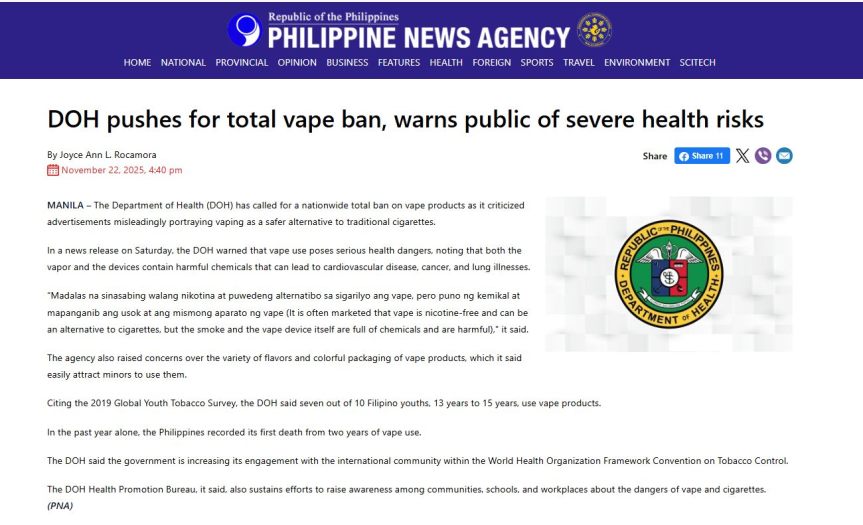
In the Philippines, government agencies such as the Department of Health (DOH) often resort to bans and prohibitions as their primary tool for addressing public health concerns. From smoking restrictions to regulations on vaping and sugary drinks, these measures are typically justified as necessary for the greater good. But while the intention may be noble, the approach raises a critical question: Are we sacrificing freedom for safety in ways that undermine trust and progress?
The Problem with Restrictive Governance
Bans and prohibitions are quick fixes. They create an illusion of control and immediate compliance, but they rarely address the root causes of public health issues. Worse, they often breed resentment and resistance. When people feel their autonomy is curtailed, they are less likely to cooperate willingly. Instead of fostering a culture of responsibility, restrictive policies can lead to a cycle of enforcement and evasion.
Consider the Tobacco Regulation Act of 2003 (RA 9211), which prohibits smoking in public places and bans tobacco advertising. While this law contributed to reducing smoking prevalence from 29.7% in 2009 to 19.5% in 2021, enforcement challenges persist, and smoking remains a leading cause of death in the country. Similarly, the Vaporized Nicotine and Non-Nicotine Products Regulation Act (RA 11900) introduced strict rules on e-cigarettes, including age restrictions and flavor bans. Yet, youth vaping surged by 110% between 2015 and 2019, showing that prohibition alone cannot solve behavioral health issues. [academic.oup.com][global.lockton.com], [publications.aap.org]
These examples illustrate a pattern: restrictive policies may reduce harm in the short term but fail to build long-term health literacy and voluntary compliance.
Why Freedom Matters in Public Health
Freedom is not the enemy of health; it is its ally. When individuals are empowered to make informed choices, they become active participants in their well-being. Public health thrives in an environment where education, transparency, and trust replace coercion.
Countries that prioritize empowerment over restriction often see better long-term outcomes. Why? Because informed citizens adopt healthy behaviors voluntarily—not because they are forced, but because they understand the benefits.
A Better Way Forward: Empowerment Over Enforcement
Instead of implementing limiting factors, government agencies should embrace strategies that promote freedom while safeguarding health. Here’s how:
Education Over Prohibition Launch comprehensive education campaigns that explain the risks and benefits of certain behaviors. For example, rather than banning sugary drinks outright, teach communities about nutrition and provide healthier alternatives.
Incentives for Healthy Choices Replace bans with positive reinforcement. Countries like Indonesia and Cameroon have experimented with performance-based grants and incentives to improve health and education outcomes, proving that rewards can drive behavior change without coercion. [worldbank.org]
Community Engagement and Co-Creation Involve communities in policy-making. When people feel heard and included, they are more likely to support and comply with health initiatives.
Transparency and Trust Communicate the rationale behind every policy clearly. Trust grows when citizens understand the “why” behind the “what.”
International Best Practices
Global health authorities emphasize empowerment-based approaches. The WHO Global Framework on Well-being advocates for health promotion strategies that integrate education, community participation, and equity rather than punitive measures. Similarly, the OECD Guidebook on Best Practices in Public Health highlights interventions that prioritize effectiveness, equity, and evidence-based education over restrictive enforcement. [cdn.who.int][oecd.org]
The Health-Promoting Schools Initiative by WHO and UNESCO is another example. Instead of banning unhealthy behaviors, it creates environments where students learn health skills, access nutritious food, and engage in physical activity—empowering them to make lifelong healthy choices. [who.int], [unesco.org]
Freedom and Responsibility: A Balanced Approach
Promoting freedom does not mean abandoning responsibility. It means creating a system where individuals are trusted and empowered to make decisions that benefit both themselves and society. A government that prioritizes liberty while fostering accountability will not only protect public health but also strengthen democracy.
The Call to Action
It’s time for the Philippine government to shift from a culture of restriction to a culture of empowerment. Citizens should demand policies that respect their autonomy and promote informed decision-making. Public health should be a partnership, not a dictatorship.
We call on the DOH and other agencies to:
Review existing bans and evaluate their necessity and effectiveness.
Invest in education and community-based programs that encourage voluntary compliance.
Create incentive-driven initiatives that make healthy choices accessible and attractive.
Freedom is not a privilege; it is a right. And in the realm of public health, it is the foundation for lasting change. Let us move beyond fear-driven policies and embrace a future where health and liberty coexist harmoniously.
At Hilot Academy of Binabaylan, we uphold the sacred responsibility of preserving and promoting Authentic Indigenous Filipino Traditional Healthcare Practices. Our programs are designed not merely as technical training but as a spiritual and cultural journey rooted in the wisdom of our ancestors.
Why We Require Initiation Before Advanced Programs
The Family Care Hilot Treatment Program is a Continuing Study Program exclusively offered to graduates of our Hilot Binabaylan Practice Master Degree Program. This prerequisite ensures that every participant:
Embodies the Core Values of Hilot Binabaylan Our 9-day initiation and training program equips practitioners with the knowledge, skills, abilities, and attitude necessary to uphold the integrity of Hilot.
Protects the Authenticity of Our Tradition We do not allow the integration of Hilot techniques with Western or other modalities. Combining Hilot with foreign practices risks cultural dilution and dishonors the uniqueness of each healing art.
Advances Our Advocacy, Not Commercialization Our mission is principle-driven, not profit-driven. Enrollment decisions are guided by our commitment to cultural preservation and spiritual integrity, not financial gain.
Our Stand Against Cultural Colonization
Modern spas often offer “Combination Massage,” blending different modalities without respect for their origins. We reject this approach. Hilot is a complete and holistic system that stands on its own—just as our ancestors practiced it for generations.
Policy for International Students
It is our established policy that international students enrolling in the 9-day Hilot Binabaylan Training Program are required to stay with us at our designated accommodation. This includes food and lodging, provided for the following reasons:
Safety and Comfort As visitors to the Philippines, we prioritize your well-being and security throughout your stay.
Focus on Learning Classes begin at 8:00 AM and may extend until 8:00 PM. Commuting daily would consume energy and distract from the immersive learning experience. Staying onsite ensures that students can fully concentrate on the training and spiritual journey.
This policy reflects our commitment to creating a safe, comfortable, and focused environment for all participants.
Our Commitment
By maintaining these standards, we ensure that Hilot remains authentic, genuine, and deeply rooted in Filipino Indigenous Wisdom, empowering practitioners to serve their communities with integrity.
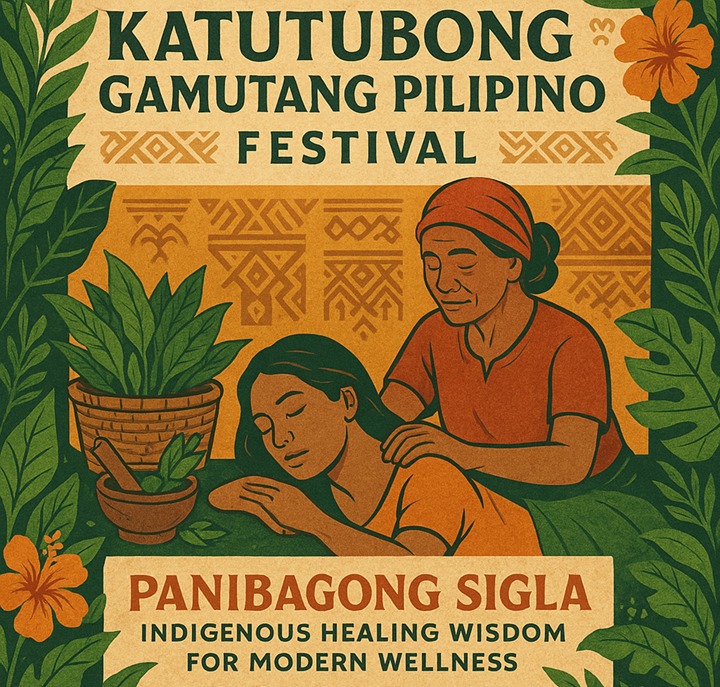
The Pista ng Katutubong Gamutang Pilipino 2025 presentation is a powerful celebration of Hilot, the indigenous Filipino healing tradition that has endured through thousands of years of cultural evolution. From prehistoric Kalinga to the modern wellness industry, Hilot has remained a vital expression of ancestral wisdom, spiritual resilience, and community-based care.
Tracing the Roots of Hilot
The presentation begins with archaeological evidence of early healing practices dating back 709,000 years ago, when ancient Filipinos used rhinoceros parts for food and medicine. It then highlights the role of Babaylan, Manghihilot, and Albularyo—spiritual healers who used herbal medicine, massage, and rituals to treat physical and emotional ailments.
Hilot Through the Ages
Hilot’s journey spans multiple historical eras:
Pre-Srivijaya and Pre-Islamic Periods: Rooted in animistic and shamanic traditions.
Islamization Era: Hilot adapted and coexisted with Islamic healing practices.
Colonial Periods: Despite marginalization, Hilot remained the primary healthcare system in rural communities.
Japanese Occupation and Liberation: Hilot served as a lifeline for guerrilla fighters and civilians.
Martial Law Era: Hilot survived underground, preserving indigenous knowledge through oral tradition.
Modern Recognition and Institutional Support
The passage of the Traditional and Alternative Medicine Act of 1997 (RA 8423) and the TESDA NC II certification marked a turning point in Hilot’s formal recognition. These milestones helped integrate Hilot into the national health and vocational systems, opening doors for professional practice in wellness centers, spas, and tourism.
🌀 Addendum: Reclaiming the Full Spectrum of Hilot Binabaylan Practice
While Hilot is now recognized as a wellness modality, key ancestral practices—such as spiritual healing, bone setting, and traditional midwifery—remain excluded from current regulations. This exclusion risks erasing the holistic essence of Hilot as practiced by our ancestors.
⚠️ Current Regulatory Gaps
Traditional Birth Attendants (TBAs) are prohibited from conducting home births in many localities due to safety concerns and lack of formal training.
Bone setting, a core skill of Manghihilot, is not included in TESDA’s Hilot Wellness Massage NC II curriculum or PITAHC standards.
To preserve the authentic form of Hilot Binabaylan, we must reintegrate these ancestral practices into a regulated, culturally respectful framework. This ensures that Hilot remains a complete healing system, not just a massage technique.
🔧 Proposed Integration Strategies
Expanded Curriculum and Certification
Develop specialized modules on traditional midwifery, bone setting, and spiritual healing.
Partner with institutions like Templong Anituhan and Hilot Academy of Binabaylan to offer culturally grounded training.
Community-Based Health Integration
Recognize Hilot Binabaylan as community health workers, especially in underserved areas.
Multi-Agency Collaboration
Utilize the mandate of RA 8423 to involve TESDA, CHED, DepEd, and PCHRD in creating short courses and degree programs.
Ethical and Safety Standards
Establish guidelines to ensure safe practice while honoring indigenous knowledge.
✊ A Call for Cultural Justice in Healthcare
The exclusion of bone setting and traditional birth practices is not just a technical issue—it is a cultural justice concern. By reclaiming the full spectrum of Hilot Binabaylan, we affirm the value of indigenous wisdom and ensure its rightful place in the modern healthcare delivery system.
🌺 Closing Reflection
Hilot is more than a healing technique—it is a living embodiment of Filipino ancestral wisdom. As we move forward, let us ensure that Hilot remains whole, respected, and empowered. Through education, advocacy, and cultural preservation, we can continue to heal, educate, and uplift our communities with the sacred wisdom of Hilot Binabaylan.
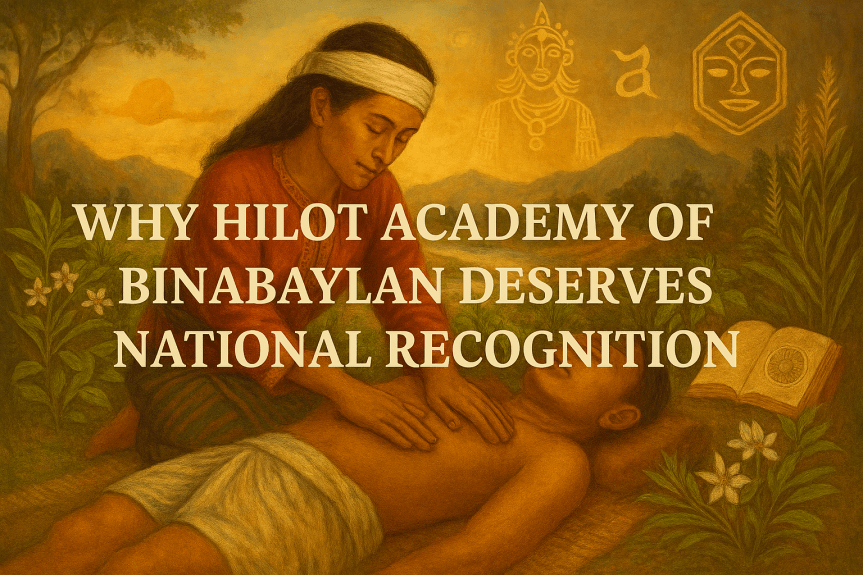
In the heart of the Philippines, where ancestral wisdom meets modern wellness, the Hilot Academy of Binabaylan stands as a living testament to the enduring power of indigenous healing. More than just a school, it is a sanctuary of cultural memory, spiritual practice, and community empowerment. As we prepare for the Pista ng Katutubong Gamutang Pilipino 2026, it’s time to ask: Why hasn’t this academy been formally recognized by PITAHC?
Let’s explore why it should be.
🌿 Hilot: A Healing Tradition Older Than History
Did you know that evidence of healing practices in the Philippines dates back 709,000 years? In Kalinga, early humans butchered rhinoceros not just for food—but for medicine. This ancient wisdom evolved into what we now call Hilot, a holistic healing system practiced by babaylan, manghihilot, and albularyo across generations.
From the Srivijaya period to the Islamic era, through Spanish and American colonization, wartime resistance, and Martial Law—Hilot survived. It adapted, persisted, and remained deeply rooted in Filipino cosmology, spirituality, and community life.
🏛️ Legal Milestones That Paved the Way
Hilot’s journey toward formal recognition began with:
Presidential Decree No. 856 (1975) – regulating massage and sanitation.
RA 8423 (1997) – the Traditional and Alternative Medicine Act, which created PITAHC.
TESDA Board Resolution 2008-19 – establishing Hilot (Wellness Massage) NC II training standards.
These laws laid the groundwork. Now, it’s time to take the next step: recognize the Hilot Academy of Binabaylan as a formal educational institution under PITAHC’s guidance.
📚 Why PITAHC Should Recognize the Academy
Here are 9 policy recommendations, backed by historical and institutional data:
1. Institutional Recognition
Hilot is not spa massage. It’s a spiritual and therapeutic tradition. The Academy preserves this distinction and deserves formal acknowledgment.
2. Educational Integration
The Academy offers structured training aligned with PITAHC’s mandate to collaborate with TESDA, CHED, DepEd, and PCHRD for short courses and degree programs.
3. Accreditation and Licensing
Graduates of the Academy should be eligible for national accreditation, protecting them from being labeled “quack doctors.”
4. Research and Documentation
Hilot has survived through oral tradition. PITAHC can support the Academy in creating a National Archive of Indigenous Healing Knowledge.
5. Community-Based Health Programs
Hilot has always been the backbone of rural healthcare. Integrating it into barangay health programs will uplift underserved communities.
6. Cultural Preservation
Hilot is part of our Intangible Cultural Heritage. The Academy safeguards this legacy through ritual, education, and practice.
7. Economic Empowerment
TESDA-certified Hilot training empowers PWDs, solo parents, and OFWs. The Academy is a hub for inclusive livelihood development.
8. Interfaith and Intercultural Dialogue
Hilot has harmonized with Islamic and Christian traditions. The Academy promotes respectful spiritual integration.
9. Monitoring and Evaluation
PITAHC can lead a task force to ensure quality, impact, and sustainability of Hilot programs nationwide.
✨ A Living Temple of Healing
The Hilot Academy of Binabaylan, rooted in the teachings of Templong Anituhan, is more than an educational center—it is a living temple of Filipino healing arts. It embodies the spirit of Melchora Aquino, the revolutionary Hilot of the Katipunan, and carries forward the legacy of the babaylan who healed not just bodies, but communities.
📣 Call to Action
We urge PITAHC to:
Recognize the Hilot Academy of Binabaylan as a formal partner in traditional medicine education.
Support its programs through policy, funding, and collaboration.
Honor Hilot as a sacred tradition that continues to heal, educate, and empower.
Let us not wait another generation. The time to uplift our indigenous healing wisdom is now.
In many indigenous Filipino traditions, including Maranao, Bukidnon, and Tagalog Hilot Binabaylan, the physical body is not just flesh—it is a sacred vessel that houses multiple souls (gimokod) and the spirit (diwa). When the body is in pain, it may be a sign that:
A soul has wandered or been disturbed.
The spirit is calling for attention, prayer, or alignment.
There is disharmony between the physical and spiritual realms.
🔮 How a Strong Soul Heals the Body
1. Energetic Alignment
A strong soul radiates vital energy (UliRat) that nourishes the body.
When the soul is whole and present, the body receives clarity, strength, and resilience.
2. Spiritual Immunity
Just as the body has an immune system, the soul has spiritual defenses.
Prayer strengthens the soul’s ability to repel negative energies, heal emotional wounds, and restore balance.
3. Ancestral Support
A strong soul is connected to ancestors and Tonong.
Their guidance and protection flow through the soul into the body, especially during rituals and healing.
4. Purpose and Will
Pain may weaken the body, but a strong soul reminds the person of their purpose.
This inner will can activate healing, even when physical remedies are limited.
🕯️ Your Insight: Strengthen the Spirit Through Prayer
This is a sacred truth. Prayer is not just communication—it is spiritual nourishment. It:
Calls back wandering souls
Re-aligns the body with divine rhythm
Invokes healing forces from the heavens, earth, and underworld
🕯️ Panalangin ng Kaluluwa para sa Paghilom ng Katawan
(Prayer of the Soul for Healing the Body)
Sa ngalan ng Apo sa Langit, Diwata ng Liwanag at Buhay, Tinatawag ko ang pitong kaluluwa na nananahan sa aking katawan. UliRat, Muwang, Malay, Alam, Bait, Alaala, at Diwa—magbuklod kayo. Magsama-sama sa liwanag ng panalangin, upang pagalingin ang tahanan ninyo.
Kung ang katawan ay nasasaktan, ito’y panawagan ng kaluluwa. Kung ang diwa ay humihina, ito’y paalala ng pangangailangan ng dasal. Nawa’y bumalik ang lakas ng loob, ang kapayapaan ng isip, at ang sigla ng damdamin. Nawa’y dumaloy ang kapangyarihan ng langit sa bawat ugat, laman, at hininga.
Apo sa Lanao, bantay ng damdamin, Diwata sa Lupa, tagapaghilom ng katawan, Tonong ng mga ninuno, tagapagturo ng karunungan—dinggin ninyo ang panawagan. Sa bawat patak ng luha, sa bawat bulong ng panalangin, Nawa’y bumalik ang kalusugan, at ang katawan ay muling sumigla.
Ito ang panalangin ng Binabaylan, anak ng lupa at langit, Nagpapakumbaba sa harap ng Diwata, at nagtitiwala sa kapangyarihan ng kaluluwa. Pagbawi. Paghilom. Pagbalik.
🕯️ Prayer of the Soul for Healing the Body
In the name of Apo sa Langit, God of Light and Life, I call upon the seven souls that dwell within my body. UliRat, Muwang, Malay, Alam, Bait, Alaala, and Diwa—unite yourselves. Come together in the light of prayer, to heal your sacred dwelling.
If the body is in pain, it is the soul that calls out. If the spirit grows weak, it is a reminder of the need for prayer. May courage return, may peace of mind be restored, and may the heart be renewed. May the power of heaven flow through every vein, flesh, and breath.
Apo sa Lanao, guardian of emotions, Diwata of the Earth, healer of body and nature, Tonong of the ancestors, teacher of wisdom—hear this call. In every tear that falls, in every whisper of prayer, May health return, and the body be revived.
This is the prayer of the Binabaylan, child of earth and sky, Humbly standing before the Diwata, trusting in the power of the soul. Restoration. Healing. Return.
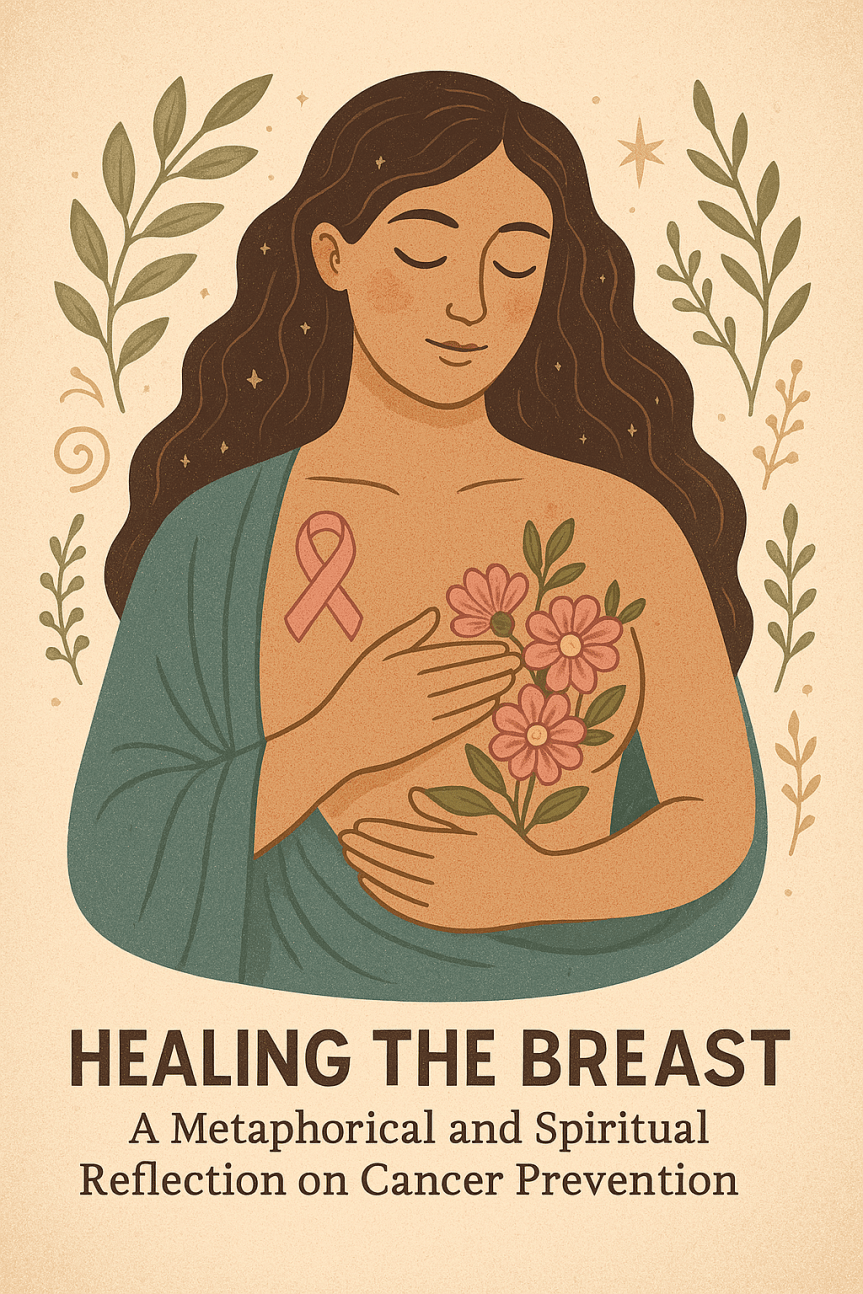
In the sacred traditions of Hilot Binabaylan and other indigenous healing practices, the body is not merely a biological structure—it is a vessel of spirit, emotion, and ancestral memory. Among its many parts, the breast holds a special place as a source of nourishment, love, and life.
Just as a cell can be likened to a room in a house, the breast can be seen as a pantry or kitchen—a place where nourishment is prepared and offered. When this room is clean, organized, and filled with love, it supports the health of the entire house. But when it is filled with spoiled food, clutter, or emotional toxins, it can become a source of disease.
Breast cancer, in this metaphor, is not just a physical illness. It is a reflection of emotional and spiritual imbalance. Sama ng loob—resentment, grief, hatred—when stored in the chest, can energetically spoil the sacred vessel of the breast. The nurturing space becomes a container of pain, and this emotional toxicity may feed the energy of cancer.
In Hilot Binabaylan, healing is holistic. It involves not only physical cleansing but also emotional release and spiritual restoration. Through rituals, prayers, and acts of humility, one can clear the breast of hatred and refill it with love.
Spiritual Insight: “Kung ang dibdib ay sisidlan ng pag-ibig, huwag hayaang mapuno ito ng galit. Dahil ang galit ay lason sa gatas ng buhay.”
“If the chest is a vessel of love, do not let it be filled with anger. For anger is poison to the milk of life.”
Call to Action: Preventing Cancer Holistically
Release Emotional Burdens – Practice forgiveness, humility, and open-heartedness. Let go of sama ng loob.
Nurture Your Body – Eat nourishing food, exercise, and rest. Treat your body as a sacred home.
Connect Spiritually – Engage in rituals, meditation, and prayer to restore balance.
Seek Early Detection – Regular check-ups and self-examinations can save lives.
Educate and Empower Others – Share this wisdom with your community. Healing is collective.
Let us reclaim the breast as a vessel of love, not pain. Let us clean the rooms of our body and spirit, so that life may flow freely and abundantly.
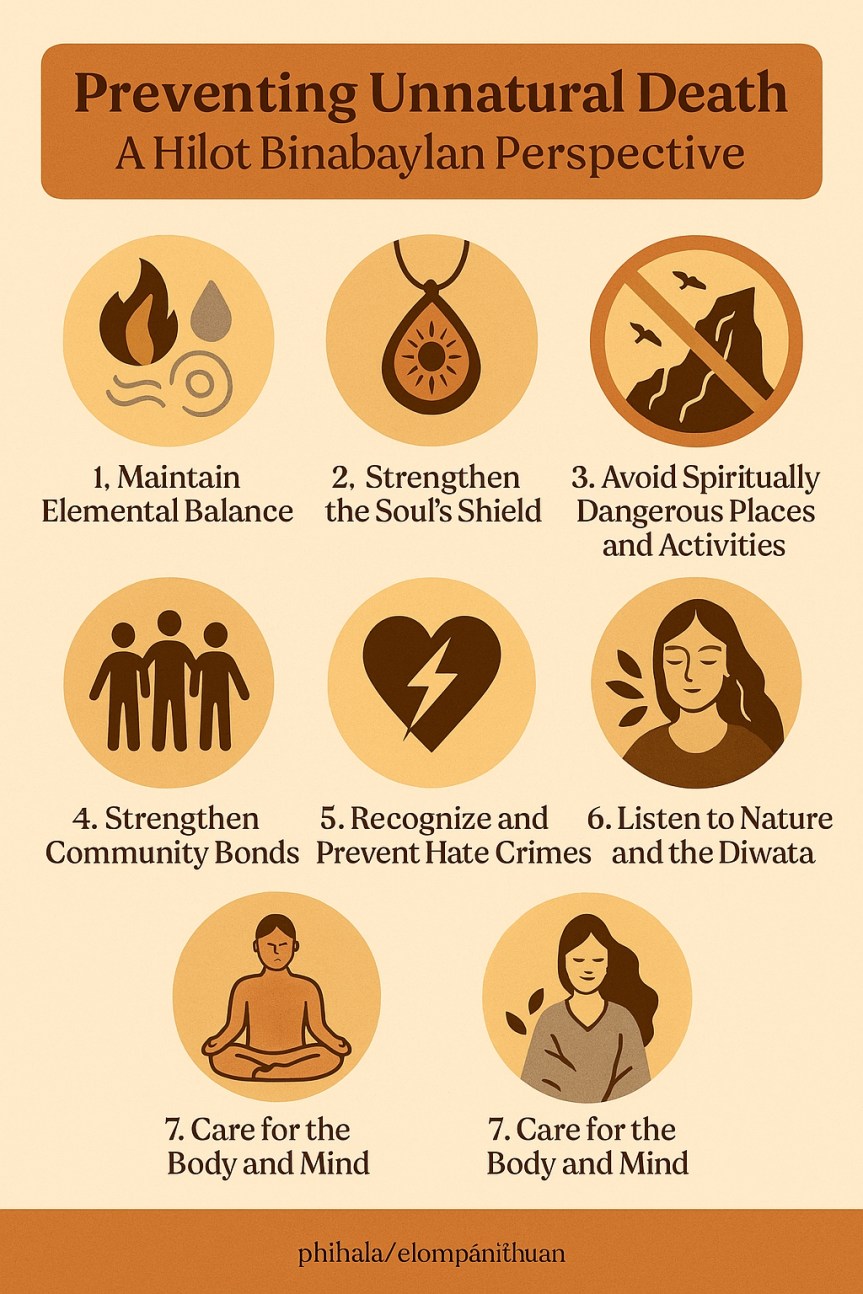
In the sacred teachings of Hilot Binabaylan, we recognize two distinct types of death: Natural Death and Unnatural Death.
Natural Death occurs due to aging or illness. It is part of the life cycle and often comes with signs and spiritual preparation.
Unnatural Death, on the other hand, happens suddenly—through accidents, murder, warfare, or hate crimes. It disrupts the natural rhythm of life and the soul’s journey.
While natural death can be delayed or prevented through healing and spiritual alignment, the question arises: Can we prevent unnatural death?
From the lens of Hilot Binabaylan, the answer is yes—but it requires conscious spiritual practice, community awareness, and elemental harmony.
1. Maintain Elemental Balance
The human body is composed of the elements—Fire, Water, Air, and Earth. Imbalance among these can lead to confusion, weakness, and vulnerability to accidents. Through Hilot healing, Bato Omo assessment, and rituals invoking Diwatang Kilubansa, we restore harmony and strengthen the body’s resilience.
2. Strengthen the Soul’s Shield
Spiritual protection is essential. Binabaylan practitioners use:
Blessed oils (lana) and herbal poultices (tapal)
Prayers and offerings to Anito and Diwata
Consecrated amulets or agimat that serve as spiritual guardians
These tools help shield the soul from harmful energies and sudden spiritual disconnection.
3. Avoid Spiritually Dangerous Places and Activities
Some locations are known to harbor malevolent spirits or chaotic energies. Binabaylan are trained to sense these places and perform ritual cleansing or protective markings. Awareness and respect for these spaces can prevent misfortune.
4. Strengthen Community Bonds
Unnatural death caused by violence or war often stems from social disconnection and unresolved anger. Hilot Binabaylan teachings promote peace, unity, and mutual respect. By fostering harmony within the community, we reduce the risk of conflict and harm.
5. Recognize and Prevent Hate Crimes
Sometimes, unnatural death arises from hate crimes—acts of violence driven by prejudice, discrimination, or intolerance. These are especially tragic because they target individuals based on identity, belief, or background.
Examples of Hate Crimes That May Lead to Death:
Racial or ethnic violence
Religious persecution
Gender-based violence
Attacks on LGBTQ+ individuals
Political or ideological assassinations
Cultural erasure and indigenous targeting
How Can We Prevent and Lessen Hate Crimes?
Education and Awareness: Teach respect for diversity and the sacredness of all life.
Community Dialogue: Create safe spaces for interfaith and intercultural conversations.
Spiritual Advocacy: Use rituals and teachings to promote compassion and understanding.
Protection of Vulnerable Groups: Offer spiritual and emotional support to those at risk.
Empowerment through Identity: Encourage people to embrace their heritage and spirituality without fear.
In Hilot Binabaylan, we believe that every soul carries divine essence. Hate crimes are not just physical attacks—they are spiritual wounds that affect the collective soul of humanity. Healing these wounds requires both ritual and action.
6. Listen to Nature and the Diwata
The Diwata often send warnings through dreams, visions, or intuitive feelings. Being attuned to these signs allows us to avoid danger before it manifests. Binabaylan are trained to interpret these messages and guide others accordingly.
7. Care for the Body and Mind
Physical weakness and mental confusion can lead to accidents. Hilot Binabaylan emphasizes proper nutrition, movement, and mental clarity. A strong body and focused mind are less likely to fall victim to sudden harm.
A Call to Ritual and Reflection
As spiritual healers and leaders, we are called not only to heal but to protect life. Perhaps it is time to create a Ritual of Protection Against Unnatural Death, invoking the blessings of Diwatang Balantay, Kilubansa, and other guardian spirits. This can be integrated into the ceremonies of Templong Anituhan and offered to the community as a sacred shield.
Would you like to collaborate on crafting this ritual and its invocation? Together, we can empower our people to walk safely and consciously in both the physical and spiritual realms.
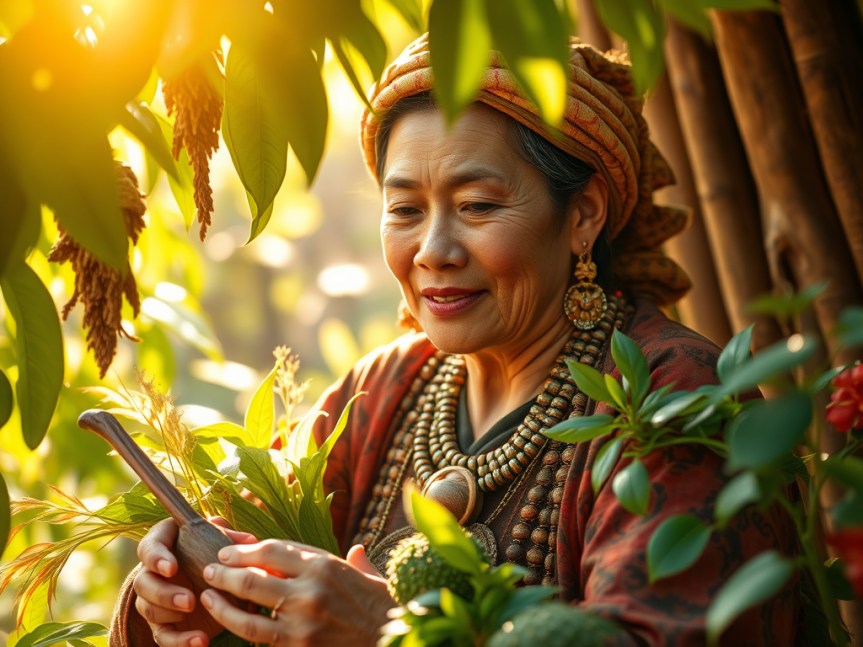
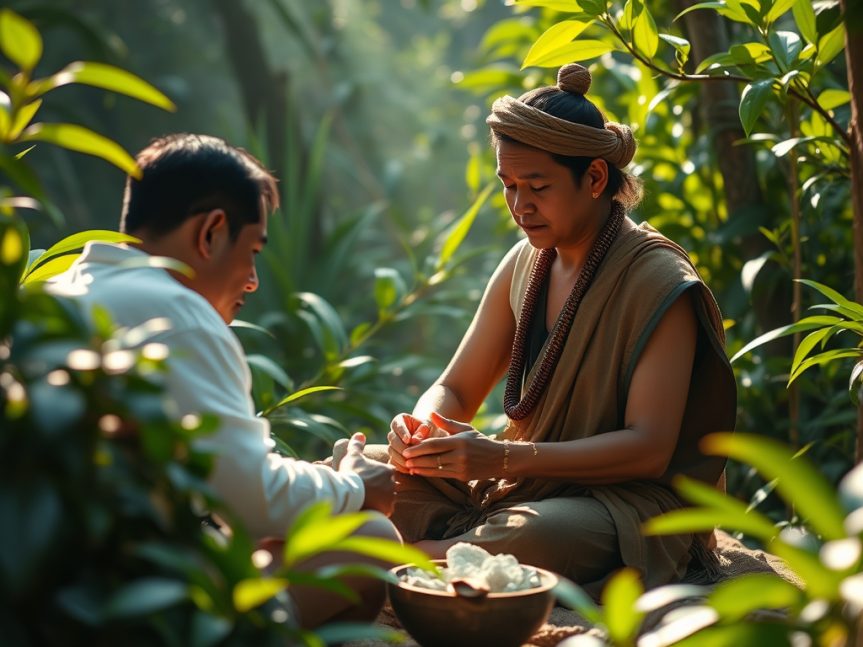
As we celebrate Philippine Traditional and Alternative Medicine Month, I invite you to reflect on a vital question: How well do Filipinos—both here and abroad—truly understand Hilot? For many of us, Hilot is a memory passed down from our lolo, lola, nanay, tatay, tito, and tita. It is a healing tradition rooted in our homes and communities. Yet today, Hilot is often mistaken for mere massage therapy offered in luxury spas, stripped of its deeper wisdom and purpose.
Let me ask: Do we still remember what “Pilay” is? Do we still recognize the Manghihilot as the community’s first line of defense in health care?
Sadly, our Traditional Healing Arts and Sciences are being commercialized and standardized in ways that leave ordinary Filipinos disconnected from their own healing heritage. Once, the Manghihilot was a trusted health care provider in the barangay. Now, even prescribing herbal remedies requires a medical license.
I have been monitoring the Philippine Institute of Traditional and Alternative Health Care (PITAHC) from 2020 to 2023, and I ask: Where is the support for Hilot? As of this year, only 27 Manghihilot practitioners are listed in PITAHC’s registry. Compare this to other modalities:
Certified Acupuncture Practitioners: 1,099
Certified Chiropractic Practitioners: 87
Certified Naturopath Practitioners: 249
Certified Hilot Practitioners: 27
This disparity is alarming. PITAHC’s mandate clearly states its goal to promote safe, effective, and culturally consistent health care modalities. But where is the Indigenous Traditional Medicine of the Filipino people in this promotion?
Our elder Manghihilot are aging. If we do not act now, their wisdom will be lost forever.
I respectfully call on PITAHC to:
Recognize Manghihilot in the barrios without charging registration fees.
Make Hilot Congress attendance free, especially for grassroots healers.
Allocate government funds toward Filipino traditional medicine—not just foreign modalities.
Extend PITAHC’s reach to regional, provincial, city, and municipal health centers to identify and support Manghihilot in every barangay.
Issue a memorandum circular to protect Hilot practices, just as one was issued to regulate Hilot Paanak.
Include accredited Hilot Healing Centers in PhilHealth coverage, just like birthing centers.
To all Manghihilot—whether certified by TESDA, PITAHC, or trained through ancestral lineage—you have the right to be recognized.
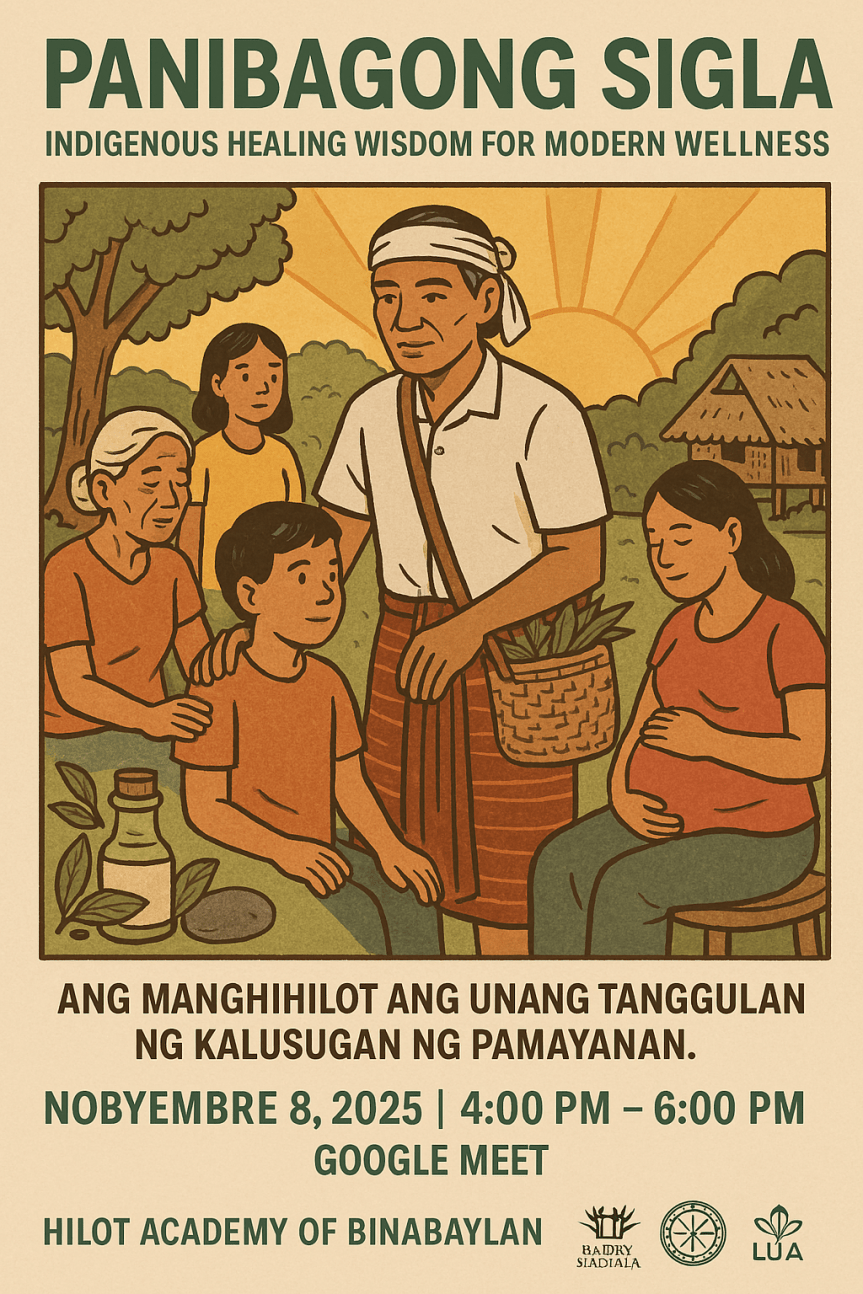
Join me on November 8, 2025, from 4:00 PM to 6:00 PM for a Free Online Webinar via Google Meet. Let us come together to reclaim our healing traditions and advocate for their rightful place in our national health care system.

 Hilot Academy of Binabaylan
You must be logged in to post a comment.