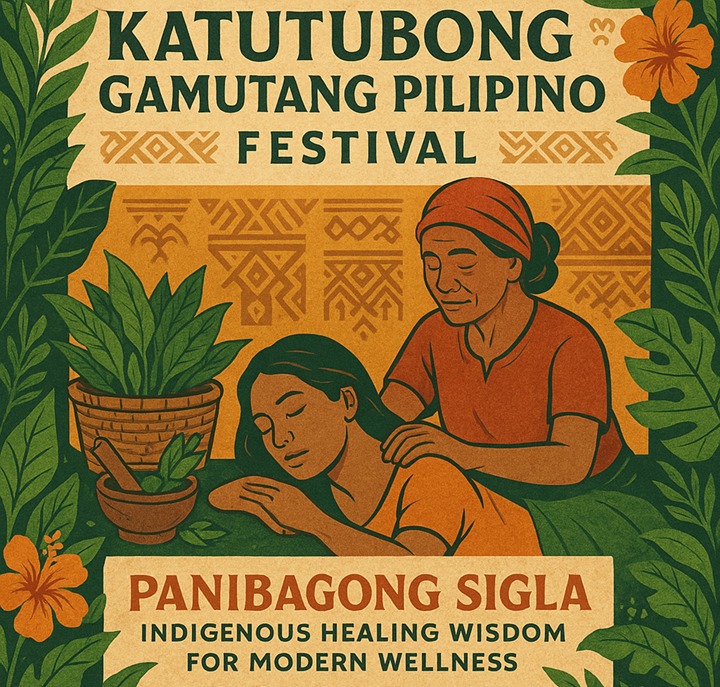
The Pista ng Katutubong Gamutang Pilipino 2025 presentation is a powerful celebration of Hilot, the indigenous Filipino healing tradition that has endured through thousands of years of cultural evolution. From prehistoric Kalinga to the modern wellness industry, Hilot has remained a vital expression of ancestral wisdom, spiritual resilience, and community-based care.
Tracing the Roots of Hilot
The presentation begins with archaeological evidence of early healing practices dating back 709,000 years ago, when ancient Filipinos used rhinoceros parts for food and medicine. It then highlights the role of Babaylan, Manghihilot, and Albularyo—spiritual healers who used herbal medicine, massage, and rituals to treat physical and emotional ailments.
Hilot Through the Ages
Hilot’s journey spans multiple historical eras:
Pre-Srivijaya and Pre-Islamic Periods: Rooted in animistic and shamanic traditions.
Islamization Era: Hilot adapted and coexisted with Islamic healing practices.
Colonial Periods: Despite marginalization, Hilot remained the primary healthcare system in rural communities.
Japanese Occupation and Liberation: Hilot served as a lifeline for guerrilla fighters and civilians.
Martial Law Era: Hilot survived underground, preserving indigenous knowledge through oral tradition.
Modern Recognition and Institutional Support
The passage of the Traditional and Alternative Medicine Act of 1997 (RA 8423) and the TESDA NC II certification marked a turning point in Hilot’s formal recognition. These milestones helped integrate Hilot into the national health and vocational systems, opening doors for professional practice in wellness centers, spas, and tourism.
🌀 Addendum: Reclaiming the Full Spectrum of Hilot Binabaylan Practice
While Hilot is now recognized as a wellness modality, key ancestral practices—such as spiritual healing, bone setting, and traditional midwifery—remain excluded from current regulations. This exclusion risks erasing the holistic essence of Hilot as practiced by our ancestors.
⚠️ Current Regulatory Gaps
Traditional Birth Attendants (TBAs) are prohibited from conducting home births in many localities due to safety concerns and lack of formal training.
Bone setting, a core skill of Manghihilot, is not included in TESDA’s Hilot Wellness Massage NC II curriculum or PITAHC standards.
To preserve the authentic form of Hilot Binabaylan, we must reintegrate these ancestral practices into a regulated, culturally respectful framework. This ensures that Hilot remains a complete healing system, not just a massage technique.
🔧 Proposed Integration Strategies
Expanded Curriculum and Certification
Develop specialized modules on traditional midwifery, bone setting, and spiritual healing.
Partner with institutions like Templong Anituhan and Hilot Academy of Binabaylan to offer culturally grounded training.
Community-Based Health Integration
Recognize Hilot Binabaylan as community health workers, especially in underserved areas.
Multi-Agency Collaboration
Utilize the mandate of RA 8423 to involve TESDA, CHED, DepEd, and PCHRD in creating short courses and degree programs.
Ethical and Safety Standards
Establish guidelines to ensure safe practice while honoring indigenous knowledge.
✊ A Call for Cultural Justice in Healthcare
The exclusion of bone setting and traditional birth practices is not just a technical issue—it is a cultural justice concern. By reclaiming the full spectrum of Hilot Binabaylan, we affirm the value of indigenous wisdom and ensure its rightful place in the modern healthcare delivery system.
🌺 Closing Reflection
Hilot is more than a healing technique—it is a living embodiment of Filipino ancestral wisdom. As we move forward, let us ensure that Hilot remains whole, respected, and empowered. Through education, advocacy, and cultural preservation, we can continue to heal, educate, and uplift our communities with the sacred wisdom of Hilot Binabaylan.
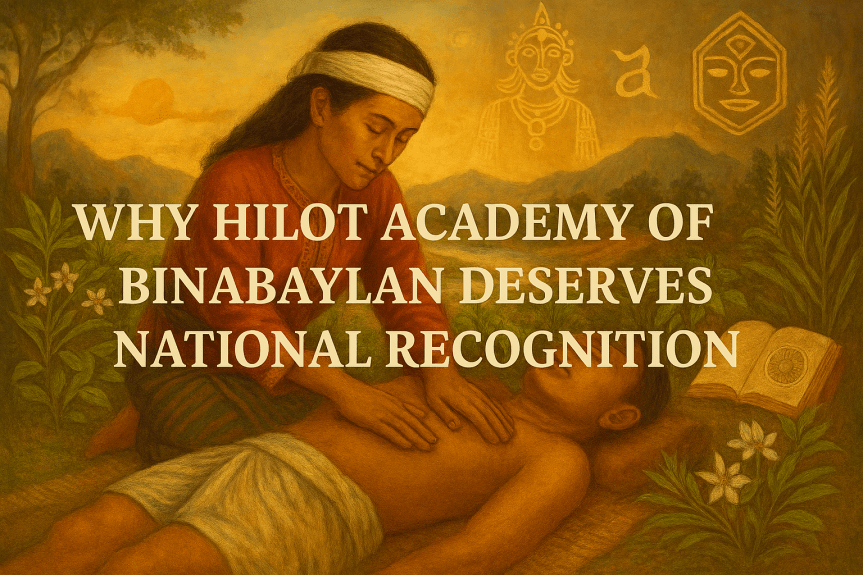
In the heart of the Philippines, where ancestral wisdom meets modern wellness, the Hilot Academy of Binabaylan stands as a living testament to the enduring power of indigenous healing. More than just a school, it is a sanctuary of cultural memory, spiritual practice, and community empowerment. As we prepare for the Pista ng Katutubong Gamutang Pilipino 2026, it’s time to ask: Why hasn’t this academy been formally recognized by PITAHC?
Let’s explore why it should be.
🌿 Hilot: A Healing Tradition Older Than History
Did you know that evidence of healing practices in the Philippines dates back 709,000 years? In Kalinga, early humans butchered rhinoceros not just for food—but for medicine. This ancient wisdom evolved into what we now call Hilot, a holistic healing system practiced by babaylan, manghihilot, and albularyo across generations.
From the Srivijaya period to the Islamic era, through Spanish and American colonization, wartime resistance, and Martial Law—Hilot survived. It adapted, persisted, and remained deeply rooted in Filipino cosmology, spirituality, and community life.
🏛️ Legal Milestones That Paved the Way
Hilot’s journey toward formal recognition began with:
Presidential Decree No. 856 (1975) – regulating massage and sanitation.
RA 8423 (1997) – the Traditional and Alternative Medicine Act, which created PITAHC.
TESDA Board Resolution 2008-19 – establishing Hilot (Wellness Massage) NC II training standards.
These laws laid the groundwork. Now, it’s time to take the next step: recognize the Hilot Academy of Binabaylan as a formal educational institution under PITAHC’s guidance.
📚 Why PITAHC Should Recognize the Academy
Here are 9 policy recommendations, backed by historical and institutional data:
1. Institutional Recognition
Hilot is not spa massage. It’s a spiritual and therapeutic tradition. The Academy preserves this distinction and deserves formal acknowledgment.
2. Educational Integration
The Academy offers structured training aligned with PITAHC’s mandate to collaborate with TESDA, CHED, DepEd, and PCHRD for short courses and degree programs.
3. Accreditation and Licensing
Graduates of the Academy should be eligible for national accreditation, protecting them from being labeled “quack doctors.”
4. Research and Documentation
Hilot has survived through oral tradition. PITAHC can support the Academy in creating a National Archive of Indigenous Healing Knowledge.
5. Community-Based Health Programs
Hilot has always been the backbone of rural healthcare. Integrating it into barangay health programs will uplift underserved communities.
6. Cultural Preservation
Hilot is part of our Intangible Cultural Heritage. The Academy safeguards this legacy through ritual, education, and practice.
7. Economic Empowerment
TESDA-certified Hilot training empowers PWDs, solo parents, and OFWs. The Academy is a hub for inclusive livelihood development.
8. Interfaith and Intercultural Dialogue
Hilot has harmonized with Islamic and Christian traditions. The Academy promotes respectful spiritual integration.
9. Monitoring and Evaluation
PITAHC can lead a task force to ensure quality, impact, and sustainability of Hilot programs nationwide.
✨ A Living Temple of Healing
The Hilot Academy of Binabaylan, rooted in the teachings of Templong Anituhan, is more than an educational center—it is a living temple of Filipino healing arts. It embodies the spirit of Melchora Aquino, the revolutionary Hilot of the Katipunan, and carries forward the legacy of the babaylan who healed not just bodies, but communities.
📣 Call to Action
We urge PITAHC to:
Recognize the Hilot Academy of Binabaylan as a formal partner in traditional medicine education.
Support its programs through policy, funding, and collaboration.
Honor Hilot as a sacred tradition that continues to heal, educate, and empower.
Let us not wait another generation. The time to uplift our indigenous healing wisdom is now.
In 2016, the Hilot Academy of Binabaylan was born with a vision to preserve and elevate the ancient healing arts and spirituality of the Filipino people. Though originally envisioned as Hilot Academy of Binabaylan International, the name was refined to HABI—a powerful acronym that not only stands for Hilot, Academy, and Binabaylan, but also evokes the Filipino word habi, meaning “to weave.”
This weaving is not merely symbolic. It reflects the Academy’s mission to interlace the physical, emotional, mental, social, and spiritual fabrics of life into a holistic tapestry of wellness. Through its teachings, HABI has become a loom where ancient wisdom and modern practice converge, creating a healing tradition that transcends borders.
From Local Roots to Global Reach
Despite initial limitations in naming, HABI has organically grown into an international movement. Since its founding, over 80 ordained and certified Hilot Binabaylan Practitioners have emerged across the globe—from the United States, Canada, Chile, Italy, France, London, Austria, Vietnam, Japan, and Australia, to its sacred homeland, the Philippines.
These practitioners began their journey seeking knowledge of Filipino healing arts. Yet, through their studies, they unearthed a deeper connection to precolonial Filipino spirituality—a sacred path that predates the Abrahamic religions of Islam and Christianity. In doing so, they became not just healers, but weavers of ancestral memory, restoring threads of indigenous wisdom long buried under colonial narratives.
Healing Beyond the Physical
At the heart of HABI’s philosophy is the understanding that true healing begins with the soul. The Academy teaches that health, illness, and wellness are not isolated phenomena within the body—they are reflections of our relationships, our environment, and our connection to the divine.
Through the lens of Kapwa, the Filipino concept of shared identity and interconnectedness, HABI practitioners recognize that healing must extend beyond the individual. It must encompass the community, the land, and the unseen energies that flow through all things.
Thus, the practice of Hilot Binabaylan includes:
– Rituals and offerings (atang) to harmonize spiritual energies – Prayer in motion, where movement becomes medicine – Sacred foods and drinks that nourish both body and spirit – Environmental energy weaving, ensuring balance and clarity in the spaces we inhabit
These methodologies are not mere supplements—they are central to the healing process. They restore the flow of life force (hininga), clear disruptions, and prevent illness from taking root.
The Loom of the Future
As HABI continues to grow, it stands as a testament to the resilience and relevance of Filipino indigenous knowledge. It is a loom of transformation, where healers become leaders, and tradition becomes a living force for global wellness.
Through its graduates and teachings, HABI is not just reviving a practice—it is weaving a new world, one where healing is sacred, interconnected, and deeply rooted in the soul of the Filipino people.
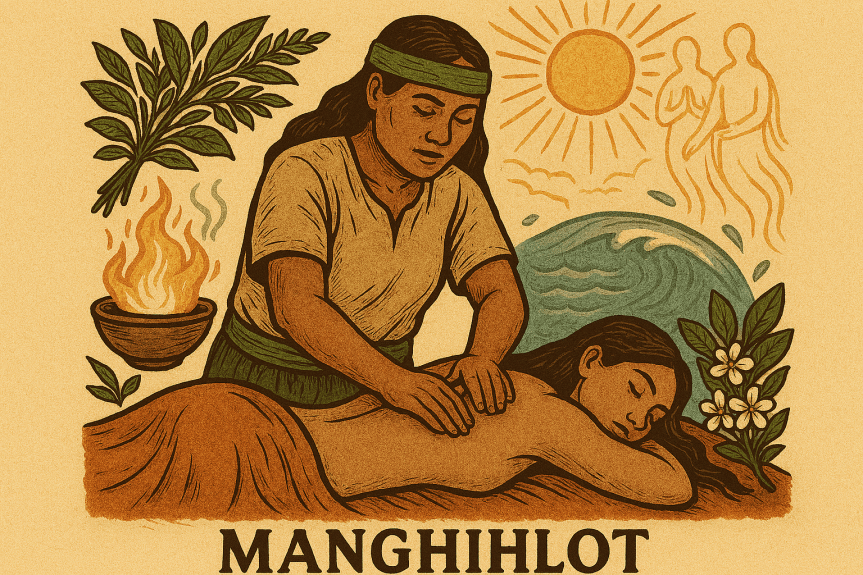
As a Manghihilot, my work goes beyond simple massage. I practice bodywork manipulation by applying herbal healing oils to areas where my patient feels discomfort. But my role does not end there. When a patient suspects that their illness is caused by unseen forces or spiritual harm, I perform Tawas—a traditional spiritual diagnostic method.
For us Filipinos, this has always been the way of the Manghihilot in rural communities. We believe that sickness can come from two sources: physical illness and spiritual imbalance. Our mission is to restore harmony and well-being. If physical manipulation does not bring relief, we call upon the forces of nature—herbs, heat, light, prayer, and water—to aid in healing.
Traditionally, these services are offered on a donation basis. There is no fixed income for a Manghihilot. This is why many of us in rural areas take on other jobs—farming, fishing, laundry work—to sustain our families. Hilot is often a calling, not a primary source of livelihood.
The Modern Challenge: Regulation and Certification
Today, the practice of Hilot is regulated and standardized by PITAHC and TESDA. To legally practice, one must obtain national certification and register as a Manghihilot. This requires schooling, which costs around ₱5,000, plus ₱1,500 for certification and another ₱1,500 for registration.
Despite these expenses, most certified Manghihilot end up working in spas on a commission basis, earning just enough to get by—often not enough to cover daily living costs. Many fall into financial debt, even after investing in their training.
The Need for Higher Education
To improve the livelihood of Manghihilot, we may need to introduce a formal four-year degree program. This would allow practitioners to climb the salary grade ladder and qualify for employment in community health centers, public hospitals, or private health facilities.
Graduates should be equipped with knowledge, skills, and abilities in Traditional Health Care, making them fit for roles such as Traditional Public Health Specialists. This is the future we envision for Hilot.
Republic Act 8371 (Indigenous Peoples’ Rights Act)
Republic Act 8423 (Traditional and Alternative Medicine Act)
Republic Act 100 (related provisions on health and indigenous practices)
These laws affirm that our work as Hilot Binabaylan practitioners is recognized and safeguarded. We should not fear performing our duties. Instead, we should embrace the bright future that lies ahead for Hilot.
Final Thoughts
Hilot is more than a profession—it is a heritage and a calling. As we move forward, let us continue to honor our traditions while adapting to modern standards. Together, we can ensure that Hilot remains a vital part of Filipino health and wellness.
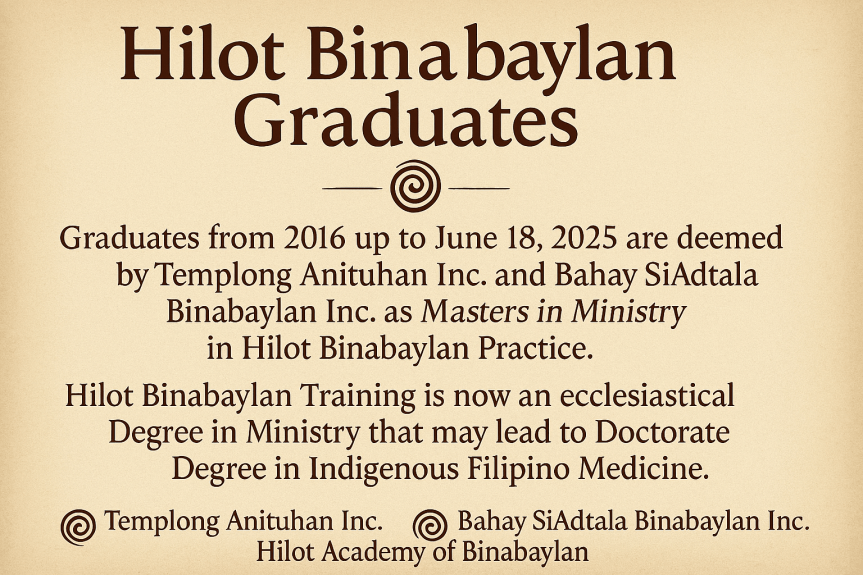
This day od 8th of August 2025- We joyfully proclaim that all graduates of the Hilot Binabaylan Training Program from 2016 up to June 18, 2025 are hereby recognized and conferred the title of Master of Ministry in Hilot Binabaylan Practice.
As a mark of this sacred recognition, graduates may now use the honorific suffix “M.Min.HBp”, signifying their credential as Master of Ministry in Hilot Binabaylan Practice.
This recognition is a testament to their dedication, spiritual growth, and mastery of Indigenous Filipino Healing Wisdom as taught through the sacred traditions of Luntiang Aghama and the ministerial guidance of Templong Anituhan.
Furthermore, we are honored to announce that the Hilot Binabaylan Training Program is now officially elevated to an Ecclesiastical Degree in Ministry, forming a foundational path that may lead to the Doctorate Degree in Indigenous Filipino Medicine.
This milestone affirms our commitment to preserving, honoring, and advancing the sacred healing arts of our ancestors, and to empowering future generations of Binabaylan Ministers to serve with wisdom, compassion, and divine purpose.
May this recognition inspire deeper service, healing, and spiritual leadership in our communities.
In the Spirit the Diwata, Engkanto Anito together with our Holy Ancestors, we celebrate this sacred elevation.
🌀 Templong Anituhan Inc. 🌀 Bahay SiAdtala Binabaylan Inc. 🌀 Hilot Academy of Binabaylan
🌀 Joint Ecclesiastical Resolution No. 08-08-2025
Templong Anituhan Inc. & Bahay SiAdtala Binabaylan Inc.
Subject:Recognition of Hilot Binabaylan Graduates (2016–2025) as Masters in Ministry and Elevation of Training Program to Ecclesiastical Degree Status
WHEREAS, the sacred teachings and practices of Hilot Binabaylan have been faithfully transmitted through the ministerial efforts of Bahay SiAdtala Binabaylan Inc. under the spiritual guidance of Templong Anituhan Inc.;
WHEREAS, the graduates of the Hilot Binabaylan Training Program from the year 2016 up to June 18, 2025 have demonstrated mastery in Indigenous Filipino Healing Wisdom and Spiritual Ministry;
WHEREAS, it is the divine will of the Diwata and the ancestral spirits that those who walk the path of healing and service be duly recognized and empowered;
NOW THEREFORE, be it resolved jointly by Templong Anituhan Inc. and Bahay SiAdtala Binabaylan Inc., that:
All graduates of the Hilot Binabaylan Training Program from 2016 to June 18, 2025 are hereby recognized and conferred the ecclesiastical title of Master of Ministry in Hilot Binabaylan Practice.
Said graduates may now officially use the suffix “M.Min.HBp” to signify their credential and spiritual authority in the practice of Hilot Binabaylan Ministry.
Effective January 2026, all individuals seeking enrollment in the Hilot Binabaylan Training Program must submit verifiable credentials proving:
A healthcare-related educational background, and/or
Completion of the Ecclesiastical Bachelor’s Degree in Aghamic Divinity and Ministry.
This resolution affirms the elevation of the Hilot Binabaylan Training Program to an Ecclesiastical Degree in Ministry, forming a pathway toward the Doctorate Degree in Indigenous Filipino Medicine.
RESOLVED FURTHER, that this resolution be made known to all affiliated ministers, clergy, and educational institutions under the spiritual jurisdiction of Templong Anituhan Inc. and Bahay SiAdtala Binabaylan Inc.
Signed this 8th day of August, 2025 In the Spirit of the Diwata, Engkanto and Anito
Signed:
Rev. Alvin L. Sentin D.D.Min IFS IFM aka Lakay Magbaya
Director on Local Community Affairs Relations
Rev. Rolando G. Comon D.D.Min. IFS IFM aka APU ADMAN
Founder/Program Director
Rev. Maria M. Haswell D.D.Min IFS IFM aka BAE AKUMA
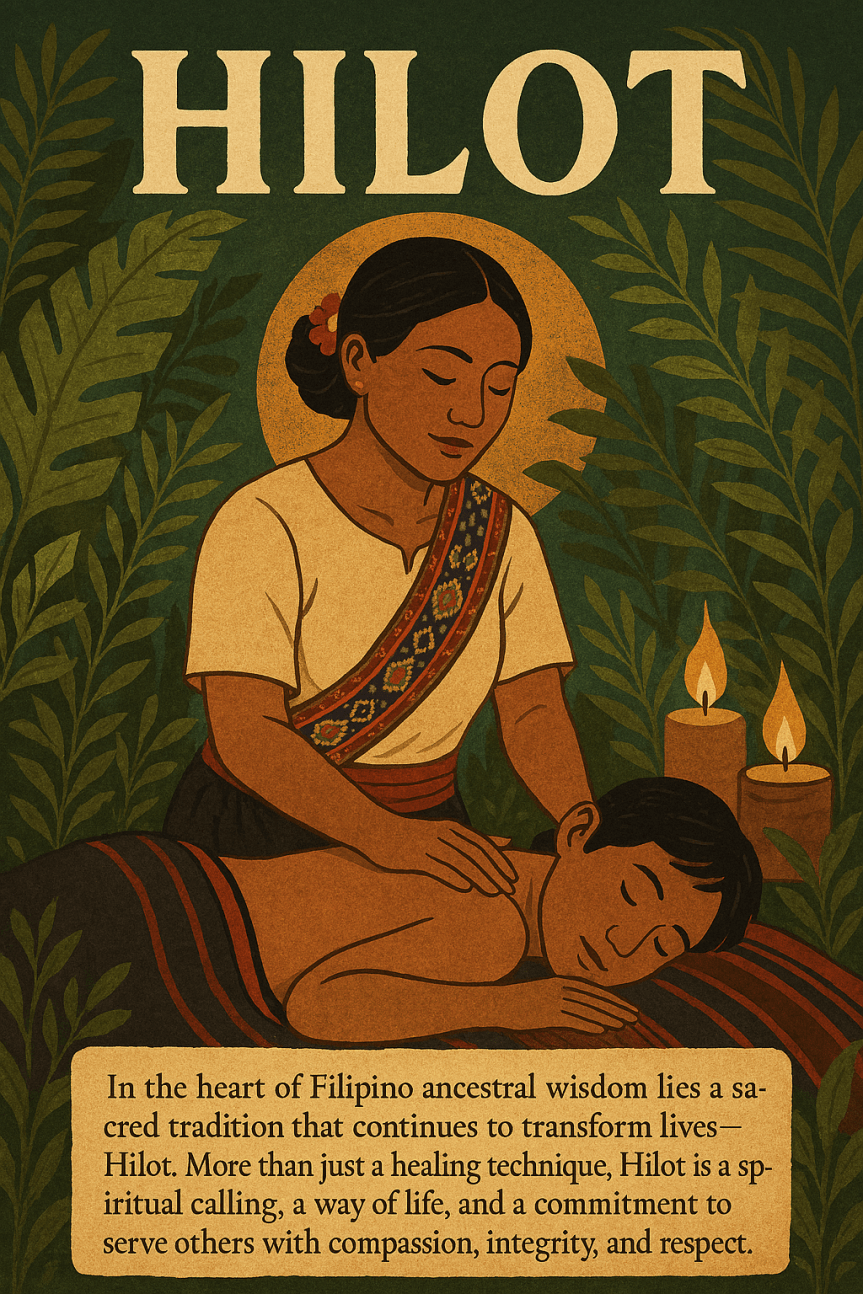
In the heart of Filipino ancestral wisdom lies a sacred tradition that continues to transform lives—Hilot. More than just a healing technique, Hilot is a spiritual calling, a way of life, and a commitment to serve others with compassion, integrity, and respect.
As the world seeks deeper, more holistic approaches to wellness, Hilot stands as a beacon of hope—reminding us that healing begins from within and is nurtured by the wisdom of our ancestors.
Why Hilot Matters Today
Modern healthcare often focuses on symptoms, but Hilot looks deeper. It recognizes that illness can stem from emotional, spiritual, and environmental imbalances. Through intuitive diagnostics like Tawas, sacred rituals, and personalized care, Hilot practitioners help individuals restore harmony in body, mind, and spirit.
But with this sacred power comes great responsibility. That’s why every Manghihilot must uphold the Hilot Code of Ethics and Healing Principles—a living covenant that guides our practice and protects those we serve.
🌿 The Hilot Code of Ethics: A Sacred Commitment
As a Manghihilot, you are not just a healer—you are a steward of life. The Code of Ethics ensures that your practice is rooted in:
Compassionate Care: Facilitating healing, not controlling it.
Respect for Individuality: Every soul is unique; every treatment is personalized.
Professional Integrity: Referring patients when conditions are beyond your scope.
Cultural Wisdom: Honoring ancestral knowledge while embracing modern insights.
Non-Discrimination: Serving all people regardless of background, identity, or status.
This code is not just a guideline—it is a spiritual vow to uphold the dignity and well-being of every person who seeks your help.
✨ Healing Principles That Guide the Manghihilot
Hilot is more than technique—it is philosophy. As a practitioner, you will learn to:
Recognize that healing begins within.
Understand that illness may be spiritual, emotional, or physical—and often all three.
Use cleansing rituals to remove the source of illness and replace it with positive energy.
Respect the natural environment as a vital part of healing.
Accept death as a transition, not an enemy, and help others live meaningfully.
These principles empower you to become a healer who not only treats symptoms but transforms lives.
🎓 Why You Should Enroll in Hilot Training
Whether you are a healthcare professional, spiritual seeker, or someone looking for a meaningful path, Hilot offers a journey of healing, purpose, and connection.
By enrolling in our Hilot training program, you will:
✅ Learn authentic Hilot techniques from certified practitioners ✅ Receive spiritual and cultural education rooted in Filipino traditions ✅ Be part of a movement to preserve and elevate Indigenous healing arts ✅ Earn credentials that recognize your role as a traditional healthcare provider ✅ Transform your life—and the lives of those you serve
🌕 Enrollment for 2026 class is Now Open!
Join the Hilot Academy of Binabaylan and become a certified Manghihilot. Let your hands be instruments of healing. Let your heart be a vessel of compassion. Let your spirit carry the wisdom of our ancestors into the future.
📩 Message us today to reserve your spot. 🌿 Limited slots available. Begin your journey now.
Hilot, the ancient Filipino art of healing, is steadily gaining global recognition as a powerful modality for wellness and spiritual restoration. As more people seek natural and culturally rooted approaches to health, Hilot stands out as a sacred tradition that bridges body, mind, and spirit.
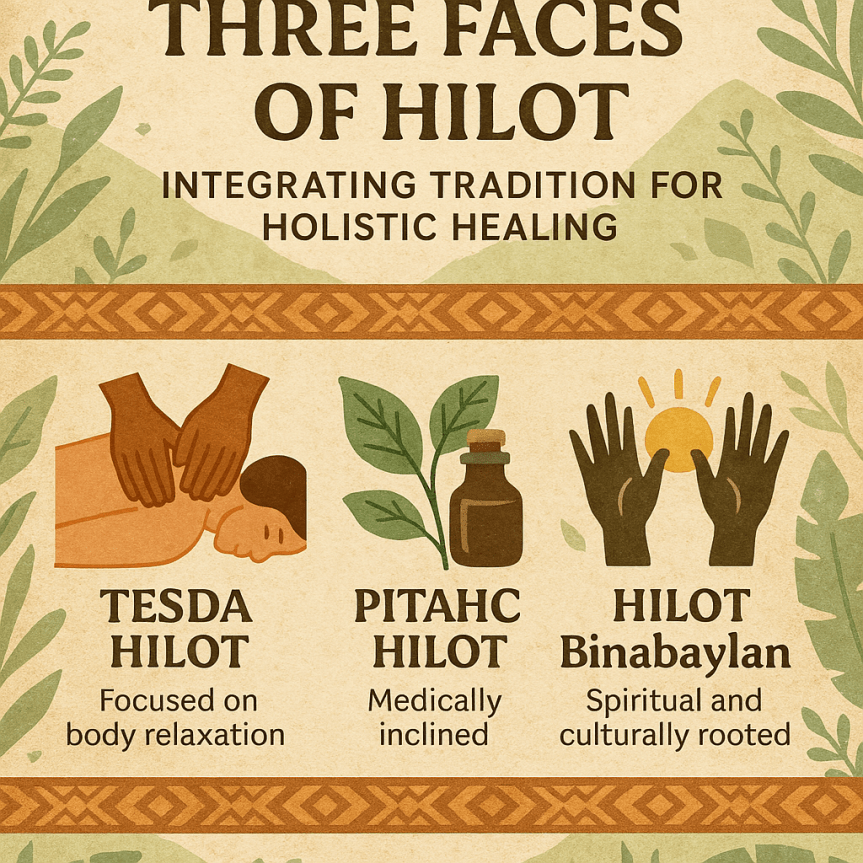
At the Hilot Academy of Binabaylan, we honor the richness and diversity within this practice. Through years of study and experience, we have identified three distinct expressions of Hilot, each serving a unique purpose in the journey toward holistic well-being:
1️⃣ TESDA Hilot
This form of Hilot is widely taught through the Technical Education and Skills Development Authority (TESDA) and focuses primarily on physical relaxation and massage therapy. It is designed to relieve stress, promote circulation, and support general wellness through touch and bodywork.
2️⃣ PITAHC Hilot
Recognized by the Philippine Institute of Traditional and Alternative Health Care (PITAHC), this approach integrates Hilot into the realm of complementary and alternative medicine. It is medically inclined, emphasizing diagnostic techniques and therapeutic interventions that align with traditional healthcare systems.
3️⃣ Hilot Binabaylan
This is our sacred path—Hilot Binabaylan—a culturally and spiritually rooted practice that draws from indigenous Filipino wisdom. It involves rituals, connection with nature, and ancestral guidance to heal not just the body, but also the soul. It is a spiritual calling that honors the sacred relationship between healer, patient, and the unseen forces of life.
🌺 A Gathering of Healing and Unity
On October 5, 2025, we will host a special gathering to celebrate and acknowledge these three expressions of Hilot. This event is not about division, but integration—recognizing that each form of Hilot contributes to a greater whole. When combined, they offer a comprehensive and deeply transformative healing experience.
Rather than contradicting one another, these approaches can be harmonized to provide optimum benefits for those we serve. Whether through physical touch, medical insight, or spiritual connection, Hilot remains a living tradition that continues to evolve and empower.
✨ Let us unite in honoring our heritage and empowering our future through the sacred art of Hilot. ✨
When we start Hilot Academy of Binabaylan on 2016, I know from that time that our Hilot will be different from what the people know about it and even on how the Philippine Government promote it to the Public. I would say that our Hilot reflects the vision of my Teacher, Dr. Rueben M. Galang Jr., MD who is the founder of the School of Alternative Medicine at St. Francis Divine College in Novaliches, Queson City that he says:
The power of Health to the hands of the People and one manghihilot in every Filipino Home.
In the Philippines, we have approximately 116.79 million as our total population this 2025 and if the average household compose of 4 to 5 persons, then we will have approximately 28.5 million families. And aside from the Philippines Filipino can also be found in the United States of America, which according to the U.S. Census Bureau, there are approximately 4.45 Million Filipinos living in USA especially in:
California that has 1,705,090 Filipinos
Hawaii that has 369,479 Filipinos
Texas that has 231,992 Filipinos
Washington that has 194,965 Filipinos
Nevada that has 184,225 Filipinos
Florida that has 178,012 Filipinos
Illinois that has 174,442 Filipinos
New York that has 160,566 Filipinos
New Jersey that has 152, 507 Filipinos
Virginia that has 119,497 Filipinos
Though this map only shows the number of Filipino that can be found in the United States of America, this will also serve as our road map in reaching out to our Kababayan in remembering our Indigenous Healing Arts and Science. Mostly Filipinos in United States of America are immigrants and either 2nd to 3rd Generation Filipino American.
Next to the United States of America, there are also large Filipino Community that can be found in the Kingdom of Saudi Arabia mostly Overseas Filipino Worker that works in Construction Firm, Health Care and House Hold Services. In general, there are 898,014 Filipinos in the entire kingdom that can be distributed on the following provinces:
Riyadh there are approximately 250,000-300,000 Filipinos
Jeddah there are approximately 150,000 – 200,000 Filipinos
Al Kobar and Dammam (Eastern Province) there are approximately 120,000- 150,000 Filipinos
Mecca and Medina there are approximately 50,000 – 70,000 Filipinos
Filipino workers in Saudi Arabia are increasingly diversified, with many now employed in private sector jobs, including healthcare, education, retail, and even small business ownership.
Next will be in Canada which many Filipinos have Migrated for permanent residency, work and Education. It is estimated that there are around 1 million Filipino migrated in Canada which is shown below:
Ontario: There are 363,655 Filipinos
British Columbia: There are 216,710 Filipinos
Alberta: There are 174,280 Filipinos
Manitoba: There are 94, 320 Filipinos
Saskatchewan: There are 43,760 Filipinos
Quebec: There are 44,880 Filipinos
Nova Scotia: There are 6,615 Filipinos
New Brunswick: There are 5,190 Filipinos
Newfoundland and Labrador: There are 2,265 Filipinos
Yukon: There are 1,945 Filipinos
Northwest Territories: There are 1,665 Filipinos
Prince Eduard Islands: There are 1,760 Filipinos
Nunavut: There are 310 Filipinos
Fourth in our list is the United Arab Emirates where there are significant numbers of Overseas Filipino Workers which approximately in 700,000 making up 6.8% of the country’s population.
In Dubai, there are already 450,000 Filipinos which roughly accounts to 21.3% of Dubai’s population. Filipinos here work in hospitality, healthcare, retail, construction, and other service industries.
Abu Dhabi: Estimated ~150,000 Many are employed in government services, oil and gas, and education.
Sharjah, Ajman, and other emirates: ~100,000 combined These areas host Filipinos working in manufacturing, logistics, and domestic services.
Next is in Japan, where Filipinos work in caregiving, entertainment and technical fields. There are many Filipino Japanese Families. Approximately there are 341,518 Filipinos Living in Japan.
As shown, the largest Filipino communities are in:
Tokyo (~72,000)
Aichi (~42,000)
Kanagawa (~39,000)
Osaka (~36,000)
Saitama (~31,000)
Nest to Japan is Australia which has a growing population of Filipino, especially in Sydney and Melbourne due to skilled migration and education. Approximately 361,860 Filipino-born people living in Australia, making them the fifth-largest migrant community in the country. This represents about 1.4% of Australia’s total population.
State/Territory
Filipino-born Population
New South Wales (NSW)
98,510
Victoria (VIC)
75,480
Queensland (QLD)
60,360
Western Australia (WA)
35,120
South Australia (SA)
18,740
Australian Capital Territory (ACT)
4,880
Northern Territory (NT)
2,800
Tasmania (TAS)
1,700
After Australia we are also in the United Kingdom on which Filipinos work in healthcare, especially as nurses and caregivers. As of 2025, there are approximately 165,000 to 200,000 Filipinos living in the United Kingdom
Filipino citizens: Around 40,000 officially registered in municipal records
Filipino-born residents: Estimated 57,498
Spanish citizens of Filipino ancestry: Making up the rest of the estimated total
🇪🇸 Filipino Population by Region
Here’s a breakdown of Filipino citizens by region:
Region
Filipino Population
Community of Madrid
17,471 (43.39%)
Catalonia
12,239 (30.40%)
Andalusia
3,372 (8.37%)
Balearic Islands
2,357 (5.85%)
Canary Islands
1,782 (4.43%)
Valencian Community
1,011 (2.51%)
Filipinos in Spain are active in sectors such as domestic work, caregiving, hospitality, education, and healthcare, and many are long-term residents or descendants of earlier migrants due to historical ties between the Philippines and Spain.
Through these, we envision to reach out all Filipino in Diaspora and call them back to walk to the Path of our Race on which Hilot can be a doorway in reconnecting them back to their ancestral root by embracing our own heritage and culture.
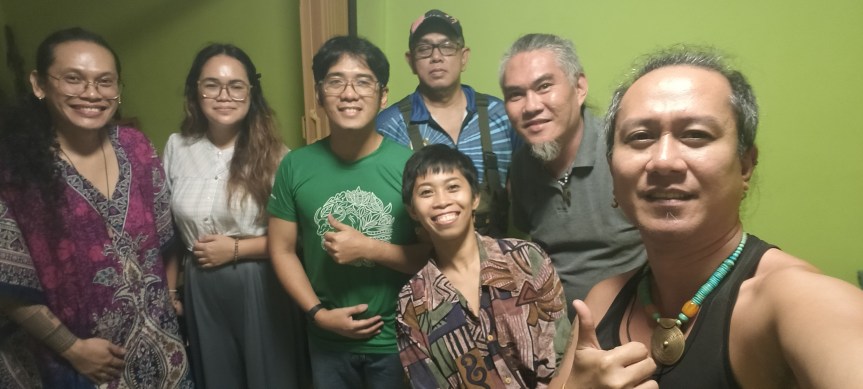
I am always amazed to have people in our class that have the same flow of thoughts running in their mind and the class that they are taking with us serve as an affirmation to the calling that they have and long to manifest in their life.
Hilot Academy was established on April 5, 2016, which is now celebrating our 9th Year Anniversary, which start to aim just to provide skills training that is aligned to the Standards and Regulation of Technical Skills and Development Authority (TESDA). But as time goes by, the need of preserving the knowledge of our Indigenous Traditional Medicine Practices prevails that we cut our self from any Governing and Accrediting Body that forbids some of our Healing practices which only limits the practitioner in providing Massage such as the Hilot Wellness Massage NC2 provided by Tesda accredited Training Center.
On 2020 at the time of Pandemic, the former Tourism Secretary have searched for us and ask us to help her establish Hilot School under the International School of Sustainable Tourism that is located in Silang, Cavite, Philippines. And through the effort that we exert in creating Hilot Philippines Development Center, Hilot Academy, Philippine Institute of Traditional Alternative Health Care (PITAHC), and Technical Education Skills Development Authority (TESDA) were able to have a dialogue about the scope of practices and certification of Hilot Practitioner which unfortunately, the agreed Memorandum Circular promised by former Pitahc Director General was not made due to the shuffling or change of person in authority that manage TESDA and the retirement of PITAHC Director General.
We were ambitious at the start of the new decade hoping that the work of Hilot will be recognized and be preserved by our Government Authority but to my regret, they have a blind eye and deaf hears and are convinced that Hilot is just a massage and Tawas should be excluded. Though many of their invited expert to convey the importance of Hilot in delivering health care do believe in Tawas being part of Hilot Modality, they are still bound to bow down to what the Roman Catholic Church would say specially from the Archdiocese of Manila Office of Exorcism that they gave reminder of not to teach tawas to the public as it invokes the devil in accordance to their teaching.
The Goal of lifting up the Practice of Hilot by professionalizing it has been hindered not only by modern science but also by the modern religion. The hope of calling our Manghihilot as Indigenous Traditional Filipino Medicine Doctor has been halted due to their not willingness to spend time in studying Hilot and find science on our healing modality.
As founder of Hilot Academy of Binabaylan, professionalizing our practice requires an Indepth study. This is why we do our effort to upgrade our curriculum. Our 9 days and 13 days course are just a familiarization course as many people whether Filipino or Foreigner do not know yet what is Hilot all about. But soon as we move forward to the future we can make it into a Bachelor’s degree course that is 4 years with Masteral and Doctorate Degree just like other Traditional Medicine Practices.
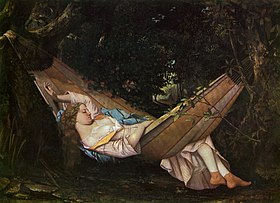
Siesta is a short nap taken in the early afternoon, often after mid-day lunch meal. This tradition is mostly an influence from our Spanish Colonizers which the word is derived from Sixta Hora or the 6th Hour of the day. As early Filipino woke up most likely before the sunrise and lunch time which is the 6th hours from the rising of the sun. When growing up as Pinoy Kid, we have been told a story about Juan Tamad or Lazy Juan which our Spanish Colonizers depiction to a common Filipino. And aside from Nap Time, there are many make up stories, that our mother’s told us as a kid why we should take a nap after meal. Common mothers would encourage their children to take a nap after lunch meal so that children will not go out of their home to play on the Street. Nap time for Children allows mothers to continue doing their household chores also to give time for themselves to relax and care for themselves.
Out of this practice, a make story about an engkanto that is known as Taong Araw which is a very bright white complexion that sucks of life force from the persons they meet on the street during noon time, especially children. Other benefit of Siesta that is not scary is that it helps a Child to grow faster. But having Siesta in our Class is not that we teach laziness to our students, but instead we intend to immerse our students/participants to Filipino Culture and instill the value of rest as part of healing process.










 Hilot Academy of Binabaylan
You must be logged in to post a comment.