Relearning Respect, Relationship, and Reverence for Nature Before the Making of Healing Lana Oil
One of the most unique aspects of the Hilot Binabaylan Training Program is that healing does not begin with herbs, oils, prayers, or techniques. Instead, it begins with a walk.
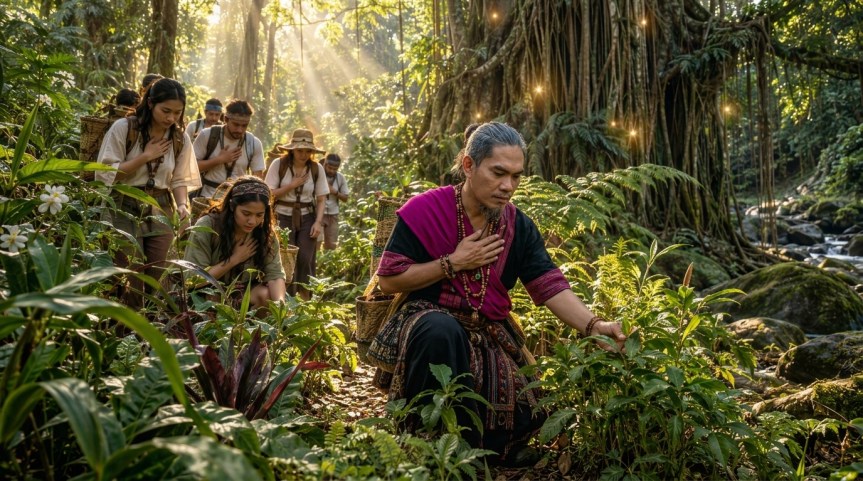
Before students learn the sacred art of preparing Healing Lana Oil, they are invited to participate in a Nature Walk, an experiential learning activity that reconnects them with the living world around them. Whether this walk takes place inside a forest park, along a beach shoreline, beside a river, or even around a neighborhood block in a busy urban city, the intention remains the same: to cultivate respect, awareness, humility, and relationship with the natural world.
The Forgotten Wisdom of Our Ancestors
In traditional Filipino culture, people were taught that humans are not the sole inhabitants of the world. Our ancestors understood that the forests, mountains, rivers, seas, and even ancient trees are inhabited by many forms of life, both visible and invisible.
For this reason, whenever entering unfamiliar places, people would respectfully say:
“Tabi-tabi po.”
“Please excuse us. We humbly ask permission to pass.”
Likewise, when approaching another person’s home, they would call out:
“Tao po.”
“A person is here.”
These simple words reflect an important cultural teaching: respect before entry.
One does not assume ownership of every place one steps into. One acknowledges that a place already has inhabitants, guardians, and relationships that existed before their arrival.
Sadly, modern society often teaches us the opposite. We are encouraged to think of nature as a resource to be used, exploited, purchased, or controlled. The ancient Filipino worldview reminds us that nature is not merely property; it is community.
Entering Nature as a Guest
During the Nature Walk, students are encouraged to shift their perspective.
Rather than seeing themselves as visitors observing nature from the outside, they begin to see themselves as participants within a larger living community.
As they walk beneath the trees, listen to birdsong, feel the wind, and observe the rhythm of life around them, they are invited to reflect:
- What does it mean to belong to nature?
- How does nature support human life daily?
- What responsibilities do we carry toward the places that nourish us?
- How can healing begin through relationship rather than extraction?
Through direct experience, students begin to understand that they are not separate from nature.
They are nature.
The breath within their lungs comes from the trees. The water in their bodies comes from the rivers and rains. The warmth that sustains life comes from the sun. The healing plants they seek are gifts from the earth.
Asking Permission Before Receiving
One of the most important lessons of the Nature Walk occurs when students encounter medicinal plants, healing herbs, stones, or natural materials that may be used later for ceremonies or healing preparations.
Rather than simply taking what they need, students are taught to approach these gifts with gratitude and respect.
They learn to ask permission.
To many modern minds, this practice may seem unusual. Yet a simple question helps us understand its importance:
How would you feel if someone entered your home without permission?
What if they opened your door, walked through your rooms, and took something that belonged to you without asking?
Most people would feel disrespected, violated, or offended.
If we expect respect from others regarding our homes and belongings, should we not extend the same courtesy to the natural world that sustains our lives?
The practice of asking permission is not merely a spiritual ritual. It is an exercise in humility. It reminds students that healing begins with gratitude, not entitlement.
Learning from the True Elders
Within the teachings of Hilot Binabaylan, the ancient forests, mountains, waters, winds, and sacred places are regarded as the dwelling places of the True Babaylan, the ancient ones who came before us.
While human beings may live for decades, many trees have stood for centuries. Rivers have flowed through generations. Mountains have witnessed countless lives rise and fall.
In this sense, nature itself becomes an elder.
The ancient ones have been teaching long before humans built their schools, temples, and cities. They teach through patience, balance, resilience, adaptation, and harmony.
During the Nature Walk, students are invited to listen.
Not merely with their ears, but with their hearts.
To walk slowly.
To observe deeply.
To recognize that wisdom does not always come from books or lectures. Sometimes wisdom is found in the silence of a forest trail, the rhythm of ocean waves, or the stillness beneath an old tree.
Preparing for Healing Lana Oil
The Nature Walk serves as an essential foundation for the Healing Lana Oil Making Class.
Before students touch the herbs, before they prepare the oils, and before they learn the sacred applications of Lana, they must first understand the relationship behind the medicine.
The herbs are not merely ingredients.
They are relatives.
They are partners in healing.
The oil is not simply a product.
It is a vessel that carries the gifts of nature and the prayers of the healer.
When students gather materials with respect, gratitude, and awareness, they bring these qualities into every stage of the healing process.
A Return to Sacred Relationship
At its heart, the Nature Walk is not about hiking.
It is not about exercise.
It is not even about collecting plants.
It is about remembering an ancient relationship that many people have forgotten.
The Hilot Binabaylan tradition teaches that healing begins when we restore respectful relationships: with ourselves, with our ancestors, with our communities, and with the living world around us.
Every step taken along a forest path, a shoreline, or a city street becomes an opportunity to practice this sacred relationship.
By saying “Tabi-tabi po,” we learn humility.
By asking permission, we learn respect.
By walking gently, we learn awareness.
By receiving nature’s gifts with gratitude, we learn reciprocity.
And through these lessons, we begin to rediscover what our ancestors always knew:
The Earth is not merely where we live. It is a community to which we belong.
Hilot Academy of Binabaylan continues to preserve and promote Indigenous Filipino healing wisdom by teaching future Manghihilot and Binabaylan not only how to heal, but how to walk gently and respectfully within the sacred web of life from which all healing flows.

