An Expanded Reflection on the Hilot Binabaylan Code of Ethics
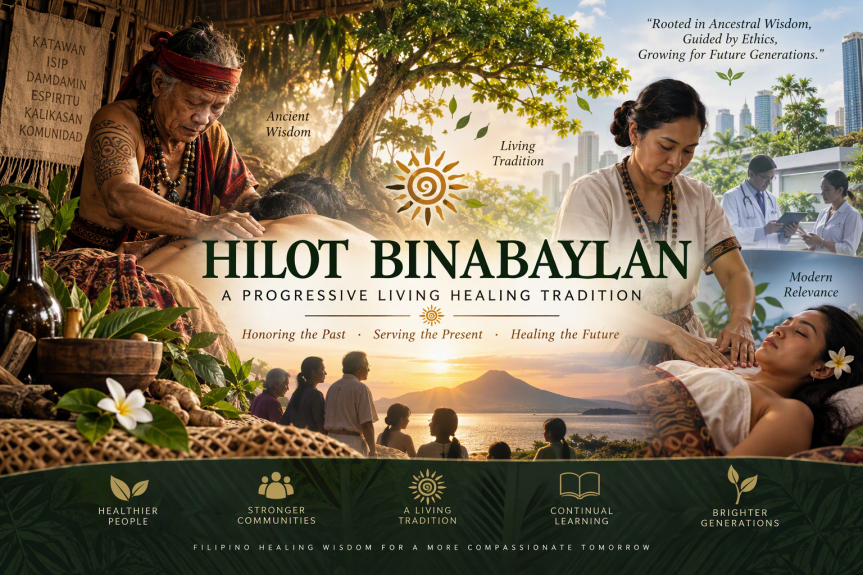
Introduction: Why Hilot Binabaylan Is a Living Healing Tradition
One of the most common questions asked by those who encounter Hilot Binabaylan is:
“Why does it seem different from the hilot practiced by my grandparents or the traditional healer I knew as a child?”
The answer lies in understanding the nature of tradition itself.
Many people imagine tradition as something frozen in time, preserved exactly as it existed generations ago. Yet throughout human history, living traditions have survived precisely because they adapted to new circumstances while maintaining their essential purpose.
Hilot is one such tradition.
For centuries, Filipino communities developed their own healthcare systems according to their environment, available resources, cultural worldview, and inherited wisdom. The hilot of Cavite may not be identical to the hilot of Bulacan, Mindanao, Bicol, Samar, or the Cordilleras. Each community developed unique methods, diagnostic systems, ritual practices, and approaches to healing.
This diversity does not weaken Hilot. Rather, it demonstrates its vitality.
Hilot Binabaylan recognizes that tradition is not merely inherited; it is also lived, practiced, tested, refined, and transmitted to future generations.
A tradition ceases to live when it can no longer respond to the needs of the people. A living tradition continues to evolve while remaining faithful to its original purpose.
The purpose of Hilot has always been the promotion of health, restoration of balance, relief of suffering, and support for the wellbeing of individuals and communities.
The techniques may evolve.
The tools may evolve.
The language may evolve.
Even the understanding of health may evolve.
But the mission remains the same.
For this reason, Hilot Binabaylan regards itself as both:
- A guardian of ancestral wisdom.
- A participant in modern healthcare realities.
The integrity of Hilot Binabaylan is therefore not maintained by copying the past exactly as it was, but by faithfully carrying its values into the present and the future.
This philosophy is expressed throughout the Hilot Binabaylan Code of Ethics.
The Hilot Binabaylan Code of Ethics
The Purpose of the Code of Ethics
The Code of Ethics exists to guide the conduct of every Manghihilot.
Ethics are more important than techniques. A practitioner may possess great knowledge and skill, but without ethical integrity such knowledge can be misused.
The Code serves as a shared covenant between practitioner and community. It establishes the values, responsibilities, limitations, and expectations that govern the practice of Hilot Binabaylan.
It also protects those who seek help by ensuring that practitioners remain accountable for their actions.
Through the Code, the public understands what standards a Manghihilot is expected to uphold.
1. The Manghihilot as a Healthcare Provider
Ethical Principle
As Manghihilot, we are healthcare providers whose goals consist of:
- Prevention of premature death and disability.
- Maintenance and improvement of life.
- Promotion of personal growth and development.
- Preparation for a good and dignified death.
Expanded Reflection
The work of a Manghihilot extends beyond the treatment of pain or discomfort.
Healthcare is not merely the absence of disease.
Health encompasses physical vitality, emotional stability, mental clarity, spiritual harmony, and meaningful relationships.
The Manghihilot accompanies individuals throughout all stages of life.
This includes:
- Preventing illness before it manifests.
- Helping individuals restore balance.
- Supporting recovery and rehabilitation.
- Encouraging healthy living practices.
- Assisting families facing terminal illness and end-of-life transitions.
The Manghihilot therefore serves as a health educator, wellness guide, cultural healer, and community caregiver.
2. Hilot as Traditional Medicine
Ethical Principle
As Manghihilot, we are traditional medicine practitioners whose practice is rooted in ancestral knowledge.
Expanded Reflection
Traditional medicine represents the accumulated observations and experiences of generations.
Long before hospitals existed, communities relied upon indigenous healing systems to maintain health.
Hilot emerged from careful observation of:
- The human body.
- Patterns of illness.
- The healing effects of touch.
- Herbal medicine.
- Environmental influences.
- Spiritual and emotional wellbeing.
Hilot Binabaylan recognizes the value of this ancestral inheritance.
At the same time, the tradition continues to learn.
The wisdom of the ancestors is not dishonored by learning new knowledge. Rather, it is honored when future generations continue their spirit of inquiry and exploration.
Traditional knowledge and modern knowledge need not be enemies.
Both may work together for the benefit of humanity.
3. Facilitating the Natural Healing Capacity of the Individual
Ethical Principle
Every individual possesses an innate ability to heal.
Expanded Reflection
One of the most profound teachings within Hilot Binabaylan is that healing does not originate from the healer.
The practitioner does not “give” health to another person.
Instead, the Manghihilot helps create conditions that allow the person’s natural healing capacities to function more effectively.
The body continuously seeks balance.
The mind seeks clarity.
The spirit seeks harmony.
The role of the Manghihilot is to support these natural processes.
This principle encourages humility.
The healer is not a miracle worker.
The healer is a facilitator of healing.
True healing ultimately arises from within the individual.
4. Recognizing Professional Limitations
Ethical Principle
We do not treat conditions beyond our knowledge and competence.
Expanded Reflection
One of the greatest expressions of integrity is the willingness to admit limitations.
No healthcare practitioner knows everything.
A Manghihilot who claims to cure all illnesses endangers both the client and the tradition itself.
Wisdom includes recognizing when another professional is better equipped to address a specific condition.
A responsible practitioner will refer clients to:
- Physicians
- Nurses
- Psychologists
- Physical Therapists
- Other appropriate healthcare professionals
When necessary.
Referral is not weakness.
Referral is ethical responsibility.
5. Lifelong Learning and Evolution
Ethical Principle
A Manghihilot must remain open to learning and growth.
Expanded Reflection
This principle stands at the heart of Hilot Binabaylan as a living healing tradition.
Many healing systems disappear because they become resistant to adaptation.
Hilot Binabaylan chooses a different path.
We recognize that:
- New health challenges emerge.
- New scientific discoveries appear.
- Society changes.
- Communities evolve.
If Hilot is to remain beneficial for future generations, practitioners must continue learning.
This does not mean abandoning tradition.
It means allowing tradition to grow.
A tree remains alive because it continues to produce new leaves while remaining rooted in the same soil.
Similarly, Hilot remains rooted in ancestral wisdom while extending its branches toward future possibilities.
6. Respect for Human Rights and Informed Consent
Ethical Principle
Every person possesses dignity and fundamental rights.
Expanded Reflection
No individual should receive treatment without understanding what is being done and why it is being done.
Before treatment, the Manghihilot should explain:
- The assessment process.
- The proposed treatment.
- Expected outcomes.
- Possible limitations.
The individual retains the right to:
- Accept treatment.
- Refuse treatment.
- Ask questions.
- Seek alternative opinions.
Respect for autonomy is an essential element of ethical healing.
7. Tawas and Holistic Assessment
Ethical Principle
Assessment must precede treatment.
Expanded Reflection
A Manghihilot does not merely react to symptoms.
Through assessment practices such as Tawas and other traditional investigative methods, practitioners attempt to understand the condition of the individual.
The purpose of assessment is not superstition nor blind assumption.
Its purpose is discernment.
The practitioner seeks to understand:
- Physical manifestations.
- Emotional influences.
- Environmental factors.
- Social circumstances.
- Spiritual concerns.
Only after assessment can an appropriate care plan be developed.
8. The Recognition of Spiritual Illness
Ethical Principle
Human suffering may have physical, emotional, psychological, social, or spiritual dimensions.
Expanded Reflection
Hilot Binabaylan acknowledges that human beings possess interconnected dimensions of existence.
Physical symptoms are sometimes accompanied by:
- Grief
- Trauma
- Fear
- Anxiety
- Emotional burden
- Spiritual distress
The tradition recognizes that suffering may affect the whole person.
For this reason, rituals may be employed to facilitate:
- Emotional release
- Reflection
- Reconciliation
- Spiritual comfort
- Community support
These practices do not replace appropriate medical or psychological care when needed.
Rather, they address dimensions of human experience that individuals may find meaningful within their cultural and spiritual framework.
9. Honoring Individual Uniqueness
Ethical Principle
Every individual is unique.
Expanded Reflection
No two people are exactly alike.
Two individuals may experience:
- Similar symptoms.
- Similar diagnoses.
- Similar circumstances.
Yet their healing journey may differ greatly.
Hilot Binabaylan therefore rejects a one-size-fits-all approach.
Each individual:
- Carries a unique history.
- Possesses unique strengths.
- Faces unique challenges.
- Responds differently to treatment.
The Manghihilot adapts their approach to meet the needs of the person rather than forcing the person to fit a predetermined treatment model.
10. Integration with Modern Healthcare
Ethical Principle
Traditional and conventional healthcare may work together.
Expanded Reflection
Hilot Binabaylan does not position itself in opposition to modern medicine.
Both systems possess strengths.
Modern medicine excels in:
- Emergency care.
- Surgery.
- Diagnostic technology.
- Management of complex diseases.
Traditional healing may contribute through:
- Health promotion.
- Wellness education.
- Cultural relevance.
- Community-based care.
- Holistic support.
Rather than creating division, Hilot Binabaylan encourages collaboration whenever appropriate.
The ultimate concern is the wellbeing of the individual.
11. Personal Responsibility in Health
Ethical Principle
Health requires active participation by the individual.
Expanded Reflection
A Manghihilot may provide guidance and assistance, but healing cannot occur through passive dependence alone.
Individuals must also participate in their own wellbeing through:
- Healthy lifestyle choices.
- Seeking appropriate healthcare.
- Following recommendations responsibly.
- Developing self-awareness.
Likewise, serious illnesses require proper medical evaluation.
Ethical practice demands that chronic and potentially life-threatening conditions receive appropriate medical attention before Hilot interventions are considered.
The Manghihilot supports healthcare, but does not replace necessary medical care.
Conclusion: Integrity Through Ethical Living
The integrity of Hilot Binabaylan is not preserved by insisting that every practitioner perform healing exactly as it was done centuries ago.
Nor is it preserved by rejecting new knowledge.
Integrity is preserved through faithful adherence to ethical principles.
It is maintained when practitioners remain humble enough to acknowledge their limitations, courageous enough to continue learning, compassionate enough to honor human dignity, and wise enough to integrate ancestral knowledge with contemporary realities.
Hilot Binabaylan is a living healing tradition because it continues to breathe, grow, learn, adapt, and serve.
Its roots remain deeply planted in the wisdom of Filipino ancestors.
Its branches continue to reach toward the future.
And as long as there are Manghihilot who embody its values, the tradition will remain alive, relevant, and capable of bringing healing to generations yet to come.

