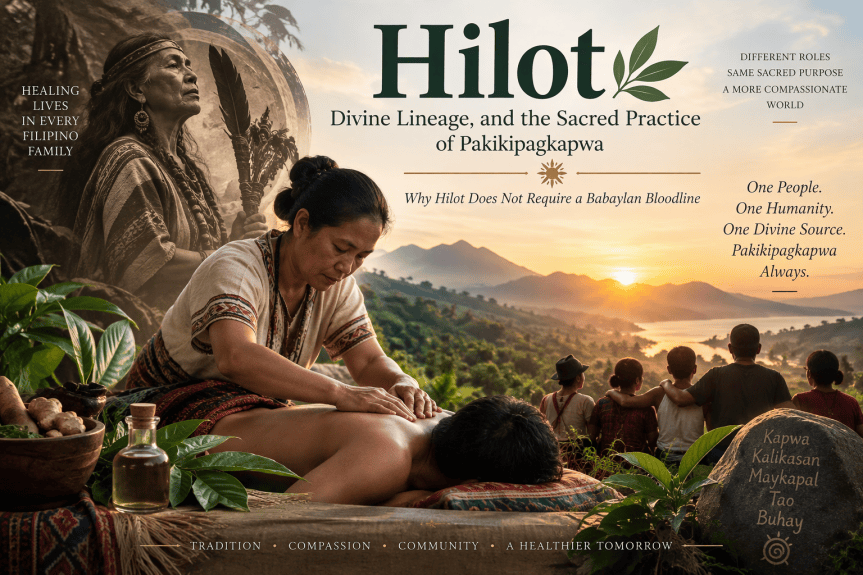
In recent years, discussions about Filipino traditional healing have become more visible in academic, cultural, and spiritual circles. One claim occasionally presented is that a person can only become a true manghihilot if they possess a direct lineage from a Babaylan. While this perspective may arise from a sincere desire to honor indigenous traditions, it risks reducing the rich diversity of Filipino healing practices into a narrow and historically inaccurate framework.
The truth is that Hilot has never belonged exclusively to Babaylans.
Hilot belongs to the Filipino people.
Hilot as a Living Tradition of Every Filipino Family
For generations, Filipino families have practiced their own forms of healthcare and healing within their homes and communities. Long before hospitals, professional healthcare systems, or formal institutions existed, families cared for one another through practical knowledge handed down from parents, grandparents, and elders.
Many Filipinos can recall childhood experiences of being massaged by a grandmother for “lamig,” having herbal preparations applied to the body, receiving treatments for pilay or strain, or learning traditional ways of caring for the sick. These practices existed not because every family descended from a Babaylan, but because every family carried the responsibility of preserving life and wellbeing.
Hilot emerged from the fundamental human desire to care for oneself and others.
To suggest that all manghihilot must trace their lineage to a Babaylan would mean disregarding the countless Filipino mothers, fathers, lolos, lolas, aunts, and uncles who have faithfully maintained healing knowledge within their own families for generations.
The history of Hilot is much broader than the history of the Babaylan.
The Responsibility of Self-Care
At its deepest level, healing begins with personal responsibility.
Every living being is entrusted with the care of their own body, mind, and spirit. The desire to live, to heal, and to maintain wellbeing is not a privilege granted only to specialists or religious practitioners. It is an inherent responsibility that comes with life itself.
A person does not need permission from a spiritual lineage to care for a wound, soothe pain, restore balance, improve health, or learn how to care for family members.
The preservation of life is a sacred duty shared by all.
This understanding forms one of the foundations of traditional Filipino healing. Health is not solely the responsibility of experts. It is a collective responsibility that begins with the individual and extends outward to family, community, and society.
When Pakikipagkapwa Becomes Healing
There are moments when a person can no longer fully care for themselves.
Illness, injury, disability, old age, grief, emotional suffering, and periods of weakness create situations where one needs the assistance of others.
This is where the Filipino value of pakikipagkapwa becomes visible.
Pakikipagkapwa is more than kindness. It is the recognition that another person’s wellbeing is connected to our own. It is the understanding that we are not isolated individuals but participants in a shared human existence.
When a manghihilot offers comfort to someone in pain, they embody pakikipagkapwa.
When a community gathers to help a sick neighbor, they embody pakikipagkapwa.
When family members care for an aging loved one, they embody pakikipagkapwa.
Healing is not merely a clinical act. It is an expression of our interconnectedness.
The Divine Lineage Shared by All
One of the misconceptions surrounding lineage is the belief that sacred authority belongs only to a select group of blood descendants.
Yet many Indigenous Filipino spiritual teachings recognize a deeper truth.
Every human being originates from the same sacred source.
Every person carries a divine spark.
Every person participates in the gift of life bestowed by the Creator, the Great Source, or the Dakilang Maykapal.
If we speak of lineage, then our first lineage is not biological but spiritual.
We all belong to the family of life.
We all share a divine ancestry.
We all emerge from the same sacred mystery.
This understanding transforms healing from an exclusive inheritance into a universal vocation. The ability to show compassion, provide comfort, reduce suffering, and preserve life is not reserved for a chosen bloodline.
It is part of our shared humanity.
Understanding the Role of the Babaylan
Recognizing that Hilot does not require Babaylan lineage does not diminish the importance of the Babaylan.
On the contrary, it allows us to understand the Babaylan more accurately.
Historically, the Babaylan occupied a specialized role within the community. They served as ritual leaders, spiritual mediators, wisdom keepers, counselors, and custodians of communal traditions. Their responsibilities often extended beyond healing into ceremony, conflict resolution, communication with spirits, agricultural rites, and the maintenance of social harmony.
The Babaylan was not simply a healer.
The Babaylan was a facilitator of relationships.
A bridge.
A connector.
A guide.
In contemporary language, we might say that the Babaylan’s deepest function was to facilitate pakikipagkapwa between people, community, nature, ancestors, spirits, and the Divine.
Their role was not to monopolize healing but to nurture the sacred relationships that make healing possible.
Hilot Beyond Bloodline
The future of Hilot depends not on proving bloodline but on embodying values.
A true manghihilot is known less by ancestry and more by character.
They demonstrate compassion.
They cultivate knowledge.
They respect life.
They practice integrity.
They honor the dignity of those they serve.
They recognize the limits of their competence and work responsibly alongside modern healthcare systems when necessary.
Most importantly, they understand that healing is an act of service rather than a claim of superiority.
The essence of Hilot is not found in genealogy.
It is found in the compassionate application of knowledge for the wellbeing of others.
Conclusion
Hilot is a living healing tradition that belongs to the Filipino people. While Babaylans have played vital roles in the spiritual and cultural life of many Filipino communities, the practice of Hilot itself has never been limited to those who possess a Babaylan lineage.
Every family has the capacity to nurture health.
Every community has the responsibility to care for its members.
Every human being shares a divine lineage that originates from the same sacred source.
The role of the Babaylan is not to restrict access to healing but to deepen our understanding of pakikipagkapwa, reminding us that service to another is ultimately service to oneself, because all life is interconnected.
When we care for another person, we honor the sacred gift of life.
When we relieve suffering, we participate in a holy act.
And when we practice Hilot with wisdom, compassion, and integrity, we continue a tradition that has always belonged to the people, nourished by the spirit of pakikipagkapwa, and rooted in the divine lineage shared by all humanity.

