One of the most common questions we receive from prospective students, especially those coming from different countries and cultural backgrounds, is:
“The program includes traditional Filipino spiritual beliefs and practices. Is any particular religious or spiritual belief expected from participants, or is the program approached primarily from a cultural and educational perspective?”
The short answer is:
No, participants are not required to adopt any particular religion, spiritual path, or belief system in order to study Hilot Binabaylan.
However, understanding the deeper context of Hilot requires us to recognize that Hilot did not emerge solely as a physical healing technique. It developed within the broader worldview of Indigenous Filipino Spirituality, where health, wellness, community, nature, and spirituality are interconnected aspects of life.
Hilot Is More Than Physical Healing
Today, Hilot is widely recognized in the Philippines as a traditional healing practice and healthcare modality. It has received recognition through government institutions such as the Technical Education and Skills Development Authority (TESDA) and the Philippine Institute of Traditional and Alternative Health Care (PITAHC).
Yet, Hilot has always been much more than the treatment of physical discomfort.
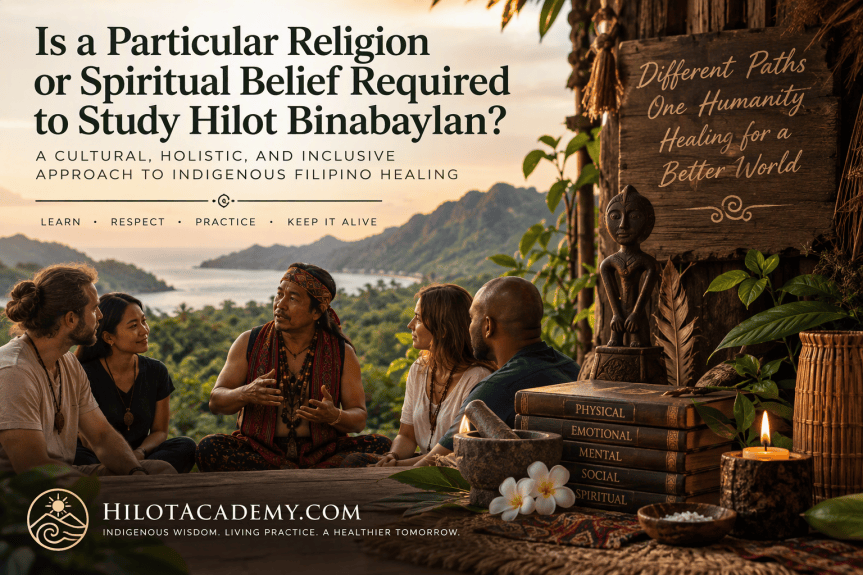
Traditional Hilot recognizes that a person’s well-being is influenced by multiple dimensions of life:
- Physical Health
- Emotional Well-being
- Mental Wellness
- Social Relationships
- Spiritual Balance
For this reason, Hilot is often described as a holistic healing tradition.
As I often tell my students, a human being is not merely a physical body. A person possesses body, soul, and spirit. These dimensions work together to create a living, functioning, and healthy individual.
If healthcare focuses exclusively on the physical body, then it concerns only one aspect of the human experience. A mortician also works with the physical body, yet healing involves much more than preserving physical form.
A true Hilot practitioner therefore seeks to understand not only anatomy and physiology, but also the deeper dimensions of human existence. In Hilot Binabaylan, we study what may be called the “anatomy of the soul” and the “anatomy of the spirit” alongside the physical body.
Indigenous Filipino Spirituality as a Foundation
Hilot Binabaylan is rooted in Indigenous Filipino Healing Arts and Sciences. As such, many of its concepts, philosophies, and healing approaches arise from Indigenous Filipino Spirituality.
This spirituality serves as a cultural and philosophical foundation from which many healing principles are derived.
It is important to understand that Indigenous Filipino Spirituality is not necessarily the same as organized religion.
Rather than prescribing a specific creed that every student must believe, it offers a way of understanding:
- Humanity’s relationship with nature
- Respect for ancestors and cultural heritage
- The interconnectedness of life
- Community responsibility
- Holistic wellness
- The sacredness of healing work
Students are encouraged to learn and understand these concepts as part of their educational journey, regardless of their personal religious affiliation.
Students of Different Faiths Are Welcome
Throughout the years, students from various backgrounds have shown interest in Hilot Binabaylan:
- Christians
- Catholics
- Protestants
- Indigenous practitioners
- Spiritual seekers
- Healthcare professionals
- Individuals with no religious affiliation
Participation in the program does not require abandoning one’s existing faith, cultural identity, or personal spiritual beliefs.
Learning Hilot Binabaylan does not make someone Filipino, nor does it require becoming part of a Filipino religious movement.
Instead, students are invited to learn from the wisdom of Indigenous Filipino healing traditions and explore how these teachings can complement their existing worldview, profession, or healing practice.
Just as one may study Traditional Chinese Medicine without becoming Chinese, or Ayurveda without becoming Indian, one may study Hilot Binabaylan while honoring their own cultural and spiritual heritage.
Beyond Information: The Goal Is Practice
At Hilot Academy of Binabaylan, our goal is not simply to produce individuals who possess information about Hilot.
Our goal is to develop practitioners.
There is an important difference between knowledge and practice.
Knowledge stored only in books can be forgotten.
Information that remains only in the mind can fade over time.
But wisdom gained through actual practice continues to deepen and grow through experience.
Every client served, every case encountered, every healing session performed becomes part of the practitioner’s continuing education.
For this reason, Hilot Binabaylan is taught as a living tradition rather than a historical artifact.
Keeping Hilot Alive
Many cultural traditions around the world have been preserved in museums, archives, and academic papers. While documentation is important, a tradition survives most fully when it continues to be practiced.
Our vision at Hilot Academy of Binabaylan is not merely to preserve Hilot as something that existed in the past.
We seek to support Hilot as a living, evolving, and relevant healing tradition.
We want Hilot to remain:
- Interactive rather than static
- Experiential rather than purely theoretical
- Practical rather than merely historical
- Progressive while honoring tradition
- Adaptable to present and future generations
Traditions remain alive when they are practiced, refined, and shared responsibly.
Our Educational Approach
The Hilot Binabaylan Program is therefore approached from both a cultural and experiential perspective.
Students are introduced to Indigenous Filipino spiritual concepts because they are essential to understanding the historical and philosophical foundations of Hilot. However, participants are not required to convert to any belief system.
What is expected is openness to learning, cultural respect, and a willingness to engage with the tradition in a meaningful and responsible way.
The goal is not to tell students what they must believe.
The goal is to help students understand how generations of Filipino healers viewed health, wellness, life, community, nature, and the healing process itself.
In doing so, students gain not only knowledge of a healing modality, but also a deeper appreciation for one of the Philippines’ most enduring cultural treasures.
At Hilot Academy of Binabaylan, we believe that traditions are best preserved not by placing them behind glass, but by placing them into practice. Through study, experience, and responsible application, Hilot continues to grow as a living embodiment of Indigenous Filipino healing wisdom for the modern world.

