🌿 Understanding the Three Faces of Hilot: A Path to Holistic Filipino Healing 🌿

Hilot, the ancient Filipino art of healing, is steadily gaining global recognition as a powerful modality for wellness and spiritual restoration. As more people seek natural and culturally rooted approaches to health, Hilot stands out as a sacred tradition that bridges body, mind, and spirit.

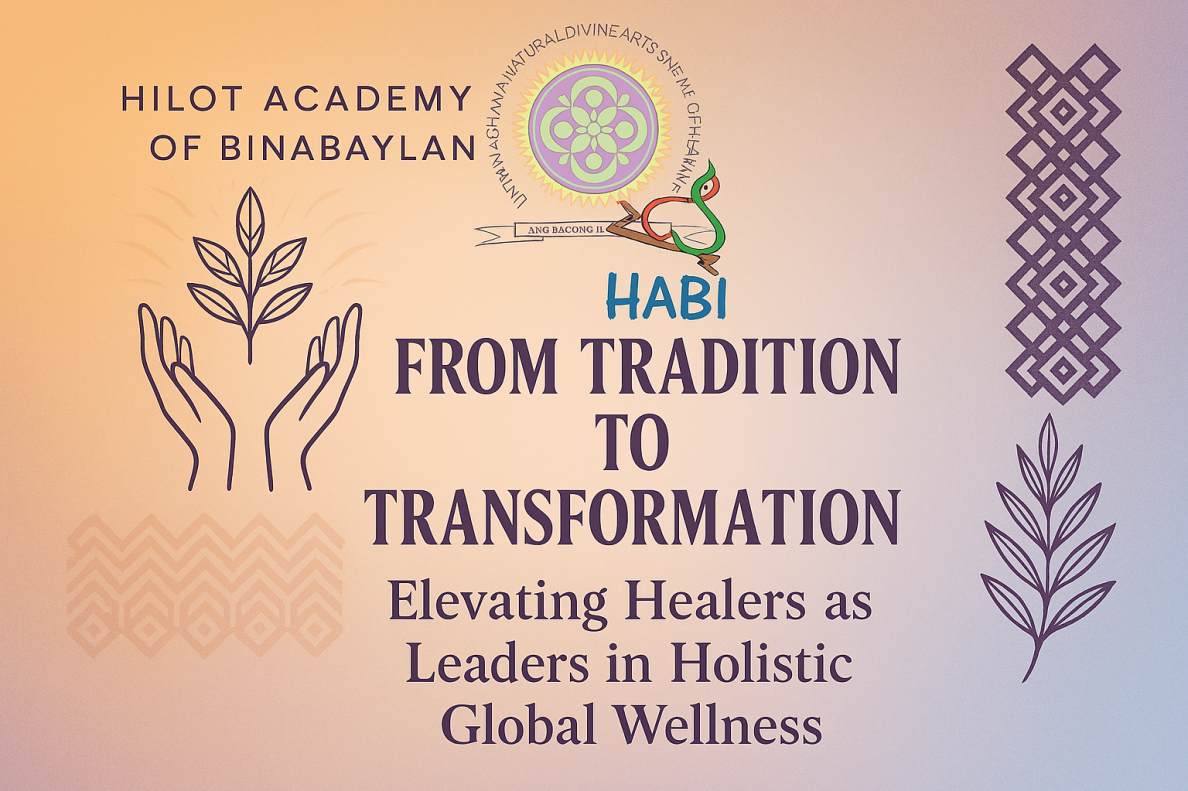
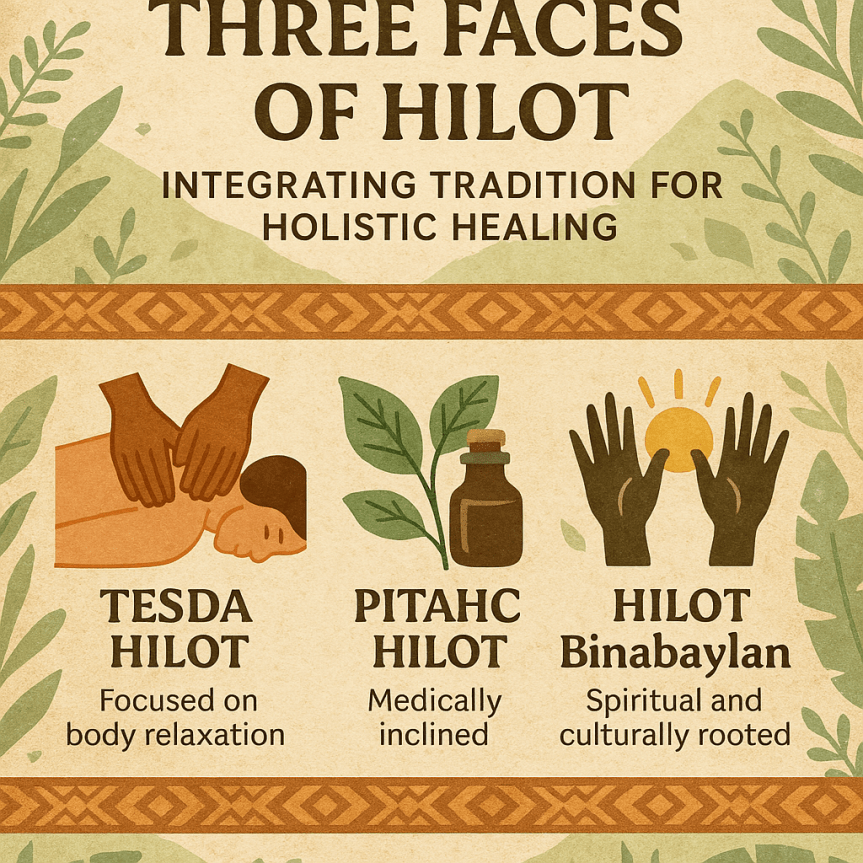
At the Hilot Academy of Binabaylan, we honor the richness and diversity within this practice. Through years of study and experience, we have identified three distinct expressions of Hilot, each serving a unique purpose in the journey toward holistic well-being:

1️⃣ TESDA Hilot

This form of Hilot is widely taught through the Technical Education and Skills Development Authority (TESDA) and focuses primarily on physical relaxation and massage therapy. It is designed to relieve stress, promote circulation, and support general wellness through touch and bodywork.

2️⃣ PITAHC Hilot

Recognized by the Philippine Institute of Traditional and Alternative Health Care (PITAHC), this approach integrates Hilot into the realm of complementary and alternative medicine. It is medically inclined, emphasizing diagnostic techniques and therapeutic interventions that align with traditional healthcare systems.

3️⃣ Hilot Binabaylan

This is our sacred path—Hilot Binabaylan—a culturally and spiritually rooted practice that draws from indigenous Filipino wisdom. It involves rituals, connection with nature, and ancestral guidance to heal not just the body, but also the soul. It is a spiritual calling that honors the sacred relationship between healer, patient, and the unseen forces of life.


🌺 A Gathering of Healing and Unity

On October 5, 2025, we will host a special gathering to celebrate and acknowledge these three expressions of Hilot. This event is not about division, but integration—recognizing that each form of Hilot contributes to a greater whole. When combined, they offer a comprehensive and deeply transformative healing experience.

Rather than contradicting one another, these approaches can be harmonized to provide optimum benefits for those we serve. Whether through physical touch, medical insight, or spiritual connection, Hilot remains a living tradition that continues to evolve and empower.


✨ Let us unite in honoring our heritage and empowering our future through the sacred art of Hilot. ✨

#HilotBinabaylan #AncestralHealing #FilipinoWisdom #HilotAcademy #IntegrativeHealing #TemplongAnituhan
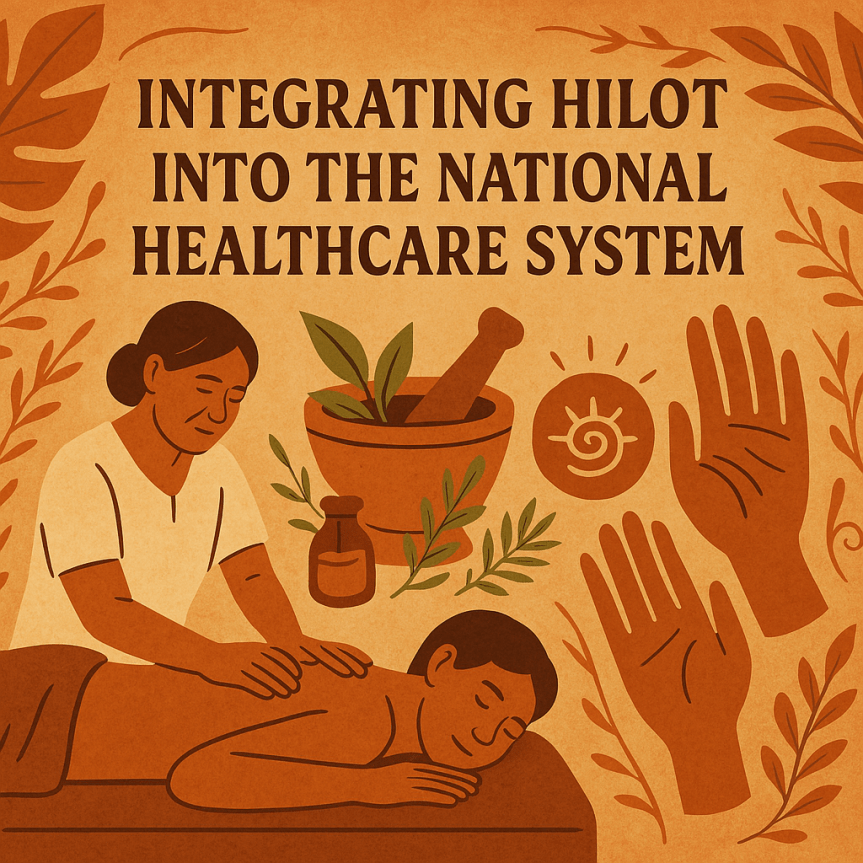
🌿 Embracing Hilot: Integrating Traditional Healing into the Philippine Healthcare System

In the heart of Filipino culture lies a healing tradition that predates modern medicine—Hilot. More than just a massage, Hilot is a holistic approach to wellness that addresses the body, mind, and spirit. As the Philippines continues to modernize its healthcare system, there is a growing movement to reclaim and integrate Hilot into the national healthcare delivery system.

🏛️ A Legal Foundation: RA 8423

The integration of Hilot is not just a cultural aspiration—it is supported by law. Republic Act No. 8423, also known as the Traditional and Alternative Medicine Act (TAMA) of 1997, mandates the promotion and integration of traditional and alternative healthcare practices into the national health system. This law led to the creation of the Philippine Institute of Traditional and Alternative Health Care (PITAHC), which now oversees the certification and regulation of traditional healers, including Hilot practitioners.

🔍 Understanding the Types of Hilot

There are three primary streams of Hilot practice in the Philippines:

  • Hilot Binabaylan: Rooted in indigenous spirituality, this form of Hilot is passed down through oral tradition and spiritual calling. It involves rituals, energy healing, and ancestral wisdom.
  • TESDA Hilot: Offered as a vocational course under TESDA, this version focuses on massage therapy and wellness, preparing practitioners for work in spas and wellness centers.
  • PITAHC Hilot: Recognized by the Department of Health, this form integrates traditional diagnostic and healing methods with public health services, emphasizing herbal medicine, community wellness, and preventive care.

🌀 A Framework for Integration

To fully integrate Hilot into the national healthcare system, a structured approach is essential. Here’s a five-phase model:

1. Diagnostic Phase

Recognize Hilot’s traditional diagnostic methods—such as pulse reading and energy assessment—as complementary to biomedical diagnostics, especially in rural health units.

2. Cleansing Phase

Train Hilot practitioners to offer non-invasive cleansing techniques like pahid, tuob, and ventosa in barangay health centers as part of wellness and preventive care.

3. Repair Phase

Allow certified Hilot practitioners to provide therapeutic massage and herbal remedies under DOH supervision, in collaboration with PITAHC-recognized healing centers.

4. Strengthening Phase

Mobilize Hilot practitioners to lead community herbal gardens and ethnobotanical documentation, in partnership with LGUs and the Department of Agriculture.

5. Maintenance Phase

Empower Hilot practitioners to serve as health coaches, teaching traditional wellness practices, nutrition, and stress management in barangay health education programs.

🤝 Policy and Institutional Support

PITAHC’s Circular No. 01, s. 2016 provides a clear pathway for:

  • Certification of Hilot practitioners
  • Accreditation of Hilot training and healing centers
  • Integration into public health services

With the legal and institutional framework in place, what’s needed now is community support, local government action, and national recognition of Hilot’s value in building a healthier, more culturally grounded Philippines.


📣 Final Thoughts

Integrating Hilot into the national healthcare system is more than a policy move—it’s a cultural revival. It honors our ancestors, empowers our communities, and offers a holistic path to wellness that is uniquely Filipino.


Onwards to our 9th Year Anniversary

I am always amazed to have people in our class that have the same flow of thoughts running in their mind and the class that they are taking with us serve as an affirmation to the calling that they have and long to manifest in their life.

Hilot Academy was established on April 5, 2016, which is now celebrating our 9th Year Anniversary, which start to aim just to provide skills training that is aligned to the Standards and Regulation of Technical Skills and Development Authority (TESDA). But as time goes by, the need of preserving the knowledge of our Indigenous Traditional Medicine Practices prevails that we cut our self from any Governing and Accrediting Body that forbids some of our Healing practices which only limits the practitioner in providing Massage such as the Hilot Wellness Massage NC2 provided by Tesda accredited Training Center.

On 2020 at the time of Pandemic, the former Tourism Secretary have searched for us and ask us to help her establish Hilot School under the International School of Sustainable Tourism that is located in Silang, Cavite, Philippines. And through the effort that we exert in creating Hilot Philippines Development Center, Hilot Academy, Philippine Institute of Traditional Alternative Health Care (PITAHC), and Technical Education Skills Development Authority (TESDA) were able to have a dialogue about the scope of practices and certification of Hilot Practitioner which unfortunately, the agreed Memorandum Circular promised by former Pitahc Director General was not made due to the shuffling or change of person in authority that manage TESDA and the retirement of PITAHC Director General.

We were ambitious at the start of the new decade hoping that the work of Hilot will be recognized and be preserved by our Government Authority but to my regret, they have a blind eye and deaf hears and are convinced that Hilot is just a massage and Tawas should be excluded. Though many of their invited expert to convey the importance of Hilot in delivering health care do believe in Tawas being part of Hilot Modality, they are still bound to bow down to what the Roman Catholic Church would say specially from the Archdiocese of Manila Office of Exorcism that they gave reminder of not to teach tawas to the public as it invokes the devil in accordance to their teaching.

The Goal of lifting up the Practice of Hilot by professionalizing it has been hindered not only by modern science but also by the modern religion. The hope of calling our Manghihilot as Indigenous Traditional Filipino Medicine Doctor has been halted due to their not willingness to spend time in studying Hilot and find science on our healing modality.

As founder of Hilot Academy of Binabaylan, professionalizing our practice requires an Indepth study. This is why we do our effort to upgrade our curriculum. Our 9 days and 13 days course are just a familiarization course as many people whether Filipino or Foreigner do not know yet what is Hilot all about. But soon as we move forward to the future we can make it into a Bachelor’s degree course that is 4 years with Masteral and Doctorate Degree just like other Traditional Medicine Practices.

Paghimo sang Lana

Lana is a Cebuano word that pertains to the Coconut Oil. It is said that Coconut is endemic to the Indo-Pacific Region which includes the SouthEast Asia, Indian subcontinent and the Pacific Islands. This is why there are noticeable similarity of our Culture and even on Healing practices on the said Region.

But in terms of the use of Coconut Oil, it has been used by our Ancestors thousand years ago even prior to the coming of the Spanish Colonizers. Aside from the medicinal properties of Coconut oil, our Ancestors know that it has a Sacred origins, as the Tagalog people believe that the Coconut is a sacred to our Ancient God named Bathala. In one of my Blog at Why Healing oil is the common medicine for the rural Filipino? – Hilot Academy of Binabaylan I wrote:

Healing Oil has been a Powerful Tool of many Filipino in Healthcare even prior to Colonization and arrival of modern Medicine in the Philippines.

It is prescribed by our Ancestors that has direct lineage to our God which we call us Anito. This belief has been strengthened when the Kingdom of India have reached out our Country during the 3rd to 6th Century.

The belief that the oil derived from the Coconut is a byproduct of the Divine Body of the Gods Ulilang Kaluluwa (lonely soul) and Galang Kaluluwa (wondering soul) in the Katagalugan Pantheon.

While in Mindanao by the Talaandig Tribe it was prescribed by their Holy Propher Apu Agbibilin to use Coconut oil and Lemon grass in Peace Making as a sign of the God Magbabaya through the God of Peace Agta Yabun Magbaya.- End of Qoute

Even up to now, many Filipinos are still using Coconut Oil (Healing Oil) in managing their illnesses, especially those are who are deprived of Financial Stability and hard to access Health Care facilities; they use it by applying it externally and even ingest it Internally especially during the time of Pandemic that it has been used to treat persons with Corona Virus.

Aside from its medicinal properties, Coconut oil has its Magical/Spiritual properties that has been established by our Ancestors in protection against Evil Spirits such as the Busaw or Po-oy. It also has been used as Spirit Detector when the bottle of coconut oil boils or shown bubbles which means there are presence of evil spirit.

Manufacturing or Making of Coconut oil is being done Ritually. Specially with the Healers of Siquijor which is part of the Central Visayas Region. It starts 6 Friday before Good Friday on the Lenten Season, this will make Good Friday as the 7th Friday. For this year, this ritual will start on March 7, 2025. This Pangalap Ritual Gathering of Herbs invokes the Spirit of Pakikipagkapwa, as this gathering are not limited to local Healers and Witches of Siquijor but also with other Provinces Healers and Witches in honoring the Power of Nature.

Hilot Academy of Binabaylan through Luntiang Aghama Natural Divine Arts of Healing Inc. adopts this practice and teach it through our future Cultural Bearer and Ancestral Wisdom Keeper known as Hilot Binabaylan that we may preserve it for the benefit of our Future Generation.

Paghimo sang Lana is usually made in the Morning which is the preparation of Herbs and cooked by 12 Noon and distribute it among participants before 3 PM specially if made with a large group of Healer.

A question has been asked to me by a student if the Philippines has not been Christianized so there will be no Holy Week, when do our PreColonial Ancestors make their Healing Oil? That was a good question that requires a good answer as well. In analyzing the day of making or cooking oil which are mostly done by Folk Catholics, Christian Mystics and some animist healers, they do it during Good Friday which in accordance to Catholic Faith, it was adjusted near Full Moon which Christ was nailed on the Cross on a Full Moon. Though our precolonial beliefs is not based on Jesus Christ, but Full Moon is sacred and powerful enough that aside from following the movement of the Sun, the Phases of the Moon is also observed. So, Paghimo sang Lana is best done on the day of Full Moon that may invoke the perfect balance of Sun and Moon which are the Children of Bathala being Apolaki-the Sun and Mayari – the Moon.

Answering Questions of Medical Channel Asia

Health Care requires trust from the people that will receive it. That is why Hilot has been the most trusted Healthcare modality in the Philippines since before the Colonization Period. Modern Medicine is only a recent introduction to the Filipino People especially to those who are living in the rural areas and in a far-flung community where modern Health Care doesn’t reach. And besides, the introduction of modern medicine was only available for the rich people who can afford it. While Hilot can be easily availed by any one as it does not cost much. Traditionally, Hilot can be obtained from Family Members such as mother, aunties or even grandmother. The Principle of Loving Care is applied in Hilot Treatment that does not require monetary payment. Here are my answers to your questions:

  1. What skills and training are necessary for someone to become a trusted manghihilot, and how do you ensure safety in your practice? The Skills of Manghihilot in treatment is based on Traditional Healing Principles.
  • DIAGNOSTIC. Manghihilot uses different diagnostic methods to determine if the illness is caused by Physical Mean or Spiritual Mean. That is why there is a Finger Alignment Method (pantay daliri) to determine if the illness is caused Spiritually or Physically. Then if the cause of illness is caused by the Spirit, the Manghihilot employs Tawas which can be likened into a Psycho- Emotional Assessment. Hilot Academy redefined Tawas from being Spiritual Diagnosis to Traditional Alternative Wellness Analytic System.And if the illness is caused Physically, the Diagnostic Method employed is called Pasubay which observed the patient using 5 senses to determine the disorder of the patient. And if the person has internal problems which are caused by the imbalance of the organ, the manghihilot employs himulso or pulse reading analysis. 
  • CLEANSING. Whether the illness is caused spiritually or physically, we believe that the person becomes impure that it needs to be cleansed. The water is employed in cleansing whether internally or externally.
  • REPAIR. After cleansing, the manghihilot will address the problem by repairing it. There are different treatment techniques to be employed on different illnesses. Even if there are 2 persons suffering from similar illness, the treatment is uniquely different from each individual.
  • STRENGTHENING. After treatment, whether be it simple illness to chronic disease, the Body gets weak that is why the manghihilot will provide herbal tea to drink and prescribe food to eat to recover the patient’s strength; and lastly
  • MAINTENANCE: The manghihilot will provide to the patient some home care remedies, amulets and charms and even instructions of physical activity that the person may prevent from getting sick from the same ailments.

In terms of Training, the Authentic Manghihilot are not schooled. The Knowledge, Skills, Abilities and Attitude of Manghihilot are being taught through observation and experience either through apprenticeship from a Hilot Master or out of compassion, just like a mother that her child gets sick will find a way to apply cure to her child. Though as Manghihilot, we do not claim that we can cure, but we believe that all individuals have the ability to heal themselves, and we as manghihilot are only the facilitator that helps the individual to achieve their own healing through the medicine we provide that is by employing the powers of the elements such as herbs, heat, light, water and time. As manghihilot, we are translators more than communicators. We listen to the voice of the Spirit and their body and relay to the individual what they do not understand and after that we seek help from nature to have medicine for the sick.

How do you ensure safety in your practice? This is a personal question on how I personally ensure the safeness of my practice. So, I will respond to this in accordance with our Code of Ethics. In the book i write which is titled as Hilot Gamutan: a Fundamental Guide in Hilot Treatment Methodology, i will quote on page 9, that states:

“As manghihilot, we do not treat patients that have conditions that are beyond our understanding. We refer them to proper healthcare professionals as necessary.
As manghihilot, we are trained to treat Traditional Filipino Ailments known as Pilay, and our works only revolved in treating this illness.
Our limitation as manghihilot is bound only to what we know, so in order to overcome this limitation we should be open for learning and face the modern challenges of life; as time evolves into modernity we will bring hilot all along so that future generations may still benefit from it.”

That is how I observe safety in my practice of Hilot.

2. How do you address criticism that Hilot may cause complications, especially in cases where professional medical intervention is needed?

Just like what it is stated in our Code of Ethics, we limit our practice in Treating Pilay which is our Traditional Illness. But with the advent of modern medicine and colonizing indigenous tribes, the illness of brought by colonizers such as the cry of one dumagat chieftain, when the government enters the forest, new illnesses have been found in their tribe that originally there are only 10 common illnesses that comes to them which they can solve. So, they are asking for help from the Government to send medical doctors in the forest, but unfortunately, there are only few Honorable doctors who will take that challenge to live among the indigenous people and adopt their culture. 

3. What role do you see Hilot playing in a modern healthcare setting? Should it complement or stand apart from mainstream medicine?

Hilot plays a primary role in Health Care as we are the grass root of Modern Medicine. Common People who live in rural areas trusted Hilot more than the modern healthcare professionals. We can bridge that gap by educating the people to trust modern medical practitioners, unlike the modern doctors who discriminate against us in our practice. In the lessons about the Generations of Healers the Modern Doctors are 4th Generation healers as ordained by the Supreme Divine Creator who is the First genration healer, next was the  Babaylan, third, during the coming of the colonizers the healing abilities of Babaylan are distributed to the Manghihilot and  Mananambal, the fourth is the Modern Doctors, the Fifth is the Hilot Binabaylan which we belong and the 6th generation in prophecy are the Integrative Medical Doctors who combined the Modern Science and the Ancestral ways of Filipino Healing. 

As Hilot Binabaylan, I am looking forward for this to happen as of this moment, there are no Modern Medical Doctor who practice Hilot in Health Care, even Dr. Jaime Galvez Tan who advocates hilot does not practice it instead do acupuncture nor Dr. Isidro Sia former Director General of Pitahc also practice Acupuncture and Dr. Anabelle Pabiona De Guzman, another Pitahc Director General who established the Naturopathic School in Far Eastern University Manila. Dr. Mina Gabor who is former Department of Tourism Secretary has established Hilot School at International School of Sustainable Tourism can not be considered as Integrative Doctor as she is not a medical doctor by profession nor a manghihilot. 

4. What steps do you think should be taken to modernise Hilot while preserving its cultural significance

First is, we have Republic Act 8423 that establishes Philippine Institute of Traditional Alternative Health Care or PITAHC. This law has the objective to promote and advocate the use of traditional, alternative, preventive and curative healthcare modalities that have been proven safe, effective, cost effective and consistent with Government standards of medical practice. But as we can see, PITAHC only put aside the promotion of Hilot and relied much on the Department of Tourism. Hilot is not a Hospitality Service but we must be included in Health Care Services. Hilot is not for Entertainment. You ask every living lola and lolo right now on how they remember Hilot, they will tell you that when they get sick, their mother will send them to a manghihilot.As Manghihilot, we do not rely on Pharmaceutical but instead we create our own medicine by harvesting it to our Garden. This is the reason why we do not charge money, because the medicines we formulate are from our own backyard. Manghihilot Cultivates the land where it produces our medicine. By that you can see we are not just a body worker, but we are also an Earth Steward. But as I go back to the steps in modernizing Hilot and preserve its cultural significance, Hilot should be put out in the Spa Industry but instead be employed in Public Health Care Facilities. Trained Hilot in Schools can work as Field Researcher in documenting Herbs, trees, flowers that grow in their Barangay. And from what they gather, they will send it to a more advanced Facility in Pitahc to conduct more intensive research to find the medicinal value of the plants. Then, upon finding its medicinal value, they can cultivate and propagate. Harvest then manufactures finished products such as tea, tablets, syrups, liniments, oils, etc. that can be distributed to the barangay constituents. 

Pitahc should be included in DOH Offices that have Regional, Provincial, Municioal/ City and Baranggay Health Center. Since we are the grass root of health care, Modern Medicine and Traditional Medicine can work together hand-in-hand in caring for the health of the people.

I pray that I answered all of your Questions.

(Please do visit Medical Channel Asia for more Modern Health Care Contents and how it could help to integrate the Traditional Medicine into the modern health care practices in Asia.)