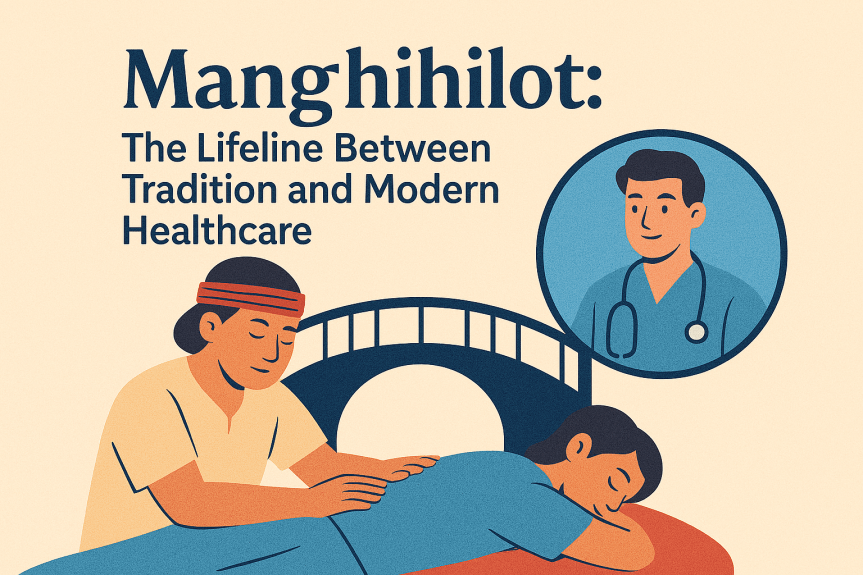
Manghihilot: The Lifeline Between Tradition and Modern Healthcare

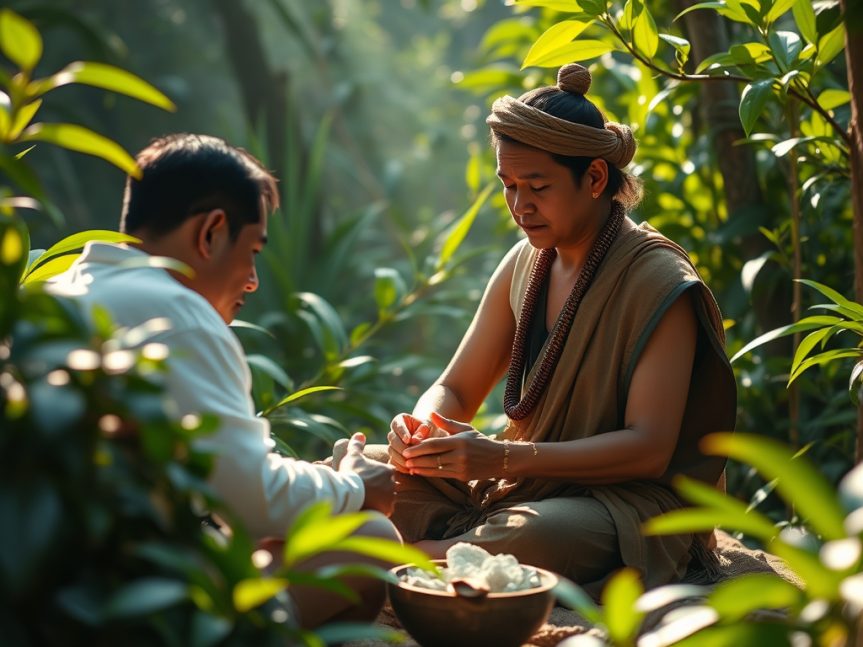
In the heart of Filipino communities, the manghihilot stands as a trusted figure—a healer, a guide, and now, a vital connector between the people and the formal healthcare system. Rooted in centuries-old wisdom, Hilot is more than a therapeutic practice; it is a cultural bridge that fosters trust and accessibility in times of need.

Ethics That Empower

The Hilot Code of Ethics reminds us: “We do not treat patients with conditions beyond our understanding. We refer them to proper healthcare professionals as necessary.” This principle reflects humility and responsibility. Yet, it does not mean turning away those who seek help. Instead, manghihilot practitioners perform initial assessment and relief care, ensuring comfort while facilitating access to advanced medical treatment.

Why This Role Is Crucial

For many Filipinos—especially in rural areas—healthcare is not just a matter of distance; it’s a matter of trust. Hospitals can feel intimidating, and financial constraints often delay treatment. Here, the manghihilot becomes a bridge of trust, guiding patients toward modern care without abandoning cultural values.

By offering first-line care, stabilizing conditions, and educating families, manghihilot practitioners help overcome fear and mistrust. They make the transition from traditional healing to modern medicine smoother, ensuring that no one is left behind.

Integration, Not Opposition

The future of healthcare lies in collaboration. Manghihilot practitioners complement modern medicine by:

  • Providing culturally sensitive care.
  • Acting as first responders in remote areas.
  • Facilitating referrals to hospitals and clinics.

This synergy creates a holistic approach where tradition and science work hand-in-hand for the well-being of the community.

A Call to Action

To strengthen this role, we need support from both the public and healthcare institutions:

  • Recognize manghihilot practitioners as vital partners in community health.
  • Provide training and resources for proper referral systems.
  • Promote integration programs that respect cultural heritage while ensuring safety.

By supporting this collaboration, we empower communities, preserve tradition, and improve healthcare access for all.


Join the Movement! Advocate for the integration of Hilot into public health programs. Share this article, start conversations, and help build a healthcare system that honors both tradition and modernity.
Policy on Enrollment for Specialized Programs

At Hilot Academy of Binabaylan, we uphold the sacred responsibility of preserving and promoting Authentic Indigenous Filipino Traditional Healthcare Practices. Our programs are designed not merely as technical training but as a spiritual and cultural journey rooted in the wisdom of our ancestors.

Why We Require Initiation Before Advanced Programs

The Family Care Hilot Treatment Program is a Continuing Study Program exclusively offered to graduates of our Hilot Binabaylan Practice Master Degree Program. This prerequisite ensures that every participant:

  • Embodies the Core Values of Hilot Binabaylan
    Our 9-day initiation and training program equips practitioners with the knowledge, skills, abilities, and attitude necessary to uphold the integrity of Hilot.
  • Protects the Authenticity of Our Tradition
    We do not allow the integration of Hilot techniques with Western or other modalities. Combining Hilot with foreign practices risks cultural dilution and dishonors the uniqueness of each healing art.
  • Advances Our Advocacy, Not Commercialization
    Our mission is principle-driven, not profit-driven. Enrollment decisions are guided by our commitment to cultural preservation and spiritual integrity, not financial gain.

Our Stand Against Cultural Colonization

Modern spas often offer “Combination Massage,” blending different modalities without respect for their origins. We reject this approach. Hilot is a complete and holistic system that stands on its own—just as our ancestors practiced it for generations.

Policy for International Students

It is our established policy that international students enrolling in the 9-day Hilot Binabaylan Training Program are required to stay with us at our designated accommodation. This includes food and lodging, provided for the following reasons:

  • Safety and Comfort
    As visitors to the Philippines, we prioritize your well-being and security throughout your stay.
  • Focus on Learning
    Classes begin at 8:00 AM and may extend until 8:00 PM. Commuting daily would consume energy and distract from the immersive learning experience. Staying onsite ensures that students can fully concentrate on the training and spiritual journey.

This policy reflects our commitment to creating a safe, comfortable, and focused environment for all participants.

Our Commitment

By maintaining these standards, we ensure that Hilot remains authentic, genuine, and deeply rooted in Filipino Indigenous Wisdom, empowering practitioners to serve their communities with integrity.

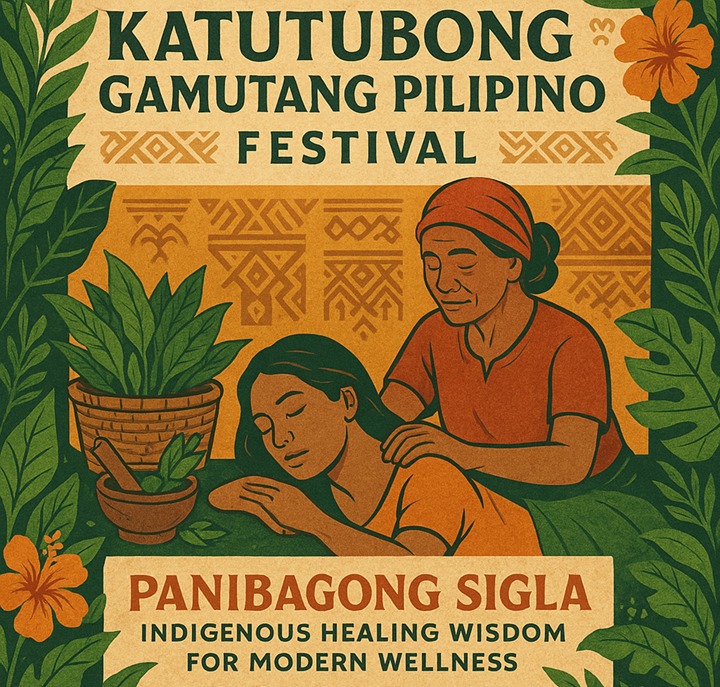
Pista ng Katutubong Gamutang Pilipino 2025: Honoring the Sacred Tradition of Hilot The Indigenous Healing Wisdom of the Filipino People

The Pista ng Katutubong Gamutang Pilipino 2025 presentation is a powerful celebration of Hilot, the indigenous Filipino healing tradition that has endured through thousands of years of cultural evolution. From prehistoric Kalinga to the modern wellness industry, Hilot has remained a vital expression of ancestral wisdom, spiritual resilience, and community-based care.

Tracing the Roots of Hilot

The presentation begins with archaeological evidence of early healing practices dating back 709,000 years ago, when ancient Filipinos used rhinoceros parts for food and medicine. It then highlights the role of Babaylan, Manghihilot, and Albularyo—spiritual healers who used herbal medicine, massage, and rituals to treat physical and emotional ailments.

Hilot Through the Ages

Hilot’s journey spans multiple historical eras:

  • Pre-Srivijaya and Pre-Islamic Periods: Rooted in animistic and shamanic traditions.
  • Islamization Era: Hilot adapted and coexisted with Islamic healing practices.
  • Colonial Periods: Despite marginalization, Hilot remained the primary healthcare system in rural communities.
  • Japanese Occupation and Liberation: Hilot served as a lifeline for guerrilla fighters and civilians.
  • Martial Law Era: Hilot survived underground, preserving indigenous knowledge through oral tradition.

Modern Recognition and Institutional Support

The passage of the Traditional and Alternative Medicine Act of 1997 (RA 8423) and the TESDA NC II certification marked a turning point in Hilot’s formal recognition. These milestones helped integrate Hilot into the national health and vocational systems, opening doors for professional practice in wellness centers, spas, and tourism.


🌀 Addendum: Reclaiming the Full Spectrum of Hilot Binabaylan Practice

While Hilot is now recognized as a wellness modality, key ancestral practices—such as spiritual healing, bone setting, and traditional midwifery—remain excluded from current regulations. This exclusion risks erasing the holistic essence of Hilot as practiced by our ancestors.

⚠️ Current Regulatory Gaps

  • Traditional Birth Attendants (TBAs) are prohibited from conducting home births in many localities due to safety concerns and lack of formal training.
  • Bone setting, a core skill of Manghihilot, is not included in TESDA’s Hilot Wellness Massage NC II curriculum or PITAHC standards.
  • Spiritual healing, though central to Hilot, is often sidelined in favor of clinical approaches. [Pista ng K…ipino 2026 | PowerPoint]

🌿 Why Inclusion Matters

To preserve the authentic form of Hilot Binabaylan, we must reintegrate these ancestral practices into a regulated, culturally respectful framework. This ensures that Hilot remains a complete healing system, not just a massage technique.

🔧 Proposed Integration Strategies

  1. Expanded Curriculum and Certification
    • Develop specialized modules on traditional midwifery, bone setting, and spiritual healing.
    • Partner with institutions like Templong Anituhan and Hilot Academy of Binabaylan to offer culturally grounded training.
  2. Community-Based Health Integration
    • Recognize Hilot Binabaylan as community health workers, especially in underserved areas.
  3. Multi-Agency Collaboration
    • Utilize the mandate of RA 8423 to involve TESDA, CHED, DepEd, and PCHRD in creating short courses and degree programs.
  4. Ethical and Safety Standards
    • Establish guidelines to ensure safe practice while honoring indigenous knowledge.

A Call for Cultural Justice in Healthcare

The exclusion of bone setting and traditional birth practices is not just a technical issue—it is a cultural justice concern. By reclaiming the full spectrum of Hilot Binabaylan, we affirm the value of indigenous wisdom and ensure its rightful place in the modern healthcare delivery system.


🌺 Closing Reflection

Hilot is more than a healing technique—it is a living embodiment of Filipino ancestral wisdom. As we move forward, let us ensure that Hilot remains whole, respected, and empowered. Through education, advocacy, and cultural preservation, we can continue to heal, educate, and uplift our communities with the sacred wisdom of Hilot Binabaylan.

Hilot Binabaylan in North America: Legal Status and Advocacy Pathways

Hilot Binabaylan is a sacred healing tradition rooted in the Indigenous Spiritual Practices of the Philippines. It integrates physical, emotional, and spiritual care through rituals, herbal medicine, massage, and ancestral wisdom. As Filipino communities grow across North America, many Hilot Binabaylan practitioners are seeking ways to share their healing arts while navigating legal and healthcare systems that may not yet recognize their practice.

Legal Status in the United States

Currently, there is no federal law in the United States that directly regulates or standardizes Hilot Binabaylan. However, there are promising developments in the broader field of Complementary and Alternative Medicine (CAM) and Indigenous healing:

– State-Level Safe Harbor Laws: Some states allow traditional healers to practice without formal biomedical licenses, provided they do not claim to treat specific diseases or perform invasive procedures.
– Medicaid Reimbursement for Indigenous Healing: States like California, Arizona, New Mexico, and Oregon have approved Medicaid coverage for Native American traditional healing practices through Section 1115 waivers.
– FDA Oversight of CAM Products: Herbal oils, balms, and other Hilot products may be subject to FDA regulation if marketed for disease treatment.

Legal Status in Canada

In Canada, the practice of Hilot Binabaylan is not prohibited, but it exists in a complex and evolving legal and regulatory landscape. There are no laws that outright prohibit Filipino Indigenous healing practices, but they are not yet formally recognized or regulated under Canadian health professional frameworks.

– Ontario’s Regulated Health Professions Act provides exemptions for Aboriginal healers providing traditional healing services to Aboriginal persons or communities.
– Health Canada’s Self-Care Framework and Cost Recovery Program impose high fees and strict compliance rules on natural health products, which may affect Hilot products.
– Historical suppression of Indigenous healing practices under the Indian Act has left a legacy of cultural bias, although Canada has adopted the UN Declaration on the Rights of Indigenous Peoples (UNDRIP).
– The Truth and Reconciliation Commission’s Call to Action #22 urges recognition of Aboriginal healing practices in the healthcare system.

Suggested Call to Actions for Hilot Binabaylan Practitioners

In the United States

  • Form a U.S.-Based Hilot Binabaylan Association to advocate for recognition and organize cultural education.
  • – Engage with multicultural and Indigenous health organizations to build collaborative healing programs.
  • – Document and publish case studies to establish credibility and support inclusion in healthcare systems.
  • – Seek inclusion in state CAM registries and petition for safe harbor protections.
  • – Educate the public and medical community through workshops and healing clinics.

In Canada

  • – Form a Canadian Hilot Binabaylan Network to unite Filipino healers and advocate for cultural recognition.
  • – Collaborate with Indigenous health centers to offer joint healing sessions and build solidarity.
  • – Educate and advocate through cultural events and public engagement.
  • – Document healing outcomes to support inclusion in complementary medicine registries.
  • – Engage with policy makers to submit proposals to provincial health ministries and multicultural advisory boards.

Conclusion

Hilot Binabaylan is more than a healing practice—it is a living expression of Filipino Indigenous spirituality. While the legal systems in the United States and Canada do not yet fully recognize it, there are clear pathways for advocacy, education, and integration. Through unity, documentation, and cultural diplomacy, Hilot Binabaylan practitioners can help bring this sacred tradition into the light of global healing.

Hilot Binabaylan Practice: Protected by Faith, Guided by Ancestral Wisdom

n the evolving landscape of traditional Filipino healing arts, Hilot Binabaylan Practice stands as a sacred spiritual ministry—distinct from institutionalized wellness modalities. While agencies like PITAHC and TESDA have developed frameworks to regulate Hilot as a health and wellness service, Hilot Binabaylan remains autonomous, rooted in indigenous spirituality and protected under the 1987 Philippine Constitution.

 Constitutional Protection of Spiritual Healing

The Philippine Constitution guarantees the freedom of religion and spiritual expression:

Article III, Section 5
“No law shall be made respecting an establishment of religion or prohibiting the free exercise thereof. The free exercise and enjoyment of religious profession and worship, without discrimination or preference, shall forever be allowed.”

This means that spiritual healing practices, such as Hilot Binabaylan, cannot be regulated or restricted by the Stateunless they pose a threat to public safety or order.

When Can the State Intervene?

While Hilot Binabaylan is protected as a religious and ministerial practice, it must be exercised responsibly. The State may intervene only if the practice:

  • Endangers health or life (e.g., use of toxic substances, denial of medical care)
  • Violates consent or privacy (e.g., performing rituals without permission)
  • Disrupts public order (e.g., unauthorized public gatherings causing disturbance)
  • Engages in fraud or exploitation (e.g., false healing claims for financial gain)

These boundaries are not meant to suppress spiritual traditions, but to ensure ethical and safe practice for both practitioners and the community.

Hilot Binabaylan: A Sacred Vocation

Unlike vocational Hilot courses regulated by TESDA or PITAHC, Hilot Binabaylan is a spiritual calling. It involves:

  • Rituals, orasyon, anito communication, and diwata invocation
  • Ordination as Dayang, Lakan, Hilot Tanglaw, or Doctor of Ministry in Hilot Binabaylan Practice (D.Min.HBp)
  • Training under spiritual authorities, such as the Hilot Academy of Binabaylan, Bahay Siadtala Binabaylan Inc., and Templong Anituhan Inc.

This ministerial path is not subject to government certification, but is governed by ancestral wisdom, cosmology, and spiritual ethics.

Why This Distinction Matters

Understanding the difference between regulated Hilot and Hilot Binabaylan is essential for:

  • Practitioners: To align with their true calling—whether vocational or spiritual.
  • Clients: To understand the nature of the healing they receive.
  • Institutions: To respect the autonomy of Indigenous Spiritual Practices and avoid overreach.

Preserving the Sacred

As we continue to honor and practice Hilot Binabaylan, let us remain vigilant in upholding its sacredness, ethical standards, and constitutional protection. This is not just a healing technique—it is a ministerial act of devotion, a living tradition of our ancestors, and a spiritual gift to the Filipino people.

Policy on Training, Certification, Mentorship, and Doctoral Advancement in Hilot Binabaylan Practice 2025

I. Purpose

This policy outlines the standards and procedures for training, certification, mentorship, and doctoral advancement within the Hilot Academy of Binabaylan, under the spiritual and educational guidance of Bahay Siadtala Binabaylan Inc. It ensures that all practitioners uphold the sacred, ethical, and professional standards of Hilot Binabaylan Practice.

II. Enrollment Eligibility for Master’s in Ministry (M.Min.HBp)

To enroll in the Master’s in Ministry Degree Program on Hilot Binabaylan Practice, applicants must meet the following criteria:

  1. Legal Age Requirement
    • Must be 18 years old or above.
  2. Financial Capacity
    • Must be able to afford the training program, which includes tuition, accommodation, food, materials, and certification.
  3. Educational Background
    • Must have foundational knowledge in:
      • Human Anatomy and Physiology
      • Vital Signs Monitoring
      • Fundamentals of Health Care Practice

III. Training Program Structure

The program consists of 9 days of in-person training, covering the Hilot Healing Protocol, which includes:

  1. Fundamentals of Hilot Practice
  2. Hilot Diagnostic Procedures
  3. Hilot Cleansing Rituals
  4. Hilot Repair/Treatment Methodologies
  5. Body Strengthening and Wellness Enhancer
  6. Hilot Supplementation and Maintenance

IV. Certification and Ordination

Upon successful completion:

  • Students receive a Certificate of Completion and are ordained with the rank title of Dayang (female-identifying) or Lakan (male-identifying).
  • Graduates may serve at the Ministerial Center of Bahay Siadtala Binabaylan Inc., contributing to healing and spiritual services or distantly and serve as Bahay Siadtala Binabaylan Inc. Missionary Healer in their area of residence.

V. Advancement to Hilot Tanglaw (Mentor and Supervisor)

To upgrade from Hilot Binabaylan Practitioner to Hilot Tanglaw, the following requirements must be met:

A. Practice Experience

  • Must have 1 to 2 years of active practice in Hilot Binabaylan Methods.

B. Case Study Submission

  • Must submit 10 to 25 patient case studies, each including:
    • Chief Complaint
    • Practitioner’s Understanding
    • Treatment Plan and Duration
    • Patient Feedback and Results

C. Mentorship Session

  • Candidate must organize a mentoring session:
    • Either one-on-one or with a group of up to 10 mentees
    • Mentoring session fees are paid to Hilot Academy

D. Training Facilitation

  • Candidate may conduct:
    • The full 9-day training, or
    • Selected subjects, as declared to the Hilot Binabaylan Council

E. Validation and Installation

  • After mentoring, candidate must:
    • Submit a mentorship report
    • Request validation of mentees by the Hilot Binabaylan Council
    • Upon successful online validation, candidate will:
    • Receive Ordination and Certification as Hilot Binabaylan
    • Be installed as Hilot Tanglaw in their area of service

VI. Advancement to Doctor of Ministry in Hilot Binabaylan Practice (D.Min.HBp)

The word Doctor comes from the Latin word docere, meaning “to teach.” Thus, the Doctor of Ministry in Hilot Binabaylan Practice is a title conferred upon those who have demonstrated mastery and the ability to teach and lead in the tradition.

A. Prerequisites

  • Must be a Master of Ministry in Hilot Binabaylan Practice (M.Min.HBp) for 1 to 2 years
  • Must be a Hilot Tanglaw (HTm) who has:
    • Conducted at least 10 Hilot Binabaylan Trainings
    • Submitted 20 to 50 patient case studies

B. Thesis and Dissertation

  • Must submit a thesis or dissertation based on:
    • A special case handled during practice, and/or
    • A special curriculum highlighting the candidate’s unique method of applying Hilot Binabaylan Techniques

C. Application Process

  1. Letter of Intent
    • Submit to the Hilot Binabaylan Council expressing desire to level up to Doctorate
  2. Document Submission
    • Include copies of:
      • M.Min.HBp Certificate
      • HTm Certificate
      • Case Studies
  3. Interview and Review
    • Candidate will undergo an online interview regarding their thesis/dissertation
  4. Thesis Presentation
    • Organize an in-person workshop or seminar to present the thesis
  5. Conferral Ceremony
    • The Doctorate Degree will be conferred at Templong Anituhan Inc. in the Philippines

D. Responsibilities

  • As a Hilot Binabaylan Doctor, the individual is expected to:
    • Manage their own Ministerial Center or Hilot Healing Center
    • Teach and mentor others in the Hilot Binabaylan Practice

VII. Ministerial Center Distribution and Practitioner-to-Patient Ratio

The practice of Hilot Binabaylan is not a competitive endeavor, but a sacred vocation rooted in compassion, service, and spiritual responsibility. Unlike commercialized healing systems, Hilot Binabaylan honors the unique relationship between the Manghihilot and the community, ensuring that each practitioner is spiritually and professionally equipped to serve with integrity.

A. Practitioner-to-Patient Ratio

  • In alignment with global healthcare standards and the compassionate nature of Hilot, the ideal Manghihilot-to-Patient Ratio is 1:2,000.
  • This ratio ensures that each practitioner can provide personalized, holistic, and spiritually grounded care to their patients without compromising quality or ethical standards.

B. Ministerial Center Distribution

To ensure accessibility and proper spiritual governance, the following distribution of Ministerial Centers is proposed:

  • United States of America:
    Each of the 50 states shall ideally host one Ministerial Center, serving as a hub for training, healing, and spiritual services in Hilot Binabaylan Practice.
  • Philippines:
    Each of the 18 administrative regions shall host one Regional Ministerial Center, serving as a sacred space for community healing, education, and ordination under the guidance of Bahay Siadtala Binabaylan Inc.

These centers shall be led by ordained Hilot Binabaylan Doctors and Mentors, and shall operate in accordance with the standards set forth by the Hilot Binabaylan Council and Templong Anituhan Inc.

VIII. Code of Conduct

All students, mentors, and ordained practitioners of the Hilot Academy of Binabaylan are entrusted with the sacred duty to uphold the integrity of the Hilot Binabaylan Practice. This Code of Conduct serves as a spiritual covenant and ethical framework that guides their actions, relationships, and service to the community.

1. Respect for Indigenous Wisdom and Spiritual Traditions

  • Practitioners must honor the ancestral teachings and sacred rituals passed down through generations of Binabaylan, Babaylan, and Hilot healers.
  • All ceremonies, healing sessions, and educational activities must be conducted with reverence to the Diwata, Anito, and the spiritual realms recognized by Templong Anituhan.
  • Cultural appropriation, distortion, or commercialization of sacred practices is strictly prohibited.
  • Practitioners must actively preserve and promote the cultural heritage of the Filipino Indigenous Healing Arts.

2. Commitment to Healing, Service, and Ethical Practice

  • Serve with compassion, humility, and integrity. Healing is not a competition—it is a sacred duty. Practitioners must avoid rivalry and instead foster collaboration, mutual respect, and community upliftment.
  • Practitioners must prioritize the well-being of their patients, students, and community members, offering care with compassion, humility, and integrity.
  • Healing must be approached holistically—addressing the physical, emotional, mental, and spiritual dimensions of the individual.
  • Confidentiality, informed consent, and non-discrimination are essential ethical standards in all healing and mentoring engagements.
  • Practitioners must avoid any form of exploitation, manipulation, or abuse of power in their roles as healers and mentors.

3. Accountability to the Hilot Binabaylan Council and Ministerial Center

  • All practitioners are spiritually and professionally accountable to the Hilot Binabaylan Council and the Ministerial Center of Bahay Siadtala Binabaylan Inc.
  • Practitioners must submit reports, case studies, and documentation as required for validation, certification, and advancement.
  • Any misconduct, ethical violation, or deviation from the sacred protocols may result in disciplinary action, including revocation of certification or ordination.
  • Practitioners are encouraged to seek guidance, correction, and spiritual renewal through the Council and the Temple when facing challenges in their practice.

IX. Signatories and Approval

This policy is hereby approved and affirmed by the undersigned, representing the spiritual and educational leadership of Hilot Academy of Binabaylan and Bahay Siadtala Binabaylan Inc. on the 8th of September 2025.

Approved by:

Hilot Binabaylan Council

Lakay Magbaya Aghama, Director on Local Community Affairs Relations/ Administrator of Bahay Siadtala Binabaylan Inc. Taguig, Metro Manila, Philippines
Apu Adman Aghama, Founder/ Program Director/ Administrator of Templong Anituhan Inc. San Jose Del Monte, Bulacan, Philippines
Bae Akuma Aghama, Director of International Affairs Relations/ Administrator of Kapwa Wellness, San Ramon, California, USA

A RESOLUTION AMENDING THE ENROLLMENT PROCEDURE FOR THE MASTER’S IN MINISTRY DEGREE PROGRAM ON HILOT BINABAYLAN PRACTICE AND INTRODUCING THE HILOT TANGLAW MENTORSHIP PROGRAM UNDER BAHAY SIADTALA BINABAYLAN INC.

BOARD RESOLUTION NO. 08-1, SERIES OF 2025

WHEREAS, the Hilot Binabaylan Training Program has been elevated to a Master’s in Ministry Degree Program on Hilot Binabaylan Practice, reflecting its comprehensive curriculum on Indigenous Filipino Health Care Practices;

WHEREAS, Bahay Siadtala Binabaylan Inc., a Ministerial Center of Templong Anituhan Inc., has assumed full jurisdiction over the said training program;

WHEREAS, the Hilot Academy of Binabaylan recognizes the need for continuing professional development and mentorship to sustain and elevate the practice of Hilot Binabaylan;

NOW THEREFORE, BE IT RESOLVED, AS IT IS HEREBY RESOLVED, that the Board of Bahay Siadtala Binabaylan Inc. adopts the following amendments and additions:


I. Master’s in Ministry Degree Program on Hilot Binabaylan Practice

  1. Program Title and Jurisdiction
    The training shall be officially known as the Master’s in Ministry Degree Program on Hilot Binabaylan Practice, administered by Bahay Siadtala Binabaylan Inc., located at No. 88 Pres. Quirino St., Brgy. South Signal Village, Zone 6, Taguig City, Metro Manila, Philippines.
  2. Eligibility for Enrollment
    • Open to individuals of any nationality with the capacity for independent decision-making.
    • Must possess basic healthcare knowledge, including Human Anatomy and Physiology and Vital Signs Taking.
  3. Mode of Delivery
    • Conducted in-person and face-to-face, requiring physical attendance.
  4. Enrollment Fee and Inclusions
    • Standard fee: USD 1,250.00 or local equivalent.
    • Includes:
      • Hotel accommodation
      • Five meals per training day
      • Learning materials
      • Certificates of completion and ordination
  5. Curriculum Requirements
    Completion of the following modules is required:
    • Hilot Diagnostics: Finger Alignment, Tudluan, Himulsuhan, Pasubay, Hilot Profiling
    • Hilot Cleansing Rituals: Internal and External
    • Hilot Repair Treatments
    • Hilot Strengthening Methods
    • Hilot Maintenance
  6. Credentialing and Recognition
    Graduates shall receive:
    • Certificate of Completion
    • Ordination Credentials
    • Title designation of Lakan or Dayang, signifying membership in Templong Anituhan Inc.

II. Hilot Tanglaw Mentorship Program

  1. Program Overview
    The Hilot Tanglaw Program is a continuing professional development initiative of the Hilot Academy of Binabaylan, designed to elevate qualified Hilot Binabaylan Practitioners into Hilot Binabaylan Mentors.
  2. Mentor Responsibilities
    As Hilot Tanglaw, mentors shall:
    • Provide Guidance and Advice
    • Offer Support and Encouragement
    • Facilitate Skill Development
    • Assist in Goal Setting and Accountability
    • Enable Networking and Opportunities
    • Serve as Role Models of integrity and professionalism
  3. Enrollment and Application
    • Applicants must fill out a Mentorship Application Form, declaring:
      • Subjects they wish to mentor (may select all)
      • Number of students to be mentored
      • Scheduled training dates
  4. Fee Structure and Remittance
    • Each student pays USD 1,250.00 for a 9-day mentorship program
    • Mentor receives USD 875.00 as stipend
    • USD 375.00 (30%) is remitted to the Hilot Academy of Binabaylan
  5. Validation and Graduation
    • Upon completion, mentors shall schedule their protégés for online validation
    • Validation fee: USD 100.00, paid to the Hilot Binabaylan Council
    • The Council shall:
      • Conduct validation
      • Schedule graduation and ordination
      • Issue signed certificates and official seals

RESOLVED FURTHER, that this resolution shall take effect immediately and be disseminated to all concerned parties for implementation and compliance.

APPROVED this 16 day of August, 2025 at Bahay Siadtala Binabaylan Inc., Taguig City, Metro Manila, Philippines.


Certified True and Correct:


Rev. Alvin L. Sentin D.D.Min. IFS IFM Co-Founder/Director on Local Community Affairs Relations/ Hilot Binabaylan Council
Rev. Rolando G. Comon D.D.Min. IFS IFM Co-Founder/ Program Director/ Hilot Binabaylan Council
Rev. Maria M. Haswell D.D.Min. IFS IFM Co-Founder/Director on International Affairs Relations/ Hilot Binabaylan Council

Understanding PITAHC Accreditation and Competency Assessment for Hilot Practitioners

The Philippine Institute of Traditional and Alternative Health Care (PITAHC) plays a vital role in regulating and promoting traditional Filipino healing practices, including Hilot. For organizations and practitioners involved in Hilot, understanding the accreditation and certification process is essential for legal recognition, professional credibility, and ethical practice.


✅ Benefits of PITAHC Accreditation

1. Legal Authority to Operate

Accredited Hilot organizations are officially recognized by the Department of Health through PITAHC, granting them the legal right to conduct training and healing services.

2. Certification of Practitioners

Organizations can issue:

  • Certificates of Registration to formally trained Hilot practitioners.
  • Certificates of Recognition to community-recognized Manghihilot with at least 10 years of practice.

3. Accredited Training and Healing Centers

Accredited institutions may operate:

  • Hilot Training Centers for formal education.
  • Hilot Healing Centers in homes, clinics, spas, resorts, and hospitals.

4. Participation in National Health System

Accredited organizations help integrate Hilot into the national healthcare delivery system.

5. Representation and Advocacy

Organizations may nominate representatives to the National Certification Committee for Hilot (NCCH), influencing policy and ethical standards.

6. Protection Against Unregulated Practices

Only PITAHC-accredited entities are authorized to train and certify Hilot practitioners, ensuring safety and credibility.


🧪 Competency Assessment by NCCH

For Formally Trained Practitioners

  • Completion of training from a PITAHC-accredited center.
  • Submission of a portfolio with at least 100 patient cases.
  • Passing a competency assessment that includes practical demonstrations and ethical evaluations.

For Community-Recognized Manghihilot

  • Minimum of 10 years of practice.
  • Endorsement by community leaders.
  • Sponsorship by a PITAHC-recognized organization.
  • Submission of a portfolio and testimonials.

Committee Composition

The NCCH includes:

  • Manghihilot and Hilot practitioners.
  • Medical doctors practicing Hilot.
  • Trainers from accredited centers.
  • PITAHC officials.

💰 Fee Guidelines

The official fee for the competency assessment is ₱500.00. This is a one-time application fee mandated by PITAHC Circular No. 01, Series of 2016.


⚠️ Reporting Overcharging Violations

If an organization charges more than ₱500 for the assessment alone:

  1. Request a Fee Breakdown to verify additional charges.
  2. Report to PITAHC with documentation (receipts, advisories).
  3. Contact NCCH for clarification and investigation.

Overcharging may lead to administrative sanctions and, if fraudulent, could result in criminal liability.


📞 Contact Information

To reach the National Certification Committee for Hilot:


For more updates and resources, visit hilotacademy.com or contact us for assistance with certification, training, and compliance.

📜 Official Announcement from Templong Anituhan Inc. and Bahay SiAdtala Binabaylan Inc.

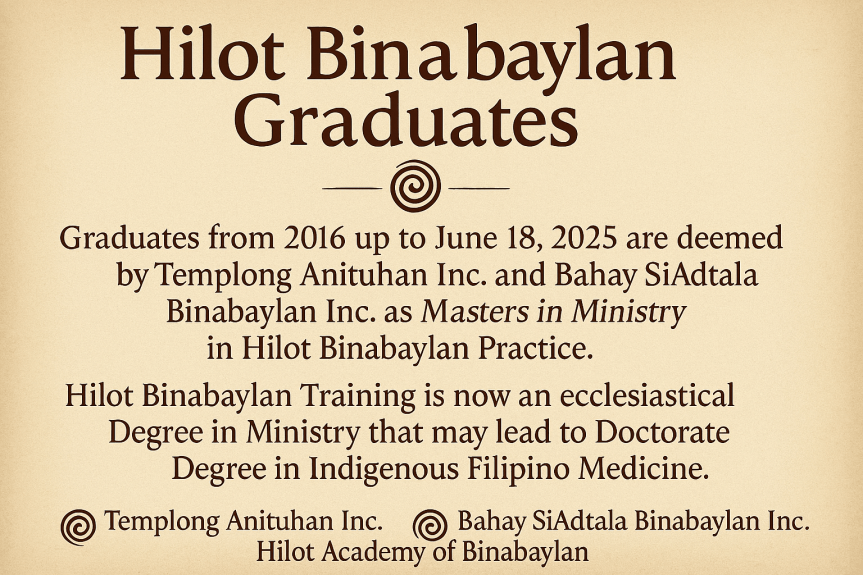
This day od 8th of August 2025- We joyfully proclaim that all graduates of the Hilot Binabaylan Training Program from 2016 up to June 18, 2025 are hereby recognized and conferred the title of Master of Ministry in Hilot Binabaylan Practice.

As a mark of this sacred recognition, graduates may now use the honorific suffix “M.Min.HBp”, signifying their credential as Master of Ministry in Hilot Binabaylan Practice.

This recognition is a testament to their dedication, spiritual growth, and mastery of Indigenous Filipino Healing Wisdom as taught through the sacred traditions of Luntiang Aghama and the ministerial guidance of Templong Anituhan.

Furthermore, we are honored to announce that the Hilot Binabaylan Training Program is now officially elevated to an Ecclesiastical Degree in Ministry, forming a foundational path that may lead to the Doctorate Degree in Indigenous Filipino Medicine.

This milestone affirms our commitment to preserving, honoring, and advancing the sacred healing arts of our ancestors, and to empowering future generations of Binabaylan Ministers to serve with wisdom, compassion, and divine purpose.

May this recognition inspire deeper service, healing, and spiritual leadership in our communities.

In the Spirit the Diwata, Engkanto Anito together with our Holy Ancestors, we celebrate this sacred elevation.

🌀 Templong Anituhan Inc.
🌀 Bahay SiAdtala Binabaylan Inc.
🌀 Hilot Academy of Binabaylan

🌀 Joint Ecclesiastical Resolution No. 08-08-2025

Templong Anituhan Inc. & Bahay SiAdtala Binabaylan Inc.

Subject: Recognition of Hilot Binabaylan Graduates (2016–2025) as Masters in Ministry and Elevation of Training Program to Ecclesiastical Degree Status

WHEREAS, the sacred teachings and practices of Hilot Binabaylan have been faithfully transmitted through the ministerial efforts of Bahay SiAdtala Binabaylan Inc. under the spiritual guidance of Templong Anituhan Inc.;

WHEREAS, the graduates of the Hilot Binabaylan Training Program from the year 2016 up to June 18, 2025 have demonstrated mastery in Indigenous Filipino Healing Wisdom and Spiritual Ministry;

WHEREAS, it is the divine will of the Diwata and the ancestral spirits that those who walk the path of healing and service be duly recognized and empowered;

NOW THEREFORE, be it resolved jointly by Templong Anituhan Inc. and Bahay SiAdtala Binabaylan Inc., that:

  1. All graduates of the Hilot Binabaylan Training Program from 2016 to June 18, 2025 are hereby recognized and conferred the ecclesiastical title of Master of Ministry in Hilot Binabaylan Practice.
  2. Said graduates may now officially use the suffix “M.Min.HBp” to signify their credential and spiritual authority in the practice of Hilot Binabaylan Ministry.
  3. Effective January 2026, all individuals seeking enrollment in the Hilot Binabaylan Training Program must submit verifiable credentials proving:
    • healthcare-related educational background, and/or
    • Completion of the Ecclesiastical Bachelor’s Degree in Aghamic Divinity and Ministry.
  4. This resolution affirms the elevation of the Hilot Binabaylan Training Program to an Ecclesiastical Degree in Ministry, forming a pathway toward the Doctorate Degree in Indigenous Filipino Medicine.

RESOLVED FURTHER, that this resolution be made known to all affiliated ministers, clergy, and educational institutions under the spiritual jurisdiction of Templong Anituhan Inc. and Bahay SiAdtala Binabaylan Inc.

Signed this 8th day of August, 2025
In the Spirit of the Diwata, Engkanto and Anito

Signed:

Rev. Alvin L. Sentin D.D.Min IFS IFM aka Lakay Magbaya

Director on Local Community Affairs Relations

Rev. Rolando G. Comon D.D.Min. IFS IFM aka APU ADMAN

Founder/Program Director

Rev. Maria M. Haswell D.D.Min IFS IFM aka BAE AKUMA

Director on International Affairs Relations

📢 Public Advisory: On the Protection of Hilot as a Shared Cultural Heritage

Issued by:
Templong Anituhan ng Luntiang Aghama
Hilot Academy of Binabaylan
In solidarity with Independent Manghihilot Practitioners


🛑 Warning Against Monopolization of Hilot

We issue this advisory to caution any organization, institution, or individual that attempts to monopolize the practice of Hilot by claiming exclusive authority or ownership over this sacred tradition.

Hilot is a shared cultural and spiritual heritage of the Filipino people. It is not a proprietary system, nor can it be restricted to a single group or entity.


⚖️ Legal Basis

The following laws protect the right of all Filipinos to practice Hilot:

  • 1987 Philippine Constitution
    • Article XIV, Sections 17–22: Protects indigenous cultural communities and their traditions.
    • Article III, Section 5: Guarantees freedom of religion and spiritual practice.
  • Republic Act No. 8371 – Indigenous Peoples’ Rights Act (IPRA)
    • Recognizes the right of Indigenous Peoples to preserve and develop their traditional healing systems.
  • Republic Act No. 10066 – National Cultural Heritage Act of 2009
    • Prohibits the misappropriation or exclusive control of cultural heritage.
  • Republic Act No. 8423 – Traditional and Alternative Medicine Act (TAMA)
    • Encourages the development of traditional health care without monopolization.

🏛️ Government Agencies and Cultural Institutions Responsible for Oversight

We call on the following agencies to uphold and protect the inclusive practice of Hilot:

  • National Commission for Culture and the Arts (NCCA) – Lead agency for cultural heritage protection
  • National Museum of the Philippines – Preserves and documents Filipino cultural heritage
  • National Historical Commission of the Philippines (NHCP) – Conserves historical and intangible heritage
  • Komisyon sa Wikang Filipino (KWF) – Promotes indigenous languages and cultural expressions
  • Philippine Council for Health Research and Development (PCHRD – DOST) – Maintains the TKDL on traditional health knowledge
  • Department of Health (DOH) – PITAHC – Regulates traditional medicine within the formal health system

📣 Our Stand

We affirm that:

  • Hilot is a sacred calling, not a commercial brand.
  • No organization has the legal or moral right to claim exclusive ownership of Hilot.
  • Manghihilot practitioners, whether PITAHC-certified or not, have the constitutional and ancestral right to practice Hilot in accordance with their traditions.

🤝 Call to Action

We call on:

  • Government agencies to uphold the rights of traditional healers.
  • Cultural institutions to protect Hilot as a living heritage.
  • Communities and practitioners to stand united against exclusion and monopolization.

✍️ Issued this 4th day of August 2025

Rev. Rolando Gomez Comon
Chief Priest, Templong Anituhan ng Luntiang Aghama
Founder/Program Director Hilot Academy of Binabaylan