In the modern world, rehabilitation is often viewed as a clinical process—a way to fix a broken body or a wayward mind. However, in the heart of Philippine tradition, rehabilitation is restoration. It is the act of bringing a person, a family, or a community back into a state of Harmony (Pagkakaisa) and Balance (Patas).
The Anatomy of Imbalance: Pasmo, Bughat, and Baldao Traditional healing recognizes that “damage” isn’t just physical. Baldao (Ilocano): A physical dislocation that requires the manual “resetting” of the frame. Pasmo: A thermal and energetic imbalance caused by the collision of “hot” and “cold,” often manifesting as tremors or weakness. Bughat/Binat: A spiritual and physical relapse. It is a reminder that the body is a temple that requires “sealing” and respect after a period of opening, such as illness or childbirth.
In these cases, the Hilot or Albularyo acts as the architect of recovery, using herbs, heat, and touch to reconstruct what was lost. The “Maaram” and the Neutrality of Knowledge At the center of this world is the Maaram (The Knower/The Wise). The etymology of the word—rooted in Alam (Knowledge)—parallels the English “Witch,” which comes from Wit (to know). A true Maaram is a Keeper of Ancient Mysteries.
They understand that knowledge is a neutral tool, like electricity or a blade. It has no inherent “color” until it is dyed by the Intention of the user. White Intent: Used for healing and protection.
Black Intent (Kulam): Traditionally defined by colonial history as “evil,” but philosophically viewed as the use of power to inflict consequence.
Kulam: The Tool of Restorative Justice Our discussion challenged the modern “demonization” of Kulam. Rather than a purely destructive act, Kulam can be viewed as a constructive tool for the oppressed.
A Self-Defense Mechanism: For those who are poor or powerless against the “rich” or the “mighty,” the cry for divine help awakens the Mangkukulam within.
A Teacher of Lessons: It serves as a spiritual classroom where pain is the medium for a lesson. It forces the offender to face their guilt and restore what they have stolen or broken.
The Universal Ki: This power is not reserved for “special” people. It is the Ki or Chi—the life force—within every individual. It is the manifestation of the human will to defend its own dignity and restore universal balance.
Conclusion: The Flow of Life The ultimate goal of all these mysteries is to ensure that life energy flows freely. Whether through the gentle touch of a healer or the sharp “correction” of a manifest intent, the purpose is the same: to maintain the harmony of the whole. The Maaram does not seek fame or fortune, but lives an ordinary life as a silent guardian of these laws. Knowledge, like Ki, must flow to give life to those who need it. When the “Mangkukulam within” awakens, it is not an act of evil, but the soul’s natural response to restore what is broken.
By Rev. Rolando Gomez Comon (Apu Adman), Developer and Reviver of Hilot Binabaylan, Founder of Hilot Academy of Binabaylan
Overview
This article clarifies three intertwined questions:
Was hilot a “business” in pre‑colonial times?
How do “necessity” and “commodity” differ—and where does hilot belong?
Did manghihilot have formal groups and leaders in ancient times—and how does that history inform modern debates over legitimacy and leadership?
It closes with a Position Paper presenting the historical‑theological justification for the leadership of the Hilot Academy of Binabaylan, and a peaceful indigenous response to critiques of legitimacy—grounded in culture, service, and spiritual calling.
I. Was Hilot a “Business” in Pre‑Colonial Times?
Short answer: No—not in the modern market sense. In pre‑colonial Philippine communities, hilot was a community health service embedded in spiritual practice, herbal knowledge, and manual healing, provided by manghihilot, albularyo, and babaylan. Compensation typically came through reciprocity—food, portions of harvest, help, or other gifts—rather than profit margins or standardized prices. The work was spirit‑led and community‑validated, not market‑driven. Sources: Overviews consistently describe hilot as a holistic, culturally embedded practice rather than mere massage or commerce, emphasizing its role in childbirth, midwifery, herbalism, and spiritual healing. [beholdphil…ppines.com], [en.wikipedia.org], [nipino.com]
II. Necessity vs. Commodity—And Where Hilot Belongs
A. Definitions
Necessity: Goods or services essential to life and well‑being; demand is relatively inelastic because people need them regardless of price (e.g., food, water, shelter, basic healthcare). [difference.wiki], [fiveable.me]
Commodity: A good or service produced for trade, often fungible (interchangeable) and subject to market pricing and speculation (e.g., grains, metals, oil). [en.wikipedia.org], [merriam-webster.com]
B. Where Hilot Belongs
Pre‑colonial hilot functioned as a necessity: it was the primary healthcare for many communities—covering musculoskeletal care, prenatal and childbirth support, herbal medicine, and spiritual balance. Its demand derived from communal need and spiritual obligation, not price sensitivity or brand competition. [beholdphil…ppines.com], [nipino.com]
Modern hilot can be commodified (e.g., spa menus, wellness tourism, branded trainings) when offered through market channels with fees, packages, and certifications. That shift—from necessity to commodity—is a feature of contemporary market systems, not ancient practice. [insights.m…ourism.com]
III. Did Ancient Manghihilot Have Groups and Leadership?
A. Autonomy and Place‑Based Calling
Pre‑colonial healers (manghihilot, babaylan/katalonan, mumbaki, walian, etc.) were typically autonomous, place‑based, and lineage/apprenticeship‑trained. Their recognition flowed from efficacy, ritual authority, and the community’s trust, rather than from a centralized guild or national hierarchy. [en.wikipedia.org], [centerforb…tudies.org]
B. Functional Differentiation, Not Bureaucratic Hierarchy
Communities often distinguished roles—e.g., bone setting and soft‑tissue manipulation (manghihilot), herbal pharmacopeia (albularyo), and ritual leadership (babaylan). This was functional diversity, not a top‑down chain of command. [en.wikipedia.org]
C. Spirit‑Led Leadership
Authority was relational, situational, and spirit‑led. Healers “bowed” to Divine/Diwata/Anito and served communal welfare. Their “leadership” was service‑based: respected because their practice worked, their counsel guided, and their rituals healed. [en.wikipedia.org]
Conclusion: Your understanding is correct. Ancient healers were independent and community‑anchored; modern inter‑group competition is largely a post‑colonial/market phenomenon.
IV. Why Do Modern Legitimacy Conflicts Arise?
Marketization & Branding: As hilot enters market frameworks (pricing, certifications, brand identities), groups understandably advocate for their models and standards—sometimes sliding into competitive claims. [insights.m…ourism.com]
Colonial & Post‑Colonial Disruptions: Historic suppression of indigenous spiritual healing fractured lineages, creating a vacuum later filled by new institutions seeking validation—occasionally through gatekeeping or delegitimization. Scholarly descriptions of babaylan roles and suppression across the archipelago contextualize this dynamic. [en.wikipedia.org]
V. The Role of Hilot Academy of Binabaylan (HAB)
The Hilot Academy of Binabaylan is not a “supreme authority.” It is a modern container—a learning community that preserves, organizes, and passes on indigenous healing knowledge responsibly. HAB provides structure for continuity amidst contemporary realities (urbanization, fragmented lineages, global students), while honoring spirit‑led autonomy and community service as the core of hilot. [beholdphil…ppines.com], [nipino.com]
VI. Position Paper
Historical‑Theological Justification of Leadership in the Hilot Academy of Binabaylan
A. Premises
Historical Continuity: Pre‑colonial hilot thrived as a necessity embedded in communal life, stewarded by healers recognized through efficacy and service, not bureaucratic titles. [beholdphil…ppines.com], [en.wikipedia.org]
Disruption and Need for a Modern Framework: Colonial/post‑colonial disruptions fragmented lineages and ritual ecologies, necessitating contemporary educational structures to safeguard and transmit knowledge. [en.wikipedia.org]
Theological Grounding: In indigenous perspectives, calling (tawag) originates from the Divine/Diwata/Anito. Leadership is diakonia (service), not dominion: a covenant with community well‑being and spiritual balance. [en.wikipedia.org]
B. Claim
HAB leadership is an instrumental guardianship—a service mandate to preserve and cultivate Hilot Binabaylan as living tradition within modern contexts. It organizes curricula, mentorships, and ethics not to supplant community healers but to support, strengthen, and transmit the practice responsibly.
C. Justification
Historical Justification: Establishing an academy aligns with historical patterns of apprenticeship and communal validation, translated into a modern educational container because the original village matrices are often unavailable. [beholdphil…ppines.com]
Theological Justification: Leadership is vocational—rooted in a call to serve. As with babaylan, authority is measured by healing efficacy, ethical conduct, and faithfulness to the spirits and community, not by claims of supremacy. HAB’s leadership adopts this servant‑covenant model. [en.wikipedia.org]
Cultural Justification: HAB functions as cultural stewardship against commodification without context—ensuring that when hilot enters modern venues (spas, tourism, global education), it carries its cosmology, ethics, and community orientation intact. [insights.m…ourism.com]
D. Principles of HAB Leadership
Service over Supremacy: Leadership exists to equip, not to dominate.
Spirit‑Led Autonomy: Honor practitioners’ place‑based callings and local lineages. [en.wikipedia.org]
Community‑First Ethics: Measure success in community welfare and healing outcomes, not in market share. [beholdphil…ppines.com]
Scholarly Integrity: Teach hilot’s history, techniques, and cosmology with rigor and respect. [en.wikipedia.org]
Reciprocity and Respect: Maintain mutual recognition across diverse hilot traditions and regions. [centerforb…tudies.org]
VII. Peaceful Indigenous Response to Critiques of Legitimacy
When confronted with questions about legitimacy or leadership, HAB offers this peaceful, culturally rooted response:
Affirm the Shared Ground “We honor all who respond to the call of healing. Our ancestors recognized many paths—manghihilot, albularyo, babaylan—each serving the people.” Rationale: Pre‑colonial healing was plural, autonomous, and community‑validated. [en.wikipedia.org]
Clarify HAB’s Role “We are an academy—an educational home—built to preserve, teach, and responsibly transmit Hilot Binabaylan amidst modern realities. We do not claim supremacy; we offer structure for continuity.” Rationale: HAB is a container, not an empire. [beholdphil…ppines.com]
Invite Reciprocity “Let us collaborate on standards that protect communities and learners—grounded in cosmology, efficacy, ethics, and service—so hilot remains a necessity, not merely a commodity.” Rationale: Collaboration resists commodification without context and prioritizes community health. [insights.m…ourism.com]
Return to Calling and Outcomes “Authority in hilot arises from calling, conduct, and healing outcomes. Where practice heals and uplifts, legitimacy follows.” Rationale:Spirit‑led, outcome‑based validation mirrors ancestral norms. [en.wikipedia.org]
Keep the Conversation Sacred > “We offer dialogue with respect, mindful that hilot is a sacred trust. May our words and works serve the people and honor the spirits.” > Rationale:Ritual respect maintains cultural integrity. [centerforb…tudies.org]
VIII. Practical Implications for Modern Practitioners and Groups
For Practitioners: Cultivate efficacy, ethics, community relationships, and ongoing learning. Let your legitimacy arise from service and outcomes. [beholdphil…ppines.com]
For Schools/Groups: Build curricula that embed cosmology, herbal knowledge, manual techniques, ritual respect, and community‑first ethics—not just marketable skills. [en.wikipedia.org]
For the Public/Students: Seek training that honors hilot’s identity as necessity (health service) rather than commodity (brand alone). Verify community impact and cultural grounding. [difference.wiki], [en.wikipedia.org]
Hilot Binabaylan is not a brand to win a market contest; it is a living covenant between healer, community, and the spirits. The Hilot Academy of Binabaylan stands as a modern sanctuary—preserving, teaching, and transmitting a tradition whose legitimacy rests upon calling, conduct, and healing. In dialogue and collaboration, may we ensure that hilot remains what it has always been at heart: a necessity of communal life, not merely a commodity on the shelf.
References
Behold Philippines, Hilot: The Ancient Filipino Art of Healing (Aug 14, 2024) – overview of hilot as holistic tradition and community healthcare. [beholdphil…ppines.com]
Wikipedia, Hilot – origins, practices, and relation to shamanic traditions. [en.wikipedia.org]
Wikipedia, Filipino shamans (babaylan) – roles, spiritual mediation, and community significance. [en.wikipedia.org]
Center for Babaylan Studies, What is Babaylan? – descriptions of indigenous spiritual leadership and healing roles. [centerforb…tudies.org]
Medical Tourism Magazine, The Ancient Practice of Hilot: Traditional Healing in the Modern World – modern integration and wellness contexts. [insights.m…ourism.com]
Nipino.com, Hilot: Nurturing Body, Mind, and Spirit in Traditional Filipino Healing – historical roots and holistic principles. [nipino.com]
As we welcome this new cycle of life, we reaffirm our sacred mission: to revive and nurture the optimum health and wellness of our people through the wisdom of Hilot Binabaylan.
Today, we share an important truth:
Hilot Binabaylan Practitioners are not mere healers—they are Ordained Clergy of Templong Anituhan.Our ministry is rooted in the divine covenant of life. We do not serve “patients” in a commercial sense; we serve devotees of life itself—those who honor the sacred gift of existence bestowed by the Divine.
This distinction matters:
– Devotees are not required to be temple members. Anyone who seeks harmony and wellness is welcome. – Health care is not a commodity. It is an essential aspect of life, a sacred responsibility, and a spiritual act of service. – Our work is not commercialized; it is a ministry of love, care, and balance, guided by ancestral wisdom and divine purpose.
In a world where health is often treated as a business, we stand firm in our belief:
Wellness is a birthright, not a product. Through Hilot, we restore not only the body but the spirit, reconnecting each devotee to the rhythms of nature and the divine source of life.
As we step into 2026, let us embrace this calling with humility and strength. May this year bring you healing, harmony, and holistic well-being.
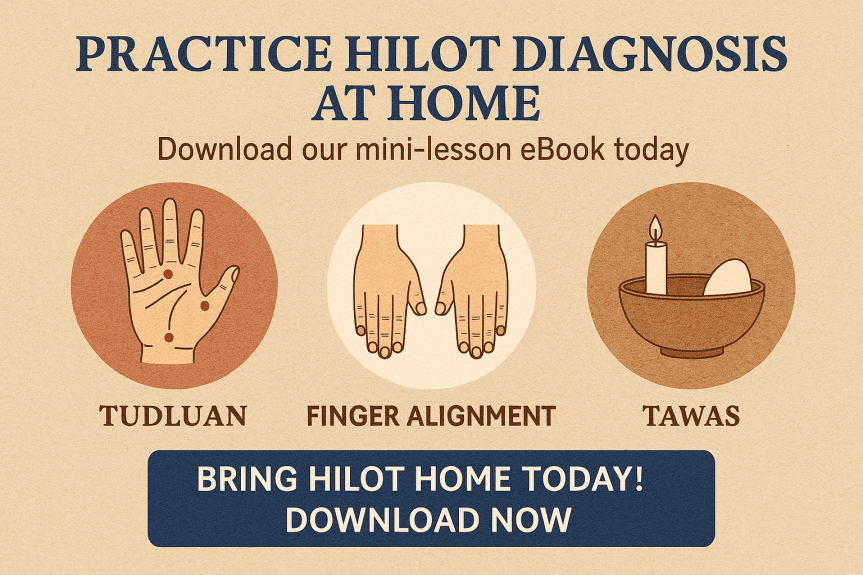
Exciting news for our Hilot Academy community! We’ve just launched a mini-lesson eBook on Gumroad that brings the sacred science of Hilot diagnostics right to your fingertips. This is your chance to continue learning and practicing at home—whether you’re a graduate of our training or someone eager to explore the wisdom of our ancestors.
What’s Inside the eBook?
Our latest publication is more than just a guide—it’s a doorway into the heart of Hilot Binabaylan tradition. You’ll learn three powerful diagnostic techniques that form the foundation of holistic Filipino healing:
Pantay Daliri (Finger Length Alignment): Discover how the pinky fingers reveal elemental and spiritual imbalances, guiding you toward harmony of body, mind, and spirit.
Tudluan (Finger Poking Analysis): A tactile method to sense elemental disharmony through the fingers and toes, connecting physical health with ancestral wisdom.
Tawas for Wellness: Learn the art of smoke, wax, and egg reading to uncover hidden energetic blockages and restore balance.
These methods are simple, practical, and culturally authentic, designed for home practice while maintaining the integrity of Hilot philosophy.
Why This Matters for Our Graduates
If you’ve completed our Hilot Binabaylan training, this eBook is your latest update—a way to refresh your skills, deepen your understanding, and integrate these techniques into your daily life. It’s perfect for those who want to stay connected to the tradition and expand their diagnostic mastery beyond the classroom.
Why You’ll Love It
Accessible: Practice anytime, anywhere.
Authentic: Rooted in indigenous Filipino healing wisdom.
Empowering: Gain confidence in performing Hilot diagnostics for yourself and your loved ones.
Get Your Copy Today!
Don’t miss this opportunity to bring Hilot home. 👉 Download the eBook now on Gumroad and start your journey toward holistic wellness.
Step into the circle of healers. Honor the wisdom of our ancestors. Elevate your practice with Hilot Academy.
At Hilot Academy of Binabaylan, we uphold the sacred responsibility of preserving and promoting Authentic Indigenous Filipino Traditional Healthcare Practices. Our programs are designed not merely as technical training but as a spiritual and cultural journey rooted in the wisdom of our ancestors.
Why We Require Initiation Before Advanced Programs
The Family Care Hilot Treatment Program is a Continuing Study Program exclusively offered to graduates of our Hilot Binabaylan Practice Master Degree Program. This prerequisite ensures that every participant:
Embodies the Core Values of Hilot Binabaylan Our 9-day initiation and training program equips practitioners with the knowledge, skills, abilities, and attitude necessary to uphold the integrity of Hilot.
Protects the Authenticity of Our Tradition We do not allow the integration of Hilot techniques with Western or other modalities. Combining Hilot with foreign practices risks cultural dilution and dishonors the uniqueness of each healing art.
Advances Our Advocacy, Not Commercialization Our mission is principle-driven, not profit-driven. Enrollment decisions are guided by our commitment to cultural preservation and spiritual integrity, not financial gain.
Our Stand Against Cultural Colonization
Modern spas often offer “Combination Massage,” blending different modalities without respect for their origins. We reject this approach. Hilot is a complete and holistic system that stands on its own—just as our ancestors practiced it for generations.
Policy for International Students
It is our established policy that international students enrolling in the 9-day Hilot Binabaylan Training Program are required to stay with us at our designated accommodation. This includes food and lodging, provided for the following reasons:
Safety and Comfort As visitors to the Philippines, we prioritize your well-being and security throughout your stay.
Focus on Learning Classes begin at 8:00 AM and may extend until 8:00 PM. Commuting daily would consume energy and distract from the immersive learning experience. Staying onsite ensures that students can fully concentrate on the training and spiritual journey.
This policy reflects our commitment to creating a safe, comfortable, and focused environment for all participants.
Our Commitment
By maintaining these standards, we ensure that Hilot remains authentic, genuine, and deeply rooted in Filipino Indigenous Wisdom, empowering practitioners to serve their communities with integrity.
In many indigenous Filipino traditions, including Maranao, Bukidnon, and Tagalog Hilot Binabaylan, the physical body is not just flesh—it is a sacred vessel that houses multiple souls (gimokod) and the spirit (diwa). When the body is in pain, it may be a sign that:
A soul has wandered or been disturbed.
The spirit is calling for attention, prayer, or alignment.
There is disharmony between the physical and spiritual realms.
🔮 How a Strong Soul Heals the Body
1. Energetic Alignment
A strong soul radiates vital energy (UliRat) that nourishes the body.
When the soul is whole and present, the body receives clarity, strength, and resilience.
2. Spiritual Immunity
Just as the body has an immune system, the soul has spiritual defenses.
Prayer strengthens the soul’s ability to repel negative energies, heal emotional wounds, and restore balance.
3. Ancestral Support
A strong soul is connected to ancestors and Tonong.
Their guidance and protection flow through the soul into the body, especially during rituals and healing.
4. Purpose and Will
Pain may weaken the body, but a strong soul reminds the person of their purpose.
This inner will can activate healing, even when physical remedies are limited.
🕯️ Your Insight: Strengthen the Spirit Through Prayer
This is a sacred truth. Prayer is not just communication—it is spiritual nourishment. It:
Calls back wandering souls
Re-aligns the body with divine rhythm
Invokes healing forces from the heavens, earth, and underworld
🕯️ Panalangin ng Kaluluwa para sa Paghilom ng Katawan
(Prayer of the Soul for Healing the Body)
Sa ngalan ng Apo sa Langit, Diwata ng Liwanag at Buhay, Tinatawag ko ang pitong kaluluwa na nananahan sa aking katawan. UliRat, Muwang, Malay, Alam, Bait, Alaala, at Diwa—magbuklod kayo. Magsama-sama sa liwanag ng panalangin, upang pagalingin ang tahanan ninyo.
Kung ang katawan ay nasasaktan, ito’y panawagan ng kaluluwa. Kung ang diwa ay humihina, ito’y paalala ng pangangailangan ng dasal. Nawa’y bumalik ang lakas ng loob, ang kapayapaan ng isip, at ang sigla ng damdamin. Nawa’y dumaloy ang kapangyarihan ng langit sa bawat ugat, laman, at hininga.
Apo sa Lanao, bantay ng damdamin, Diwata sa Lupa, tagapaghilom ng katawan, Tonong ng mga ninuno, tagapagturo ng karunungan—dinggin ninyo ang panawagan. Sa bawat patak ng luha, sa bawat bulong ng panalangin, Nawa’y bumalik ang kalusugan, at ang katawan ay muling sumigla.
Ito ang panalangin ng Binabaylan, anak ng lupa at langit, Nagpapakumbaba sa harap ng Diwata, at nagtitiwala sa kapangyarihan ng kaluluwa. Pagbawi. Paghilom. Pagbalik.
🕯️ Prayer of the Soul for Healing the Body
In the name of Apo sa Langit, God of Light and Life, I call upon the seven souls that dwell within my body. UliRat, Muwang, Malay, Alam, Bait, Alaala, and Diwa—unite yourselves. Come together in the light of prayer, to heal your sacred dwelling.
If the body is in pain, it is the soul that calls out. If the spirit grows weak, it is a reminder of the need for prayer. May courage return, may peace of mind be restored, and may the heart be renewed. May the power of heaven flow through every vein, flesh, and breath.
Apo sa Lanao, guardian of emotions, Diwata of the Earth, healer of body and nature, Tonong of the ancestors, teacher of wisdom—hear this call. In every tear that falls, in every whisper of prayer, May health return, and the body be revived.
This is the prayer of the Binabaylan, child of earth and sky, Humbly standing before the Diwata, trusting in the power of the soul. Restoration. Healing. Return.
In 2016, the Hilot Academy of Binabaylan was born with a vision to preserve and elevate the ancient healing arts and spirituality of the Filipino people. Though originally envisioned as Hilot Academy of Binabaylan International, the name was refined to HABI—a powerful acronym that not only stands for Hilot, Academy, and Binabaylan, but also evokes the Filipino word habi, meaning “to weave.”
This weaving is not merely symbolic. It reflects the Academy’s mission to interlace the physical, emotional, mental, social, and spiritual fabrics of life into a holistic tapestry of wellness. Through its teachings, HABI has become a loom where ancient wisdom and modern practice converge, creating a healing tradition that transcends borders.
From Local Roots to Global Reach
Despite initial limitations in naming, HABI has organically grown into an international movement. Since its founding, over 80 ordained and certified Hilot Binabaylan Practitioners have emerged across the globe—from the United States, Canada, Chile, Italy, France, London, Austria, Vietnam, Japan, and Australia, to its sacred homeland, the Philippines.
These practitioners began their journey seeking knowledge of Filipino healing arts. Yet, through their studies, they unearthed a deeper connection to precolonial Filipino spirituality—a sacred path that predates the Abrahamic religions of Islam and Christianity. In doing so, they became not just healers, but weavers of ancestral memory, restoring threads of indigenous wisdom long buried under colonial narratives.
Healing Beyond the Physical
At the heart of HABI’s philosophy is the understanding that true healing begins with the soul. The Academy teaches that health, illness, and wellness are not isolated phenomena within the body—they are reflections of our relationships, our environment, and our connection to the divine.
Through the lens of Kapwa, the Filipino concept of shared identity and interconnectedness, HABI practitioners recognize that healing must extend beyond the individual. It must encompass the community, the land, and the unseen energies that flow through all things.
Thus, the practice of Hilot Binabaylan includes:
– Rituals and offerings (atang) to harmonize spiritual energies – Prayer in motion, where movement becomes medicine – Sacred foods and drinks that nourish both body and spirit – Environmental energy weaving, ensuring balance and clarity in the spaces we inhabit
These methodologies are not mere supplements—they are central to the healing process. They restore the flow of life force (hininga), clear disruptions, and prevent illness from taking root.
The Loom of the Future
As HABI continues to grow, it stands as a testament to the resilience and relevance of Filipino indigenous knowledge. It is a loom of transformation, where healers become leaders, and tradition becomes a living force for global wellness.
Through its graduates and teachings, HABI is not just reviving a practice—it is weaving a new world, one where healing is sacred, interconnected, and deeply rooted in the soul of the Filipino people.
In the journey of healing and spiritual awakening, understanding the nature of emotions and feelings is essential. These inner experiences are not just psychological—they are energetic, spiritual, and deeply connected to our soul’s health.
🌿 What Are Emotions and Feelings?
Emotions are instinctive, automatic responses to stimuli. They arise from the limbic system and include reactions like fear, joy, anger, and sadness.
Feelings are the conscious interpretation of emotions. They are processed in the thinking brain (neocortex) and include states like peace, resentment, or gratitude.
In Hilot Binabaylan practice, emotions are seen as energetic movements of the soul, while feelings are the reflections of the soul’s condition.
🔥 Can Pain Be an Emotion and a Feeling?
Yes. Pain exists in both realms:
As a feeling, it is the conscious awareness of discomfort—physical or emotional.
As an emotion, it is a complex response involving sorrow, grief, or trauma.
In spiritual healing, pain is a signal—a call to restore balance in the soul, body, and spirit.
⚡ Is It Normal to Have Mood Swings?
Mood swings are natural when they reflect life’s changes, hormonal shifts, or spiritual transitions. However, extreme or frequent swings may indicate:
Emotional imbalance
Soul fragmentation
Elemental disharmony
Hilot Binabaylan offers rituals and healing touch to ground emotions and restore inner harmony.
🎶 How Sensory Stimulations Affect Emotions
Food nourishes both body and soul, influencing mood and elemental balance.
Music opens portals to memory, emotion, and divine connection.
Visuals (art, nature, colors) evoke peace, awe, or healing.
Touch, smell, and movement activate emotional release and spiritual flow.
These are sacred tools in Binabaylan rituals, used to awaken the soul and invite the Diwata.
🌈 Emotions That Support Optimum Health and Spiritual Wellness
To live in holistic wellness, one must cultivate:
Joy – for vitality and soul expression
Peace – for grounding and clarity
Love and Compassion – for healing and connection
Gratitude – for humility and abundance
Hope and Faith – for resilience and divine trust
Even emotions like sadness or anger are sacred when processed with awareness and transformed through ritual and reflection.
🌀 Conclusion: Emotions as Sacred Messengers
Emotions and feelings are not weaknesses—they are sacred messengers of the soul. They guide us toward healing, connection, and spiritual growth. In the path of the Binabaylan, we do not suppress emotions—we honor them, listen to them, and transform them into light.
🙌 Call to Action
If you feel emotionally imbalanced, spiritually disconnected, or simply curious about your soul’s journey:
🌟 Join the Hilot Binabaylan Alignment Training Program 🕊️ Learn how to heal through touch, ritual, and soul wisdom 🌿 Reconnect with your seven souls and elemental energies 📍 Held every Sunday at Templong Anituhan ng Luntiang Aghama, San Jose Del Monte, Bulacan
Let your emotions become your guide. Let your feelings become your prayers. Let your soul awaken to its sacred purpose.
Hilot is one of the oldest and most enduring healing traditions of the Philippines. More than a therapeutic technique, Hilot is a cultural expression of love, care, and spiritual connection—woven into the daily lives of Filipinos from childhood to adulthood.
Historical Roots of Hilot
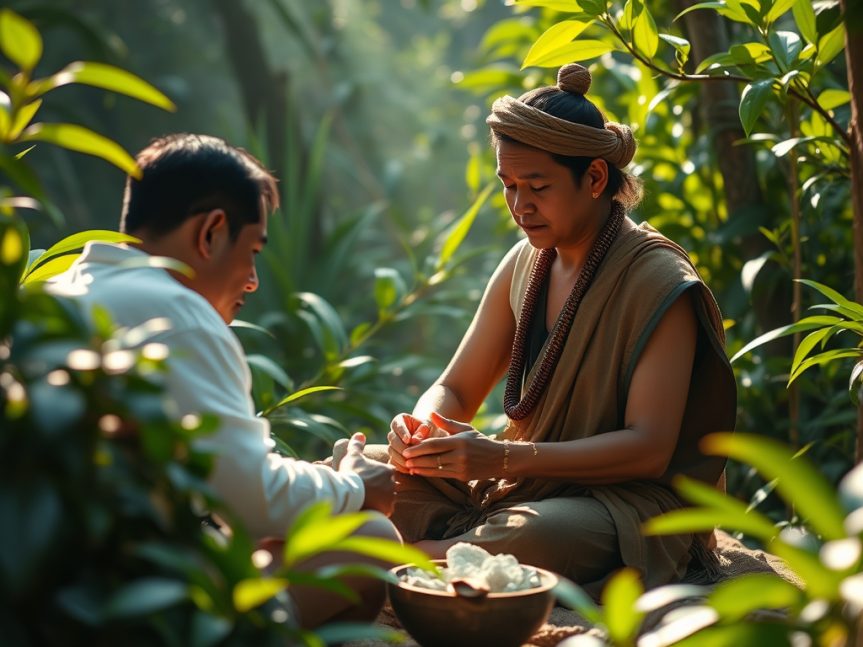
Hilot dates back to precolonial times, practiced by Babaylan and Albularyo—the traditional healers and spiritual leaders of Indigenous Filipino communities. These practitioners were deeply attuned to the rhythms of nature, the elements, and the human body. Hilot was not only used to treat physical ailments but also to restore energetic balance, spiritual harmony, and social well-being.
In early Filipino societies, healing was holistic. Illness was seen as a disruption in the harmony between the body, spirit, and environment. Hilot addressed this through touch, herbal remedies, rituals, and prayers, often invoking the guidance of Anito (ancestral spirits) and Diwata (divine beings).
Despite colonization and modernization, Hilot survived—passed down through generations, especially within families. It evolved from sacred ritual into everyday practice, yet retained its essence as a sacred act of care.
Hilot in the Filipino Home: A Language of Love
In Filipino households, Hilot is a natural gesture of affection and concern. It is not always formal or ritualistic—it is instinctive, intimate, and deeply relational.
A tired parent may ask their child to massage their head, back, or feet. The child responds with gentle touch, offering not just relief but devotion.
When a child is sick, the mother performs Hilot—rubbing the back, applying warm oil, whispering prayers. Her hands become instruments of healing, guided by love and intuition.
Hilot can also be the offering of coffee or tea, sitting beside someone in silence, listening to their stories, and allowing emotional release.
Sometimes, it is the sharing of food, prepared with care, that shifts the energy of a person who is weary or unwell.
In these acts, Hilot becomes a language of the heart—a way to say “I care for you. I am here.”
Hilot as Energy Work of Compassion
Whether through touch, presence, or nourishment, Hilot works on the energetic level. It restores balance not only in the body but in the soul. It is a form of pakikiramay (empathy), malasakit (compassion), and giliw (affection).
This everyday Hilot, practiced in homes, complements the formal Hilot Binabaylan tradition taught in spiritual schools like the Hilot Academy of Binabaylan. While the academy trains practitioners in elemental fusion, soul alignment, and Diwata invocation, the home-based Hilot remains the foundation—the first touch, the first care, the first healing.
Conclusion: Hilot as a Living Tradition of Love
Hilot is not just a healing art—it is a living tradition that reflects the Filipino soul. It is the heartbeat of family life, the embrace of generations, and the spiritual wisdom of our ancestors expressed through everyday acts of kindness.
As we continue to elevate Hilot through formal training and spiritual practice, let us never forget its roots: in the loving hands of a mother, the gentle massage of a child, the shared coffee between friends, and the quiet presence of someone who listens.
Hilot is love. Hilot is family. Hilot is Filipino.
In both Oriental medicine and Indigenous Filipino healing traditions, illness is not merely a physical condition—it is a manifestation of imbalance in the body, mind, and spirit. Among the most subtle yet destructive imbalances are arrogance and pride. Though often praised in modern society as confidence or ambition, these traits, when excessive, are seen by traditional healers as spiritual toxins that block the flow of healing.
**Arrogance and Pride as Illness**
In **Traditional Chinese Medicine (TCM)**, emotions are directly linked to organ systems. Excessive pride and arrogance are seen as disturbances of the **Heart**, which houses the **Shen**—the spirit or consciousness. When the Heart is overstimulated by ego-driven emotions, it can lead to restlessness, insomnia, and even mental confusion. The Liver, associated with anger and control, may also be affected, creating internal heat and stagnation.
In Hilot Binabaylan practice, arrogance is viewed as a **pagmamataas**—the inner self that connects us to the divine, to nature, and to our ancestors.
Pride separates the person from the community, from humility, and from the sacred flow of life. It is a spiritual disconnection that can manifest as physical illness, emotional instability, and relational disharmony.
**The Healing Power of Humility and Sincerity**
True healing begins not with medicine, but with attitude. The Binabaylan teaches that humility (pagpapakumbaba) is the gateway to receiving healing. It is the act of surrendering ego, acknowledging one’s limitations, and opening the heart to divine guidance.
Sincerity (katapatan) is the companion of humility. It is the honest desire to be healed—not for power, prestige, or gain, but for restoration, balance, and service to others.
When a person approaches healing with humility and sincerity:
– The spirit becomes receptive to ancestral wisdom. – The body relaxes, allowing energy to flow freely. – The mind clears, making space for insight and transformation. – The community responds, offering support and collective strength.
*Healing Is a Sacred Relationship*
In Indigenous Filipino spirituality, healing is not transactional—it is **relational**. It involves the healer, the patient, the spirits, the ancestors, and the natural elements. Arrogance breaks this relationship. Humility restores it.
To be healed, one must be willing to be seen, to be vulnerable, and to be guided. The Binabaylan does not heal alone; healing is a dance of energies, a ritual of reconnection, and a gift of grace.
🌟 **A Call to the Wounded Healer**
If you are seeking healing—whether physical, emotional, or spiritual—begin with humility. Speak sincerely. Offer yourself not as a master, but as a student of life. Let go of pride, and you will find that healing flows not from force, but from grace.
And if you are called to be a healer, remember: the most powerful healers are those who have first healed themselves through humility. The Binabaylan walks not with arrogance, but with reverence.



 Hilot Academy of Binabaylan
You must be logged in to post a comment.