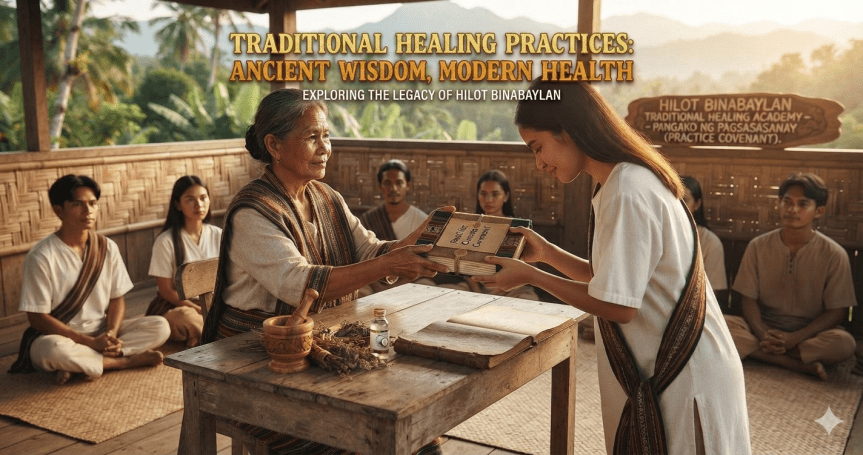
When you graduate from a conventional university, you walk away with a degree, a cap, and a clear path toward state licensure. But what happens when you graduate from an academy dedicated to ancient, lineage-based healing methods?
In institutions teaching ancestral arts like Hilot Binabaylan, graduation looks a bit different. Graduates often sign a document called a Practice Covenant. While it reads like a deeply formal contract, its purpose, legal status, and boundaries are unique.
Let’s break down exactly what these traditional agreements mean, why violating them is not a crime, and how Philippine law actually protects this rich cultural heritage.
What is a “Practice Covenant”?
A Practice Covenant is a voluntary agreement between a traditional training academy and its graduates. Rather than acting as a standard corporate employment contract, it serves as a moral compass and a spiritual bond.
The primary goal of the agreement is stewardship. It ensures that the practitioner handles ancestral healing knowledge with respect, integrity, and cultural accuracy.
The typical covenant centers around five core pillars:
- Ancestral Honor: Committing to preserve the cultural and traditional roots of the practice.
- Ethical Practice: Promising to use the knowledge exclusively for healing and never for exploitation or harm.
- Spiritual Alignment: Viewing the craft as a holistic calling tied deeply to nature and community.
- Community Service: Pledging to support those in need and help others connect with their cultural roots.
- Lifelong Mentorship: Maintaining an active link to the academy for continuous education and community gathering.
The Legal Reality: Breaking the Covenant is NOT a Crime
Because these documents use serious legal and formal language, a common point of confusion arises: If a practitioner breaks one of these rules, are they breaking the law?
The short answer is no.
Under the statutory laws of the land, an internal organizational covenant carries absolutely zero criminal liability. Because this is an internal ethical and spiritual code, failing to live up to its standards will never result in:
- Police intervention or criminal records
- Lawsuits in public, civil courts
- Government fines or jail time
How Is It Enforced?
Accountability remains strictly internal and institutional. If a practitioner behaves unethically or violates the spirit of the tradition, the academy relies on community-based remedies:
- Spiritual Counsel: Offering peer guidance to correct the practitioner’s course.
- Healing Intervention: Peer-led remediation to address behavioral issues.
- Withdrawal of Recognition: The academy’s ultimate recourse. They possess the legal right to strip the individual of their institutional titles, official certifications, and endorsement within their professional healing network.
Ultimately, the practitioner remains a free citizen under civil law. They can switch careers or walk away from the practice at any moment without facing legal penalties.
How Philippine Law Protects Traditional Healers: The TAMA Act (RA 8423)
You might wonder how an academy has the right to issue these titles and agreements in the first place. The answer lies in a landmark piece of legislation: Republic Act No. 8423, also known as the Traditional and Alternative Medicine Act (TAMA) of 1997.
Authored by Senator Juan Flavier, the TAMA Act completely changed how the Philippine government views indigenous healing systems. It protects and legitimizes practices like Hilot through several key mechanisms:
1. Creation of PITAHC
The law established the Philippine Institute of Traditional and Alternative Health Care (PITAHC), an attached agency of the Department of Health (DOH). PITAHC is specifically tasked with respecting, promoting, and integrating traditional medicine into the national healthcare delivery system.
2. Ownership of Indigenous Knowledge
The TAMA Act explicitly recognizes that indigenous societies own their traditional medical knowledge. The state provides a legally workable basis to ensure that outsiders cannot exploit ancestral recipes, rituals, or healing systems without permission, recognition, and proper financial sharing with the community.
3. Protection, Not Criminalization
As long as traditional or spiritual healing is performed in a safe, responsible, and non-deceptive manner, RA 8423 ensures it is fully legal. It acknowledges that spiritual and natural remedies are a vital part of primary healthcare, especially in rural areas with limited access to modern hospitals.
(Note: The law only steps in if a practitioner claims they can “cure all diseases,” explicitly misleads people, or stops critically ill patients from seeking emergency hospital care.)
The Takeaway
An organizational practice covenant is a beautiful bridge between ancient tradition and modern administrative structure. It provides traditional academies a way to protect the purity of their lineage while keeping accountability purely within their own community walls. Backed by the TAMA Act, it allows indigenous healing systems to thrive legally, responsibly, and respectfully.
What are your thoughts on traditional covenants versus standard state licensing? Let us know in the comments below!

