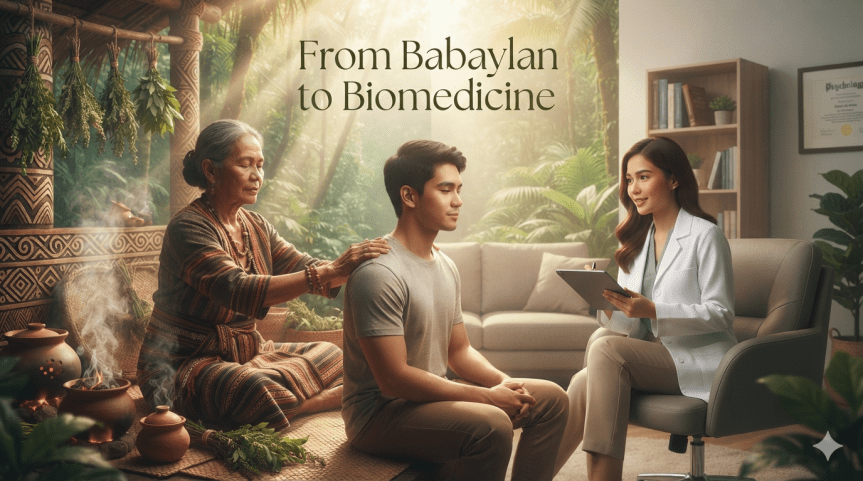
For decades, we have looked at conditions like depression, anxiety, ADHD, bipolar disorder, and autism strictly through a Western, clinical lens. We talk about chemical imbalances, neural pathways, and diagnostic manuals. But long before European ships arrived on our shores, our ancestors were already navigating the deep complexities of human behavior, mood shifts, and neurodivergence.
They did not have words like “psychiatry” or “neurodevelopmental,” yet they had a sophisticated, deeply empathetic system for understanding the mind and the spirit.
By looking back at our pre-colonial past, we can bridge the gap between ancient wisdom and modern science, discovering how traditional practices like Hilot Binabaylan can work hand-in-hand with modern medicine today.
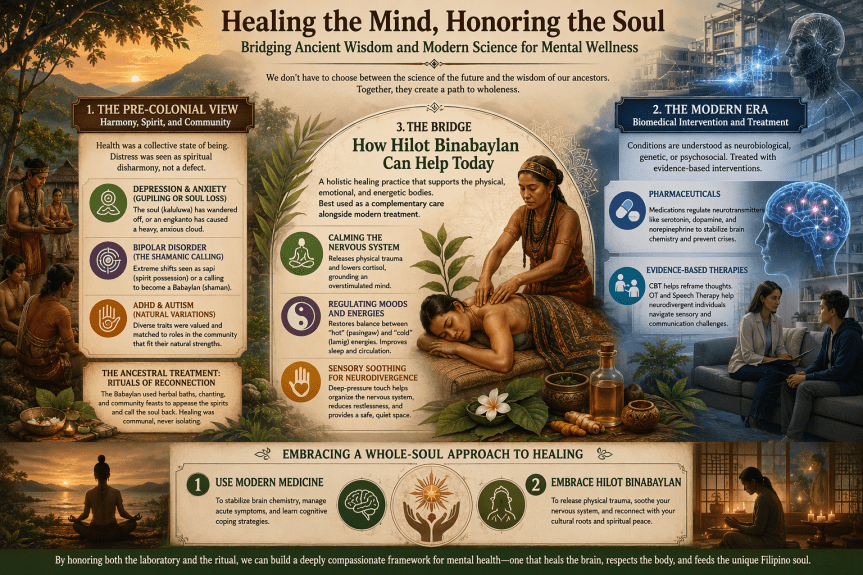
1. The Pre-Colonial View: Harmony, Spirit, and Community
In the pre-colonial Philippines, health was not an individual asset; it was a collective state of being. Life was dictated by kapwa (shared identity), kalikasan (nature), and the spirit world. Our ancestors did not view psychological distress or alternative ways of thinking as biological “defects.” Instead, they framed them through spiritual harmony or disharmony.
Here is how the traits of modern mental health conditions were understood and responded to by pre-colonial communities:
- Depression and Anxiety (Gupiling or Soul Loss): Intense grief, worry, or trauma were often seen as a state where the kaluluwa (soul) had wandered off or been startled away from the body. It could also mean a person had accidentally offended an engkanto (nature spirit), causing a heavy, anxious cloud to settle over them.
- Bipolar Disorder (The Shamanic Calling): Sudden, extreme shifts between deep melancholy and high-energy, ecstatic states were rarely feared. Instead, someone who spoke to unseen beings, sang erratically, or entered deep, trance-like states was often viewed as experiencing sapi (spirit possession) or receiving a calling to become a Babaylan (shaman).
- ADHD and Autism (Natural Variations in Character): In a society focused on tribal survival, diverse skills were highly valued. There were no rigid, standardized corporate offices or classrooms. A person with hyper-focus (Autism) might become a master craftsman or weaver. A person with high energy and hyper-awareness (ADHD) might excel as a specialized hunter or gatherer. They were simply integrated into roles that matched their natural traits.
The Ancestral Treatment: Rituals of Reconnection
When someone’s spirit was broken or imbalanced, the village did not isolate them. The Babaylan would step in to conduct rituals. They used herbal baths, chanting, and community feasts to appease the spirits and gently entice the wandering soul back into the body. Healing was a communal event designed to bring the individual back into the fold of the tribe.
2. The Modern Era: Biomedical Intervention and Treatment
As the centuries progressed through Spanish and American colonization, the Western medical framework took root. Today, the global scientific community recognizes these conditions as distinct neurobiological, genetic, or psychosocial dysfunctions. Modern medicine treats them using rigorous, evidence-based interventions:
- Pharmaceuticals: Medications like Antidepressants (SSRIs) for depression/anxiety, Mood Stabilizers (like Lithium) for bipolar disorder, and Stimulants for ADHD help regulate neurotransmitters like serotonin, dopamine, and norepinephrine. They stabilize the biological “thermostat” of the brain.
- Evidence-Based Therapies: Practices like Cognitive Behavioral Therapy (CBT) help individuals reframe negative thought patterns, while specialized interventions like Occupational Therapy (OT) and Speech Therapy assist neurodivergent individuals (such as those on the autism spectrum) in navigating sensory processing and communication.
Modern medicine provides the clinical precision and biochemical support necessary to manage severe symptoms, prevent crises, and help individuals function in a fast-paced, modern world.
3. The Bridge: How Hilot Binabaylan Can Help Today
Can an ancient practice coexist with modern psychiatry? Absolutely. Hilot Binabaylan—formally recognized by the Philippine Institute of Traditional and Alternative Health Care (PITAHC)—is far more than a physical massage [↑]. It is a holistic healing science that targets the intersections of the physical, emotional, and energetic bodies.
When used as a complementary, supportive care system alongside modern medical treatment, Hilot offers profound benefits:
Calming the Nervous System
Chronic anxiety and depression cause the physical body to hoard stress, tightening the muscles, veins (urat), and tendons (pennet). A skilled manghihilot uses physical manipulation and warming herbal oils to release this physical trauma. This process lowers cortisol (stress hormone) levels and grounds an overstimulated mind.
Regulating Moods and Energies
In traditional medicine, bipolar cycles can be viewed as extreme shifts between “hot” (pasingaw) and “cold” (lamig) bodily energies. Hilot focuses on clearing energetic blocks to restore equilibrium. Furthermore, the deep relaxation induced by Hilot improves circulation and promotes better sleep, which is critical for preventing manic or depressive episodes.
Sensory Soothing for Neurodivergence
For individuals with ADHD or Autism, the world can be an overwhelming sensory minefield. The predictable, deep-pressure touch of an authentic Hilot session acts much like a weighted blanket. It helps organize the nervous system, reduces physical restlessness, and provides a safe, quiet environment to unwind without the pressure of verbal communication.
Embracing a Whole-Soul Approach to Healing
We do not have to choose between the science of the future and the wisdom of our ancestors. The safest, most empowering path forward is a beautifully blended approach:
- Use Modern Medicine to stabilize brain chemistry, manage acute clinical symptoms, and learn cognitive coping strategies.
- Embrace Hilot Binabaylan to release physical trauma from your muscles, soothe your nervous system, and reconnect with your cultural roots and spiritual peace.
By honoring both the laboratory and the ritual, we can build a deeply compassionate framework for mental health—one that heals the brain, respects the body, and feeds the unique Filipino soul.
If you enjoyed exploring this intersection of history and healing, let me know what caught your attention! Would you like to read a deep-dive blog post into specific indigenous herbs used for mental calming, or learn more about how modern Filipino psychologists combine culture and science?

