For decades, the global wellness movement has looked to the East for answers to emotional burnout, trauma, and anxiety. Millions of people routinely discuss clearing their Chakras, moving their Prana, or adopting an Ayurvedic diet.
But while these systems are beautiful and ancient traditions deeply rooted in India, they often feel like an imported, foreign vocabulary to the modern Filipino.
What if the answers to our emotional and psychological struggles didn’t require borrowing foreign concepts? What if our ancestors already mapped out a highly sophisticated, localized subtle energy body—a native “Filipino Chakra System”—designed specifically to diagnose and treat the human mind, body, and spirit?
By looking into the traditional beliefs of indigenous groups like the Mamanwa people and analyzing the core DNA of the Filipino language, we can piece together a powerful, decolonized framework for mental health and holistic healing.
Reclaiming the Subtle Body: The 7 Facets of the Filipino Soul
Unlike Western models that view the mind as a machine or Indian systems that view energy as spinning wheels along the spine, traditional Filipino cosmology views human consciousness as a collective family of seven distinct soul-facets.
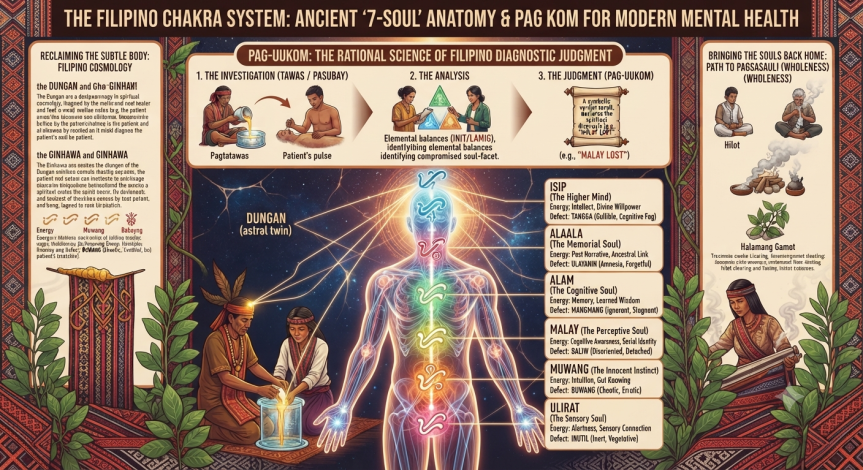
Housed within the overarching vessel of our astral twin—the Dungan—these seven facets act as spiritual co-workers. When they are aligned, we experience complete vitality (Ginhawa). When they are fractured, shocked, or displaced, we fall into specific states of mental, emotional, or physical illness.
By mapping the natural vocabulary of Filipino awareness, we reveal our native energy centers and their pathological opposites:
                  [ 7. ISIP ]  ----------> Defect: Tanga / Tulala
                       |
                 [ 6. ALAALA ] ----------> Defect: Kalimot / Ulyanin
                       |
               [ 5. BAIT/KATINUAN ] ----> Defect: Sira / Nawala sa Katinuan
                       |
                  [ 4. ALAM ]  ----------> Defect: Mangmang
                       |
                 [ 3. MALAY ]  ----------> Defect: Baliw
                       |
                 [ 2. MUWANG ] ----------> Defect: Buwang
                       |
                [ 1. ULIRAT ]  ----------> Defect: Inutil
1. Ulirat (The Sensory Soul)
- The Energy: Your physical alertness and sensory connection to the immediate present.
- The Sickness (Inutil): When Ulirat is severed, the body becomes inert, paralyzed, or vegetative—present in form but completely unresponsive to the environment.
2. Muwang (The Innocent Instinct)
- The Energy: Your primordial, instinctual knowing, pure gut intuition, and childlike emotional center.
- The Sickness (Buwang): When Muwang is shattered by deep trauma or shock, a person becomes buwang—acting wildly erratic, chaotic, and ungrounded.
3. Malay (The Perceptive Soul)
- The Energy: Active, cognitive awareness; knowing who you are, where you are, and awakening to your social identity.
- The Sickness (Baliw): If a terrifying experience causes the Malay to flee, a person becomes baliw—completely detached from shared reality and experiencing spiritual disorientation.
4. Alam (The Cognitive Soul)
- The Energy: The accumulator of wisdom, skills, memory, and learned capabilities.
- The Sickness (Mangmang): A closing of this energy center results in being mangmang—an inability to process lessons, adapt, or absorb knowledge.
5. Bait / Katinuan (The Moral Soul)
- The Energy: Your ethical compass, reason, sanity, and capacity for kabutihang-loob (inner goodness).
- The Sickness (Sira ang Bait): A total collapse of empathy, conscience, and moral grounding, leading to malicious or unhinged sociopathic behavior.
6. Alaala (The Memorial Soul)
- The Energy: Your connection to your past, your personal narrative, and the ancestral line.
- The Sickness (Kalimot / Ulyanin): A severed link to time, resulting in severe forgetfulness, amnesia, or dementia—floating through life without a historical anchor.
7. Isip (The Higher Mind)
- The Energy: The crowning zenith of intellect, critical strategy, execution, and divine willpower.
- The Sickness (Tanga / Tulala): A weak or stagnant Isip leaves a person in a cognitive fog, deeply gullible, easily manipulated, and unable to find direction.
Pag-uukom: The Rational Science of Filipino Diagnostic Judgment
In Western medicine, a practitioner runs blood tests to form a diagnosis. In modern wellness, a healer might scan your aura. In traditional Filipino healing (Hilot and Panambal), the clinical protocol follows a highly logical, step-by-step process of investigation, evaluation, and judgment called Pag-uukom.
Derived from the root word hukom (to judge or pass a verdict), Pag-uukom is the formal spiritual and psychological diagnosis. A traditional healer (Manghihilot or Babaylan) acts as an objective cosmic judge who uses specific investigative tools to determine exactly which of the seven souls has been compromised:
- The Investigation (Tawas or Pasubay): The healer uses diagnostic rituals like Pagtatawas (pouring wax or reading elements in water) or Pasubay (the physical and ancestral tracing of pulse points, known as himulso). They trace the timeline of the illness back to its energetic root.
- The Analysis: The healer evaluates the findings. Is the body experiencing an elemental imbalance of heat and cold (init/lamig)? Has a boundary been crossed? Which specific soul-facet has wandered away?
- The Judgment (Pag-uukom): The healer passes the definitive verdict. They do not just treat symptoms; they declare the spiritual reality (e.g., “The patient is experiencing severe anxiety because their Malay was startled and has lost its way”).
- The Treatment Plan: With the judgment finalized, a targeted treatment plan is executed to affect a true cure. Physical blockages are cleared using Hilot massage to reset the ugat (energy lines), elemental balances are restored with local herbal medicine (halamang gamot), and the scattered soul is called back home through Suob (smoke clearing) and Orasyon (spoken charms).
Bringing the Souls Back Home: The Future of Pinoy Mental Health
When we look at mental health through this indigenous lens, the stigma of emotional illness completely dissolves. A person suffering from severe depression or a psychological breakdown is not “broken” or permanently defective; they are simply experiencing a fragmentation of their spiritual companions. They are suffering from a loss of Ginhawa.
The ultimate goal of traditional Filipino healing is never just “coping”—it is Pagsasauli (The Return) or Pagbabalik (The Homecoming). It is the gentle, loving act of calling all seven scattered parts of your consciousness back into your physical vessel until you are entirely buo (whole) once again.
By embracing our own native framework of the seven souls and the rigorous diagnostic wisdom of Pag-uukom, we can provide deeply resonant, culturally safe support for emotional and mental well-being. It is time to look inward, speak our own language of healing, and welcome our wandering souls back home.

