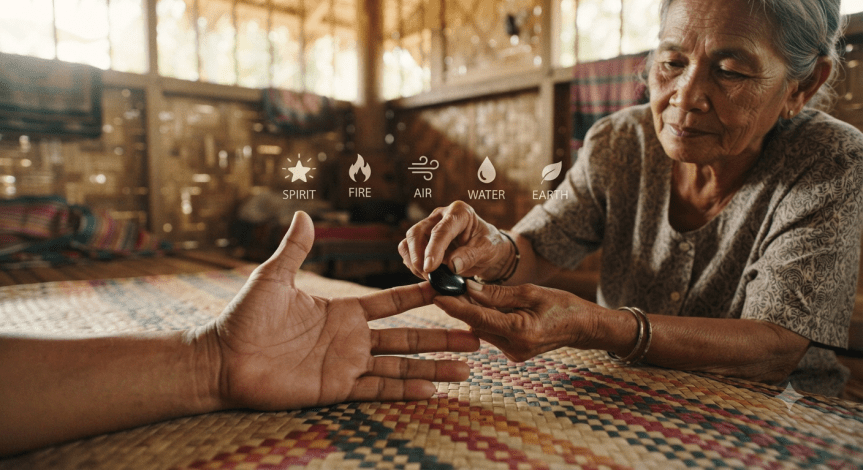
In traditional energy medicine, each finger serves as a gateway to the cosmos, representing the five great elements:
- Thumb: Spirit (Ether)
- Forefinger: Fire
- Middle Finger: Air
- Ring Finger: Water
- Pinky Finger: Earth
When an imbalance or “blockage” (bara) exists within an element, the Black Coral pendant acts as a conductor, reacting physically by becoming heavy, throbbing, or generating intense heat.
While this practice holds deep spiritual roots, modern science and medicine offer an equally profound explanation for why these intense physical sensations occur at the fingertips during a session. Here is how the worlds of folk healing and anatomy collide.
The Conductor: Why Black Coral?
Before diving into human anatomy, we must look at the tool itself. True Banaog (Black Coral) is a highly dense, organic marine material. Because it is incredibly compact and naturally rich in organic oils, it does not absorb water or decay easily. It possesses an excellent thermal and tactile conductivity. This means any minute change in human skin temperature, sweat, or pressure is immediately amplified by the coral, making it the perfect tool for a sensitive practitioner.
The Psychological & Neurological Reflexes
When a practitioner presses the Black Coral against a client’s finger, the physical reactions felt—such as sudden warmth, a “magnetic” heaviness, or a sudden twitch—can be mapped directly to human psychology and neurology.
1. Galvanic Skin Response (GSR)
The human autonomic nervous system controls our stress, anxiety, and emotional responses through the sympathetic branch. The fingertips contain one of the highest concentrations of eccrine sweat glands and nerve endings in the entire body.
When a client is anxious, in pain, or deeply focused during a diagnosis, their nervous system triggers microscopic amounts of moisture to release from these glands. Even if the skin looks dry, this micro-sweat changes the skin’s electrical conductance. When the dense Black Coral touches this moisture, it alters the friction and thermal trap between the skin and the object. This creates a sudden sensation of heaviness or warmth, indicating emotional or physical stress in the patient.
2. The Ideomotor Phenomenon
Folk healing requires immense mental focus and deep connection between the healer and the patient. This focus can trigger the Ideomotor Phenomenon—a scientifically proven psychological reaction where the brain signals the muscles to make microscopic, involuntary movements (unconscious micro-movements) based on an expectation.
Because an experienced healer subconsciously picks up on the patient’s body language, breathing, and facial tension, the healer’s hand might subtly shift its grip, angle, or pressure on the coral. This micro-adjustment is felt by both the healer and patient as a sudden throb, prick, or pulse from the wood, which traditional arts interpret as the element “speaking.”
The Medical Reality of Energetic “Blockages”
In Hilot, a cold, numb, or painful reaction in a specific finger indicates a blockage (bara). In modern medicine, these exact symptoms in the fingertips are primary indicators of underlying neurological and cardiovascular conditions.
1. Peripheral Neuropathy (Nerve Damage)
Our fingertips are packed with delicate nerve endings. If a patient suffers from underlying issues like high blood sugar (Diabetes), Vitamin B deficiencies, or chronic nerve compression, they may develop Peripheral Neuropathy.
Damaged nerves send erratic, hyper-sensitive electrical signals to the brain. When the hard, dense Black Coral presses against a finger with neuropathy, it can trigger an immediate sharp pain, tingling, or “electric shock” sensation, perfectly aligning with the traditional diagnosis of a severe elemental blockage.
2. Poor Blood Circulation
A “cold” blockage or a lack of energy response in a finger often points to poor blood circulation. Conditions like Raynaud’s Phenomenon or narrowed arteries cause the blood vessels in the fingers to spasm and constrict, drastically reducing blood flow.
When the coral touches these specific fingers, the skin is naturally much colder and less responsive, and it rapidly siphons the warmth away from the healer’s hand. Medicine views this as poor vascular health, while tradition views it as a lack of vital life force (isang nanunuyo o malamig na bara).
3. Somatoform and Stress-Related Disorders
The mind and body are intrinsically linked. When individuals suffer from severe emotional trauma, chronic anxiety, or unexpressed depression, the brain often translates this mental anguish into very real physical symptoms—a condition known as a somatoform disorder.
These patients constantly live in a “fight-or-flight” state, causing rapid heart rates, shallow breathing, and erratic hand temperatures. During a Tudluan session, their highly sensitive nervous system reacts intensely to the touch of the coral, manifesting as a profound energetic imbalance across the elements.
Conclusion: Two Sides of the Same Coin
Understanding the science behind Tudluan does not diminish the magic or historical value of traditional Filipino healing. Instead, it validates it.
Ancient healers did not have access to modern neurological equipment, yet they intuitively understood that the fingertips were the map to a person’s inner health. By using Black Coral as a physical diagnostic amplifier, practitioners were—and still are—successfully detecting real, physical markers of stress, circulatory issues, and nerve sensitivity.
By combining the spiritual comfort of traditional Hilot with the awareness of modern medicine, folk practices can safely continue to provide holistic comfort, stress relief, and early warnings for those seeking balance in a chaotic world.

