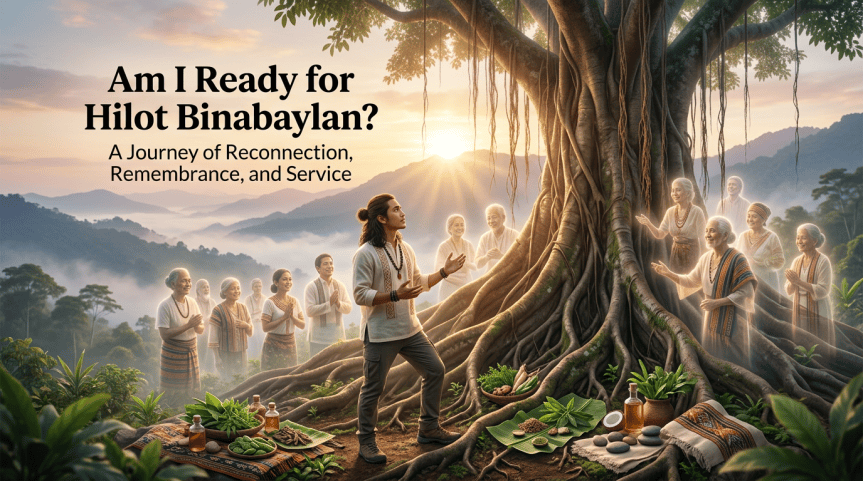
One of the most common questions we receive at Hilot Academy of Binabaylan is:
“How do I know if I am ready for this path?”
The question often comes from Filipinos living overseas, second- and third-generation Filipino descendants, healthcare practitioners, wellness professionals, and spiritual seekers who feel called to learn more about their ancestral roots but are uncertain whether they have enough knowledge, experience, or cultural background to begin.
The answer may surprise you.
Readiness for Hilot Binabaylan is not determined by how much you already know. It is determined by your willingness to learn, your openness to reconnect with your heritage, and your commitment to honor the traditions that have been entrusted to us by our ancestors.
The Journey Begins with Curiosity
Many students arrive at our programs with little or no formal knowledge of Indigenous Filipino traditions.
Some are nurses, massage therapists, energy workers, counselors, yoga practitioners, herbalists, community healers, or wellness advocates. Others are simply Filipinos who feel a deep desire to understand where they come from and what healing looked like before modern systems and colonial influences shaped the cultural landscape of the Philippines.
The Hilot Binabaylan Competency Training Program was designed precisely for these individuals.
Its purpose is not merely to teach techniques. It is to provide a foundation for understanding the Indigenous Filipino Healing Arts and Sciences and to prepare future practitioners to become conscious custodians of this knowledge.
Why Learn Your Own Ancestral Healing Tradition?
Today, the wellness world offers many healing systems from different parts of the world. These traditions have value and have helped countless people.
However, before fully understanding how other healing modalities relate to us, there is tremendous value in understanding our own ancestral heritage.
For many Filipinos living abroad, reconnecting with Hilot Binabaylan is more than professional development. It is an act of cultural remembrance.
It allows students to:
- Understand the worldview that shaped Filipino healing traditions.
- Reconnect with ancestral values of community, spirituality, and wellness.
- Appreciate the unique role of the Binabaylan in Filipino society.
- Distinguish Indigenous Filipino healing practices from contemporary wellness systems.
- Develop a deeper sense of identity and cultural belonging.
The goal is not to reject other healing modalities. Rather, it is to understand our own roots so we can engage the wider healing world from a place of cultural confidence and authenticity.
Understanding the Role of Training and Practice
Another common question concerns the practicum requirements listed on our website.
The formal clinical integration and practicum requirements apply primarily to students enrolled in our Bachelor’s Degree pathway in Hilot Binabaylan Practice. This structured educational program spans multiple years and includes supervised practice designed to help students develop competency and mastery.
Why supervised practice?
Because mastery cannot be achieved through theory alone.
Like any healing discipline, true learning comes through observation, application, reflection, and guided experience. Students progress through each level by demonstrating their growing understanding and competence.
The Hilot Binabaylan Competency Training, however, is an intensive stand-alone program designed to provide foundational and practical training within a shorter timeframe. Graduates are encouraged to continue developing their skills through personal practice and ongoing engagement with the academy.
Learning Does Not End After Certification
Many prospective students wonder:
“What happens after I complete the training?”
The reality is that learning Hilot Binabaylan is not a one-time event. It is a continuing journey.
Students often return home inspired yet aware that new questions emerge when they begin working with family members, community members, or clients.
To support this continuing development, graduates maintain access to mentorship and consultation through distance communication channels such as email, messaging applications, audio calls, and video meetings.
This ongoing relationship allows practitioners to seek guidance, clarify concepts, discuss cases responsibly, and continue refining their skills long after completing their formal training.
Upholding Standards and Ethics
Hilot Binabaylan is not merely a collection of healing techniques.
It is also a sacred responsibility.
For this reason, students are introduced to ethical standards, professional conduct, covenants, and practitioner responsibilities as part of their training.
These standards help protect:
- The integrity of the tradition.
- The welfare of those receiving services.
- The reputation of practitioners.
- The preservation of Indigenous Filipino healing knowledge for future generations.
Practitioners in good standing are those who continue to uphold these commitments. Those undergoing review may be participating in renewal or evaluation processes, while those no longer in good standing may have failed to meet expected ethical or professional requirements.
The purpose of these standards is not punishment. Rather, they help ensure that the tradition remains credible, responsible, and worthy of the trust placed in it by communities worldwide.
Learning from a Living Lineage
Hilot Binabaylan represents a living tradition that continues to evolve while remaining rooted in ancestral wisdom.
Instruction is provided by the founders and lineage holders responsible for preserving, protecting, and transmitting the teachings of Hilot Binabaylan. This approach helps maintain consistency, authenticity, and continuity while recognizing the rich diversity of healing traditions found throughout the Philippine archipelago.
Students are not simply learning a technique. They are entering a living educational and cultural tradition dedicated to preserving Indigenous Filipino Healing Arts and Sciences.
Why We Keep Our Classes Small
One feature of our Philippine-based programs is intentionally limited class sizes.
At Bahay SiAdtala Binabaylan, classes typically accommodate only a small number of participants. This creates opportunities for:
- Personalized mentorship.
- Hands-on practice.
- Individual feedback.
- Meaningful dialogue and reflection.
- Strong student-teacher relationships.
While larger classes may be conducted internationally, the ideal learning environment remains one that allows students to receive focused guidance and individualized attention.
A Calling to Remember
If you are asking yourself whether you are ready for Hilot Binabaylan, perhaps the more important question is:
Are you willing to listen to the call of your ancestors?
You do not need to know everything before you begin.
You do not need to speak Tagalog fluently.
You do not need to have years of experience in Indigenous healing traditions.
What is required is sincerity, humility, respect for the tradition, and a genuine desire to reconnect with the healing wisdom carried by generations of Filipinos before us.
The path of Hilot Binabaylan is ultimately a journey of remembrance, responsibility, and service.
For many, it is also a journey home.
Mabuhay ang Katutubong Karunungan ng Pilipino. Mabuhay ang Hilot Binabaylan.

