In recent years, there has been a growing interest in Filipino Folk Healing, Hilot, Binabaylan traditions, and Indigenous Filipino healing arts. This renewed appreciation is encouraging because it brings visibility to knowledge systems that survived centuries of colonization, marginalization, and misunderstanding. Yet alongside this resurgence comes a serious ethical concern: the increasing number of individuals who learn Filipino healing modalities and then teach, commercialize, or rebrand them without acknowledging their teachers, communities, or cultural lineage.
Lineage recognition is not merely a matter of courtesy. It is a matter of integrity, cultural respect, and alignment with the spirit of Philippine law.
What Is Lineage Recognition?
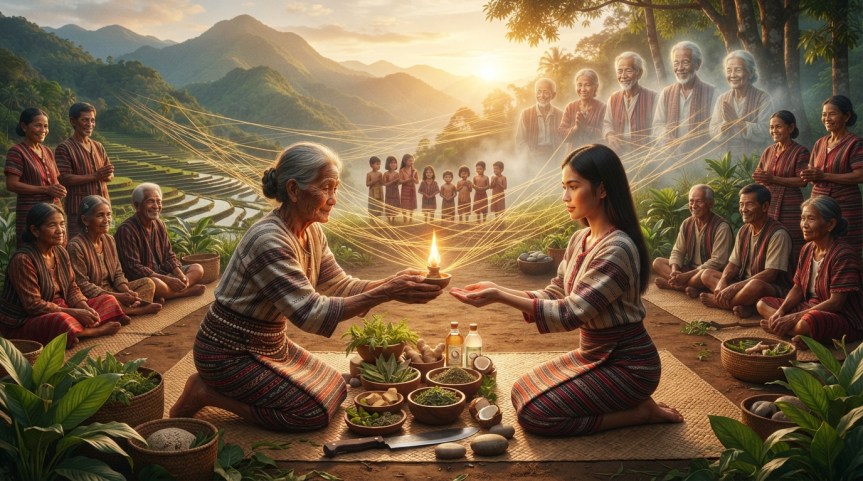
Lineage recognition is the acknowledgment of where knowledge comes from and through whom it was transmitted.
In Filipino folk healing, lineage may include:
- The traditional healers who preserved the knowledge.
- The indigenous communities that developed the practices.
- The teachers and mentors who shared the teachings.
- The institutions and organizations that trained practitioners.
- The cultural traditions from which the healing system emerged.
A practitioner may become highly skilled and eventually teach others. However, skill does not erase ancestry, and expertise does not erase indebtedness.
Every healer stands upon the shoulders of those who came before.
The Spirit of RA 8423
The Philippines recognizes the importance of protecting traditional healing knowledge through Republic Act No. 8423, also known as the Traditional and Alternative Medicine Act (TAMA) of 1997. The law established the Philippine Institute of Traditional and Alternative Health Care (PITAHC) and affirmed the importance of preserving and developing traditional healing systems. [lawphil.net], [pitahc.gov.ph]
Significantly, the law declares that indigenous societies should have a legally workable basis to own their traditional medical knowledge and that when such knowledge is used by outsiders, those communities may require acknowledgment of the source and may seek a share of financial benefits derived from its authorized commercial use. [lawphil.net], [elibrary.j…ary.gov.ph], [lawphil.net]
This principle is profound.
The law recognizes that traditional knowledge does not arise from isolated individuals. It is the collective intellectual, cultural, and spiritual heritage of communities and peoples who have preserved it across generations. [lawphil.net], [lawphil.net]
When Appreciation Becomes Appropriation
There is nothing wrong with learning Filipino folk healing.
There is nothing wrong with teaching Filipino folk healing.
There is nothing wrong with adapting traditional knowledge for modern audiences.
However, problems arise when individuals:
- Conceal their sources.
- Remove the names of their teachers.
- Rebrand traditional knowledge as their own innovation.
- Commercialize teachings without recognizing the communities that preserved them.
- Establish schools and certification programs while failing to mention the lineage from which they learned.
At that point, appreciation risks becoming appropriation.
A person who teaches Filipino healing without acknowledging its Filipino roots may gain prestige, influence, and financial benefit while the original knowledge holders remain invisible. This creates an imbalance that undermines the very communities responsible for preserving the tradition.
Why Recognition Strengthens Rather Than Weakens Authority
Some people fear that acknowledging teachers will diminish their own credibility.
The opposite is true.
In academic institutions, scholars cite their sources.
In martial arts, practitioners honor their instructors and lineage.
In spiritual traditions, clergy recognize apostolic succession, initiatory lines, or mentorship.
In medicine, professionals proudly identify where they received their training.
Authentic teachers do not lose authority by acknowledging where they learned. Rather, their transparency enhances their credibility.
When someone openly says:
“I learned this practice from Filipino teachers, elders, and healers who entrusted this knowledge to me,”
they demonstrate integrity, humility, and accountability.
These qualities inspire confidence.
The Danger of Self-Proclaimed Authority
One of the greatest threats facing traditional healing systems is the emergence of self-proclaimed authorities who present themselves as founders, originators, or ultimate experts despite having learned from others.
Such behavior can have serious consequences:
- Historical distortion.
- Cultural erasure.
- Financial exploitation.
- Community fragmentation.
- Misinformation about authentic traditions.
Future generations may become unable to distinguish between authentic lineage-based teachings and modern inventions presented as ancient wisdom.
When lineage disappears, accountability also disappears.
A Special Responsibility for the Diaspora
Filipino Americans and members of the Filipino diaspora play an important role in preserving and promoting cultural heritage.
Many have become passionate advocates for Filipino healing traditions.
This is commendable.
However, with visibility comes responsibility.
Those who teach Filipino Folk Healing abroad should strive to:
- Acknowledge Filipino origins.
- Name the teachers who trained them.
- Credit the communities from which the teachings emerged.
- Encourage students to learn directly from Filipino practitioners whenever possible.
- Support preservation efforts in the Philippines.
- Avoid presenting themselves as the sole or original source of traditional knowledge.
Doing so honors both their heritage and the people who entrusted them with the teachings.
Beyond Legal Compliance
While failure to acknowledge lineage may not automatically constitute a specific violation of RA 8423, it clearly runs contrary to the spirit and policy objectives of the law, which emphasize protection of indigenous knowledge and recognition of source communities. [lawphil.net], [elibrary.j…ary.gov.ph]
More importantly, lineage recognition is not merely a legal issue.
It is a moral issue.
It is a cultural issue.
It is a spiritual issue.
The question is not simply whether a person has the right to teach.
The deeper question is whether they teach with honesty, gratitude, and respect.
Conclusion
Filipino Folk Healing is more than a collection of techniques. It is the living heritage of communities, healers, elders, and teachers who carried this wisdom across generations.
To teach without lineage recognition is to risk severing the roots that nourish the tradition.
To teach with lineage recognition is to preserve authenticity, honor cultural heritage, uphold professional integrity, and align with the principles embodied in the Traditional and Alternative Medicine Act of 1997. [lawphil.net], [lawphil.net]
Lineage is not a limitation.
Lineage is a responsibility.
And in every authentic healing tradition, gratitude to one’s teachers is not merely remembered. It is practiced.

