We live in a world that willingly spends billions on artificial intelligence, processed food, digital communication platforms, and modern healthcare technologies. Yet many of the same people hesitate to invest in Indigenous intelligence, natural healing traditions, authentic education, and community-based wisdom that have sustained humanity for centuries.
This contradiction reveals a deeper problem in modern society: we have become accustomed to paying for convenience while expecting wisdom to be free.
Artificial Intelligence and Indigenous Intelligence
Today, governments and corporations invest enormous amounts of money in artificial intelligence. They recognize that knowledge has value. Researchers, engineers, programmers, and technology developers are compensated for the years they spend creating systems that can process information and solve problems.
Yet Indigenous intelligence, the accumulated wisdom of countless generations, is often treated as if it should be given away without compensation.
Artificial intelligence is built from data.
Indigenous intelligence is built from lived experience, observation of nature, spiritual understanding, community memory, and generations of practical application.
Artificial intelligence can analyze patterns.
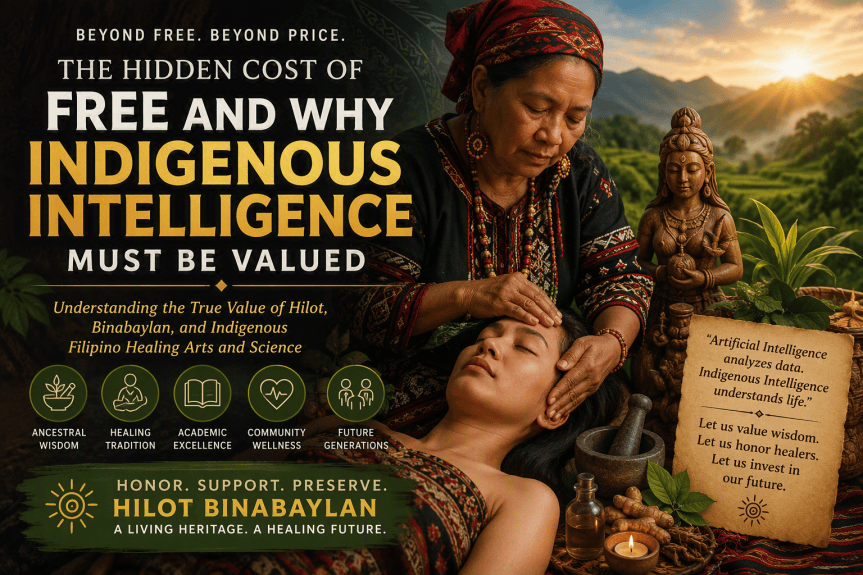
Indigenous intelligence understands relationships.
Artificial intelligence requires electricity and servers.
Indigenous intelligence requires elders, teachers, healers, rituals, and cultural continuity.
Both forms of intelligence are valuable. The difference is that society has learned how to assign monetary value to one while often overlooking the value of the other.
Why People Spend More on Processed Food Than Natural Food
Another paradox exists in the way people spend money on food.
Many consumers willingly purchase highly processed foods, convenience meals, sugary drinks, and imported products. Yet when offered fresh vegetables, organic produce, traditional herbs, or locally grown food, many immediately search for discounts or lower prices.
The hidden cost is that someone else pays the difference.
Usually, that someone is the farmer.
In public wet markets across the Philippines, bargaining or pagtatawad is a common practice. While negotiation is part of market culture, we must ask ourselves an important question:
Who absorbs the loss when prices are pushed lower?
The farmer who planted the crops.
The fisherfolk who caught the fish.
The small vendor who wakes before dawn.
The traditional healer who gathered medicinal plants.
When consumers constantly seek the cheapest option, they unknowingly weaken the very people who sustain local food systems and traditional economies.
The Addiction to Modern Communication
Modern technology has connected the world in unprecedented ways.
We can send messages instantly across oceans. We can attend meetings online. We can watch videos from every corner of the globe.
But something has been lost in the process.
Face-to-face conversation.
Community gatherings.
Apprenticeship.
Direct transmission of wisdom.
Traditional cultures were built through human presence. Knowledge was shared around fires, in family gatherings, through ceremonies, in fields, forests, rivers, and healing spaces.
A video can demonstrate a technique.
A teacher can transform a life.
There is a profound difference between consuming information and receiving wisdom.
The Challenge of Free Education
In the field of traditional healing, this issue becomes even more apparent.
Many people desire authentic Hilot training. They seek genuine Indigenous Filipino healing knowledge and want access to experienced teachers. Yet there is often an expectation that such knowledge should be provided freely.
Consider what happens when an authentic Manghihilot travels from the Philippines to teach students abroad.
The teacher invests years, sometimes decades, mastering the practice.
The teacher pays for travel, preparation, materials, administrative work, and countless unseen expenses.
The teacher leaves family, community, and clients behind to share knowledge internationally.
When people expect this training to be free, who bears the cost?
The teacher.
The institution.
The tradition itself.
Free education may appear compassionate, but when there is no sustainable support system, it slowly drains the resources of those who dedicate their lives to preserving Indigenous knowledge.
Eventually the teacher becomes exhausted.
The school struggles to operate.
The tradition weakens.
And future generations lose access to authentic instruction.
Why Many Traditional Healers Stop Passing On Their Knowledge
One of the most painful realities in the Philippines is that many authentic Manghihilot never pass their knowledge to their own children.
The reason is often simple:
There is little economic security in the practice.
Parents naturally want a better future for their children. If they see that Hilot cannot provide stable income, they encourage their children to pursue other professions.
As a result, priceless healing knowledge disappears with each generation.
Not because the knowledge lacks value.
But because society fails to value it.
This creates a cycle where Indigenous knowledge becomes endangered, not through prohibition or persecution, but through economic neglect.
Professionalizing Hilot Without Losing Its Soul
Fortunately, institutions such as Hilot Academy of Binabaylan, Bahay Hilom, and Hilot School in America are helping transform this reality.
The goal is not to replace tradition.
The goal is to strengthen it.
By documenting techniques, studying outcomes, understanding anatomy and physiology, and integrating contemporary knowledge, Hilot can be understood within modern educational frameworks while remaining rooted in Indigenous Filipino wisdom.
We examine traditional practices and articulate them through competencies, learning outcomes, skills development, professional ethics, and evidence-informed understanding.
This approach allows Hilot to stand confidently alongside other healthcare professions.
Not because Hilot needs validation from modern systems.
But because professional standards create pathways for recognition, sustainability, and respect.
The Problem with “Study Now, Pay Later”
Many educational systems promote a “study now, pay later” model.
While this can increase access, it can also create unintended consequences when applied to Indigenous knowledge systems.
Every lesson requires energy.
Every training session consumes resources.
Every mentor invests time, expertise, and spiritual commitment.
When payment is continually postponed or minimized, the burden falls on the teacher and institution.
Over time, this reduces the perceived value of the education itself.
People often protect what they invest in.
They tend to commit more deeply to knowledge they have worked hard to obtain.
Valuing education financially is not about profit alone. It is about recognizing that both student and teacher participate in a reciprocal exchange.
Investing in the Future of Indigenous Healing
If humanity can invest billions into artificial intelligence, surely we can invest in preserving Indigenous intelligence.
If we can pay premium prices for convenience foods, surely we can support farmers who grow natural and organic food.
If we can upgrade our smartphones every few years, surely we can support teachers who preserve centuries of healing wisdom.
The future of Hilot depends not only on preserving techniques but also on creating sustainable livelihoods for those who carry the tradition.
When we invest in authentic teachers, ethical schools, community healers, and Indigenous institutions, we are not merely purchasing a service.
We are ensuring that future generations will continue to inherit the healing arts and sciences of the Filipino people.
The question is not whether Indigenous knowledge has value.
The real question is whether we, as a society, are willing to recognize that value before it disappears.
Artificial intelligence may shape the future of technology, but Indigenous intelligence preserves the wisdom of humanity. Both deserve investment. Only one, however, carries the memory of our ancestors, the healing of our communities, and the soul of our culture.
A Call to Action: Honor, Support, and Preserve Hilot Binabaylan
The future of Hilot Binabaylan and Indigenous Filipino Healing Arts and Sciences will not be secured by admiration alone.
It will be secured by action.
If we truly believe that our ancestral wisdom holds value, then we must be willing to invest in its preservation, practice, and transmission. Every generation faces a choice: to allow traditional knowledge to disappear through neglect or to strengthen it through conscious support and commitment.
To students and seekers, I invite you to move beyond the mindset of merely consuming information. Become a custodian of wisdom. Invest in authentic training. Commit yourself to disciplined study. Recognize that the teachings of a Manghihilot, Binabaylan, or Indigenous healer are not products for entertainment but sacred knowledge refined through generations of lived experience.
To practitioners, let us be proud of our profession. Let us continue documenting, researching, teaching, and improving our practice while remaining rooted in the cultural and spiritual foundations that make Hilot uniquely Filipino. Professionalization should not diminish tradition. Rather, it should elevate the dignity of the healer and ensure that future generations can earn a sustainable livelihood while serving their communities.
To educators, institutions, and policymakers, let us create pathways for Indigenous Healing Arts and Sciences to be recognized as legitimate fields of study, worthy of academic inquiry, professional development, and cultural preservation. Indigenous knowledge is not a relic of the past. It is a living body of wisdom that offers solutions for holistic health and community well-being in the modern world.
To Filipinos around the globe, remember that Hilot Binabaylan is more than a healing technique. It is a cultural inheritance. It embodies our ancestors’ understanding of the body, mind, spirit, community, and relationship with nature. Every time we support authentic Hilot education, attend training, purchase local herbal products, sponsor research, or recommend qualified practitioners, we participate in the preservation of an invaluable part of Filipino heritage.
The survival of Hilot depends upon more than memory.
It depends upon practitioners who are fairly compensated.
It depends upon schools that can continue operating.
It depends upon teachers who can dedicate their lives to teaching.
It depends upon students who recognize the value of what they receive.
At Hilot Academy of Binabaylan, Bahay Hilom, and our allied institutions, we believe that Indigenous Filipino Healing Arts and Sciences deserve the same level of respect afforded to other healthcare and educational disciplines. By combining ancestral wisdom with scientific understanding, professional standards, and academic excellence, we are building a future where Hilot is not merely remembered but practiced, respected, researched, and passed on with integrity.
The next generation of Manghihilot will not emerge by accident.
They will arise because we chose to invest in them.
Let us choose to honor our ancestors by supporting their wisdom.
Let us choose to value Indigenous Intelligence as deeply as we value Artificial Intelligence.
Let us choose to preserve Hilot Binabaylan not as a museum artifact, but as a living, evolving, and thriving healing tradition.
Support authentic Hilot education. Learn from qualified teachers. Invest in Indigenous Filipino Healing Arts and Sciences. Together, let us ensure that the wisdom of our ancestors continues to heal, inspire, and guide generations yet to come.
“When we value Hilot, we value the healers. When we value the healers, we preserve the wisdom. When we preserve the wisdom, we protect the soul of our people.”

