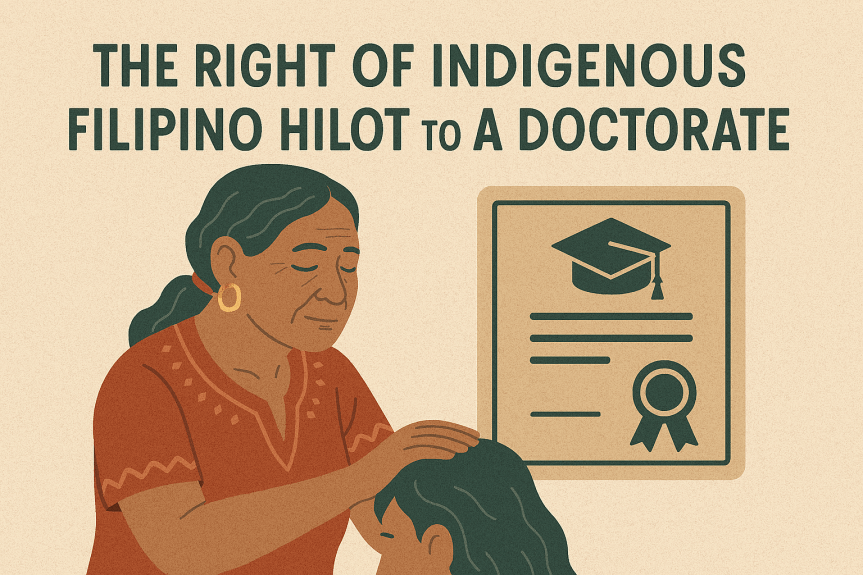
As Indigenous knowledge systems reclaim their rightful place in global conversations on healing, education, and spirituality, the need for culturally appropriate doctoral pathways has become increasingly clear. One such pathway is the Doctor of Ministry (DMin) in Indigenous Filipino Healing Arts and Sciences, with Hilot Binabaylan Practice as a formal area of specialization.
This degree affirms Indigenous Filipino healing as a living, sacred, and community‑embedded practice, while remaining fully aligned with Philippine regulatory structures and international norms for professional and ecclesiastical education.
This article explains the nature of the degree, the role of Hilot Binabaylan as a specialization, and why this doctoral framework is legitimate, ethical, and non‑conflicting with governing accreditation agencies.
What Is a Doctor of Ministry (DMin)?
A Doctor of Ministry (DMin) is an internationally recognized professional, practice‑based doctoral degree designed for experienced practitioners engaged in leadership, ministry, and community service. Unlike a Doctor of Philosophy (PhD), which is primarily research‑oriented, the DMin emphasizes:
- Advanced applied practice
- Integration of theory, spirituality, and lived context
- Ethical leadership and service
- Formation within real communities
Globally, the DMin is regarded as a terminal doctorate for professional ministry, commonly offered by seminaries and religious institutions. It is not a medical degree, nor is it intended to lead to licensure in regulated professions such as medicine or allied health.
This definition is consistent across Asia, North America, and Europe and provides the correct academic and ethical container for Indigenous and spiritual forms of healing leadership.
Indigenous Filipino Healing as Ministry, Not Medicine
Indigenous Filipino healing traditions—including Hilot Binabaylan—operate within a worldview where healing is inseparable from:
- Spiritual vocation
- Ritual authority
- Ancestral lineage
- Communal responsibility
- Ethical service to people and land
These traditions do not arise from biomedical paradigms, nor do they claim the authority of modern clinical medicine. Instead, they function as sacred healing ministries, transmitted through apprenticeship, ritual initiation, and cultural responsibility.
For this reason, a Doctor of Ministry—rather than a medical doctorate or purely academic PhD—is the most appropriate and non‑colonizing doctoral framework.
Hilot Binabaylan Practice as a Specialization
Within the Doctor of Ministry in Indigenous Filipino Healing Arts and Sciences, Hilot Binabaylan Practice functions as a focused area of specialization, allowing advanced practitioners to deepen, refine, and transmit this specific Indigenous healing tradition at the doctoral level.
What the Specialization Affirms
The Hilot Binabaylan specialization recognizes the practice as:
- A comprehensive Indigenous Filipino healing system
- Integrating bodywork (hilot), spiritual diagnostics, ritual, prayer, and herbal knowledge
- Rooted in cosmology involving Diwata, Anito, Kalikasan, and ancestral guidance
- Governed by ethical obligations to community, students, and lineage
At the doctoral level, specialization in Hilot Binabaylan does not merely teach techniques. It develops senior practitioners and stewards who are capable of:
- Ethical leadership in healing communities
- Teaching and mentoring future practitioners
- Developing curricula and ritual frameworks
- Articulating Indigenous healing in interfaith, intercultural, and academic spaces
“Healing Arts and Sciences”: A Legitimate Academic Framing
The phrase “Healing Arts and Sciences” is intentional and internationally understood.
- Healing Arts refers to ritual practice, embodied skill, ceremonial work, and intuitive diagnostics.
- Healing Sciences acknowledges structured bodies of Indigenous knowledge, including anatomy as understood in hilot, ethnomedicine, cosmology, psycho‑spiritual health, and community systems of care.
This framing does not imply biomedical practice and does not claim equivalence to medical licensure. Instead, it affirms that Indigenous healing traditions possess their own internal sciences, methods, and epistemologies.
Such language is widely used in Indigenous, traditional, and complementary healing education worldwide and is considered academically and culturally legitimate.
Alignment with CHED and Philippine Regulatory Frameworks
In the Philippines, the Commission on Higher Education (CHED) regulates civil, state‑recognized academic degrees that lead to regulated professions, licensure, or government employment ranking.
However, it is well established that:
- Ecclesiastical, ministerial, and vocational degrees—including Doctor of Ministry programs—may operate lawfully outside CHED’s Special Order (SO) system when they do not claim civil professional status.
- Many Philippine seminaries and religious institutions clearly state that their DMin degrees are professional and ecclesiastical, not civil licensure pathways.
The Doctor of Ministry in Indigenous Filipino Healing Arts and Sciences, including the Hilot Binabaylan specialization, follows this exact and lawful model:
- It is explicitly a ministerial doctorate
- It makes no claim to medical or allied health licensure
- It does not represent itself as a CHED‑regulated professional qualification
For this reason, it does not conflict with CHED authority, nor does it encroach upon regulated healthcare professions.
International Context and Precedent
Internationally, Doctor of Ministry degrees are widely accepted as legitimate professional doctorates within religious and cultural education systems. Indigenous healing doctorates in other cultures—such as Native American Sacred Medicine or African Indigenous Healing—are similarly framed within:
- Ecclesiastical authority
- Cultural legitimacy
- Community validation
- Ethical self‑regulation
The DMin in Indigenous Filipino Healing Arts and Sciences, with specialization in Hilot Binabaylan Practice, stands comfortably within these global norms.
Legitimacy, in this context, is established through:
- Transparency of scope
- Accuracy of representation
- Integrity of formation
- Accountability to community and tradition
What This Degree Is—and Is Not
This Degree IS:
- A professional doctorate in ministry
- A recognition of advanced Indigenous Filipino healing leadership
- A credential for senior practitioners, mentors, and ritual leaders
- A framework for safeguarding and transmitting Hilot Binabaylan
This Degree IS NOT:
- A medical doctorate (MD)
- A substitute for regulated healthcare degrees
- A biomedical or pharmaceutical qualification
- A claim to clinical or hospital‑based licensure
Clear communication of these boundaries ensures legal clarity, ethical practice, and protection of the tradition.
Conclusion: Safeguarding Hilot Binabaylan Through the Right Doctorate
The Doctor of Ministry in Indigenous Filipino Healing Arts and Sciences, with Hilot Binabaylan Practice as a specialization, represents a conscious and responsible choice.
Rather than forcing Indigenous healing into unsuitable Western academic molds, it:
- Honors ancestral authority
- Respects Philippine regulatory boundaries
- Aligns with international ecclesiastical practice
- Protects Hilot Binabaylan as a living sacred science
In doing so, it affirms that Indigenous Filipino healing does not need to imitate biomedicine to be legitimate—it needs the right container, rooted in its own cosmology, ethics, and purpose.
The Role of a Doctor of Ministry in Indigenous Filipino Healing Arts and Sciences (Specialization in Hilot Binabaylan Practice)
A Doctor of Ministry in Indigenous Filipino Healing Arts and Sciences (DMin‑IFHAS), with specialization in Hilot Binabaylan Practice, is a senior practitioner, cultural steward, and spiritual leader. The role is grounded in service, ethical responsibility, and ancestral accountability, not in biomedical authority.
This doctorate recognizes mastery of practice and leadership, not clinical licensure.
Core Duties and Responsibilities
1. Custodian of Indigenous Filipino Healing Knowledge
A DMin‑IFHAS is entrusted with the protection, preservation, and proper transmission of Indigenous Filipino healing traditions, particularly Hilot Binabaylan.
This includes:
- Safeguarding ritual integrity and sacred protocols
- Preventing misuse, commercialization, or misrepresentation of hilot
- Honoring ancestral lineages and spiritual authority
- Ensuring teachings are transmitted responsibly and respectfully
✅ Primary responsibility: protect the tradition from erosion, harm, and distortion.
2. Senior Practitioner of Hilot Binabaylan
As a doctoral‑level practitioner, the individual is expected to demonstrate advanced mastery of practice, not just knowledge.
This includes:
- Ethical application of hilot bodywork
- Spiritual diagnostics rooted in Indigenous cosmology
- Ritual healing and prayer within the Binabaylan framework
- Discernment of appropriate scope of practice
✅ Key expectation: healing is offered as sacred service, not as commercial treatment.
3. Spiritual and Ministerial Leadership
Because this is a Doctor of Ministry, the individual functions as a healing minister, not merely a technician.
Duties include:
- Providing spiritual guidance to individuals and communities
- Leading healing rituals, commemorations, and rites
- Offering pastoral‑style care during illness, grief, or transition
- Serving as a moral and ethical presence in the community
✅ People should expect: compassion, integrity, and spiritual maturity.
4. Teacher, Mentor, and Formation Guide
A doctoral holder is expected to form others, not merely to practice privately.
Responsibilities include:
- Teaching Hilot Binabaylan within proper initiatory frameworks
- Mentoring apprentices, students, or junior practitioners
- Developing curricula, training materials, and learning pathways
- Evaluating readiness, ethics, and character of learners
✅ Emphasis: formation of healers, not mass production of certificates.
5. Cultural and Interfaith Representative
A DMin‑IFHAS often serves as a bridge figure between Indigenous Filipino healing traditions and wider society.
This includes:
- Explaining hilot responsibly to institutions and the public
- Participating in interfaith and intercultural dialogue
- Advocating for Indigenous healing rights and dignity
- Representing Filipino Indigenous spirituality with accuracy
✅ Public role: educator and advocate, not polemicist.
6. Developer of Indigenous Healing Scholarship (Practice‑Based)
Although not a PhD researcher, a DMin holder contributes to practice‑based scholarship.
This may include:
- Documenting lived healing practices
- Writing reflective studies, manuals, or ritual texts
- Producing community‑based research or capstone projects
- Preserving oral traditions in ethical and consent‑based ways
✅ Scholarship is grounded in lived practice, not detached theory.
7. Ethical Gatekeeper and Accountability Figure
A Doctor of Ministry bears heightened responsibility for ethical conduct.
This includes:
- Clear boundaries with clients and students
- Transparency about what hilot can and cannot do
- Referrals to medical professionals when necessary
- Refusal to claim biomedical authority or guaranteed cures
✅ Ethics are non‑negotiable at the doctoral level.
What the Public Should Reasonably Expect
People engaging with a DMin‑IFHAS may rightly expect:
✅ Respect for Indigenous knowledge
✅ Spiritual depth and maturity
✅ Clear ethical boundaries
✅ No false medical claims
✅ Honest referral when a case is outside scope
✅ Teaching that honors culture, not ego
What the Public Should NOT Expect
It is equally important to state what should not be expected:
❌ Medical diagnosis or clinical treatment
❌ Hospital‑level care or biomedical procedures
❌ Replacement of licensed physicians
❌ Guaranteed cures or miracles
❌ Commercial exploitation of sacred rituals
A DMin‑IFHAS does not function as a medical doctor and should never be presented as such.
The Meaning of “Doctor” in This Context
The title “Doctor” in a Doctor of Ministry means:
- A teacher and guide
- A recognized authority within a specific tradition
- A person entrusted with stewardship and formation
- A senior practitioner of a sacred calling
It does not mean physician or biomedical expert.
This understanding is consistent worldwide for Doctor of Ministry degrees and Indigenous healing doctorates.
Summary: A Role of Service, Not Status
At its heart, a Doctor of Ministry in Indigenous Filipino Healing Arts and Sciences, specializing in Hilot Binabaylan Practice, carries a calling defined by:
Service over status
Responsibility over recognition
Stewardship over supremacy
The doctorate exists to protect the tradition, serve the people, and honor the ancestors, not to compete with modern medicine or claim inappropriate authority.
Code of Ethics
Doctor of Ministry in Indigenous Filipino Healing Arts and Sciences (Specialization in Hilot Binabaylan Practice)
Preamble
The Doctor of Ministry in Indigenous Filipino Healing Arts and Sciences, with specialization in Hilot Binabaylan Practice, is a sacred trust conferred upon senior practitioners who serve as healers, teachers, spiritual leaders, and custodians of Indigenous Filipino healing traditions.
This Code of Ethics articulates the moral, spiritual, professional, and cultural responsibilities of all who bear this title. It exists to protect the people, the tradition, the institution, and the ancestral lineage from harm, misuse, or misrepresentation.
Acceptance of this doctorate signifies a commitment to service over status, integrity over authority, and stewardship over personal gain.
I. Foundational Ethical Principles
All holders of this degree shall be guided by the following principles:
- Sacredness of Healing
Healing is a sacred act rooted in ancestral wisdom, spiritual guidance, and service to the community. - Ancestral Accountability
The healer is accountable not only to institutions and communities, but to ancestors, lineage, and future generations. - Respect for Human Dignity
Every person is approached with respect, compassion, consent, and cultural sensitivity. - Truthfulness and Transparency
The healer commits to honesty in representation, practice, and communication. - Decolonial Integrity
Indigenous healing is honored on its own terms, not reshaped to imitate biomedical or colonial frameworks.
II. Scope of Practice and Professional Boundaries
- Non‑Medical Representation
A DMin‑IFHAS holder shall not claim or imply status as a licensed medical doctor, physician, or healthcare professional. - No Biomedical Diagnosis or Treatment
The practitioner shall not diagnose diseases, prescribe pharmaceutical drugs, or perform clinical medical procedures. - Clear Scope Disclosure
Clients, students, and communities must be clearly informed that Hilot Binabaylan is an Indigenous spiritual and healing practice, not a replacement for modern medical care. - Right to Referral
When a condition is beyond the scope of Indigenous healing, the practitioner has an ethical duty to refer individuals to appropriate licensed medical professionals.
III. Ethical Practice of Hilot Binabaylan
- Competent and Trained Practice
Healing practices shall only be performed within the practitioner’s level of training, initiation, and spiritual readiness. - Consent and Volition
No healing, ritual, or energetic work shall be performed without informed and voluntary consent. - Non‑Exploitation
The practitioner shall never exploit spiritual authority, dependency, vulnerability, or faith for personal, financial, or sexual gain. - Integrity of Ritual
Sacred rituals, prayers, and spiritual protocols shall not be altered, commercialized, or performed frivolously.
IV. Teaching, Initiation, and Transmission
- Responsible Transmission
Hilot Binabaylan teachings shall be passed only to individuals who demonstrate readiness, ethical character, and respect for the tradition. - No Mass Initiation
The practitioner shall not dilute the tradition through mass certifications, instant initiation, or fraudulent credentialing. - Mentorship and Discernment
Teaching is a process of formation, mentorship, and discernment, not merely information transfer. - Protection of Sacred Knowledge
Certain teachings may remain restricted, oral, or lineage‑held and shall not be publicly disclosed without ancestral and institutional permission.
V. Cultural and Community Responsibility
- Cultural Respect
The practitioner must honor the diverse Indigenous cultures, regional expressions, and lineages within Filipino spiritual traditions. - Community Accountability
Practice shall remain accountable to community elders, councils, or recognized spiritual authorities, not solely to individual interpretation. - Advocacy Without Appropriation
Advocacy for Indigenous healing must uplift the people and culture, not center personal charisma, branding, or dominance.
VI. Ethical Leadership and Ministry
- Servant Leadership
A Doctor of Ministry leads through humility, service, and example—not coercion or authoritarianism. - Pastoral Care Standards
Spiritual counsel must be compassionate, non‑judgmental, and respectful of personal agency. - Boundaries and Safeguards
Clear emotional, sexual, financial, and spiritual boundaries shall be maintained at all times. - Conflict Resolution
Disputes shall be addressed through dialogue, mediation, and ancestral values, not public shaming or abuse of authority.
VII. Scholarship, Documentation, and Research Ethics
- Practice‑Based Scholarship
Research and writing shall arise from lived practice and community engagement, not extraction or academic exploitation. - Informed Consent in Documentation
Stories, rituals, or practices shared publicly must have consent and must protect identities when needed. - No Intellectual Theft
Indigenous knowledge shall not be appropriated, plagiarized, or claimed as personal invention.
VIII. Integrity of the Doctoral Title
- Proper Use of the Title “Doctor”
The title “Doctor” shall be used only in its ministerial and professional context, with clarity about its meaning. - No Misleading Claims
Marketing, teaching materials, or public statements shall not mislead others regarding authority, outcomes, or capabilities. - Representation of the Institution and Tradition
Holders of this degree are ambassadors of the institution and the tradition and shall act in a manner that upholds their dignity.
IX. Accountability and Consequences
- Ethical Review
Alleged violations of this Code may be subject to review by an ethics council, elders’ council, or institutional authority. - Corrective Measures
Actions may include guidance, suspension, revocation of teaching authority, or withdrawal of credentials, depending on severity. - Restorative Justice
Wherever possible, accountability shall follow restorative and reconciliatory principles aligned with Indigenous values.
Closing Commitment
To accept the title Doctor of Ministry in Indigenous Filipino Healing Arts and Sciences (Hilot Binabaylan Practice) is to accept a lifelong obligation:
To heal without harm
To teach without ego
To lead without domination
To remember without distortion
And to serve with honor to the ancestors, the people, and the future

