There is a silent but deeply damaging pattern that continues to unfold in Indigenous communities across the Philippines—and many of us are only beginning to recognize it.
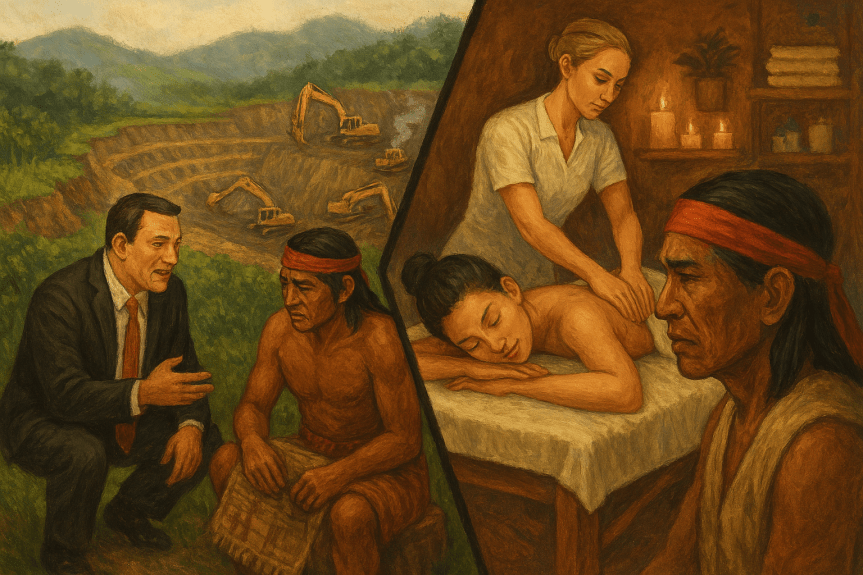
Indigenous Peoples are often subjected to systematic mental conditioning by capitalist forces. They are persuaded, lured, and sometimes coerced into selling their ancestral domains—lands that are not mere property, but living extensions of their identity, history, and spirituality. Once these lands are lost, many communities are pushed into economic dependency, surviving on government aid programs such as the Pantawid Pamilyang Pilipino Program (4Ps), rather than living with dignity through self-determination.
This tragedy is not limited to land alone.
The same pattern is happening to Hilot, the Indigenous healing system of the Filipino people.
Hilot: From Living Tradition to Marketable “Experience”
Hilot is not simply massage. It is not a spa service. It is not a wellness “add-on.”
Hilot is a holistic Indigenous medical system rooted in Filipino cosmology, spirituality, community wisdom, and intimate knowledge of the body, nature, and the unseen. It is practiced by healers who understand balance—between lamig and init, katawan and diwa, lupa and espiritu.
Yet today, Hilot is being slowly stripped of its soul.
Under the influence of the modern wellness tourism industry, Hilot is increasingly repackaged into something more “palatable” to foreign markets and upper-class consumers. It is marketed as exotic relaxation, luxury therapy, or spa culture—divorced from its cultural roots and spiritual framework.
In this process, the taal—the original, Indigenous essence of Hilot—is erased.
The Colonial Logic of “Modernization”
Capitalism has a familiar script:
- Indigenous knowledge is labeled primitive
- Traditional systems are framed as outdated
- Western or “modern” approaches are positioned as superior
This logic convinces communities to abandon their own wisdom in favor of externally imposed standards. Just as ancestral lands are sold in exchange for short-term economic relief, Indigenous healing traditions are traded for commercial viability and institutional acceptance.
What remains is a hollow version of the original—lucrative, marketable, and disconnected.
Dependency Replaces Sovereignty
When Indigenous Peoples lose their land, they lose autonomy. When healers lose their tradition, they lose authority.
Instead of empowering communities to sustain themselves through ancestral knowledge, capitalist systems create dependency—whether on government subsidies or on tourism-driven income that benefits corporations more than culture bearers.
Hilot practitioners are encouraged to align with certification systems that prioritize profitability over lineage, technique without spirit, and branding without cultural accountability.
This is not progress. This is erasure disguised as development.
Remembering Is an Act of Resistance
To remember Hilot in its Indigenous form is a political, cultural, and spiritual act.
It means honoring:
- Ancestral transmission over commercial training
- Healing as service, not spectacle
- Community wellness over individual luxury
- Cultural integrity over tourist expectations
The survival of Hilot depends not on how well it performs in spas, but on how firmly it is rooted in its Indigenous worldview.
Just as ancestral domains are sacred, so too is ancestral knowledge.
To protect Hilot is to protect Filipino identity. To practice it fully is to reclaim sovereignty over our body, spirit, and memory.
The question is not whether Hilot can survive in the modern world.
The real question is: Will we remember what Hilot truly is before it disappears beneath the weight of “wellness”?
 Hilot Academy of Binabaylan