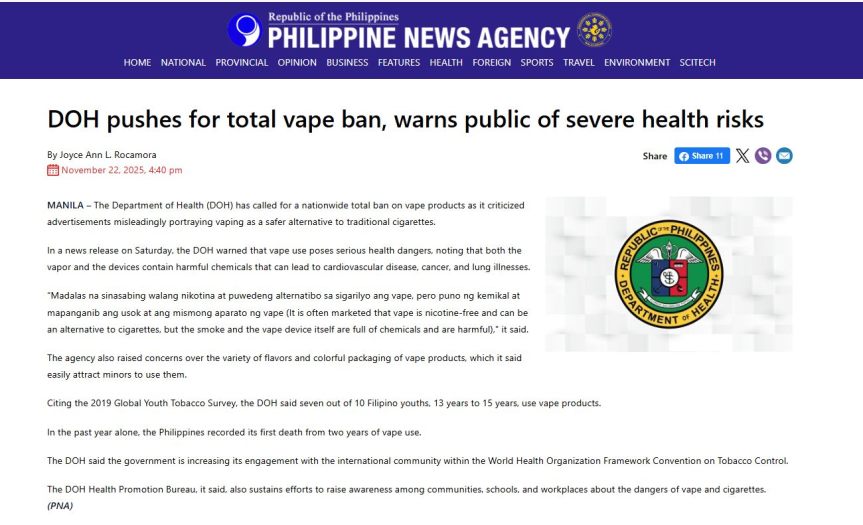
In the Philippines, government agencies such as the Department of Health (DOH) often resort to bans and prohibitions as their primary tool for addressing public health concerns. From smoking restrictions to regulations on vaping and sugary drinks, these measures are typically justified as necessary for the greater good. But while the intention may be noble, the approach raises a critical question: Are we sacrificing freedom for safety in ways that undermine trust and progress?
The Problem with Restrictive Governance
Bans and prohibitions are quick fixes. They create an illusion of control and immediate compliance, but they rarely address the root causes of public health issues. Worse, they often breed resentment and resistance. When people feel their autonomy is curtailed, they are less likely to cooperate willingly. Instead of fostering a culture of responsibility, restrictive policies can lead to a cycle of enforcement and evasion.
Consider the Tobacco Regulation Act of 2003 (RA 9211), which prohibits smoking in public places and bans tobacco advertising. While this law contributed to reducing smoking prevalence from 29.7% in 2009 to 19.5% in 2021, enforcement challenges persist, and smoking remains a leading cause of death in the country. Similarly, the Vaporized Nicotine and Non-Nicotine Products Regulation Act (RA 11900) introduced strict rules on e-cigarettes, including age restrictions and flavor bans. Yet, youth vaping surged by 110% between 2015 and 2019, showing that prohibition alone cannot solve behavioral health issues. [academic.oup.com] [global.lockton.com], [publications.aap.org]
These examples illustrate a pattern: restrictive policies may reduce harm in the short term but fail to build long-term health literacy and voluntary compliance.
Why Freedom Matters in Public Health
Freedom is not the enemy of health; it is its ally. When individuals are empowered to make informed choices, they become active participants in their well-being. Public health thrives in an environment where education, transparency, and trust replace coercion.
Countries that prioritize empowerment over restriction often see better long-term outcomes. Why? Because informed citizens adopt healthy behaviors voluntarily—not because they are forced, but because they understand the benefits.
A Better Way Forward: Empowerment Over Enforcement
Instead of implementing limiting factors, government agencies should embrace strategies that promote freedom while safeguarding health. Here’s how:
- Education Over Prohibition
Launch comprehensive education campaigns that explain the risks and benefits of certain behaviors. For example, rather than banning sugary drinks outright, teach communities about nutrition and provide healthier alternatives. - Incentives for Healthy Choices
Replace bans with positive reinforcement. Countries like Indonesia and Cameroon have experimented with performance-based grants and incentives to improve health and education outcomes, proving that rewards can drive behavior change without coercion. [worldbank.org] - Community Engagement and Co-Creation
Involve communities in policy-making. When people feel heard and included, they are more likely to support and comply with health initiatives. - Transparency and Trust
Communicate the rationale behind every policy clearly. Trust grows when citizens understand the “why” behind the “what.”
International Best Practices
Global health authorities emphasize empowerment-based approaches. The WHO Global Framework on Well-being advocates for health promotion strategies that integrate education, community participation, and equity rather than punitive measures. Similarly, the OECD Guidebook on Best Practices in Public Health highlights interventions that prioritize effectiveness, equity, and evidence-based education over restrictive enforcement. [cdn.who.int] [oecd.org]
The Health-Promoting Schools Initiative by WHO and UNESCO is another example. Instead of banning unhealthy behaviors, it creates environments where students learn health skills, access nutritious food, and engage in physical activity—empowering them to make lifelong healthy choices. [who.int], [unesco.org]
Freedom and Responsibility: A Balanced Approach
Promoting freedom does not mean abandoning responsibility. It means creating a system where individuals are trusted and empowered to make decisions that benefit both themselves and society. A government that prioritizes liberty while fostering accountability will not only protect public health but also strengthen democracy.
The Call to Action
It’s time for the Philippine government to shift from a culture of restriction to a culture of empowerment. Citizens should demand policies that respect their autonomy and promote informed decision-making. Public health should be a partnership, not a dictatorship.
We call on the DOH and other agencies to:
- Review existing bans and evaluate their necessity and effectiveness.
- Invest in education and community-based programs that encourage voluntary compliance.
- Create incentive-driven initiatives that make healthy choices accessible and attractive.
Freedom is not a privilege; it is a right. And in the realm of public health, it is the foundation for lasting change. Let us move beyond fear-driven policies and embrace a future where health and liberty coexist harmoniously.
 Hilot Academy of Binabaylan